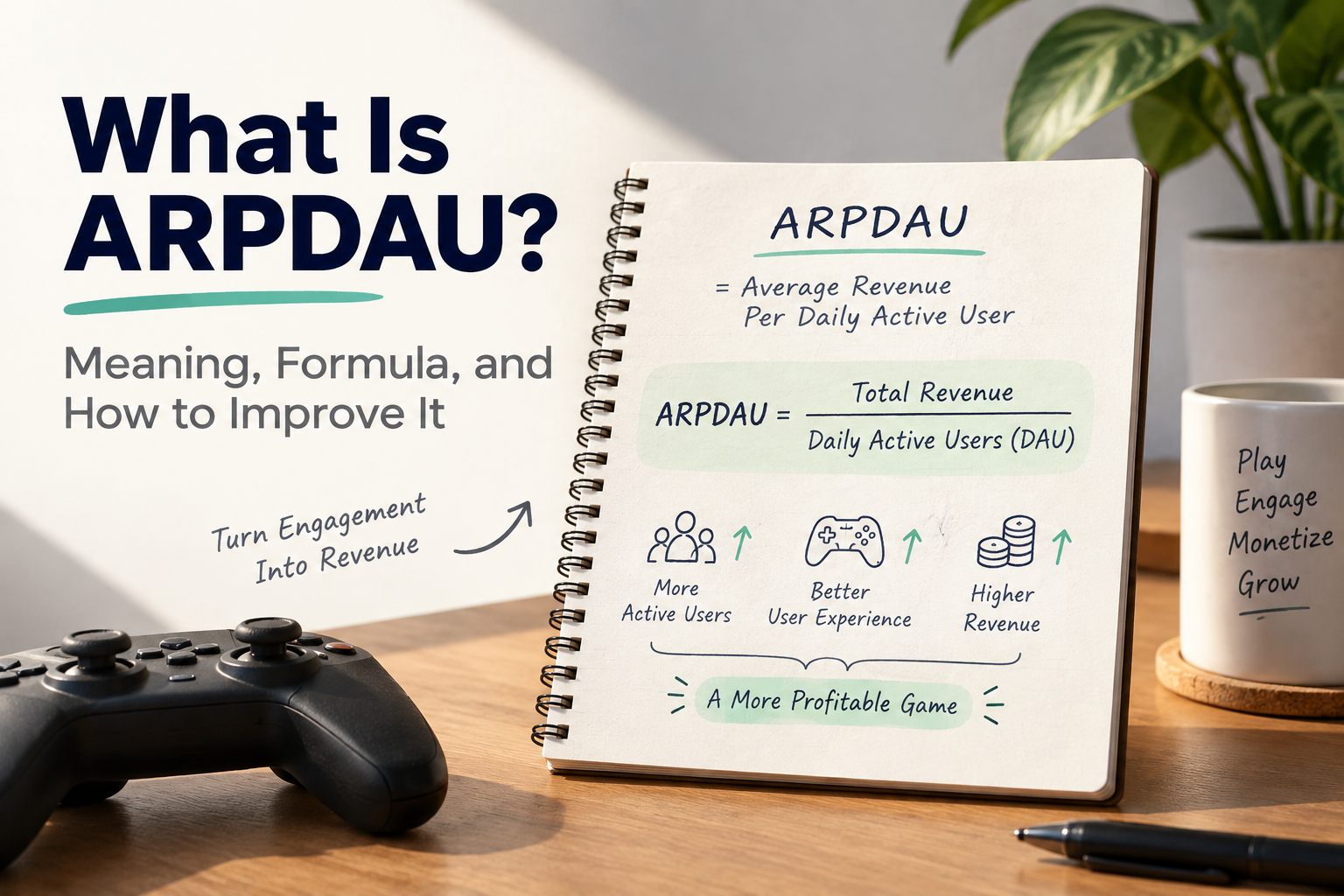
What Is ARPDAU? Meaning, Formula, and How to Improve It
What Is ARPDAU? Meaning, Formula, and How to Improve It
ARPDAU means Average Revenue Per Daily Active User. It is total revenue for a single day divided by the number of daily active users on that day: ARPDAU = Daily Revenue / DAU. A game earning $1,200 from 40,000 DAU has an ARPDAU of $0.03. It is the standard yardstick for how much each active player is worth per session-day, across ads, purchases and subscriptions combined.
ARPDAU, Defined
ARPDAU is a daily-resolution revenue metric. Unlike lifetime value, it does not wait for a cohort to mature. Unlike total revenue, it does not reward you for simply having more players. It isolates one question: on an average day, how much money does one active user generate?
That framing makes it the metric most teams check first thing in the morning. Ship a new ad placement on Tuesday, and by Wednesday you know whether it added value or cannibalised something else. Traffic spikes from a portal feature do not distort it the way they distort gross revenue, because the denominator moves with the numerator. If a feature brings in 50,000 new users who never engage with monetization, ARPDAU falls, and it should — those users are not yet paying for themselves.
A few definitional details matter more than they look:
“Revenue” means net revenue. Use what actually lands in your account after platform fees and network revenue share, not gross billings. Otherwise you will compare an ad-funded number against a store-fee-inflated one.
“Daily active user” needs one consistent definition. A session start, a device ID, a logged-in account — pick one and never change it mid-analysis. On the web, where a large share of traffic is anonymous, DAU usually means unique sessions or unique visitors, and the two can differ by a wide margin.
Currency and timezone conventions. Ad networks often report in UTC while your analytics reports in local time. A day-boundary mismatch will make ARPDAU look noisier than it is.
The ARPDAU Formula, Worked Through
The base formula is simple arithmetic:
ARPDAU = Total Daily Revenue ÷ Daily Active Users
The useful version splits the numerator by revenue source, because the two halves respond to entirely different interventions:
ARPDAU = (Ad Impressions per DAU × eCPM ÷ 1,000) + (IAP Revenue ÷ DAU)
Take a worked example. Suppose your game serves an average of 1.5 rewarded video impressions per daily active user at a $4 eCPM, and you have no in-app purchases at all. Ad ARPDAU is 1.5 × 4 ÷ 1,000 = $0.006. Across 100,000 DAU that is $600 a day, or roughly $18,000 a month. Raise impressions per DAU to 2.2 without touching eCPM and the same audience produces $880 a day. Raise eCPM instead, from $4 to $5, and it produces $750. Both levers are multiplicative, which is why teams that work on one and ignore the other leave money on the table.
Note that “impressions per DAU” is itself two things multiplied: the percentage of users who engage with a rewarded placement at all, and the number of times those users engage. A 25% engagement rate at six views per engaged user gives the same 1.5 impressions per DAU as a 75% engagement rate at two views. They are not equivalent businesses — the first is a small whale segment, the second is broad participation with a ceiling — and only one of them survives a design change to your reward economy.
ARPDAU vs ARPU vs eCPM vs LTV
Monetization metrics get used interchangeably in conversation and they are not interchangeable in a spreadsheet. Here is how the four most commonly confused ones actually differ.
Metric
What it measures
Time window
Best used for
ARPDAU
Revenue per active user, per day
One day
Fast feedback on placement, pricing and economy changes
ARPU
Revenue per user over a defined period
Week, month, or lifetime
Comparing titles or channels at a business level
ARPPU
Revenue per paying user
Any
Understanding spender depth, not audience breadth
eCPM
Ad revenue per 1,000 impressions
Any
Judging demand quality and network performance
LTV
Total revenue one user generates before churning
Cohort lifetime
Setting acquisition bids against payback
The relationship worth internalising: eCPM is an input to ARPDAU, and ARPDAU multiplied by average lifespan approximates LTV. A network can raise your eCPM while your ARPDAU falls, if the higher-paying demand comes with lower fill and fewer served impressions. That is why judging a network on eCPM alone is a mistake, and why our breakdown of CPM and eCPM is worth reading alongside this page. For the arithmetic in the other direction, the complete guide to eCPM optimization for web games covers the supply-side factors that set the rate you are paid.
Breaking ARPDAU Into Levers You Can Actually Pull
ARPDAU as a single number tells you whether something is wrong. The decomposition tells you what. Track these four sub-metrics daily and you will almost always be able to attribute a movement within an hour.
Engagement rate
The share of daily active users who trigger at least one rewarded placement. This is a product design number, not an ad number. It moves when you change where the offer appears, what it grants, and how clearly the value is communicated. A “double your coins” button on a results screen and a “continue playing” offer at a fail state will produce very different engagement rates in the same game.
Impressions per engaged user
How many times an engaged user comes back to the placement. Governed by your reward economy, your frequency caps and your session length. If this number is capped at one, you are choosing to cap ARPDAU.
Fill rate
The percentage of ad requests that return a playable ad. Requests that come back empty are engagement you generated and did not get paid for — worse, they train users not to trust the button. Fill varies sharply by geography and hour of day, so look at it segmented, not as a single blended figure.
eCPM
Demand quality. On the web, typical display placements deliver roughly $0.50 to $2 CPM. Rewarded video on AppLixir’s web inventory delivers $4+ CPM, because a completed, user-initiated video view is a fundamentally more valuable unit than a viewport impression on a banner. Whichever direction your traffic mix leans, geography drives most of the variance here.
What Counts as a Good ARPDAU
There is no universal target, and anyone quoting one without qualifying it is quoting a number from a different business than yours. ARPDAU varies by an order of magnitude or more depending on four things:
Genre and session length. A mid-core game with 25-minute sessions has far more monetization surface than a hypercasual title with 90-second sessions.
Revenue mix. Titles with meaningful in-app purchase revenue post higher ARPDAU than purely ad-funded ones, because a small spender cohort lifts the whole average.
Geography. The same game with the same design will report very different ARPDAU depending on the tier-one share of its audience.
Platform. Web, mobile app and console economics are not comparable, and mobile in-app benchmarks in particular travel badly to browser games.
Because of that last point, benchmark against web-native data if you run a web game. Our web game monetization benchmarks covers ARPU, CPMs and rewarded engagement rates specifically for browser inventory. The more productive comparison, in any case, is against yourself: your ARPDAU this week versus last week, this cohort versus that one, this geography versus the same geography a month ago.
How to Improve ARPDAU in a Web Game
The tactics below are ordered roughly by effort-to-impact ratio for a browser-based title. Most teams find the first three move the number faster than anything downstream of them.
Put the rewarded offer where the player already wants something
Engagement rate is set almost entirely by placement context. The highest-performing rewarded moments share a shape: the player has just hit a wall, and the reward removes it. Continue-after-fail, revive, double end-of-run currency, skip a timed wait, unlock a daily bonus tier. A rewarded video button parked in a settings menu will be ignored regardless of how good the ad is.
Raise the ceiling on repeat views
If your economy allows one rewarded view per session, you have chosen your impressions-per-DAU figure in advance. Look at whether a second or third view can be made meaningful — through escalating reward tiers, multiple distinct placements, or a currency sink deep enough that additional views still feel worthwhile. Watch retention alongside this, not after it.
Fix the empty-response path
Every no-fill is a lost impression and a small credibility cost. Handle it gracefully: hide or disable the offer when no ad is available rather than showing a button that fails, and check fill by country before assuming the problem is global. On the web this also means paying attention to load behaviour — a video that takes too long to start loses users who had already committed to watching.
Choose formats on net effect, not gross revenue
Interstitials generate revenue and cost retention; rewarded video generates revenue and is opt-in by construction. The right mix depends on your genre and session structure, and the honest comparison is set out in rewarded video vs interstitial ads. If a format lifts today’s ARPDAU while shortening the average player’s lifespan, LTV falls even as your dashboard turns green.
Segment before you optimise
Blended ARPDAU hides most of what is interesting. Split by country, by device class, by day-since-install, and by traffic source. A drop in the blended figure is frequently just a mix shift — more low-CPM traffic, not worse monetization — and treating it as a monetization problem sends you optimising something that was never broken.
Where Rewarded Video Fits in a Game Monetization Strategy
For most web games, ARPDAU is built from a stack rather than a single source: display or video ads for baseline coverage, rewarded video for opt-in depth, and in-app purchases or a premium tier for the small share of players willing to spend cash. That layered approach is what hybrid monetization describes, and it is the reason a single-format game usually underperforms a comparable multi-format one.
Rewarded video occupies a specific position in that stack. It reaches the majority of players who will never make a purchase, it does so without interrupting anyone who declines, and on web inventory it carries a materially higher rate than the display placements it sits beside. If you are new to the format, the developer’s guide to rewarded video ads covers mechanics, callbacks and reward design.
One structural note for browser publishers: the large mobile networks — Unity Ads, AdMob, AppLovin, ironSource — serve app inventory, not web. If your game runs in a browser, their SDKs are not an option, whatever your ARPDAU spreadsheet assumes. AppLixir was built for web specifically, serves 100M+ monthly impressions, and includes TCF 2.3 and GDPR consent handling through Didomi so European traffic monetizes rather than being dropped. Integration is a JavaScript snippet and a reward callback; the how it works page lays out the steps. The current publisher threshold is 5,000 DAU.
None of this displaces the distribution platforms you already work with. Portals like Poki and CrazyGames handle reach and their own revenue share; rewarded video sits alongside that on the traffic you own, on your own domain, in placements you control.
Measuring a Change Without Fooling Yourself
ARPDAU is noisy at small scale. Day-of-week effects alone can swing it 20–30% in either direction, and a single high-CPM geography having a good day will do the same. A few habits keep you honest:
Use a seven-day rolling average for trend reading, and reserve single-day figures for anomaly detection.
Run holdouts, not before-and-after. A control group experiencing the same seasonality is the only clean comparison. Before-and-after tests attribute the calendar to your change.
Read ARPDAU next to D1 and D7 retention. Any monetization change that lifts revenue and drops retention needs its net LTV effect calculated before it ships to everyone.
Change one thing at a time. Shipping a new placement, a reward rebalance and a network change in the same week means you learn nothing from the result.
Give experiments a full week. Weekday and weekend players behave differently enough that a three-day test on a weekday will mislead you.
The wider point is that ARPDAU is a diagnostic instrument rather than a goal in itself. You can raise it tomorrow by making the game more aggressive and lower it next quarter by losing the players who noticed. The version worth chasing is the one that rises while retention holds — which usually means giving players something they wanted in exchange for their attention, rather than taking attention they had not offered.
Frequently Asked Questions
What does ARPDAU stand for?
Average Revenue Per Daily Active User. It is calculated as total revenue for a given day divided by the number of daily active users on that day, and it includes every revenue source — advertising, in-app purchases and subscriptions — unless you deliberately split it out by channel.
How is ARPDAU different from ARPU?
The time window. ARPDAU measures a single day against that day’s active users. ARPU measures a longer period — commonly a month or a full lifetime — against all users in that period, including inactive ones. ARPDAU is the operational metric for iterating on monetization; ARPU is the business-level figure for comparing titles or acquisition channels.
Which monetization metrics should I track alongside ARPDAU?
At minimum: DAU, D1 and D7 retention, session length, eCPM, fill rate, impressions per DAU, and rewarded engagement rate. ARPDAU tells you that revenue per user moved; those seven tell you which part of the funnel moved it. LTV and ARPPU matter too, but on a slower cadence.
Can rewarded video ads raise ARPDAU without hurting retention?
The format is opt-in, so players who do not want an ad do not see one — which removes the main mechanism by which ad load damages retention. The risk sits in reward design rather than the ad itself: rewards generous enough to trivialise your progression can shorten playtime. Test the economy change and the placement separately, and watch D7 alongside ARPDAU for at least a full week.
Related Blogs
Understanding Supply-Side Platforms (SSPs): Part 5
Understanding Supply-Side Platforms (SSPs) Maximizing ad revenue isn’t just about filling ad spaces. It’s about optimizing every aspect of your monetization strategy. Supply-Side Platforms (SSPs) … Understanding Supply-Side Platforms (SSPs): Part 5
Decoding CCPA: Navigating California’s Data Protection Act In my last post, I talked about “GDPR Demystified”. Now, let’s discuss the California Consumer Privacy Act (CCPA). … Decoding CCPA
Video Game Revenue Projections for 2024 The U.S. video game market faces mixed projections for 2024, with analysts predicting a potential decrease in spending between … Video Game Revenue Projections for 2024