Game Portals vs. Your Own Website: Which Makes More Money?
A strategic guide for HTML5 and web game developers deciding where to publish—and where to build.
| TL;DR
Game portals give you instant traffic and an easy on-ramp, but they own the audience, the data, and the monetization rules. Your own website earns less on day one and more over time because it turns players into a durable, first-party asset. The developers who win don’t pick a side—they use portals for discovery and their website for retention, compounding revenue across both. |
For many HTML5 game developers, publishing to portals feels like the obvious way to make money. The players are already there. The traffic is built in. Revenue-sharing programs let you start earning without touching marketing or infrastructure. Ship the game, plug into the ad stack, collect a check.
But is that actually where you’ll make the most money?
The honest answer depends on more than CPM. It depends on who controls the player, the data, and the monetization strategy. This article compares the long-term economics of publishing exclusively on game portals against building traffic to your own website—and lays out the hybrid model most successful studios settle on.
1. Why Game Portals Are a Great Starting Point
Let’s be fair to portals, because they earn their place. For an indie developer with a finished game and no audience, a portal solves the single hardest problem in the business: getting anyone to play at all.
- Instant access to an existing, engaged audience
- No traffic to acquire and no ad budget to burn
- Simple publishing—often just an upload and a form
- Built-in distribution and discoverability
- A fast, low-risk way to validate whether a game is fun
- Community features, ratings, and recommendations you’d otherwise build yourself
The takeaway: portals dramatically lower the barrier to entry. If your goal is to test a concept or get early feedback, they’re hard to beat.
2. How Game Portals Actually Make Money
To understand the trade-off, you have to understand the portal’s business model—which is not the same as yours. Portals typically earn through a blend of:
- Advertising revenue across their whole catalog
- Revenue sharing with developers
- Premium memberships and ad-free tiers
- Sponsorships and brand deals
- Game licensing
- Featured and promoted placements
| A game portal isn’t selling your game. It’s monetizing its audience—and your game is one of the products that keeps that audience coming back. |
Your game contributes to their business. But you don’t set the broader strategy, and you don’t capture the full value of the relationship you helped create with each player.
3. What You Give Up When You Publish Only on Portals
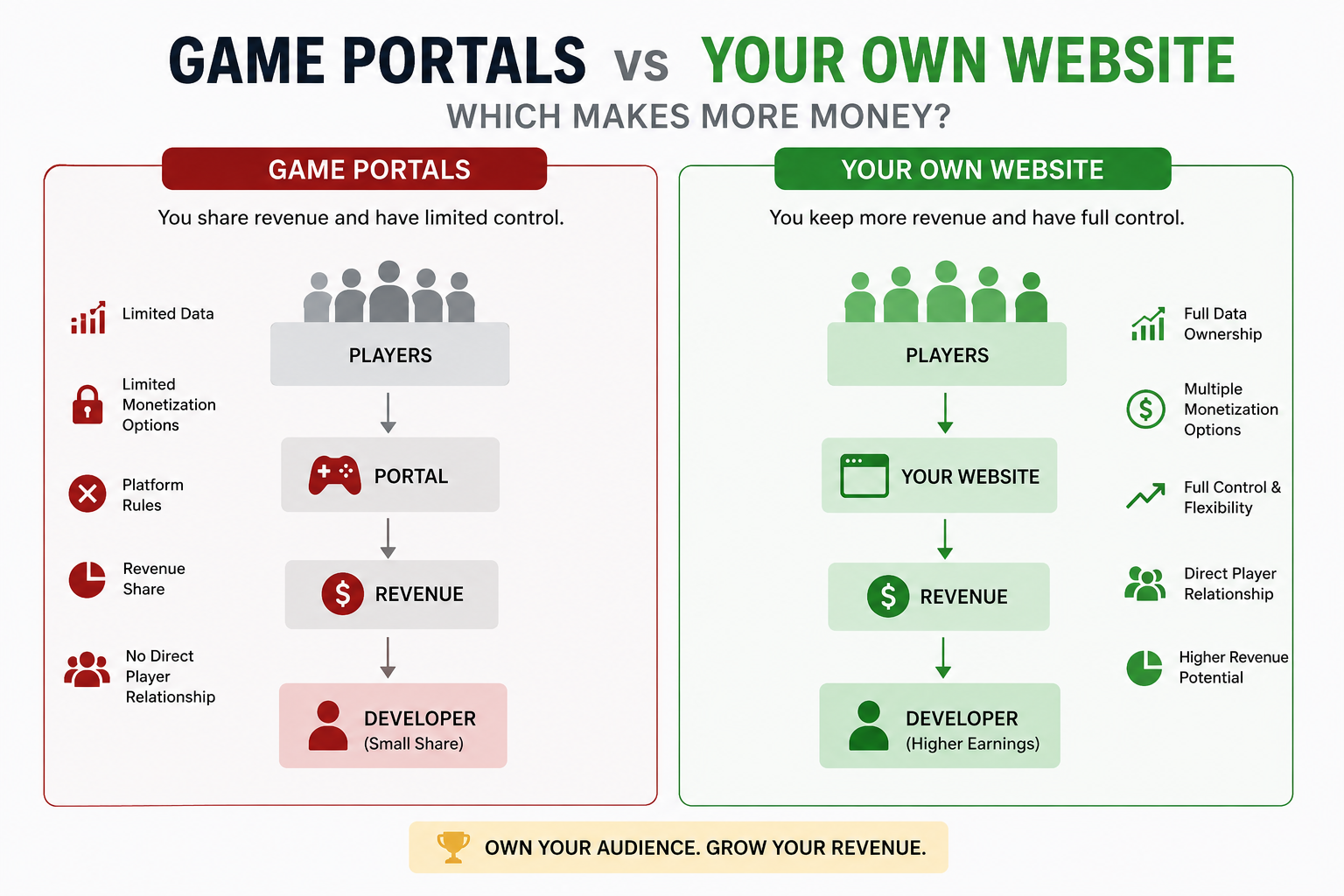
This is the turning point. Publishing on a portal is a trade: reach in exchange for control. Here’s roughly how that control splits.
| You Control | The Portal Controls |
| Gameplay and mechanics | Traffic and discovery |
| Game updates | User accounts |
| Game design | The ad stack |
| In-game rewards | Analytics and data |
| Your branding (partially) | Player relationships |
| Content | Monetization rules |
Read down that right-hand column and the cost becomes clear:
- Limited or no access to player data
- No ability to collect emails or build a mailing list
- Little to no SEO value flowing back to you
- Restricted room to run your own monetization experiments
- Exposure to sudden platform policy changes
- Revenue that depends entirely on someone else’s decisions
4. What Changes When You Publish on Your Own Website
Publishing on a domain you own flips the equation. Instead of renting space on someone else’s platform, you’re building an owned platform—an asset that accrues value with every visitor.
- Your domain and your brand
- Your analytics, tracking exactly what you choose
- Your SEO, compounding with every page you publish
- Your ad strategy, tuned to your players
- Your player accounts and your newsletter
- Your community and your direct line to it
| A portal page is a listing. A page on your own site is a business asset—one that keeps working long after launch day. |
5. Revenue Comparison: Portal vs. Website
The difference isn’t that a website prints more money on day one. It’s that it opens far more ways to earn over time.
| Revenue Opportunity | Portal | Your Own Website |
| Rewarded video ads | Limited | Full control |
| Display ads | Sometimes | Yes |
| Direct sponsorships | Rare | Yes |
| In-app purchases | Limited | Yes |
| Affiliate offers | Rare | Yes |
| Cross-promotion | Limited | Yes |
| Email marketing | No | Yes |
| Subscriptions | Rare | Yes |
Rewarded video is the clearest example. On a portal you take whatever the platform’s ad stack offers. On your own site you choose the SDK, control frequency and placement, and keep the full economics of every completed view. A privacy-first rewarded video SDK like AppLixir is built for exactly this—dropping into an HTML5 or web game and letting you own the rewarded experience end to end.
6. Why First-Party Data Matters More Than Ever
First-party data used to be a nice-to-have. In a world of third-party cookie deprecation and tightening privacy rules, it’s becoming the foundation of durable monetization.
- You understand retention because you can actually measure it
- You see which players return, and why
- You can calculate lifetime value instead of guessing at it
- You make monetization decisions from real audience insight, not a portal’s summary
The practical impact shows up in monetization. When you can see that a returning cohort completes rewarded videos at a higher rate than first-time visitors, you can adjust reward timing, ad frequency, and placement to match. On a portal, you never see that pattern—so you can never act on it. When you own the data, every optimization compounds. When you don’t, you’re improving someone else’s model of your own players.
7. SEO Is an Asset Portals Can’t Build for You
Every game page on your own domain can do work a portal listing never will. It can rank in search, earn backlinks, build domain authority, attract organic traffic, and pull in recurring visitors month after month—for free.
On a portal, those same SEO gains exist. They just accrue to the portal. You’re helping build their search authority, not yours. Over a few years, that gap between renting and owning search visibility becomes one of the largest hidden costs of a portal-only strategy.
There’s a compounding effect worth naming. A single ranking page attracts visitors, some of whom link to it or share it, which strengthens its ranking, which brings more visitors. That flywheel only spins for a domain you own. Every month it runs, the cost of acquiring your next player drops—the opposite of paying for placement you never keep.
8. Monetization Isn’t Just About Ads
Many developers fixate on CPM and stop there. Owning your platform lets you diversify well beyond a single ad unit:
- Rewarded video ads and display ads
- Interstitials, tuned to protect the experience
- Premium versions and memberships
- Merchandise and sponsorships
- Affiliate marketing and cross-promotion
- Direct player support and new-game launches to a warm audience
| Diversification is the difference between a revenue stream and a revenue system. One bad quarter shouldn’t be able to end your business. |
9. The Hybrid Strategy Successful Developers Actually Use
Here’s the part that turns theory into a plan. The strongest studios don’t choose portals or a website. They sequence them so each feeds the other:
| The Compounding Revenue Flywheel
Launch on your website → Implement rewarded ads → Build SEO → Collect analytics → Publish to portals → Link back to your site → Convert portal players into repeat visitors → Grow long-term revenue |
In this model, portals stop being your entire business and become a discovery channel. They introduce your game to new players; your website is where you keep them. That reframing is the whole game.
The mechanics are simple to start. Add a clear link from your portal listing back to your own site—a “play more on our site” call to action, a sequel teaser, or a newsletter signup for updates. Each portal player who follows that link converts from a one-time, anonymous view into a measurable, ownable relationship. You paid nothing to acquire them; the portal did the introduction. Now the retention is yours to build.
The Game Monetization Maturity Model
| Stage | What It Looks Like |
| 1 — Portal-Only | All distribution and revenue depend on third-party platforms. |
| 2 — Hybrid Distribution | You publish on portals but also run your own site. |
| 3 — Owned Audience | First-party data, email, and SEO drive returning players. |
| 4 — Multi-Channel Monetization | Ads, IAP, subscriptions, and sponsorships across owned and portal channels. |
10. Common Mistakes Developers Make
- Publishing only on portals and calling it a strategy
- Ignoring SEO until it’s years too late to matter
- Never tracking analytics, so every decision is a guess
- Leaning on a single monetization method
- Collecting no player feedback
- Depending on one traffic source you don’t control
- Treating every player as an anonymous, one-time visitor
11. Which Strategy Is Right for You?
There’s no single answer—there’s a right tool for each goal. Use this as a quick decision matrix.
| Your Goal | Best Strategy |
| Validate a new game | Portal |
| Build an audience | Website |
| Maximize long-term revenue | Website + portals |
| Improve SEO | Website |
| Collect player data | Website |
| Grow a brand | Website |
| Test gameplay quickly | Portal |
| Scale a real business | Hybrid |
The Biggest Difference Isn’t CPM
The real question was never whether portals or your website generate the higher CPM. It’s which approach helps you build something that becomes more valuable over time.
Portals are excellent for distribution and discovery. Your website is where you build lasting relationships, improve monetization, grow organic traffic, and create a business that isn’t dependent on someone else’s platform. The most successful HTML5 developers don’t choose one or the other—they use portals to acquire players and their own website to retain them.
If you’re just starting out, that doesn’t mean abandoning portals tomorrow. It means treating today’s portal traffic as the top of a funnel you actually own. Stand up a simple site, wire in rewarded video you control, and give every portal player a reason to come find you directly. The portal fills the top; your platform is where the value compounds. Do that consistently, and the question stops being “portal or website”—it becomes how much faster your owned audience can grow.
Frequently Asked Questions
Do game portals or personal websites make more money?
Portals often earn more on day one because the traffic already exists. Over time, a website tends to make more because it lets you own player data, diversify revenue, and build SEO that compounds. The highest total earnings usually come from a hybrid approach that uses both.
Can I publish the same game on a portal and my own website?
Yes. Many developers launch on their own site first, then distribute to portals as a discovery channel, linking portal players back to the owned site to convert them into repeat visitors.
Why does first-party data matter for game monetization?
With third-party cookies going away, first-party data is what lets you measure retention, calculate lifetime value, and optimize monetization from real audience insight rather than a platform’s summary.
What is the best way to add rewarded video ads to my own site?
Use a rewarded video SDK you control. A privacy-first, TCF- and GDPR-compliant option like AppLixir drops into HTML5 and web games and lets you own reward frequency, placement, and the full economics of every completed view.
| Own your rewarded video, on your own terms.
AppLixir is a privacy-first rewarded video SDK built for HTML5 and web games. Keep the player relationship, control the rewarded experience, and monetize your owned platform end to end—with TCF 2.3 and GDPR compliance built in. |