The Psychology Behind High-Performing Rewarded Ads (And What Mid-Core Demand Like Hero Wars Changes)
How player cognition — not ad tech — determines whether opt-in video earns or erodes.
| TL;DR
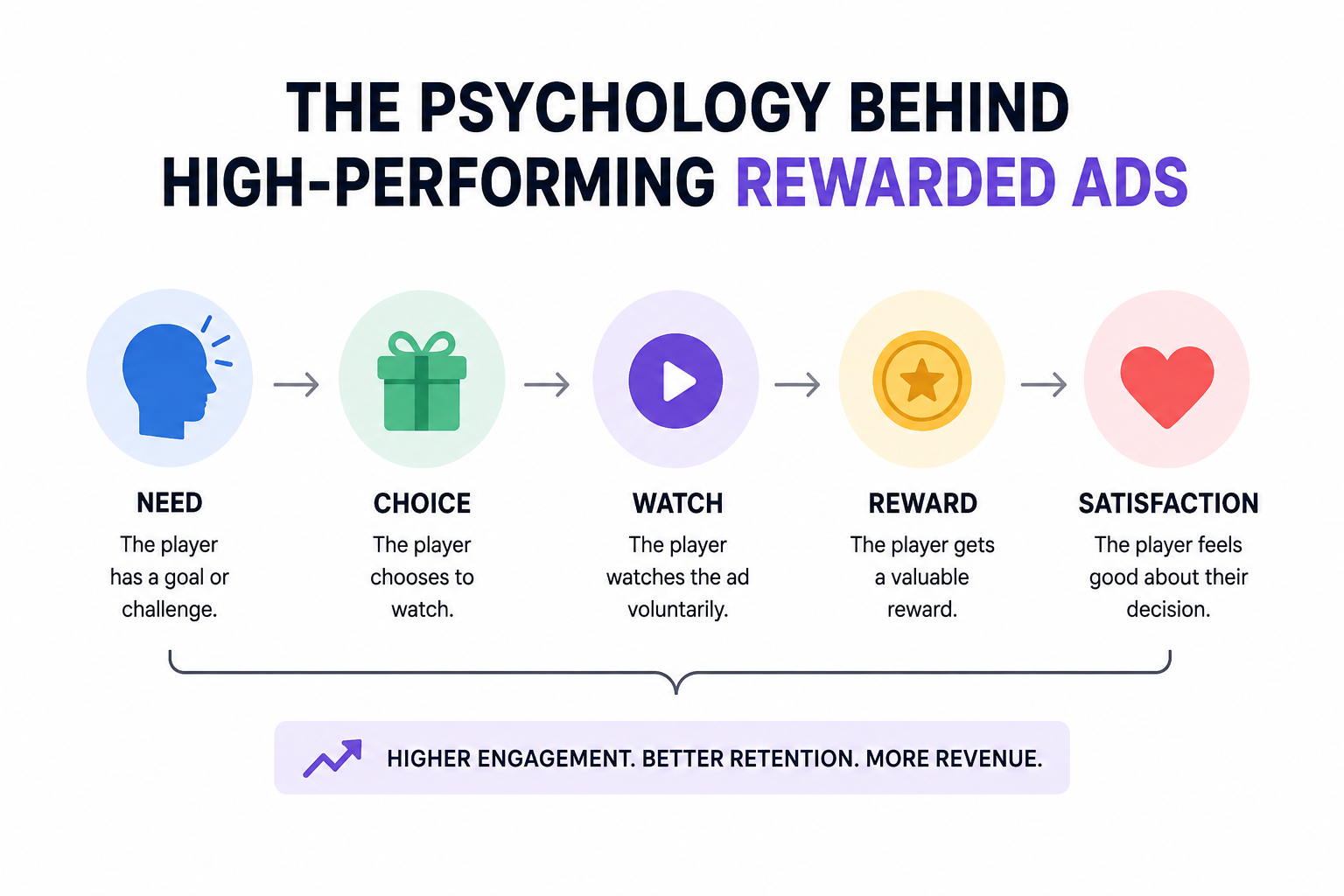
Rewarded video As is the only ad format where the player is the buyer. They spend attention and expect a return. That makes every opt-in a small consent decision, and consent decisions are governed by psychology, not by ad stack configuration. Four cognitive stages decide whether that consent is given and repeated: Anticipation, Agency, Absorption, Attribution — the Four A’s of Willing Attention. When mid-core RPG demand enters the auction — the Hero Wars class of advertiser — the psychology shifts, not just the bid. Longer creatives, playable formats and interactive end cards change what a player actually experiences inside the thirty seconds they agreed to. Higher eCPM is the easy part. Protecting the consent loop is the hard part. |
Most writing about rewarded video ad treats it as a placement problem. Where does the button go, how many views per session, what floor price to set. Those questions matter, but they sit downstream of the one that actually determines performance: why does a player choose to watch?
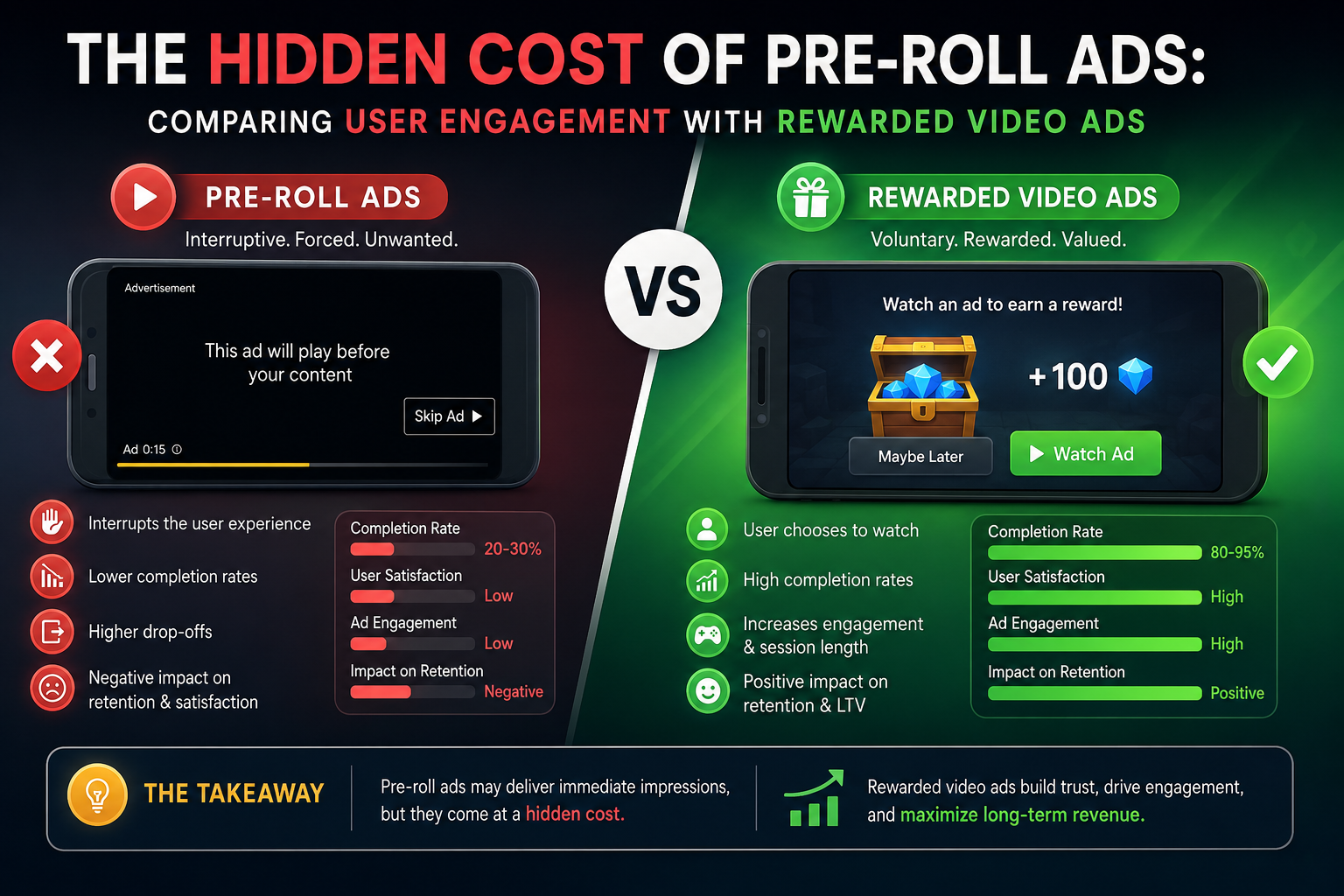
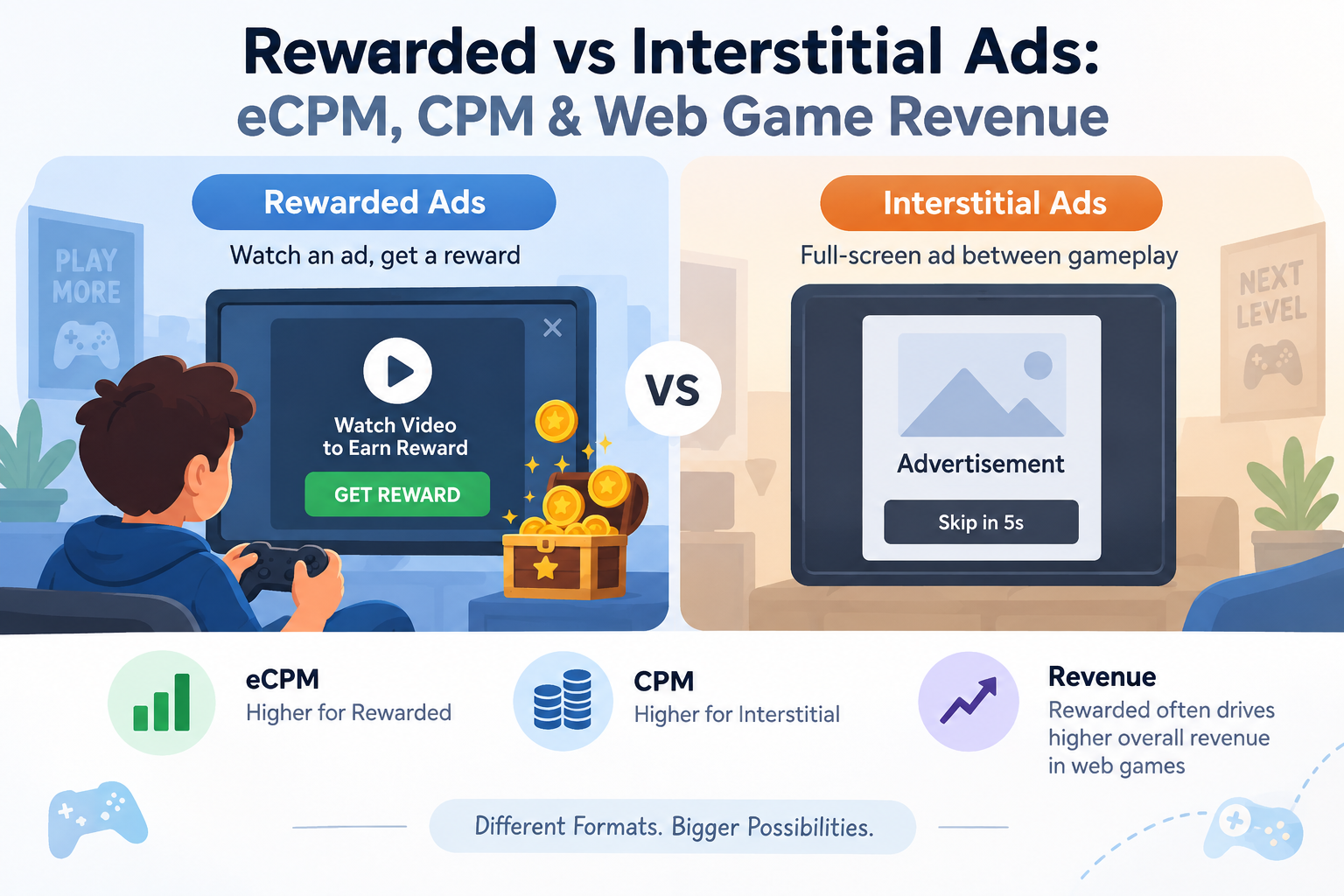
No other ad format asks this question, because no other format requires a choice. Banners are ambient. Interstitials are imposed. Rewarded video is the only format in which a person looks at an offer, evaluates it, and voluntarily spends thirty seconds of their life on it. That single structural fact makes rewarded video a behavioural product before it is an advertising product.
Which means the levers that move it are cognitive. Framing, timing, perceived control, memory. And it means the format is unusually fragile: a player who feels tricked once does not just skip the next ad, they stop believing the offer. Opt-in rate is a trust metric wearing a performance metric’s clothes.
This post breaks down the psychology in four stages, then examines a specific and increasingly common disruption to that psychology — the arrival of mid-core RPG demand on web and HTML5 inventory.
Why the Advertiser Mix Is a Psychological Variable
Publishers tend to treat demand as an economic input. More advertisers, better competition, higher eCPM. True, but incomplete. Different advertiser categories buy different creative styles, and creative style is the substance of the player’s thirty seconds.
Mid-core RPG advertisers — Hero Wars being the most recognisable of the category, alongside the broader class of hero-collector and squad-RPG titles — buy differently from hyper-casual advertisers. Their creative tends toward longer runtimes, narrative or puzzle-framed hooks, playable demos, and interactive end cards that ask for a tap before the install prompt. They are buying a high-LTV user and they are willing to spend more attention to qualify one.
For a casual HTML5 publisher, that is genuinely good news on the revenue line. Mid-core user acquisition budgets are among the deepest in games, and they bid competitively for engaged web audiences that other channels struggle to reach. But it also means the thing your player consented to has changed shape. They agreed to “watch a video for 50 coins.” What arrives may be a puzzle they are invited to solve, a battle they are asked to tap through, or a two-stage creative with an interactive layer.
That is not automatically worse. In several respects it is better — interactive creative is more absorbing than a static thirty-second spot, and absorption drives completion. But it changes the contract, and unexamined contract changes are where rewarded video quietly starts to bleed retention.
| Every rewarded impression is a transaction the player initiated. The moment they feel it was something else, the format stops working — not for that ad, but for the next ten. |
The Four A’s of Willing Attention
Willing attention is not a single event. It is a sequence, and it can break at any of four points. Each stage answers a different question in the player’s head.
| Stage | The player’s question | What breaks it | What fixes it |
| Anticipation | Is this worth thirty seconds? | Vague or generic reward preview | Name the exact reward, offered at the moment of felt need |
| Agency | Did I choose this? | Forced formats elsewhere in the session; dark-pattern prompts | A clean, dismissible opt-in with a visible decline path |
| Absorption | Am I bored yet? | Static creative, repeated frequency, genre mismatch | Interactive and playable formats; frequency and genre control |
| Attribution | Did I actually get it? | Delayed, silent or ambiguous reward delivery | Immediate, visible, celebratory confirmation |
1. Anticipation — the offer is the ad
The opt-in prompt does more work than the creative that follows it. It is where the player performs a cost-benefit calculation in roughly a second, and the variables are specificity and timing.
Specificity beats generosity. “Watch a video for a reward” underperforms “Watch a video for 3 extra lives” even when the reward is identical, because an unnamed reward cannot be valued and an unvalued reward defaults to worthless. Show the item. Show the quantity. Where possible, show it in the currency the player was just thinking about.
Timing beats both. A rewarded offer placed at a neutral moment competes with the game. The same offer placed at the moment of felt need — the fail state, the locked chest, the one-move-short puzzle — competes with nothing, because the player already wants the thing you are offering. Behavioural economics calls this the endowment effect: having nearly held something makes losing it disproportionately painful. A continue offer after a near-win converts far above a continue offer after a clean loss.
There is a discipline point buried here. The most powerful placement moment is also the most exploitable one, and publishers who mine the fail state too aggressively convert frustration into churn. The test is whether the offer resolves the frustration or extends it.
2. Agency — consent is a session-level property
Players do not evaluate your rewarded offer in isolation. They evaluate it against everything else your game has done to them in that session.
This is the most under-appreciated dynamic in the format. A forced interstitial fired at level exit does not just annoy the player for its own duration — it recalibrates their model of your intentions. The rewarded prompt that appears four minutes later is now read as another attempt to take something, rather than an offer to trade. The opt-in rate on your rewarded placement is partly a function of your interstitial policy, and most publishers never connect the two.
The practical implications are unglamorous. Give the opt-in prompt a genuine, obvious, same-size decline path. Never auto-open the offer, place the confirm button where a mistimed tap lands. Never re-prompt the same offer after a decline within the same context. Each of these is a small cost in short-term conversion and a large deposit in the credibility of every future offer.
3. Absorption — where mid-core creative changes the maths
Once the player has opted in, the job shifts from persuasion to retention of attention. Thirty seconds is long. A static creative that reveals its entire proposition in the first four seconds leaves twenty-six seconds for the player to remember they have something better to do — which is when the tab-switch, the minimise, the abandon happens.
This is where mid-core demand tends to help. Playable creatives and interactive end cards convert a passive wait into a short activity, and activity is far more absorbing than observation. Narrative-framed creative — the format the hero-collector category has largely standardised on — carries a resolution the viewer wants to see. Both structures give the player a reason internal to the ad to stay.
The counterweight is genre distance. A casual puzzle audience watching a mid-core RPG creative is being shown something meaningfully further from their taste than a same-genre ad would be. Sometimes that novelty is precisely the appeal. Sometimes it reads as noise, and completion suffers even though the creative is objectively better made. The variable to watch is not creative quality but creative-context fit, and it is measurable per campaign.
| [AppLixir data: completion rate by creative type — static video vs. playable vs. interactive end card, segmented by publisher genre. Replace before publishing.] |
4. Attribution — the memory that produces the next opt-in
The last two seconds determine the next opt-in. A reward that arrives silently, or after a visible delay, or without a clear link back to the ad the player just watched, fails to lay down the memory trace that makes the trade feel worthwhile in retrospect.
Delivery should be immediate, visible, and slightly celebratory. Animate the coins into the balance. Name the reward again on arrival. Make the causal chain — I watched, I received — impossible to miss. This costs almost nothing to implement and is the single most reliably under-built part of rewarded integrations.
The failure mode to watch for is silent failure. When an ad does not fill, or errors mid-playback, and the player receives nothing without explanation, they do not conclude that there was a technical problem. They conclude that the offer was false. One unexplained non-delivery costs more trust than several successful views build.
The Four Psychological Failure Modes
Each stage has a characteristic way of going wrong. These are worth auditing directly, because they present as flat revenue rather than as obvious defects.
| Failure mode | What it looks like | What it costs |
| Reward regret | Opt-in stays healthy, repeat opt-in decays. The reward was not worth thirty seconds in hindsight. | Silent decline in views per user; looks like fatigue, is actually pricing |
| Bait fatigue | Creative promises an experience the advertised game does not deliver. Common in high-intrigue mid-core creative. | Completion holds, trust does not; degrades the publisher’s offer credibility, not the advertiser’s |
| False agency | Opt-in is technically optional but practically coerced — tiny decline path, mistap placement. | Short-term conversion lift, medium-term collapse in opt-in rate |
| Reward inflation | Rewards escalate to sustain opt-in, devaluing the core economy. | Rewarded video begins competing with IAP instead of supporting it |
Bait fatigue deserves a direct word, because it is the failure mode most likely to arrive alongside premium mid-core demand. The hero-collector category has a well-documented history of creative that dramatises gameplay the installed product does not contain — the puzzle-pull ads being the canonical example. As a publisher you do not control advertiser creative, but you do absorb the trust cost of it, because the player experienced that ad inside your game. Where a network gives you creative-level reporting and blocking controls, that is not a nice-to-have. It is trust infrastructure.
What to Instrument
Psychology becomes actionable only when it is measured. Four metrics map to the four stages, and together they tell you which stage is failing rather than merely that revenue is flat.
- Anticipation — opt-in rate, segmented by placement moment. Diagnoses Anticipation. If a fail-state offer and a shop offer convert differently, your timing is doing work.
- Agency — opt-in rate over session time. Diagnoses Agency. If opt-in decays across a session, look at what else you are firing.
- Absorption — completion rate by creative format and by advertiser genre. Diagnoses Absorption and surfaces creative-context fit.
- Attribution — repeat opt-in rate — the share of players who opt in a second time within the same session. Diagnoses Attribution, and is the single best proxy for whether the trade felt fair.
Repeat opt-in is the metric most publishers do not track and should. Opt-in rate tells you the offer was attractive. Repeat opt-in tells you it was honest.
| [AppLixir data: network-wide opt-in rate, repeat opt-in rate within session, and average views per opted-in user across web/HTML5 publishers. Replace before publishing.] |
For the full measurement framework — including viewability, completion and engagement benchmarks — see our breakdown of the Rewarded Quality Index. For the economics of scaling views without damaging retention, see the Retention-Safe Revenue Ladder.
Designing for Consent Without a Tracking Stack
There is a version of rewarded optimisation that runs entirely on behavioural data — personalise the offer, target the creative, predict the propensity. It works, and it requires a tracking apparatus that a growing share of web publishers cannot or will not deploy under TCF 2.3 and GDPR.
The constraint turns out to be clarifying. Without personalisation to lean on, the levers that remain are the ones in this post: offer specificity, placement timing, genuine agency, creative-format control, and clean reward delivery. These are design decisions, not data decisions, and they are available to every publisher regardless of consent posture. This is the assumption AppLixir is built around — privacy-first rewarded video for HTML5, WebGL and browser games, where placement psychology and creative controls carry the load that a tracking stack would otherwise carry.
The practical upshot for a publisher taking on mid-core demand: you cannot personalise which player sees a hero-collector creative, but you can control frequency, you can control which placement moments carry which advertiser categories, and you can read completion by genre and act on it. That is most of the available upside anyway.
Frequently Asked Questions
Why do players choose to watch rewarded ads at all?
Because the trade is legible. The player knows the cost (roughly thirty seconds), knows the return (a named reward), and controls the decision. Rewarded video consistently outperforms other formats on player sentiment for exactly this reason — it is the only format that treats attention as something purchased rather than taken.
Does mid-core advertiser demand hurt a casual game’s player experience?
Not inherently, and often the opposite — interactive and playable creative from mid-core advertisers tends to hold attention better than static video. The risk is genre distance and creative honesty, both of which are manageable through frequency caps, category-level placement rules and creative-level reporting. Watch completion rate by advertiser genre before assuming either way.
What is the single highest-leverage change to a rewarded placement?
Moving the offer to the moment of felt need. A rewarded prompt at a fail state, a locked reward or a one-move-short puzzle converts substantially better than the same prompt at a neutral moment, because the player already wants what you are offering. Specificity in the reward preview is the close second.
Why does opt-in rate drop even when the reward gets bigger?
Usually because trust, not value, is the binding constraint. Bigger rewards do not repair a session in which the player was already shown a forced interstitial, mistapped a prompt, or failed to receive a reward they earned. Check repeat opt-in rate — if it is decaying while first opt-in holds, the problem is credibility, and raising rewards will only inflate the economy.
How many rewarded ads per session is too many?
There is no universal number, because the ceiling is set by placement quality rather than volume. Three offers tied to genuine moments of need will outperform six offers scattered through the session, and will do less retention damage. Let the placement moments determine the count rather than setting a target and finding moments to fill it.
| Build rewarded video your players actually opt into.
AppLixir is a privacy-first rewarded video SDK built for HTML5, WebGL and browser-based games — TCF 2.3 and GDPR compliant, with no tracking stack required. Integrate in minutes and keep full control over placement, frequency and creative categories. |
Note on figures: benchmark and performance figures referenced in this post are directional and intended to illustrate relationships rather than to serve as precise targets. Replace with AppLixir network data — eCPM, opt-in rate, repeat opt-in rate, completion rate by creative format, and fill rate — before publishing.