What $127M in Ad Revenue Actually Bought: The Block Blast Playbook, Translated for Web Games
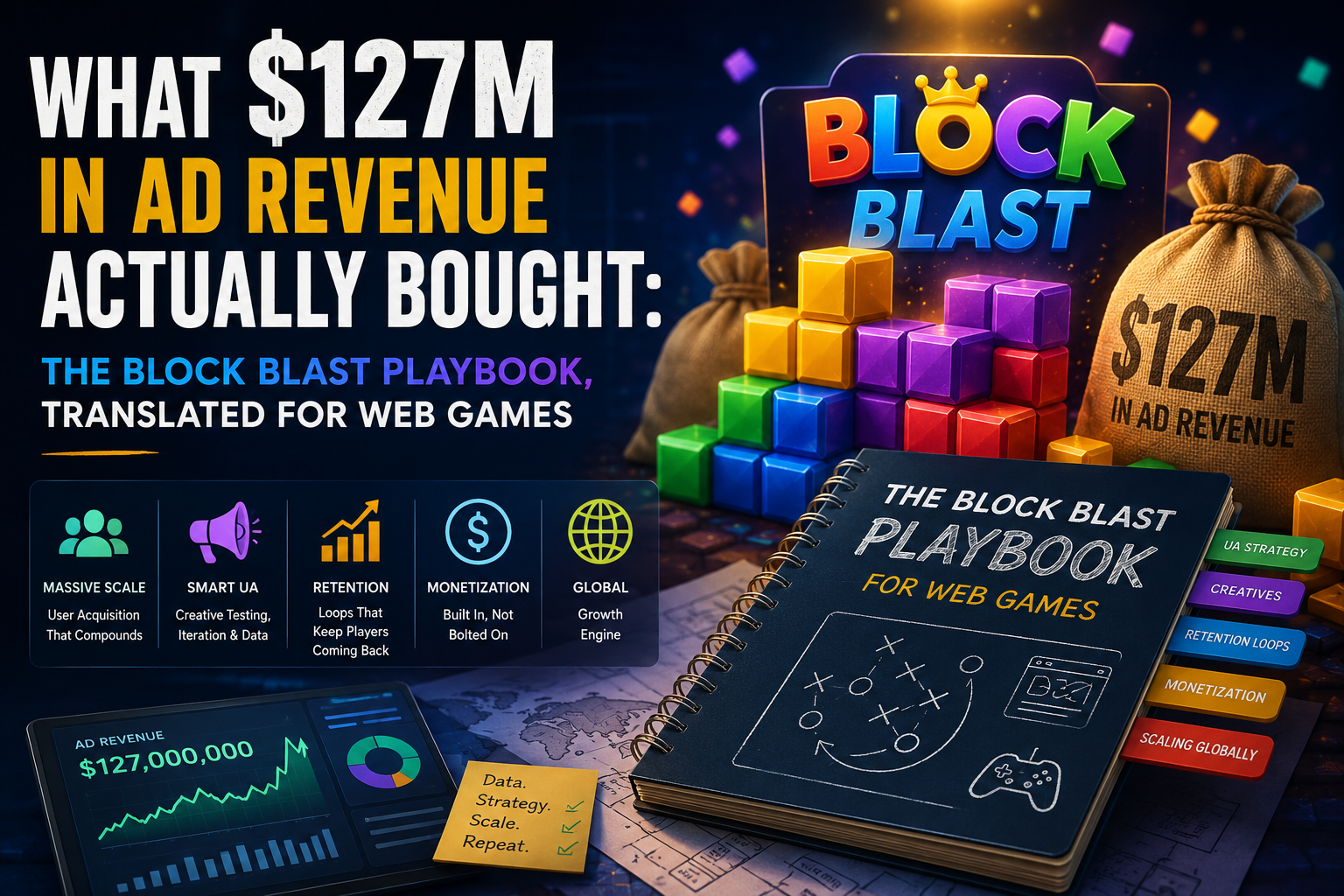
Sensor Tower named Block Blast! the top ad-earning mobile game of 2026 so far. The genre it dominates is the single most cloned category on the open web — and almost none of those web clones have copied the part that actually made the money. The Block Blast Playbook: What $127M in Ad Revenue Actually Bought reveals why this game’s success is so unique.
| TL;DR
Block Blast! earned an estimated $127 million in ad revenue between January and May 2026 — the highest of any mobile game — while running one of the least aggressive ad loads in its category: banners, short interstitials, and exactly one rewarded video per session. Puzzle now drives 53% of all mobile game ad revenue, with the Block sub-genre alone at 10%. But the finding most relevant to web publishers is buried elsewhere in the same report: games outside the top 1,000 capture 29% of all ad revenue versus just 9% of IAP. Ad monetization is structurally less winner-take-all than in-app purchases — which is exactly why the open web has a real seat at this table. |
The headline number, and why it is the wrong one to fixate on
Sensor Tower’s Gaming Deep Dive: Ad Monetization report, published in June 2026, sizes the mobile game advertising economy at more than $12 billion across 19 markets in 2025, delivered through 2.4 trillion impressions. Ad-supported titles accounted for roughly 84% of all mobile game downloads as of May 2026. The share of games carrying ads climbed from about 45% in mid-2021 to 56% by May 2026 — driven, notably, less by an explosion of ad-first games than by the steady disappearance of games without ads at all.
Inside that pool, one title sits alone at the top. Block Blast!, from Hong Kong’s Hungry Studio, is estimated to have pulled $127 million in ad revenue in the first five months of 2026. Vita Mahjong followed at $89.8 million, Candy Crush Saga at $81.1 million, Solitaire Associations Journey at $73.3 million, and Wordscapes at $42.6 million. At the publisher level Hungry Studio earned roughly $131 million, meaning Block Blast! is effectively the whole company — and it generated about 60% of that outside the United States.
The number that gives all of this weight, though, is a different one: every other casual game in the top ten earned less in the first five months of 2026 than in the same window of 2025. The category is contracting. Block Blast! is not riding a rising tide. It is taking share while the tide goes out.
| The category is contracting. Block Blast! is not riding a rising tide — it is taking share while the tide goes out. |
What Block Blast actually built
The temptation, looking at $127 million from a pure advertising business, is to assume a punishing ad load. The opposite is closer to the truth. Independent deconstructions of the game document an ad architecture that is almost conservative by 2026 standards:
- Static banners — anchored to the bottom of the play area, persistent and low-yield but effectively free in attention cost.
- Interstitials between rounds — short, skippable, and placed at natural break points rather than mid-board.
- A single rewarded placement — offered at the moment of failure, in exchange for a revive. Longer format, higher CPM, and — critically — capped at one per session.
There is no battle pass. No store pressure. No whale economy. There is not even a “remove ads” purchase, despite players openly requesting one, because the game’s offline mode already runs ad-free and serves as the escape valve. The entire revenue model is impression volume multiplied by an unusually large and unusually sticky audience: Sensor Tower puts Block Blast! at 181 million monthly active users among primarily ad-monetized titles as of May 2026, well ahead of Subway Surfers at 92 million. Hungry Studio’s own January 2026 announcement claimed 70 million daily and 300 million monthly actives.
The design insight underneath this is that the game manufactures its own inventory. Sessions are short. Failure is frequent and non-punitive. Every failure is a naturally occurring, emotionally motivated moment where a player genuinely wants something the game can trade for attention. The ad is not an interruption of the loop — it is a resolution of it.
The Scarcity-Priced Rewarded Model
The cap is the part worth naming, because it runs against the instinct of most publishers under revenue pressure. Block Blast! allows one revive per session.
We can call this the Scarcity-Priced Rewarded Model: the deliberate rationing of a rewarded placement so that its perceived value stays high, its opt-in rate stays high, and the underlying game state it protects stays meaningful. It rests on three mechanics that any publisher can reason about:
- Reward value is a function of scarcity. If a revive is always available, losing stops mattering, and a reward that rescues you from nothing is worth nothing. Scarcity is what keeps the offer valuable enough to accept.
- Opt-in rate is the real yield lever. A rewarded placement served to a motivated player who chooses it will outperform three placements served to a fatigued one, because completion rates hold, because networks bid harder on engaged inventory, and because nobody churns over an ad they asked for.
- Fewer, better-priced impressions beat more, cheaper ones. Capping the count while raising the stakes concentrates demand into one high-intent moment rather than diluting it across several low-intent ones.
This is not theory constructed after the fact. Hungry Studio’s network partners have published the numbers. Google’s AdMob case study on the studio reports an 8% increase in user retention for Block Blast! following integration work focused on format selection and UX consultation. InMobi’s case study, covering the studio’s move from banner-only into full-screen interstitial and rewarded video, reports a 5% ARPDAU lift. Both are retention-and-yield gains achieved through placement quality, not placement quantity.
25,000 A/B tests, all pointed at retention
The most underquoted statistic in the entire Block Blast! story is not a revenue figure. It is that the game reportedly ran on the order of 25,000 A/B tests during 2025 — and that they were aimed at retention rather than monetization.
That framing is the whole strategy in one line. In a model where revenue equals impressions times eCPM times audience, and where the ad load is deliberately held flat, the only variable left to grow is how many people come back tomorrow. Retention is not a wellbeing concern sitting in tension with the revenue goal. Retention is the revenue goal.
| In a model where the ad load is deliberately held flat, retention is not in tension with revenue. Retention is the revenue. |
Sensor Tower’s own analysis of the 2026 breakout titles points the same direction: games like Block Blast! and Vita Mahjong won on session-loop quality and on creative promises that matched the actual product. Players who click an ad and find precisely what was advertised retain at materially higher rates than players who feel switched. Honest creative is a retention mechanic, and in an ads-only economy, a retention mechanic is a monetization mechanic.
The finding web publishers should actually care about
Most coverage of this report has stopped at the leaderboard. The more consequential data sits in the section comparing how ad revenue and IAP revenue distribute across the market:
| Revenue tier | Share of ad revenue | Share of IAP revenue |
| Top 10 games | 11% | 22% |
| Top 50 games | 26% | 47% |
| Outside top 1,000 | 29% | 9% |
Read that bottom row twice. Games outside the thousand largest titles capture nearly a third of all advertising revenue in mobile gaming, but less than a tenth of in-app purchase revenue. In-app purchases concentrate; advertising distributes.
That asymmetry is the structural argument for every publisher who is never going to build a top-50 title — which is to say, virtually the entire web and HTML5 games ecosystem. A browser game with a devoted mid-size audience has a credible path to meaningful advertising revenue in a way it has essentially no path to meaningful IAP revenue. The economics of ads reward the long tail. The economics of purchases do not.
What does not translate to the web
Any honest translation has to start with the gaps, because copying Block Blast! placement-for-placement into a browser game will not reproduce Block Blast! results.
- There is no install moat. Block Blast! benefits from push notifications, home-screen presence, and an install that survives a closed tab. Web games start every relationship from zero and have to earn the return visit through the portal, a bookmark, or a link. Day-one retention behaves differently and should be measured on its own baseline, not against app benchmarks.
- Mediation depth is thinner. A mobile app runs deep waterfall and bidding stacks through native SDKs across many demand partners. Browser inventory clears through a narrower set of demand, and web CPMs sit realistically in the $4–15 range depending on geography, format and viewability — not the inflated figures often quoted from mobile case studies.
- Session shape differs. A browser session is frequently shorter and more interruption-prone than a mobile app session. The interstitial-between-every-round pattern that works in an app can read as hostile on the web, where the cost of leaving is a single tab close.
- There is no offline mode to absorb pressure. Block Blast! can afford to skip a “remove ads” purchase because its offline mode absorbs the demand. Web games have no equivalent pressure valve, so ad experience quality has to carry more weight.
And the constraint that most distinguishes the web: consent and privacy operate differently in a browser. There is no device advertising ID to lean on, third-party cookies are unreliable at best, and TCF 2.3 and GDPR obligations attach to a session that begins the instant a page loads. Any placement design borrowed from mobile has to be re-derived under those conditions.
What does translate — and translates well
The transferable part of the Block Blast! playbook is not the ad load. It is the design logic that decides where an ad is allowed to exist.
1. Put the rewarded placement at the failure state
The single most portable idea here. Find the moment in your web game where a player has just lost something they cared about — a run, a streak, a board, a personal best — and put the rewarded offer there and nowhere else. That moment supplies its own motivation. You do not have to manufacture a reason for the player to want the reward, which means you do not have to manufacture a reason for them to tolerate the ad.
2. Cap it, and let the cap do the pricing
One revive per session. One continue per run. Whatever the unit, name it and hold it. The cap protects the value of the reward, keeps opt-in rates high, and prevents the slow slide into ad fatigue that quietly erodes both completion rate and return visits. Publishers who raise frequency to raise revenue usually get a short-lived lift followed by a retention cost that exceeds it.
3. Treat retention as your monetization roadmap
If you are running an ads-first web game, your monetization backlog and your retention backlog should be the same document. Every test that increases return visits multiplies across every future impression. Every test that increases ad load once is a one-time gain against a recurring risk. The 25,000-test figure is out of reach for most studios, but the priority ordering behind it is not.
4. Match the creative promise to the product
This applies as strongly to portal thumbnails and preview clips as it does to paid UA creative. Players routed in from a promise the game does not keep will bounce, and on the web they will bounce faster because leaving costs nothing.
5. Make the compliance layer part of the design, not a patch
The privacy constraint is a genuine differentiator rather than a tax, provided it is built in from the start. A rewarded implementation that is consent-aware, TCF 2.3-compliant and does not require a tracking stack to function will fill in markets and on placements where a retrofitted mobile-style setup simply will not. This is the specific problem AppLixir was built for: rewarded video for HTML5, WebGL and browser games where the privacy posture is native to the SDK rather than bolted on afterwards.
The web block-puzzle opportunity is already open
Here is the part that should make this concrete. The Block sub-genre now represents roughly 10% of all mobile game ad revenue — the largest single sub-genre in the largest genre. And block puzzles are, simultaneously, among the most heavily represented categories on the open web. Poki alone lists more than sixty block games. CrazyGames maintains a dedicated block category. Standalone browser implementations of the format rank for the search term itself.
The gameplay has been cloned exhaustively. The ad architecture has not. Most web block puzzles ship with a banner and an interstitial and stop there — reproducing the least valuable two-thirds of the model while omitting the failure-state rewarded placement that carries the yield. The revive moment exists in every one of these games by definition, because the format ends when the board fills. It is simply not being monetized.
| The gameplay has been cloned exhaustively. The ad architecture has not. |
That is an unusually legible gap. The mechanic is proven, the audience is already on the web, the highest-value placement is structurally guaranteed by the genre, and the long-tail revenue distribution means a mid-size browser title does not need top-ten scale to see the benefit.
Frequently asked questions
How much ad revenue does Block Blast actually make?
Sensor Tower estimates $127 million in ad revenue between January and May 2026, making it the top ad-earning mobile game in that window. Its publisher, Hungry Studio, earned about $131 million in total, roughly 60% of it outside the United States. These are third-party estimates, and ad revenue estimates carry wider error bars than IAP estimates.
Does Block Blast make money from in-app purchases?
Essentially no. The game monetizes through advertising almost exclusively — banners, interstitials between rounds, and a single rewarded video placement offered as a revive after a loss. It does not even sell a “remove ads” option.
Why does Block Blast only allow one rewarded ad per session?
Because scarcity preserves the value of the reward. If a revive were always available, losing would carry no weight and the reward would stop being worth an ad view. Capping the placement keeps opt-in rates and completion rates high, which supports higher effective CPMs and protects retention.
Can a web or HTML5 game realistically use the same model?
The placement logic transfers well; the surrounding economics do not transfer directly. Web games lack an install moat, run shallower mediation, and operate under browser-native privacy constraints, so realistic web eCPMs sit around $4–15 rather than mobile case-study figures. The failure-state rewarded placement, the frequency cap, and the retention-first testing priority all apply.
Is advertising or in-app purchase better for a small game studio?
For most small and mid-size studios — and for nearly all web game publishers — advertising is the more accessible revenue base. Sensor Tower’s data shows games outside the top 1,000 capture 29% of ad revenue but only 9% of IAP revenue, meaning the ad market distributes to the long tail in a way the purchase market does not.
Which genre earns the most from mobile game ads?
Puzzle, by a wide margin, at roughly 53% of all mobile game ad revenue. Arcade is a distant second at 13%. Within puzzle, the Block sub-genre leads at about 10% of the total, ahead of Match Pair, Sort and Match Swap at around 7% each.
Build the rewarded layer your web game is missingAppLixir provides privacy-first rewarded video built specifically for HTML5, WebGL and browser-based games — TCF 2.3 and GDPR compliant, with no tracking stack required. If your game has a failure state, it already has the highest-value ad placement in the model described above. Integrate in an afternoon and start monetizing the moment your players already care about. Get started at applixir.com |
Sources and notes
Primary source: Sensor Tower, “Gaming Deep Dive: Ad Monetization” (June 2026), covering 19 markets across the Americas, Europe and Asia-Pacific. Ad revenue is estimated from CPM benchmarks by format and network, supplemented with direct CPM data from winning auction bids. Ad metrics cover January 2025 to May 2026. Supporting figures drawn from AdMob and InMobi published case studies on Hungry Studio, from Hungry Studio’s own January 2026 user announcement, and from independent product deconstructions of Block Blast!.
| Note on estimates: third-party ad revenue estimates fluctuate more than IAP estimates, and figures here should be read as directional rather than audited. Web eCPM ranges cited reflect general HTML5 and browser-game conditions. |