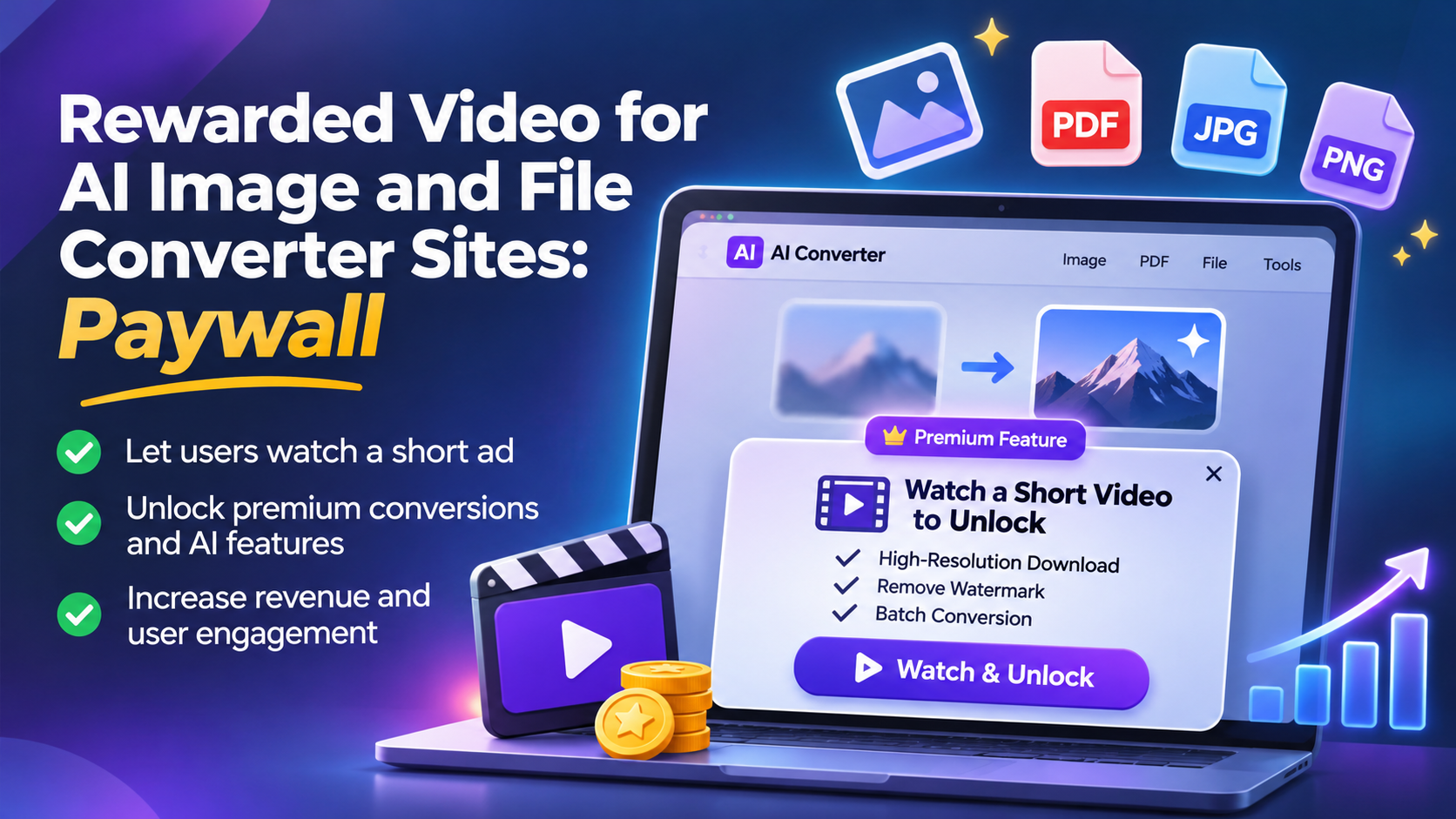
Rewarded Video for AI Image and File Converter Sites: Paywall
| TL;DR
Who this is for: AI image generators, photo editors, prompt libraries, and file converters that run in the browser. The problem: Most users never pay. Hard paywalls drive them to the next tool. Banners pay too little. The fix: Let users watch a short rewarded video to unlock one premium action, such as a prompt, an HD export, or a large file conversion. The framework: The Watch, Unlock, Upgrade Ladder turns free users into ad revenue first and buyers second. |
AI image tools and file converters are some of the fastest-growing sites on the web. A new prompt library, background remover, or PDF converter can pull in thousands of visitors a day. Search, social, and AI answer engines send traffic quickly.
Turning that traffic into revenue is the hard part. Most users arrive with one task. They want an image styled, a file converted, or a watermark removed. They finish and leave. Very few will pay for a subscription after one visit.
Rewarded video gives these sites a better option. This guide explains why it fits, how to place it, and what the integration looks like. It also includes a short video of a live integration on a real AI prompt site.
Why AI Image and Converter Sites Struggle to Monetize
These sites share a common shape. The core tool is free. A premium tier unlocks better output, larger files, or more uses. Ads cover the free traffic.
That model leaks money in three places.
1. Sessions are short and task-driven
A user converts one file or copies one prompt. The visit may last under a minute. Banner ads need time on page to earn. Short sessions give them little room.
2. Free users are not free to serve
Many AI tools pay per request to the models behind them. File converters pay for compute and bandwidth. Each free visit has a real cost. Low banner revenue may not cover it.
3. Paywalls push users away
When a site gates its best features too early, users leave for a competitor. We call this pattern Inverted V Syndrome. Traffic rises fast while the tool is open. Then the team adds a hard gate. Usage peaks and falls, and the growth curve forms an inverted V.
In the AI tool market, this risk is high. There are dozens of alternatives for every task. A blocked user is one search away from a free competitor.
Why Rewarded Video Fits This Category
Rewarded video is an opt-in ad. The user chooses to watch a short video in exchange for something they want. The ad never interrupts. It plays only when the user asks.
For AI image and converter sites, the reward is built into the product. Common examples include:
- Prompt libraries: unlock one premium prompt.
- AI image generators: get extra generations or credits for the day.
- Photo editors: export in HD or remove a watermark.
- File converters: convert a larger file or a batch of files.
- Background removers and upscalers: download at full resolution.
Three traits make the fit strong:
- It is web-native. These tools run in the browser. There is no app store and no SDK build. A script tag and a short callback do the job.
- It pays more than banners. Web rewarded video runs roughly $10–15 eCPM, versus roughly $4–8 for banners. Both are directional 2026 estimates.
- It matches the task. The user is already waiting for a result. A short ad in exchange for a better result feels like a fair trade.
See It Live: A Real Integration
The video below shows a live rewarded video integration on an AI photo-prompt library. The site offers free prompts, premium prompts, and a lifetime upgrade. Free users can watch a short ad to unlock a premium prompt.
Watch for three things in the video. First, notice how little code is involved. Second, see where the unlock button sits on the prompt card. Third, note that the upgrade offer stays visible next to the ad option.
How the Integration Works
Step 1: Load the AppLixir script
The integration starts with a single CDN script. It loads once per page and needs no build step. It works with plain HTML, React, Next.js, and most other frameworks.
Step 2: Attach the ad to the unlock moment
Place the trigger where users meet a limit. That might be a locked prompt, an HD export button, or a file-size cap. Show two choices side by side. One is to watch an ad and unlock this item. The other is to upgrade and unlock everything.
Step 3: Grant the reward on completion
The AppLixir player returns a status object when the ad ends. Check that status before granting the reward. If the ad completes, unlock the item. If no ad is available, fall back to the upgrade offer or a free alternative.
// Illustrative only — confirm against applixirinc/applixir-integration (v6.1.0)
function onUnlockClick(itemId) {
invokeApplixirVideoUnit({
onStatus: (status) => {           // { type, ad?, error? }
if (status.type === 'ad-rewarded') unlockItem(itemId);
else if (status.type === 'ad-error') showUpgradeOffer();
}
});
}
|
Step 4: Test and go live
Test on desktop and mobile browsers before launch. Check the unlock, the fallback, and the upgrade path. For most sites, the full integration takes [AppLixir data: typical integration time].
Our integration repo includes examples, React snippets, and ready-made prompts for AI coding tools. A developer can ask an AI assistant to add the integration and get working code quickly.
Where the Ad Sits: The Watch, Unlock, Upgrade Ladder
The most important choice is not the code. It is where the ad lives in the user journey. We recommend a pattern called the Watch, Unlock, Upgrade Ladder.
The ladder has three rungs. Each one matches a different level of user commitment.
| Rung | User state | What they do | What the site earns |
| 1. Use | New or one-task visitor | Uses the free tool | Display ad revenue |
| 2. Watch & Unlock | Hits a limit, wants one more | Watches a rewarded ad | Rewarded eCPM (~$10–15, directional) |
| 3. Upgrade | Repeat user who unlocks often | Buys a plan or lifetime pass | Subscription or one-time purchase |
The ladder works because no rung is a wall. A casual visitor is never forced to pay. They can climb one step at a time.
The middle rung also does sales work. A user who watches three ads in a week learns the value of premium features. That user is now a strong lead for the paid plan. Rewarded video becomes both a revenue stream and a conversion path.
This is the direct cure for Inverted V Syndrome. The product keeps its premium value. But it stops turning curious users away at the door.
| Ladder design rules
Make the reward specific. “Unlock this prompt” or “Export in HD” beats “Watch an ad for rewards.” Always show both options. Place the upgrade offer beside the ad option, not behind it. Never interrupt. The ad plays only after a user clicks to request it. Cap frequency. Let heavy users feel the value of the paid plan rather than endless ads. |
Placement Ideas by Site Type
| Site type | Natural limit | Rewarded unlock |
| Prompt library | Premium prompts | Unlock one premium prompt |
| AI image generator | Daily generation cap | Extra generations or credits |
| AI photo editor | Watermark or low-res export | One HD, watermark-free export |
| File converter | File size or batch limit | Convert one large file or batch |
| Background remover / upscaler | Preview-only resolution | Full-resolution download |
Start with the single limit users hit most often. That is where opt-in will be highest. Add more placements only after you see how the first one performs.
What to Expect: Directional Benchmarks
Results depend on audience, geography, and placement. The figures below are directional 2026 estimates for web rewarded video. They will be updated with live AppLixir reporting data.
| Metric | Directional range | What it tells you |
| Opt-in rate | [AppLixir data: opt-in % range] | Share of users offered an unlock who choose to watch |
| Completion rate | [AppLixir data: completion % range] | Share of started ads watched to the end |
| Rewarded eCPM | ~$10–15 | Revenue per 1,000 completed views |
| Fill rate | [AppLixir data: fill % range] | Share of requests that return an ad |
A useful way to model revenue is the Rewarded Revenue Equation. Revenue equals eligible users, times opt-in rate, times completion rate, times fill rate, times eCPM. Each term is a lever. Your placement drives opt-in. The opt-in format drives completion. Your ad partner drives fill and eCPM.
The common fear is that rewarded ads will cannibalize paid plans. In practice, rewarded ads mostly reach users who would not pay today. Keeping the upgrade offer visible and capping ad frequency protects paid conversions. Track paid conversions before and after launch to confirm this for your own site.
Why This Matters Now
The AI tool market has changed fast. It is now cheap to launch a useful image tool or converter. New ones appear every week. Many gain traffic quickly from search, social, and AI answer engines.
Keeping that traffic is harder. Users compare tools in seconds. A hard paywall is now a bigger risk than it was a few years ago. At the same time, model and compute costs mean every free visit costs money.
Rewarded video sits between those two pressures. It earns more per user than banners. It keeps the door open for users who are not ready to pay. And it gives each user a clear, fair trade.
There is a strategic upside too. Rewarded unlocks show which premium features users want most. That data can guide what to build next and what to feature in your upgrade pitch.
Is Your Site a Fit?
Use this checklist:
- You have gated value. Some features, outputs, or content are reserved for paying users.
- Most users never pay. Your free-to-paid conversion rate is low.
- Each free visit has a cost. Model calls, compute, or bandwidth add up.
- The reward can be small and specific. One unlock, one export, one extra use.
- You run on the web. No app store wrapper is needed.
If you checked three or more, rewarded video is worth testing. Start with one placement at your most common limit. Measure opt-in and paid conversions for a few weeks. Then expand.
Frequently Asked Questions
Can rewarded video work on non-game websites?
Yes. Rewarded video works anywhere a user wants something you can grant instantly. AI image tools and converters are a natural fit because each use has a clear, valuable output.
Will rewarded ads cannibalize my paid plan?
Not when the ladder is designed well. Rewarded ads serve users who would not pay today. Showing the upgrade offer beside the ad keeps the paid path visible. Frequency caps make the paid plan more attractive to heavy users.
How long does a web integration take?
For a typical site, it is one script and a short callback. The video above shows the full process on a live site.
What eCPM can an AI tool or converter expect?
As a directional 2026 estimate, web rewarded video runs roughly $10–15 eCPM. Banners run roughly $4–8. Actual rates vary by geography, audience, and fill.
Does rewarded video hurt the user experience?
No, because it is opt-in. The ad plays only when the user clicks to request it. The free tool stays uninterrupted.
Related Reading
- [AppLixir: Rewarded video for web]
- [AppLixir: Inverted V Syndrome post]
- [AppLixir: Rewarded Revenue Equation post]
| Turn your paywall into a ladder
AppLixir is a web-first rewarded video platform for HTML5 games, web apps, AI tools, and content sites. Add one script and start earning from users who will never pay. Get started at applixir.com or talk to our team about your use case. |