The Inverted V Syndrome: Why Web Tools Spike, Then Bleed Users
Your traffic didn’t die. Your gate killed it.
| TL;DR
The Inverted V Syndrome is the rise-then-collapse traffic pattern of web tools that gate core value before users form a habit. The drop is rarely a demand problem. It is a gate-timing problem. The fix has three parts. Deliver one complete result free. Ask after the aha moment. Add an earn path, such as rewarded access, next to the pay path. |
The Chart Every Tool Founder Knows
Picture the dashboard for a new AI image upscaler. Launch week brings a spike from a product directory. Search traffic follows. Users post before-and-after shots on social media. The line climbs for weeks.
Then the team adds a signup wall. Free users get three credits. Downloads above 1080p need a paid plan. Within a month, the line turns. Six weeks later, daily visitors sit below launch levels.
The founders blame seasonality, a new competitor, or a search update. Sometimes they’re right. More often, the shape of the chart tells a simpler story.
The line went up because the tool was useful and free. It came down because the tool stopped being reachable. I call this pattern the Inverted V Syndrome.
What Is the Inverted V Syndrome?
| DEFINITION
The Inverted V Syndrome is the rise-then-collapse traffic pattern that occurs when a web tool gates its core value before users have formed a habit. Acquisition climbs on free, frictionless value. Attrition follows the gate, not the product. |
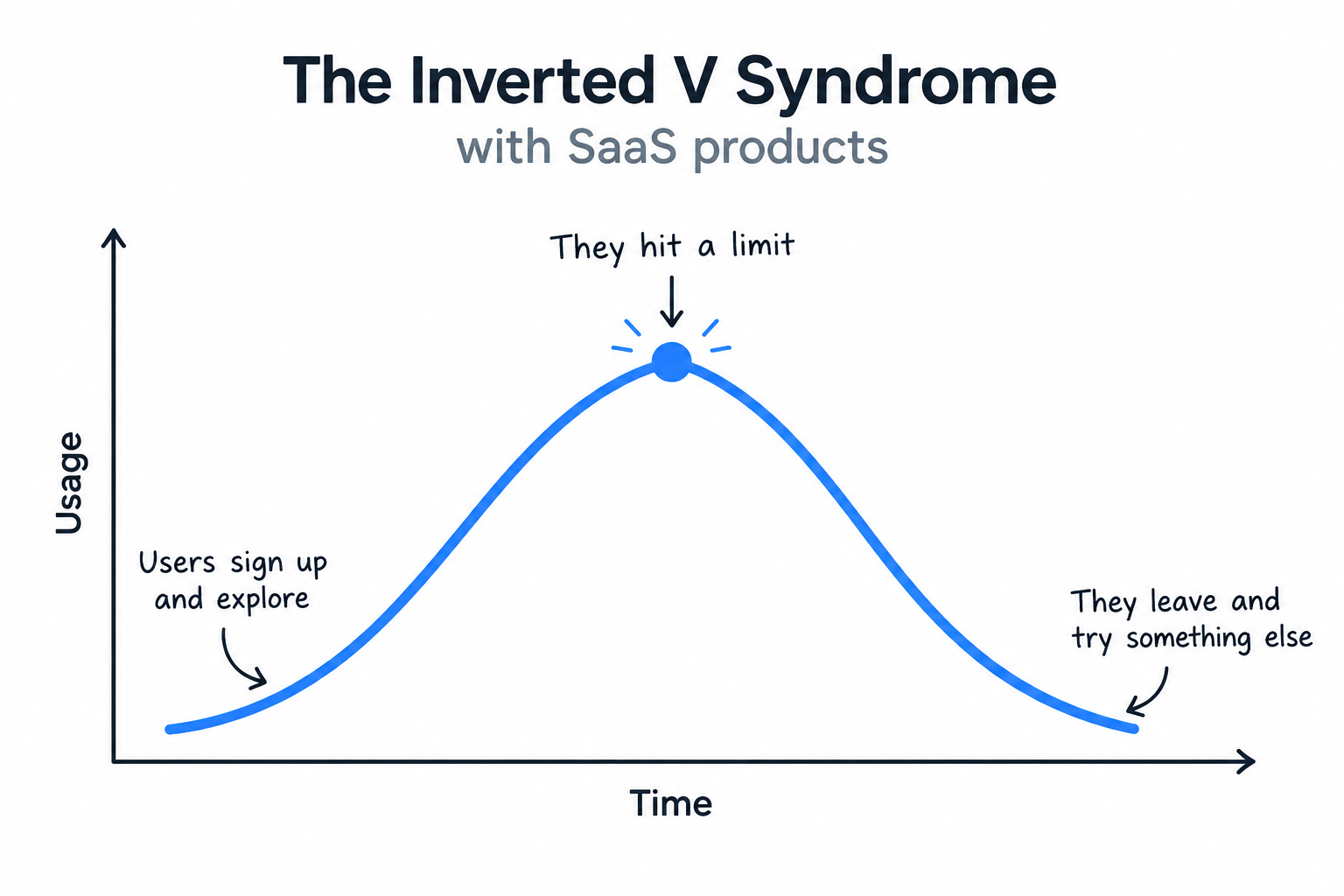
The name comes straight from the chart. Plot daily active users over time. You get a sharp peak with two steep sides. It looks like an upside-down V.
The left slope: acquisition
The left slope is earned. Free, instant results drive search clicks, shares, and return visits. Each happy user feeds the next wave. They leave backlinks, forum mentions, and branded searches behind them.
The right slope: attrition
The right slope is self-inflicted. A gate appears, and a small share of users pay. Most leave. They don’t leave because they disliked the tool. They leave at the exact moment the tool asks for something.
How it differs from normal churn
Normal churn happens after use. People try a product, lose interest, and drift away. The Inverted V is different. Users leave before they get value, right at the gate. That makes it easy to measure. It also makes it fixable.
Which Web Tools Are Most at Risk?
Any product can gate too early. But four categories of web tools show the pattern most often:
- AI image generators and editors. Background removers, upscalers, style converters, and avatar makers.
- File converters. PDF, video, audio, and image format tools.
- Freemium SaaS utilities. Resume builders, logo makers, transcription tools, and QR code generators.
- Browser-based HTML5 games. Titles that add paywalls or hard energy timers after a strong launch.
These categories share a user profile. Visitors arrive with high intent and low loyalty. They want one task done now. And they know ten alternatives sit one search away.
That mix is dangerous. High intent means users will tolerate a small ask. Low loyalty means they won’t tolerate a big one.
The Five Gates That Trigger the Collapse
Not every gate causes an Inverted V. The damage depends on what the gate blocks and when it appears. These five patterns do the most harm.
| Gate | What users see | Why it drives exits |
| 1. Signup-first wall | An account is required before any result | Asks for commitment before proving value |
| 2. Quality ransom | Only watermarked or low-res output is free | The free result is unusable, so it isn’t really free |
| 3. Mid-task credit cap | Credits run out halfway through a job | Interrupts users at peak frustration |
| 4. Bait-and-gate | A paywall appears at download, after the work is done | Feels like a trick and fuels angry reviews |
| 5. Free-tier rollback | Features that were free suddenly cost money | Breaks trust with the users who built your traffic |
The bait-and-gate is often the most damaging. Users invest time uploading, editing, and waiting. Then the tool holds the result hostage. Some pay. Many leave angry, and angry users write reviews.
The free-tier rollback deserves its own warning. It punishes your earliest fans. These are the people who linked to you, recommended you, and ranked you. When they turn on you, the right slope gets steeper fast.
Why Hard Gates Backfire
Gates feel like the responsible business move. The tool costs money to run, especially with AI inference. Someone has to pay. The problem isn’t charging. It’s charging in a way that throws away most of your audience.
The conversion math
Freemium tools commonly convert a low single-digit share of free users to paid. Treat that as a directional 2026 estimate, not a promise.
Now run that number through a hard gate. Say 100,000 visitors hit the wall in a month and 3% pay. That leaves 97,000 people who got nothing. You earned nothing from them either.
| THE GATE LOSS EQUATION
Gate Loss = Gate Visitors × (1 − Paid Conversion Rate) × Value per Visit Value per Visit is what a non-paying visit could earn through an earn path. With a hard gate, you collect none of it. |
A hard gate turns most of your traffic into a cost center. You pay to acquire, host, and serve those users. Then you show them the door.
The search feedback loop
Search engines reward pages that satisfy the query. A converter that demands a signup before converting rarely does. Users bounce back to the results and click a competitor instead.
Over time, rankings slip. Fewer visitors arrive. The top of the funnel shrinks. The right slope steepens. The loop feeds itself.
The reputation tax
“Used to be free” may be the most damaging phrase in a tool review. It shows up in forum threads, app directories, and comparison posts. Those pages then rank for your brand name. New visitors meet the complaint before they meet the product.
Diagnosing It: The Gate Timing Test
Before you blame the market, run your tool through four questions. I call this the Gate Timing Test. Score one point for each yes.
- First-Value Rule. Does every visitor get one complete, usable result before any ask?
- Habit Timing. Does the first ask arrive after users return, rather than on the first visit?
- Earn Path. Is there a way to keep going without paying?
- Share Test. Would a free user still share the result or link to the tool?
| HOW TO READ YOUR SCORE
4 points: your gate is well timed. Monitor it, but don’t rebuild it. 2–3 points: you’re at risk. Fix the weakest answer first. 0–1 points: you are probably already on the right slope of the V. |
Symptoms to check in your analytics
- A traffic peak that lines up with the week your gate or pricing change shipped.
- An exit rate on the gate or pricing page far above your site average.
- A wide gap between signups started and signups completed.
- Branded search volume falling a few weeks after the gate launched.
- Referral traffic from forums and blogs fading, even as paid acquisition holds steady.
One symptom can be noise. Three or more usually mean the gate is doing the damage.
The Fix: Replace “Pay or Leave” With “Pay or Earn”
A hard gate offers two choices: pay, or leave. Most users choose to leave. The fix adds a third option. Users can earn access with a few seconds of attention.
Think of access as a ladder rather than a wall. Each rung asks a little more and gives a little more. This mirrors the Retention-Safe Revenue Ladder, applied to tools instead of games.
| Rung | What the user gives | What the user gets |
| Free tier | Nothing | One complete, usable result |
| Soft limit | A pause or a short wait | A few more results per day |
| Rewarded access | One opt-in video ad | One extra unlock: HD export, no watermark, one more generation |
| Subscription | Money | Unlimited use, no ads, batch jobs, API access |
How rewarded access works in a web tool
A user runs out of free conversions. Instead of a paywall, they see a choice. They can upgrade, or watch a short video to unlock one more. They opt in. The ad plays. The tool delivers the file.
The key word is opt-in. Nobody is forced to watch anything. The user trades attention for value on their own terms. That’s the difference between a rewarded unlock and an interruption. It also reflects the Four A’s of Willing Attention: the user chooses to engage because the reward is clear.
This is exactly the model AppLixir was built for. It delivers opt-in rewarded video for web and HTML5 experiences, with no app store in the loop. The same pattern fits an AI upscaler as well as a browser game.
The economics of an earn path
On the web, rewarded video typically earns about $4–15 eCPM. Banners usually land around $1–2. Both are directional 2026 estimates.
Here’s a hypothetical example. Take the 97,000 visitors who would have left at the gate. Suppose 30% opt in to one rewarded unlock. At a $12 eCPM, that’s about $350 per 100,000 gate visits from a single view each.
That number grows with repeat use. Users who come back and unlock three times a week multiply it quickly.
The bigger win is indirect. Those users stay. They keep sharing, linking, and searching for your brand. The left slope keeps feeding you.
Why payers still pay
A common worry is cannibalization. Won’t users just watch ads instead of subscribing? Some will, and that’s fine. They were never going to pay.
Power users behave differently. Watching an ad before every file gets old fast. Subscriptions still win on speed, volume, batch processing, and ad-free use. A well-designed earn path caps how far free users can go. It sends heavy users toward the plan built for them.
What a Flattened V Looks Like
The goal isn’t to erase the right slope entirely. Some decline after a launch spike is normal. The goal is to turn the sharp peak into a plateau.
In a flattened V, traffic dips after the launch buzz fades, then settles high. Revenue rises instead of falling, because non-payers now monetize. Branded search holds. Referral traffic keeps arriving.
Compare the two shapes side by side. The hard gate produces a peak and a cliff. The earn path produces a peak and a shelf. The shelf is where a sustainable tool business lives.
Checklist: How to Avoid the Inverted V
- Give every new visitor one complete, useful result for free.
- Place the first ask after the aha moment, never before it.
- Never hold finished work hostage at the download step.
- Offer an earn path alongside the pay path.
- Keep rewards proportional: one ad should unlock one meaningful thing.
- Reserve speed, volume, and ad-free use for paid plans.
- Grandfather early users before cutting free features.
- Track exits at the gate, not just conversions past it.
The Bottom Line
The Inverted V Syndrome isn’t a law of nature. It’s a design choice, usually made under cost pressure and usually made too early.
Free users aren’t a cost to cut off. They’re an audience you haven’t monetized yet. Give them a way to earn what they can’t buy, and the V turns into a plateau.
Frequently Asked Questions
What is the Inverted V Syndrome?
The Inverted V Syndrome is a traffic pattern where a web tool grows fast on free value, then declines just as fast after gating that value. The chart of active users forms an upside-down V.
Is the Inverted V Syndrome the same as churn?
No. Churn happens after users get value and lose interest. The Inverted V happens at the gate, before users get value. Users leave because of the ask, not the product.
Should I remove my paywall to fix it?
Usually not. Keep the paywall, but move it later and add an earn path beside it. Users who won’t pay can still earn access, and you still monetize them.
Does rewarded video reduce paid subscriptions?
Not when it’s designed well. Cap rewarded unlocks and reserve speed, volume, and ad-free use for paid plans. Heavy users then have clear reasons to upgrade.
How do I know if my tool has the Inverted V Syndrome?
Run the Gate Timing Test and check your analytics. Look for a traffic peak aligned with a gate launch, a high exit rate on the gate page, and falling branded search.
| TURN YOUR GATE INTO AN EARN PATH
AppLixir helps web tools and HTML5 games add opt-in rewarded video, so users who won’t pay can still unlock value, and you still earn from them. Start monetizing your free users at applixir.com. |