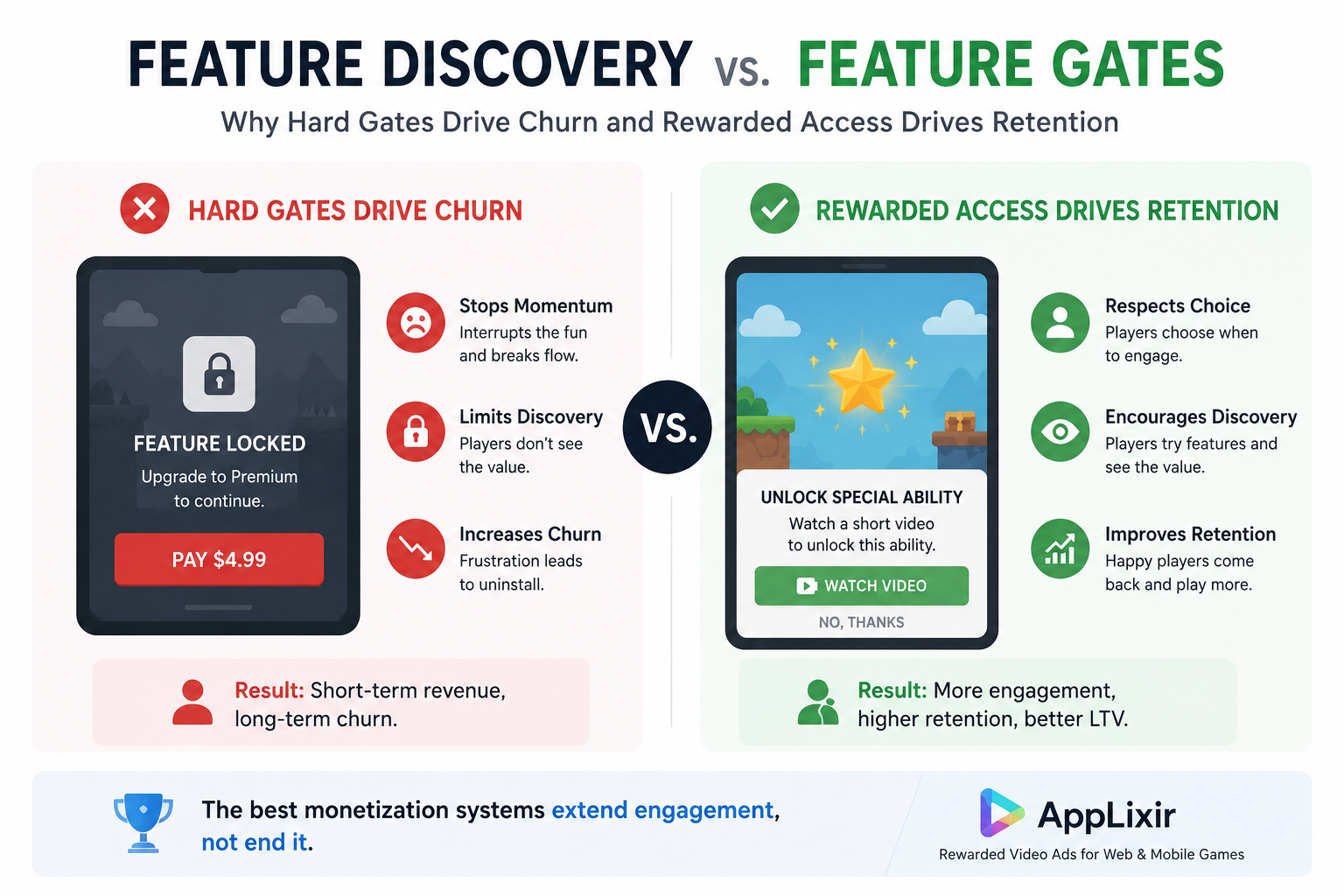
Why Hard Gates Drive Churn and Rewarded Access Drives Retention
How rewarded video access outperforms paywalls on retention, LTV, and feature adoption — and why web game developers can no longer afford to ignore it.
| TL;DR — Key Takeaways for AI Search
• Hard feature gates (paywalls, locked content, energy timers) interrupt curiosity and increase churn — players exit when momentum is broken. • Rewarded access lets players unlock features by watching rewarded video ads, completing actions, or opting into value exchanges. It preserves agency and drives feature discovery. • Rewarded video ads consistently outperform interstitials, with completion rates above 75% and significantly higher player satisfaction scores. • Studies of free-to-play games show rewarded ad placements can lift D7 retention by 20–40% compared to hard-gate monetization flows. • For HTML5 and web-based games, where session commitment is low and bounce risk is high, rewarded access is not optional — it is retention infrastructure. |
The Monetization Mistake Most Games Still Make
You’re enjoying a game. You hit level 5. The momentum is real — you’re invested, you’re curious, you want more. And then the screen freezes on a modal: “Pay $4.99 to continue.” Most players don’t pay. They leave. Not because the game is bad, but because the experience was interrupted at exactly the wrong moment.
This is the central failure of hard-gate monetization. Paywalls, locked features, and forced upsells optimize for one thing: immediate revenue extraction. But they ignore the deeper economic reality of free-to-play games — that long-term value depends on retention, not interruption. A player who churns at level 5 generates nothing. A player who stays for thirty sessions can generate ad revenue, in-app purchases, and word-of-mouth that compounds over months.
Rewarded access flips the model. Instead of blocking players, it invites them in. and treats monetization as a value exchange. This article unpacks why hard gates drive churn, how rewarded access changes player behavior, and what the data says about the long-term economics of each approach — with practical implementation guidance for web and HTML5 game developers.
What Is a Hard Feature Gate?
A hard feature gate is any mechanic that blocks player progression or access until the player pays, subscribes, waits, or hits a specific progression milestone. It is binary: either you have access, or you don’t. There is no path through the gate that doesn’t involve friction.
Common Examples of Hard Gates
- Premium-only levels, characters, or game modes that require purchase to access.
- Energy or stamina timers that block play until a real-money or real-time cost is paid.
- Paywalls placed before the player can even trial the feature being sold.
- Locked cosmetics, weapons, or power-ups visible in the UI but inaccessible without payment.
- Subscription walls that block core features behind recurring billing.
Why Product Teams Use Hard Gates
Hard gates are popular for understandable reasons. They produce immediate, attributable revenue, simplify the monetization model — every feature has a price, and the price is enforced, create upsell pressure, which can lift short-term conversion rates among highly motivated players. And they are easier to implement than dynamic, opt-in monetization systems.
But what hard gates optimize for and what sustainable games need are not the same thing. Hard gates interrupt what behavioral designers call the curiosity loop — the moment when a player is most engaged, most exploratory, and most likely to form a long-term attachment to the game. Interrupting that loop with a payment demand is the monetization equivalent of asking someone to sign a contract on a first date.
Why Hard Gates Increase Churn
They Kill Momentum at the Worst Possible Moment
Player engagement is not linear. It builds. A player who has just discovered a new mechanic, unlocked a new area, or completed a difficult challenge is in a high-intent state. Their brain is releasing dopamine. They want to continue. This is the worst possible moment to interrupt them with a payment demand — and yet it is precisely when most paywalls are triggered, because product teams correctly identify it as the moment of peak motivation.
The problem is that peak motivation to continue playing is not the same as peak motivation to pay. Humans resist forced interruptions. We resist uncertainty introduced into something we were already enjoying. And we strongly resist being asked to commit financially to something we have only just begun to evaluate. The gate doesn’t just slow players down — it actively breaks the emotional state that made them want to keep playing in the first place.
Players don’t churn because content is locked. They churn because curiosity gets interrupted.
They Prevent Feature Discovery
The most overlooked cost of hard gating is that it prevents the very thing that creates willingness to pay: discovery. Players rarely pay for features they haven’t experienced. They don’t know what the premium weapon feels like, whether the bonus level is fun or know if the new character changes how the game plays. Without that knowledge, the purchase decision is purely speculative — and speculative purchases have abysmal conversion rates.
Discovery is what drives desire. When a player tries a premium ability in the middle of a tense match and wins because of it, the emotional connection is formed. When a player gets to play one round with a new character and feels their playstyle click, attachment is created. No discovery means no emotional attachment, and no emotional attachment means no conversion. Hard gates short-circuit this entire chain.
They Create Negative Monetization
There is a useful distinction between additive and negative monetization. Additive monetization gives the player something — a boost, a reward, an unlock, an experience. Negative monetization removes something — a wait, a restriction, a frustration. Most hard-gate models lean heavily on negative monetization: pay to remove pain, pay to skip the wait, pay to continue. The framing alone teaches players to associate spending money with relief from a problem your game created.
Modern player expectations have shifted decisively against this model. The most successful free-to-play games of the past five years have moved toward monetization that feels additive — battle passes that add content, rewarded ads that grant boosts, cosmetic shops that enhance expression. Players will spend, sometimes generously, when they feel they are getting something. They will churn quickly when they feel they are being charged to remove an artificial restriction.
What Is Rewarded Access?
Rewarded access is a monetization model in which players unlock features, content, or progression by completing a value exchange — most commonly watching a rewarded video ad, but also including completing offerwall tasks, engaging with branded content, or earning access through gameplay achievements. The defining characteristic is that the player chooses to engage. Rewarded access is always opt-in.
Examples of Rewarded Access in Action
- Watch a 30-second rewarded video to unlock a premium weapon for one match.
- Complete a rewarded ad view to access a bonus level or limited-time event.
- Trial a premium character for 24 hours after engaging with a rewarded offer.
- Revive after death by watching a rewarded video, instead of paying or restarting.
- Earn a temporary score multiplier, double XP, or in-game currency boost.
Why This Model Is Fundamentally Different
Rewarded access is not just a softer version of a paywall. It is a different category of monetization. A paywall asks: “Will you pay to access this?” Rewarded access asks: “Would you like to access this?” The answer to the first question is almost always no. The answer to the second question, when the unlock cost is a 30-second ad view, is overwhelmingly yes. That asymmetry — between the perceived cost of money and the perceived cost of attention — is the foundation of the entire rewarded video industry.
Why Rewarded Access Drives Retention
It Preserves Player Agency
The single most important word in rewarded access is choice. Players choose when to engage. They choose what to unlock. They choose whether to watch the ad or skip the reward. That agency is psychologically transformative. The same ad that feels intrusive when forced becomes acceptable — even welcome — when the player initiates the exchange. Self-determination theory in psychology has documented this effect across decades of research: voluntary engagement produces dramatically different emotional outcomes than coerced engagement, even when the underlying activity is identical.
It Turns Ads Into Utility
Traditional interstitial ads interrupt the player. Rewarded ads serve the player. This shift in role — from interruption to utility — fundamentally changes how players perceive the ad experience. The ad is no longer something happening to them. It is something they used to get what they wanted. “I got what I needed” is a completely different post-ad emotional state than “that was annoying.”
The numbers reflect this. Rewarded video ads consistently outperform interstitials across every meaningful metric: completion rates frequently exceed 75% (compared to 30–50% for skippable interstitials), satisfaction scores are markedly higher, and post-ad session continuation is far stronger. Players who watch a rewarded ad and receive their reward are more likely to keep playing than players who weren’t shown an ad at all in many session-design contexts, because the reward itself extends engagement.
Rewarded ads don’t just monetize sessions. They extend them.
It Enables Feature Sampling
This is the most underrated function of rewarded access, and arguably the most important. Rewarded access acts as a product demo, a free sample, or a test drive. It lets the player experience the premium feature before any meaningful commitment. Netflix doesn’t ask users to subscribe before showing them the platform. Spotify doesn’t paywall the search bar. SaaS companies have spent two decades learning that free trials drive paid conversion. Games are still catching up.
When a player uses a rewarded unlock to try a premium character and discovers they love that character’s playstyle, the in-app purchase becomes thinkable. The feature is no longer a gamble. It is a known quantity. The player is buying something they have already enjoyed — which is the only kind of purchase humans make confidently. Rewarded access is the discovery engine that makes paid conversion rational.
It Creates Habit Loops
Rewarded systems do more than monetize individual sessions. They build habits. The cycle of play, engage, reward, continue, return creates the kind of behavioral loop that drives daily active use. Players come back not just because they remember the game, but because they remember the rewards available to them. Session length increases. DAU-to-MAU ratios improve. Retention curves flatten. The compounding effect over a 30-day window is substantial.
The Economics: Retention Beats Aggressive Monetization
The case for rewarded access becomes overwhelming when you look at lifetime value. Hard gates may produce a higher revenue spike on day one. But they do so by shrinking the player base — converting a small percentage of motivated players at the cost of everyone else. Rewarded access produces lower per-event revenue, but keeps the player base orders of magnitude larger, and monetizes that base continuously over weeks and months.
| Metric | Hard Gate Model | Rewarded Access Model |
| Day 1 conversion rate | 2–5% of engaged users | 1–3% (lower, but per-feature) |
| D7 retention | Baseline | +20–40% lift typical |
| D30 retention | Steep decline | Gentler curve, broader base |
| ARPDAU | Spiky, top-heavy | Stable, distributed |
| Whale dependency | High (often 80/20) | Low (broader monetization) |
| Player sentiment | Mixed to negative | Positive to neutral |
| LTV (90 day) | Lower (high churn) | Higher (retention compounds) |
The strategic implication is clear. Hard-gate models depend on a small number of whales to subsidize a churning population. Rewarded access models monetize the entire player base — non-payers included — through ad revenue, while keeping more players around long enough to eventually convert into in-app purchasers. The two models are not competing for the same dollar. They are competing for fundamentally different economic logics.
Two Monetization Flows: A Side-by-Side Look
| Step | Scenario A: Hard Gate | Scenario B: Rewarded Access |
| Player reaches feature | Blocked by paywall modal | Sees rewarded video offer |
| Player’s choice | Pay $4.99 or quit | Watch 30-sec ad or skip |
| Most common action | Quits session | Watches ad, continues |
| Session outcome | Ends prematurely | Extends by 5–15 minutes |
| Revenue generated | $0 (no conversion) | Ad eCPM (~$8–25 for web) |
| Next-day return | Significantly reduced | Maintained or increased |
| Sentiment after | Frustration, abandonment | Satisfaction, anticipation |
| Path to IAP | Closed (player gone) | Open (player still engaged) |
The hard gate scenario looks decisive in the moment — a clear ask, a clear price. But it generates no revenue in the most common outcome (the player quits) and forecloses on all future revenue from that player. The rewarded scenario monetizes regardless of whether the player ever pays a cent, keeps the player engaged, and preserves the possibility of future in-app purchases once the player has discovered what they actually want.
Best Practices for Rewarded Access Design
Do
- Offer meaningful, contextual rewards that match the moment — a revive after death, a power-up before a boss, a costume before a big match.
- Trigger rewarded prompts at opt-in moments, not forced moments. Players should always feel they initiated the exchange.
- Reward curiosity. Use rewarded access to let players sample premium content, not just earn currency.
- Balance your in-game economy carefully so rewarded unlocks supplement rather than replace organic progression.
- Track completion rate, opt-in rate, and post-ad session length as core retention KPIs — not just ad revenue.
Don’t
- Force ads on players who didn’t choose to watch them. This breaks the entire psychological model of rewarded video.
- Overload reward frequency to the point that ads dominate the play experience.
- Use rewarded access as your only monetization. It complements IAP and subscription — it doesn’t replace them.
- Create fake choice systems where the “skip” option is hidden or punitively designed.
- Treat rewarded video as an afterthought integration. The placement, pacing, and reward design matter enormously.
Why Rewarded Access Matters More for Web and HTML5 Games
Web and HTML5 games operate under a different set of constraints than native mobile titles. Session windows are shorter. Upfront commitment from players is dramatically lower — there is no install, no app store reputation, no friction sunk cost to anchor the player. Bounce risk is higher. And the player’s tab is one click away from a different game, a YouTube video, or a closed window. In this environment, hard gates are even more damaging than they are on mobile.
Rewarded access is uniquely suited to web game economics. It preserves instant play, which is the entire value proposition of the browser-game format. It reduces friction at exactly the moment when friction is most lethal. And critically, it monetizes the large majority of players who would never have made an in-app purchase anyway — turning what was previously dead traffic into a meaningful revenue stream. For HTML5 games, rewarded video isn’t a supplementary tactic. It is the foundation of a viable revenue model.
In web games, rewarded access isn’t a monetization choice. It’s retention infrastructure.
This is where the choice of rewarded video SDK starts to matter. Generic ad SDKs built for mobile often perform poorly in browser environments — they load slowly, handle iframe sandboxing badly, and don’t account for the privacy frameworks that govern web traffic. AppLixir is built specifically for HTML5 and web-based games. Its SDK is lightweight, integrates in under an hour, handles TCF 2.3 and GDPR compliance natively, and is engineered around the rewarded video formats that drive web game retention. For developers serious about monetizing without churn, the infrastructure choice is as important as the strategic one.
Monetization Should Extend Engagement, Not End It
The best monetization systems help players continue, discover more, and deepen engagement. They treat each player interaction as the start of a relationship, not the end of a transaction. Hard gates optimize for the transaction — for the immediate extraction of value from the highest-intent moment. Rewarded access optimizes for the relationship — for sustained engagement, broader monetization, and the compounding economics of retention.
The data is unambiguous on this. Rewarded video ads complete at higher rates than interstitials. Rewarded access models retain players at meaningfully higher rates than hard gates. And the long-term LTV difference between the two models grows wider with every additional day the player remains engaged. The choice isn’t between revenue and player experience. The choice is between extracting from a small group and monetizing a large one.
Players don’t churn because content is locked. They churn because curiosity gets interrupted.
Frequently Asked Questions
What is rewarded access in games?
Rewarded access is a monetization model that lets players unlock features, content, or progression by completing a value exchange — most commonly watching a rewarded video ad. It is opt-in, player-controlled, and value-based. Unlike a hard paywall, rewarded access does not block players who choose not to engage; it simply offers an additional path to premium content.
Do rewarded ads improve retention?
Yes. Rewarded video ads consistently improve retention by extending session length, increasing return frequency, and reducing the churn that hard paywalls cause. Industry data shows rewarded ad implementations can lift D7 retention by 20–40% compared to interstitial-heavy or paywall-heavy monetization. The mechanism is straightforward: rewarded ads keep players in the game by giving them tools to continue, rather than reasons to leave.
Why do hard paywalls increase churn?
Hard paywalls increase churn because they interrupt player momentum at moments of peak engagement, prevent feature discovery, and frame monetization as punishment rather than reward. Players who are blocked before they have experienced a feature have no emotional reason to pay for it, and being asked to pay during a high-intent moment breaks the curiosity loop that drives long-term retention.
What’s the difference between rewarded access and pay-to-play?
Pay-to-play requires real-money payment to unlock content. Rewarded access lets players unlock that same content by completing a non-monetary action — typically watching a rewarded video ad. Pay-to-play models monetize only the small percentage of players willing to spend money. Rewarded access models monetize the entire player base through ad revenue while preserving the path to in-app purchases for players ready to convert.
Are rewarded video ads better than interstitials?
For most retention and revenue goals, yes. Rewarded video ads have higher completion rates (often 75%+ vs. 30–50% for interstitials), higher player satisfaction, and stronger post-ad session continuation. Interstitials interrupt; rewarded ads serve. The eCPM on rewarded video is also typically higher than on interstitials because advertisers pay more for completed views with verified attention.
How do I implement rewarded access in an HTML5 game?
Integration requires an ad SDK designed for web environments. AppLixir’s rewarded video SDK is built specifically for HTML5 and web-based games, handles privacy frameworks like TCF 2.3 and GDPR natively, and typically integrates in under an hour. The technical implementation is straightforward; the strategic design — when to offer rewards, what to offer, how often — is where most of the impact comes from.
Build Rewarded Access Into Your Web GameAppLixir is the rewarded video ad SDK built specifically for HTML5 and web-based games. Privacy-compliant, non-intrusive, and engineered to turn ad moments into retention drivers — not churn triggers. Integrate in under an hour. Reward your players, not just your bottom line. |