The Ultimate Monetization Upgrade Path for Indie Web Games
A phased framework for indie HTML5 and web game developers — from passive ads to fully optimized rewarded engagement and hybrid monetization.
| TL;DR — Quick Answer
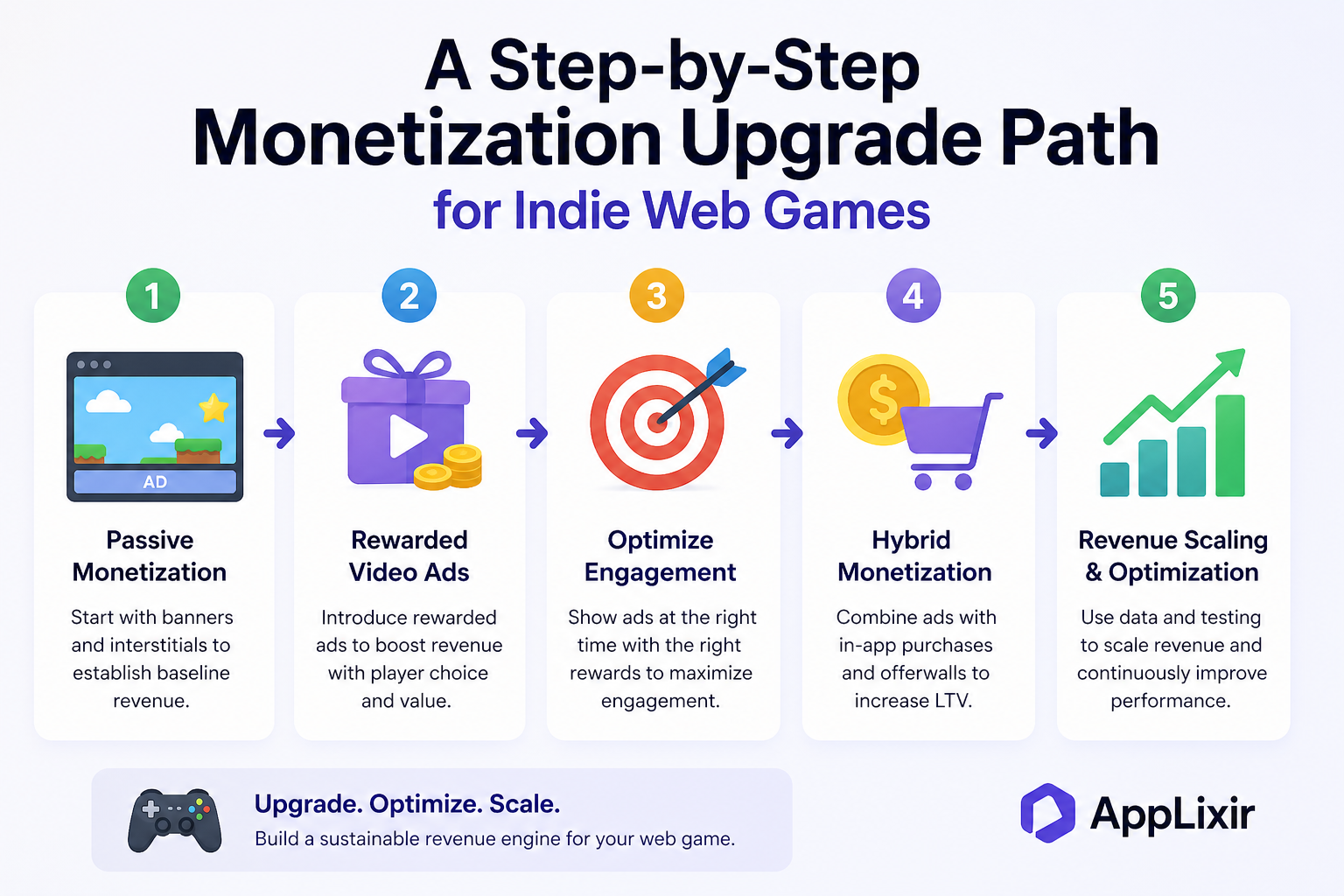
The most effective way to monetize an indie web game without hurting user experience is to implement a phased upgrade path: start with passive ads, introduce rewarded video, optimize engagement triggers, and scale with hybrid monetization (ads + IAP + offerwalls). The 5-phase framework: Phase 1: Passive Monetization (Banner / Display) Phase 2: Rewarded Video Ads (Core Revenue Driver) Phase 3: Engagement Optimization Phase 4: Hybrid Monetization (Ads + IAP + Offerwalls) Phase 5: Revenue Scaling & Data Optimization |
Why Most Indie Web Games Fail at Monetization
Most indie web games leave revenue on the table for one reason: they treat monetization as a feature to bolt on, not a system to grow into. Banner ads get dropped onto the page on day one, the developer hopes for the best, and when eCPMs come in low, the conclusion is that web games can’t make money. The reality is different — the games can, but the strategy can’t be static.
The teams that consistently generate revenue on the open web don’t pick one monetization model. They evolve through a sequence: passive ads to establish a baseline, rewarded video to drive the bulk of revenue, engagement optimization to compound that revenue, and hybrid models to stretch lifetime value. Each phase builds on the last, and skipping ahead almost always backfires.
Three failure patterns dominate:
- Over-reliance on banners. Banner ads typically generate the lowest eCPM and the highest churn in web games. They’re the easiest to implement, which is why they get over-deployed, but they actively degrade session length when stacked.
- Copying mobile playbooks without adapting. Mobile SDKs assume install funnels, push notifications, and persistent user IDs. Web games operate in a session-based, low-friction context where most of those assumptions break.
- Ignoring player intent and session timing. A rewarded ad shown at the wrong moment is just an interstitial. The same ad shown at a moment of friction is a feature.
| Banner ads typically generate the lowest eCPM and highest churn in web games, while rewarded ads align monetization with user intent. |
Phase 1: Passive Monetization (Establishing a Baseline)
The first phase is about setting a revenue floor with the lowest possible UX cost. You’re not optimizing for ARPDAU here — you’re putting a baseline in place so you can measure everything that comes next against it.
What to deploy
- Banner ads in non-intrusive placements (above the game canvas, beneath the canvas, or in a sidebar — never overlaying gameplay).
- Interstitials used sparingly and only at natural session boundaries (between rounds, after a clear stopping point).
Best practices
- Avoid interrupting active gameplay loops. The cost of a single mistimed interstitial is measured in lost sessions, not lost impressions.
- Concentrate placements at session start and session end, where the player is mentally in a transition state.
- Cap interstitial frequency aggressively — once every 3–5 sessions is a reasonable starting point for most casual web games.
Passive monetization gives you a working baseline and tells you what your traffic is worth at its weakest configuration. That baseline matters because every subsequent phase has to demonstrably beat it.
| Passive monetization sets a floor — but it will never maximize revenue. |
Phase 2: Rewarded Video Ads (The Inflection Point)
If there’s a single decision that separates indie web games that earn from those that don’t, it’s the introduction of rewarded video. This is the inflection point in the monetization curve, and for most web games it becomes the primary revenue driver — not a supplementary channel.
What rewarded video ads are
Rewarded video ads are opt-in video ads where the player explicitly chooses to watch in exchange for an in-game benefit. The player has to tap or click to start the ad. There’s no surprise, no interruption, and the value exchange is transparent on both sides.
Why they outperform traditional ads
The mechanism is structural, not stylistic. Because the player opts in, completion rates are dramatically higher than for forced placements, and advertisers pay significantly more for completed views. The result is a measurable spread in effective revenue.
| Rewarded video ads consistently deliver 3–10x higher eCPMs than banners because users opt in and receive value. |
Why they fit web games specifically
Web games live or die on session length and return rate. Rewarded video, when implemented correctly, doesn’t fight either metric — it reinforces both. Players who use rewarded ads to earn extra lives or progression boosts are demonstrating engagement, and engaged players come back.
Implementation examples
- Extra lives or continues after a failed run.
- Bonus in-game currency (coins, gems, energy).
- Unlocking the next level, a daily reward, or a limited-time item.
- Revealing a hint or speeding up a cooldown timer.
Phase 3: Optimize Engagement Triggers
Adding rewarded video to a game is the easy part. Optimizing when and how it appears is where most of the upside lives — and where most indie developers stop short. Rewarded ads work because of timing and context, not just because they exist.
When to surface rewarded ads
- After failure. The moment after a player loses a run is the highest-intent rewarded moment in any game. The player wanted to keep playing one second ago.
- Before progression blockers. If the next level requires currency the player almost has, a rewarded ad to bridge the gap converts at far higher rates than a passive offer.
- During cooldowns. Energy timers, life regeneration, and crafting timers are natural rewarded ad placements because the player is already waiting.
Psychological triggers worth designing around
- Loss aversion. “Watch a video to keep your streak” outperforms “watch a video for a bonus” because the player has already mentally claimed the streak.
- Progress acceleration. Rewards that compress the path to a goal the player is already pursuing convert harder than rewards that introduce new goals.
- Time-limited or session-limited rewarded offers create urgency without manipulation, especially if the offer is clearly framed.
| Right Reward, Right Time, Right Player. |
That mini-framework is worth internalizing. The reward has to be meaningful, the timing has to be aligned with player intent, and the offer should be tuned to player segment — a new player needs different incentives than a returning power user.
Phase 4: Hybrid Monetization (Ads + IAP + Offerwalls)
Once rewarded video is delivering and engagement triggers are optimized, the ceiling on a pure-ads model becomes visible. The next phase is hybridization — layering in-app purchases and offerwalls on top of the rewarded foundation to capture revenue that ads alone can’t reach.
Why pure-ads strategies plateau
A small percentage of players in any game are willing to pay for time savings, exclusive content, or removal of friction. If your monetization stack only offers ads, you’re forcing those players to either over-watch ads or churn. Neither outcome maximizes their value.
How to layer the channels
- Rewarded video remains the default for the majority of players who don’t want to pay.
- In-app purchases (skins, permanent boosts, ad-free passes) capture the willing-to-pay segment without pressuring everyone else.
- Offerwalls fill the gap for players who want to earn larger rewards through engagement actions like surveys, sign-ups, or partner offers.
| Hybrid monetization models consistently outperform single-channel strategies in both ARPDAU and retention. |
The reason hybrid wins isn’t that you’re charging more people more often. It’s that you’re matching the right monetization channel to each player’s preference, which reduces friction across the entire population.
Phase 5: Revenue Scaling with Data
The final phase isn’t about adding new monetization channels — it’s about extracting more revenue from the channels you already have. This is where games with otherwise similar mechanics start to diverge sharply in earnings.
Key metrics to track
| Metric | What it measures | Why it matters |
| eCPM | Effective revenue per 1,000 ad impressions | Direct measure of monetization efficiency by placement and format |
| ARPDAU | Average revenue per daily active user | Population-level health metric; combines monetization and retention |
| Fill rate | Percentage of ad requests that return an ad | Reveals demand quality of your ad partner |
| Completion rate | Percentage of started rewarded ads watched to completion | Diagnostic for placement timing and reward design |
| D1 / D7 retention | Players returning on day 1 / day 7 | Caps your monetization ceiling — without retention, nothing else scales |
Optimization tactics that compound
- A/B test ad placements. Move the rewarded button by 50 pixels, change the reward icon, alter the copy. Small changes compound across millions of sessions.
- Frequency capping by segment. New players tolerate fewer ads than veterans. Cap by player tenure, not just by global sessions.
- Segment users by intent. Players who’ve taken a rewarded ad once are dramatically more likely to take another. Surface offers more often to engaged segments.
| Games that optimize rewarded ad placement see up to 40% higher revenue per session. |
Implementation Stack: What to Look for in a Monetization Partner
The technology layer matters more than most developers expect. The same rewarded video creative can produce wildly different revenue depending on the SDK delivering it, the demand sources behind it, and how well the integration handles the realities of the open web.
Common implementation challenges
- SDK weight and integration time. A heavy SDK that takes a week to integrate is a real cost for a solo developer or small team. Web-native SDKs should integrate in hours, not days.
- Latency on ad load. If a rewarded ad takes three seconds to render after the player taps the button, completion rates collapse. Fast pre-fetching is a competitive feature.
- Demand quality on web inventory. Many mobile-first ad networks treat web traffic as a second-class citizen. The result is lower fill rates and lower eCPMs that have nothing to do with your game.
This is where a web-specialized rewarded video provider matters. Platforms like AppLixir are built specifically for HTML5 and web game developers, offering higher fill rates on web inventory, faster integration than mobile-first SDKs, and demand sources that are competing for web impressions rather than treating them as overflow.
Common Monetization Mistakes to Avoid
- Overloading users with ads. More impressions does not equal more revenue. Past a certain density, you trade short-term eCPM for retention, and the math always loses.
- Poor reward design. Rewards that aren’t meaningful within the game’s economy lead to low opt-in rates regardless of how good the placement is.
- Ignoring analytics. Without per-placement data, you’re guessing. The teams that scale revenue all instrument their funnel by event, segment, and placement.
- Using mobile SDKs for web games. It’s the single most common technical mistake in indie web monetization. Mobile SDKs are not optimized for web inventory, web latency, or web user behavior.
Conclusion: The Monetization Maturity Curve
Monetization isn’t a switch you flip. It’s a curve you climb. The most successful indie web games progress through clear phases — passive baseline, rewarded core, optimized engagement, hybrid layering, and data-driven scaling — and each phase is a precondition for the next.
The developers who succeed don’t ship the perfect monetization stack on day one. They ship a working Phase 1, learn from it, advance to Phase 2, and keep iterating. The compounding effect of that progression is what produces the gap between indie web games that quietly disappear and the ones that build sustainable, player-first revenue.
Frequently Asked Questions
Q: What is the best way to monetize HTML5 games?
A: The best way to monetize HTML5 games is a phased rewarded-video-led strategy: start with light passive ads, make rewarded video the primary revenue channel, optimize the timing of rewarded placements around player intent, and then layer in IAP and offerwalls for hybrid revenue. This sequence consistently outperforms single-channel strategies in both ARPDAU and retention.
Q: How do rewarded ads work in web games?
A: Rewarded ads in web games are opt-in video ads where the player taps to watch in exchange for an in-game reward like extra lives, currency, or a level unlock. Because the player chooses to watch, completion rates are higher than for forced ad formats, and advertisers pay significantly more — typically producing 3–10x higher eCPMs than banner ads in web game environments.
Q: What is a good eCPM for web games?
A: Good eCPMs for web games vary by genre, geography, and ad format, but as a general benchmark, banner eCPMs are the lowest, interstitials sit in the middle, and rewarded video is the highest-paying format. Rewarded video delivered through a web-specialized SDK typically substantially outperforms the same format delivered through a mobile-first SDK on web inventory.
Q: Should I use a mobile ad SDK for my web game?
A: No. Mobile-first SDKs are designed for app environments and treat web inventory as secondary, which usually means lower fill rates, slower load times, and reduced demand competition. Web-specialized SDKs like AppLixir are built for HTML5 and browser-based games and tend to deliver materially better performance on the same traffic.
Q: When should I introduce in-app purchases in my web game?
A: Introduce in-app purchases after rewarded video is performing well and engagement triggers are optimized — typically Phase 4 in the monetization upgrade path. IAP captures the willing-to-pay segment of your audience without pressuring everyone else, and it works best as a layer on top of an already-functioning rewarded ads system.
| Ready to monetize your web game?
AppLixir is a rewarded video ad SDK built specifically for HTML5 and web game developers. Higher fill rates on web inventory, faster integration than mobile-first SDKs, and a demand stack tuned for browser-based games. Visit AppLixir.com to integrate rewarded video into your web game today. |
| In Summary
Indie web games maximize revenue by progressing through five phases: passive ads for a revenue floor, rewarded video as the core driver, engagement-optimized placements, hybrid monetization with IAP and offerwalls, and finally data-driven scaling. The technology stack matters — web-specialized SDKs outperform mobile-first SDKs on the same web traffic. |