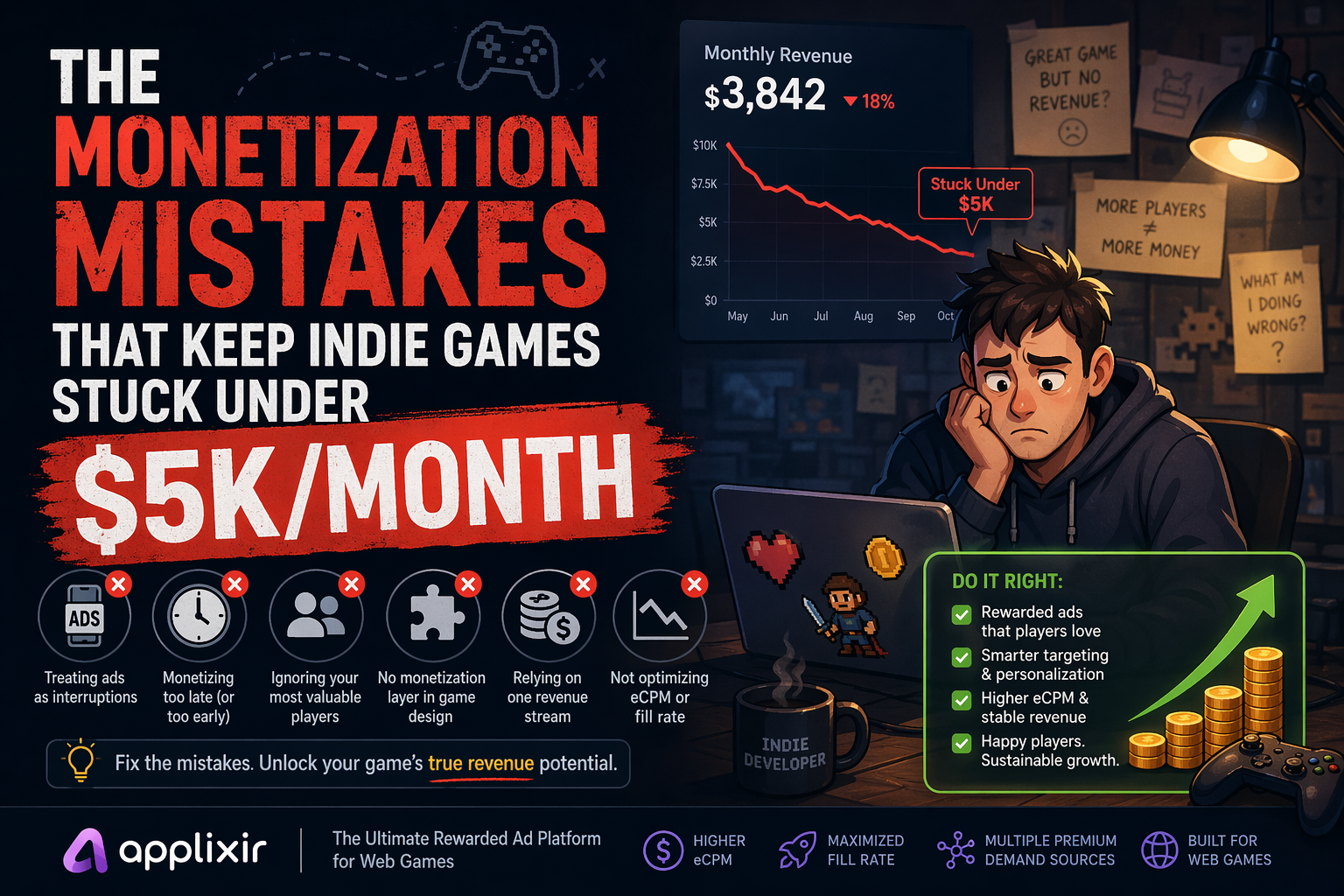
The Monetization Mistakes That Keep Indie Games Stuck Under $5K/Month
Why most web and HTML5 games plateau — and the six fixes that separate $5K games from $50K games.
| TL;DR — Key Takeaways |
| • Most indie games don’t fail because of gameplay — they fail because of monetization timing, format, and player psychology misalignment.
• Games under $5K/month typically under-monetize their most engaged 10% of users. • Opt-in rewarded video ads can generate 3–10x higher engagement than forced interstitials. • The difference between a $5K game and a $50K game is not traffic — it’s how intelligently you monetize player intent. • Six recurring mistakes keep indie games stuck: forced ads, bad timing, ignoring power users, no monetization layer in design, single revenue streams, and no eCPM/fill-rate optimization. |
The Real Reason Your Game Is Stuck
Most indie games don’t fail because of gameplay. They fail because of monetization — specifically, the timing, format, and psychological alignment of how the game asks players for attention and money. Great gameplay with bad monetization produces a game that gets played but never earns. Average gameplay with smart monetization produces a game that quietly prints money for years.
This post breaks down the specific, recurring mistakes that keep HTML5 and web games stuck under $5K per month, backed by the monetization patterns and benchmarks we see across the industry. Every mistake comes with a fix you can implement this week — not a theoretical framework, but concrete changes to ad format, placement, and player segmentation.
Section 1: The $5K Ceiling Problem
The $5K/month mark is a meaningful threshold. It’s the point where a game has proven it can attract and retain players, generate some ad revenue, and justify a developer’s continued attention. But it’s also the most common plateau in indie web gaming — the place where thousands of games quietly park, generating enough income to feel validated but never enough to scale into a real business.
Games stuck at this ceiling share a distinct diagnostic fingerprint. ARPDAU (average revenue per daily active user) sits well below $0.05. Day-1 retention hovers in the 20–30% range when healthy games clear 40%. Day-7 retention collapses below 10%. Rewarded ad opt-in rates, when measured at all, fall under 20% — a clear sign that monetization isn’t integrated into the core loop.
Games under $5K/month typically under-monetize their most engaged 10% of users. The ceiling is a design problem, not a traffic problem.
The critical insight: doubling traffic to a game with these metrics doesn’t double revenue. It produces marginal gains that get eaten by acquisition costs. The only path off the $5K plateau is fixing the monetization mechanics themselves — how, when, and to whom the game presents revenue opportunities.
Mistake #1: Treating Ads as Interruptions Instead of Rewards
The Problem
The default indie-dev instinct is to treat ads as a tax on the player — an unpleasant thing that must happen so the developer gets paid. This leads to interstitial spam: full-screen ads jammed between levels, after menus, on app resume, and anywhere else a developer can find a frame to fill. The player has no agency. The ad feels like punishment for playing.
The downstream effects are predictable and severe. Session length drops as players churn out faster. Players develop ad blindness, tuning out the exact moments the developer is trying to monetize. Retention curves steepen. And because forced ads deliver low engagement signals back to the ad exchange, eCPM declines over time — a feedback loop that punishes exactly the developers who rely most on forced formats.
The Fix
Shift to rewarded video ads as the primary revenue format. Rewarded ads are opt-in: the player chooses to watch in exchange for a tangible in-game benefit — an extra life, doubled currency, an unlocked level, a skipped timer. The shift from forced to opt-in changes the entire psychology of the ad placement. Players are no longer being interrupted; they’re being offered a deal.
The mechanics reward this alignment. Opt-in viewers watch more, click more, and convert more — which feeds higher engagement signals back to ad networks, which raises eCPM. Rewarded formats outperform traditional formats in web games precisely because they align with player intent rather than fighting it.
Opt-in rewarded ads can generate 3–10x higher engagement than forced interstitials. The player becomes a willing participant in the monetization loop rather than a hostage to it.
Mistake #2: Monetizing Too Late (or Too Early)
The Problem
Timing is the second-most-common failure. Some developers show ads before the player has experienced any value — the session hasn’t hooked them yet, and the first ad becomes the reason they close the tab. Others wait so long to introduce monetization that engaged players pass through the entire session without ever encountering a revenue opportunity.
Both failure modes produce the same symptom: an ARPDAU number that’s disconnected from the game’s actual engagement. The game has players. It just isn’t asking them for anything at the moments that would work.
The Fix: Value Moment Monetization
Map the specific emotional moments where a rewarded ad offer becomes genuinely useful to the player. These “value moments” are not random — they’re predictable structural beats in almost every game loop:
- First reward: After the player earns their first meaningful win, offer a rewarded ad to double or extend it. They’ve just experienced success and want more of it.
- First failure: When the player dies, runs out of moves, or hits a fail state, offer a rewarded ad for a continue. Motivation is at its peak.
- First progression bottleneck: When progression slows — a hard level, a long wait timer, a scarce resource — offer a rewarded ad as the relief valve.
The principle: show the ad when the player wants help, not when the developer wants impressions. This single reframe moves rewarded ad opt-in rates from the 10–20% range into the 40–60% range in well-tuned games.
Mistake #3: Ignoring Your Most Valuable Players
The Problem
Most indie games are monetized uniformly. Every player sees the same ad placements, the same frequency, the same offers. This treats a 30-second casual visitor and a 2-hour daily engaged player as the same user — which they aren’t, economically or psychologically.
The top 5–10% of players in almost every game drive the majority of ad revenue. They open more sessions, play longer, trigger more value moments, and opt in at higher rates. A uniform monetization strategy means the game gives these players exactly the same number of revenue opportunities as the casual player who bounces in ninety seconds.
The Fix
Segment users by engagement depth and tune monetization density accordingly. Casual players should see minimal, unobtrusive ad touchpoints — the goal with them is retention, not immediate revenue. High-intent players, identified by session count, session length, or progression speed, should see more rewarded offers, more generous reward ratios, and more frequent optional monetization loops.
Your highest-engagement users are also your highest ad-converting users. Treating them identically to casual visitors leaves the majority of your revenue on the table.
Mistake #4: No Monetization Layer in Game Design
The Problem
Monetization added after a game is built almost always feels tacked-on. The ad placements land in awkward spots because the game’s loop wasn’t designed with ad breaks in mind. The rewards don’t feel meaningful because the economy wasn’t engineered to make ad rewards structurally valuable. Conversion stays low no matter how many optimization passes the developer runs.
The Fix
Design monetization loops as first-class elements of the game, not afterthoughts. The canonical structure:
Reward → Progress → Friction → Reward Ad
The player earns a reward. That reward accelerates progress. Progress hits a natural friction point — a harder level, a resource shortage, a timer. The rewarded ad offers to resolve the friction. The loop then restarts. When monetization is baked into the core economy this way, ad rewards aren’t intrusions; they’re part of the pacing.
Classic loops that work in web games:
- Extra life: Watch an ad to continue after death. Works in any game with fail states.
- Double coins: Watch an ad at level end to double the currency earned. Works in any progression economy.
- Skip wait timers: Watch an ad to bypass a cooldown or energy timer. Works in any game with pacing gates.
- Bonus chest / reroll: Watch an ad for an extra random reward. Works in any game with loot.
Mistake #5: Relying on a Single Revenue Stream
The Problem
Pure-ad games are vulnerable to eCPM volatility, seasonal ad market fluctuations, and demand-side shocks. Pure-IAP games are vulnerable to conversion cliffs — typically fewer than 3% of players ever pay, which caps total revenue hard. Either approach in isolation leaves the game exposed to the weaknesses of its single channel.
The Fix
Build hybrid monetization: rewarded ads as the high-volume baseline, with optional IAP layered on top for players who want to skip ads entirely, purchase exclusive cosmetics, or accelerate progression beyond what ads offer. The two channels reinforce each other. Ad revenue captures value from the 97% who will never pay. IAP captures disproportionate value from the 3% who will — including an “ad-free” tier that often converts better than cosmetic IAP in casual games.
Hybrid structures also stabilize revenue. When ad markets dip, IAP holds steady. When IAP conversion softens, ad volume absorbs the slack. The combined floor is materially higher and more predictable than either channel alone.
Mistake #6: Not Optimizing eCPM or Fill Rate
The Problem
A surprising number of indie developers don’t track their core ad performance metrics at all. They know their total revenue. They don’t know their effective CPM, their fill rate, or their engagement rate — which means they have no idea which of those levers is underperforming, and therefore no idea what to fix.
The Key Metrics
- eCPM (effective cost per mille): Revenue per 1,000 impressions. The single most important monetization KPI. Low eCPM usually signals weak demand competition or poor engagement signals.
- Fill rate: The percentage of ad requests that return an ad. Low fill rate means lost revenue on players who are ready to watch.
- Engagement / completion rate: The percentage of shown ads that are watched to completion. Directly tied to payout and to future eCPM via feedback loops.
The Fix
Use a rewarded ad platform that actively optimizes these three metrics — not just a basic SDK that serves whatever fills. The difference between default ad serving and optimized ad serving can be 2–3x eCPM on the same traffic, purely through better demand-source routing, auction pressure, and player-level segmentation.

AppLixir is built specifically for this layer of the web monetization stack: rewarded video optimization for HTML5 and web games, with the demand competition and engagement telemetry most generic ad networks don’t prioritize for browser-based traffic.
What a $5K → $50K Game Does Differently
The scaling gap between a stuck indie game and a growth-stage indie game comes down to a handful of repeatable choices. The table below summarizes the differences as we see them across real game portfolios:
| Dimension | Under $5K/month | Scaling Games ($50K+) |
| Ad format | Forced interstitials | Rewarded video primary |
| Placement strategy | Static, fixed timing | Dynamic triggers tied to value moments |
| User treatment | Uniform monetization | Player-aware segmentation |
| Design integration | Ads added post-build | Monetization loops in core design |
| Revenue structure | Single channel (ads or IAP) | Hybrid: rewarded ads + IAP |
| Optimization cadence | Set-and-forget or late fixes | Continuous testing on eCPM, fill, opt-in |
| Metric visibility | Total revenue only | eCPM, fill rate, opt-in, ARPDAU tracked weekly |
Implementation Blueprint
If your game is stuck under the $5K ceiling, the following sequence will move it faster than any traffic campaign. Work through the steps in order — each one compounds with the next.
- Identify your top engagement moments. Map the five specific points in your loop where players feel reward, frustration, or progression pressure. These are your future rewarded ad placements.
- Replace forced interstitials with rewarded ads. Remove every non-opt-in ad placement unless it demonstrably outperforms. Rewarded becomes the primary format.
- Add two to three reward loops. Implement at minimum: extra life on death, double coins at level end, and one timer-skip or bonus-chest mechanic tied to your specific economy.
- Segment your users. Split at least two tiers — casual vs. engaged — using session count or total playtime. Offer more rewarded opportunities to the engaged tier.
- Track metrics weekly. eCPM, fill rate, opt-in rate, ARPDAU, D1 and D7 retention. No optimization without instrumentation.
FAQ: Monetizing Web and HTML5 Games
What is the best way to monetize HTML5 games?
The most reliable structure for HTML5 and web games is a hybrid built on rewarded video ads as the high-volume baseline, combined with optional IAP for progression acceleration or ad-free tiers. Rewarded ads convert the broadest slice of players because they’re opt-in and align with moments of in-game motivation — continues, doubled rewards, timer skips. IAP captures disproportionate value from the small percentage who pay. Forced interstitials should be used sparingly or not at all in web contexts where player exit cost is near-zero.
Are rewarded ads better than interstitial ads?
For almost every web and HTML5 game, yes. Rewarded ads are opt-in, which drives higher completion rates, higher engagement signals back to ad exchanges, and materially higher eCPM over time. Interstitials produce short-term impressions but damage retention, which compounds negatively across the full player lifetime. In measured comparisons, rewarded ads typically outperform forced interstitials by 3–10x on engagement metrics and by a significant margin on long-run revenue per user.
How much can rewarded video ads earn in a web game?
Earnings depend on eCPM, opt-in rate, and the number of rewarded impressions per daily active user. A well-tuned web game with rewarded ads integrated into core loops typically sees ARPDAU between $0.05 and $0.25 from ads alone, with top-performing geographies and verticals pushing higher. Scaling from $5K to $50K per month is rarely about tripling traffic — it’s about tripling rewarded impressions per user through better placement, better segmentation, and higher opt-in rates.
When should a rewarded ad be shown?
Show rewarded ads at value moments — points where the player wants help. The three canonical triggers are: after the first meaningful reward (offer to double it), at the first fail state (offer a continue), and at the first progression bottleneck (offer to resolve the friction). Random or time-based rewarded offers convert far worse than offers tied to the player’s current in-game emotion.
Final Takeaway
The plateau isn’t about your gameplay. It isn’t about your traffic. It’s about whether your monetization is designed around player psychology or bolted on against it. Every game that breaks through the $5K ceiling does so by answering the same question better than its competitors: at this exact moment, does the player want what I’m offering them?
The difference between a $5K game and a $50K game isn’t traffic — it’s how intelligently you monetize player intent.
AppLixir is built for exactly this layer: rewarded video monetization engineered for HTML5 and web games, with the demand competition, engagement telemetry, and player-aware optimization that turn browser traffic into meaningful revenue. If your game is stuck under the ceiling, the integration takes under an hour — and the metrics start moving the same week.
| Ready to break the $5K ceiling?
Integrate AppLixir’s rewarded video SDK in under an hour and start capturing the revenue your current monetization is leaving behind. Built for HTML5, WebGL, and browser-based games — with eCPM optimization, fill-rate engineering, and player-aware serving baked in. |