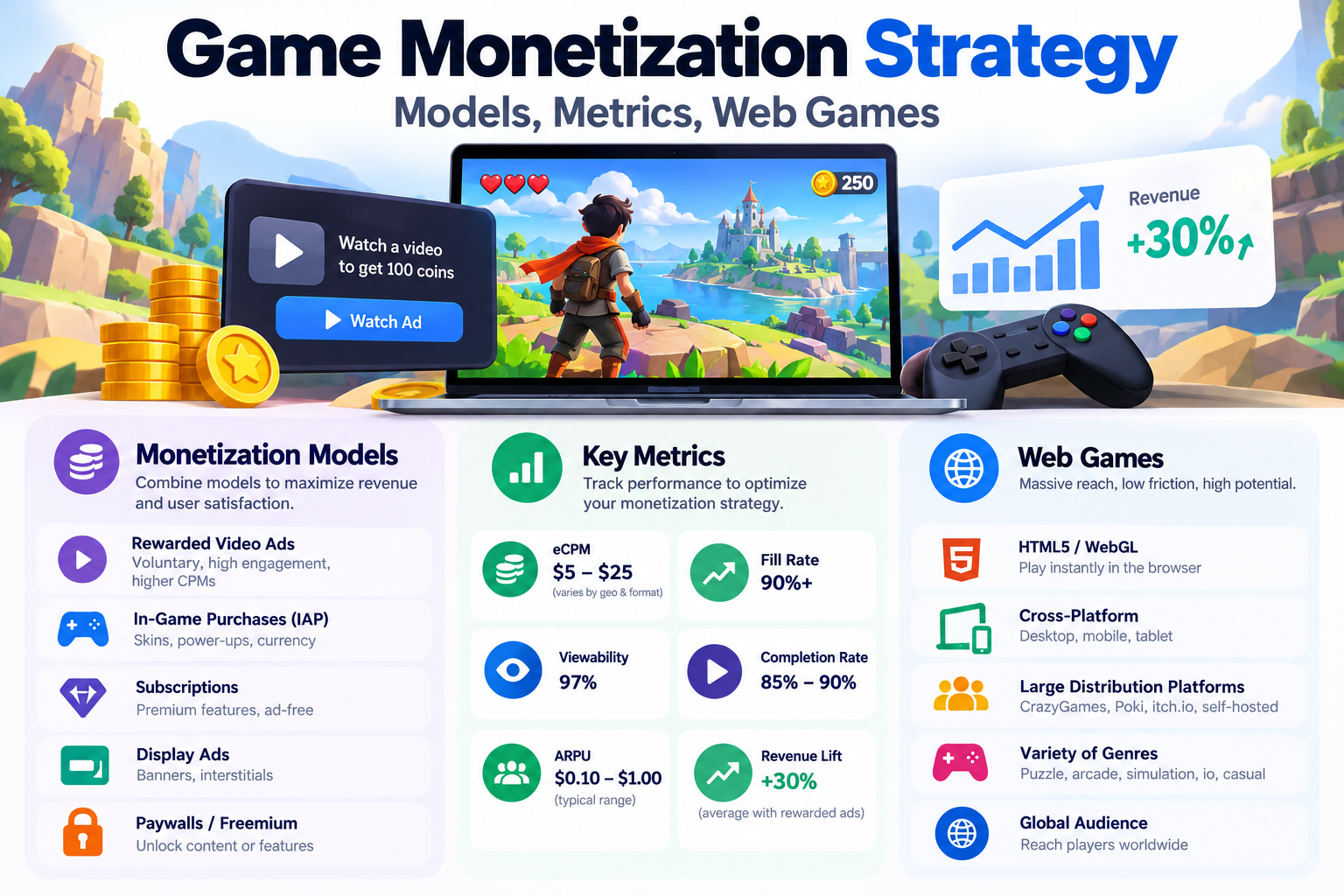
Game Monetization: Models, Strategy and Web Game Revenue
TL;DR
- Game monetization is the practice of converting play into revenue through advertising, in-app purchases, subscriptions, or an upfront price. In free-to-play, roughly 2% of players ever make a purchase, so advertising is the only model that reaches the other ~98%.
- There are five working game monetization models: in-app advertising, in-app purchases, subscriptions and battle passes, premium (paid) games, and hybrid. Hybrid is the default for successful free-to-play titles.
- For browser and HTML5 games, rewarded video is the right default format: it is opt-in, it does not interrupt play, and AppLixir delivers $4+ CPM on web rewarded video against roughly $0.50–$2 for typical web display.
- Mobile ad networks — Unity Ads, AdMob, AppLovin, ironSource — do not serve browser traffic. Poki, CrazyGames and similar portals are distribution channels that sit alongside a web ad network, not substitutes for one.
- Judge every monetization change on eCPM, ARPDAU and Day-7 retention together. A change that lifts eCPM while cutting retention is a loss, not a win.
Most game monetization arguments are really arguments about who pays. Once you know how little of a free-to-play audience ever opens a wallet, model selection stops being philosophical and becomes arithmetic. What follows is the full picture: the models, the formats, the genre fit, the metrics, and a clear position on what browser-based games should run by default.
What is game monetization?
Game monetization is the process of generating revenue from a game — through advertising, selling virtual goods and consumables, recurring subscriptions, or a one-time purchase price. The goal is to cover development and operating costs and produce profit without degrading the experience that brought players in.
Game monetization is a design decision, not a post-launch bolt-on. The moment you decide that extra lives exist, that a level has a fail state, or that soft currency can be earned, you have made a monetization decision. Studios that plan revenue during development build it into pacing. Studios that add it afterwards usually end up interrupting the moments players care about most.
The history is short and it points one way. Arcade cabinets charged per play. Cartridges and discs charged once, at release. Shareware introduced try-before-you-buy. Online multiplayer added monthly subscriptions in the 1990s. Digital storefronts then collapsed distribution costs and free-to-play arrived with microtransactions, and later rewarded video. The structural change is the shift from release-spike revenue to recurring revenue: a cartridge earned once, a live free-to-play game earns every day it retains players.
The five game monetization models
There are five game monetization models in practical use, and nearly every commercial game is one of them or a blend of two.
- In-app advertising. Revenue per impression, paid by advertisers rather than players. Covers rewarded video, interstitials, display banners and pre-rolls. The only model that monetizes the ~98% of free-to-play players who never spend.
- In-app purchases (IAP). Consumables, hard currency, cosmetics and permanent upgrades. High revenue per paying user, tiny share of payers, and on the web it carries checkout friction that mobile app stores remove.
- Subscriptions and battle passes. Recurring revenue for ad removal, premium currency drips, or a season of unlockables. Works where the game has a content cadence to sell against.
- Premium (paid) games. One upfront price, no in-game economy required. Viable on Steam and consoles; essentially unworkable for a browser game that players reach by clicking a link.
- Hybrid. Advertising plus IAP, usually with ad-removal or a battle pass layered on top. This is the default for successful free-to-play titles, because the two revenue streams reach different people.
Hybrid is not a hedge, it is a segmentation strategy. Spenders buy; non-spenders watch. The design problem is making sure the two do not cannibalise each other — see the detail in hybrid monetization models for free-to-play games.
Which game monetization models actually work on the web?
On the web, the working combination is rewarded video as the revenue base, with in-app purchases as an optional second layer for the small minority who will enter payment details in a browser. Premium pricing does not work for browser games, and subscriptions only work once a game has a known, returning audience.
The reason is format economics. Typical web display inventory pays roughly $0.50–$2 CPM. AppLixir delivers $4+ CPM on web rewarded video, because a completed, opt-in video view is worth far more to an advertiser than a banner in a sidebar. The gap between those two numbers is the whole argument for building a reward moment into the loop rather than selling more banner space. The mechanics are broken down in how much rewarded video ads pay on web games.
A rewarded video ad is an opt-in video the player chooses to watch in exchange for an in-game benefit — extra lives, currency, a continue, a doubled reward. The player initiates it, which is why it does not carry the retention cost that forced interstitials do.
When rewarded video does not fit
Rewarded video needs something to reward. It fits badly in three cases. First, games with no scarcity in the loop: if nothing is limited — no lives, no currency, no cooldown, no fail state — there is nothing a reward can meaningfully unlock, and the offer reads as a beg. Second, strictly linear narrative games where the only thing an ad could buy is skipping your own content. Third, very small audiences: AppLixir’s publisher threshold is 5,000 daily active users, below which programmatic demand does not fill consistently enough to be worth the integration.
In those cases the honest answer is a different model — IAP for cosmetics, a paid build on a storefront, or direct sponsorship — rather than forcing an ad placement the design cannot support.
Game monetization strategy: choosing by audience and genre
A game monetization strategy starts with two questions: who is playing, and what is scarce in the loop. The first determines willingness to pay; the second determines what an ad can be exchanged for. Everything else — placement, cap, reward size — follows from those answers.
Design the economy before you design the offers. A game economy that is too generous leaves nothing worth paying or watching for; one that is too tight makes players feel the game cannot be played without spending. The balance point is where a rewarded offer is clearly attractive but visibly optional. Monetization-centred design — building the mechanics around the revenue hooks first — tends to produce games that convert well in week one and retain badly by week four, which is the worst possible outcome for a model whose revenue depends on return visits.
Idle and incremental games
Idle games suit rewarded video better than almost any other genre, because the core loop already contains the reward: more resources, faster progress, doubled offline earnings. Most genres have to manufacture a moment of need. Idle games have one at every return visit.
- Offline-earnings doubler. 2x or more on resources earned while away, shown at the moment of return when the reward is largest and most visible.
- Timed production boost. Faster output for a set period. Stacks naturally with active play and the value is easy to read.
- Time skip. Several hours of production instantly — solves a real wait without selling the game’s pacing away.
- Prestige or reset bonus. Extra currency at a decision point the player is already weighing.
- Free premium currency. Useful as a once-daily offer, weak if repeated.
Size idle rewards relative to the player’s current income, never as fixed amounts. A fixed reward that matters in hour one is worthless by day ten. And because idle players return many times a day, cap rewarded offers per day as well as per session.
Casual, puzzle, and IO games
Puzzle and casual games monetize on the fail state: a continue, an extra move, a hint, a second chance at a lost run. These are the highest-intent rewarded moments in any genre, because the player has already invested the session and the alternative is losing it. IO and multiplayer web games have shorter, more repetitive sessions, so the reward usually sits between rounds — a cosmetic unlock, a respawn boost, a daily chest — rather than mid-match, where it would break the pacing for everyone else in the lobby.
Web game monetization vs mobile game monetization
Web game monetization and mobile game monetization share formats but not infrastructure. The clearest practical difference: the large mobile ad networks do not serve browser traffic at all, so a web game cannot simply reuse a mobile monetization stack.
| Dimension | Mobile game monetization | Web game monetization |
|---|---|---|
| Ad supply | Unity Ads, AdMob, AppLovin, ironSource via native SDKs | Web-native rewarded providers such as AppLixir; mobile networks do not serve web |
| Rewarded CPM | Varies by geo and platform | $4+ CPM on AppLixir web rewarded video vs ~$0.50–$2 for typical web display |
| Purchase flow | Store billing, one tap, card already on file | Browser checkout, higher friction, lower IAP conversion |
| Distribution | App stores, paid UA | Portals such as Poki and CrazyGames, plus owned sites and embeds |
| Install barrier | Download required before first session | Click and play; sessions start instantly |
| Consent | Platform ATT / consent frameworks | TCF 2.4 / GDPR, handled in AppLixir via Didomi |
Two consequences follow. First, a WebGL build does not inherit your mobile ad stack — the detail is in Unity rewarded ads and AdMob rewarded ads on WebGL games. Second, because browser IAP converts worse than store IAP, the advertising share of a web game’s revenue is structurally larger than the same game’s on mobile.
Distribution portals sit alongside this, not against it. Poki, CrazyGames and similar platforms bring players and handle their own placement economics on their domains. AppLixir monetizes the traffic you own — your site, your embeds, your own portal pages — with rewarded video. Publishers run both, and the two revenue lines are additive.
What content publishers can borrow from game monetization
Content sites can use the same game monetization mechanics, because the exchange is the same: the reader gives attention, and gets something concrete in return. The transferable models are rewarded video, branded content, display advertising, subscriptions and merchandising.
- Rewarded video for content. A reader watches an opt-in video to unlock an article, a download, a premium tool, or an ad-free session. It pays materially more than the display unit it replaces — see monetizing a website with rewarded video ads.
- Branded content. Sponsored articles and interactive features give advertisers targeted exposure, and work for both games and content sites.
- Display advertising. Still the baseline, but immersive formats such as takeovers and interstitials buy attention at a retention cost that needs measuring.
- Subscriptions and merchandising. Both depend on audience identity. Games prove the point: fans buy merchandise from properties they feel ownership over, and content brands with that kind of loyalty can do the same.
The metrics that prove a game monetization strategy is working
Three numbers decide whether a game monetization change was a good one: eCPM, ARPDAU and Day-7 retention. Read individually, each one will lie to you. Read together, they are hard to argue with.
- eCPM — effective revenue per thousand impressions, the price of your inventory. It tells you what the market pays, not how many impressions you generated.
- ARPDAU — average revenue per daily active user, across ads and purchases combined. This is the number that moves when placement design improves. ARPDAU: meaning, formula and how to improve it covers the levers.
- Day-7 retention — the brake. A placement that lifts ARPDAU 15% while dropping D7 is destroying lifetime value faster than it is adding daily revenue.
Two supporting numbers are worth watching: rewarded opt-in rate, which tells you whether the offer is attractive and well-placed, and completion rate, which tells you whether the reward is worth finishing for. If opt-in is high and completion is low, the reward is too small for the time asked. [DATA NEEDED: AppLixir median opt-in and completion benchmarks by genre.]
Cap frequency deliberately. Per-session and per-day caps protect the reward’s perceived value and stop heavy users from flattening your eCPM with low-value repeat impressions. For large studios, the practical route to adding rewarded ads without hurting retention is to ship the placement to a traffic slice first and compare D7 against a holdout before rolling it out.
How to add rewarded video to a web game
AppLixir is a programmatic rewarded video platform built for web games and content publishers, serving 100M+ monthly impressions. Integration is an HTML5/JavaScript SDK that runs in the browser, with TCF 2.4 and GDPR consent handled through Didomi, and a 5,000 DAU minimum for publishers.
The pattern is: decide the reward moment in your loop, add a container element, call the player, and grant the reward only on a completed view.
initializeAndOpenPlayer({
  apiKey: "YOUR_API_KEY",
  injectionElementId: "applixir-ad-container",
  adStatusCallbackFn: (status) => {
    if (status.type === "complete") grantReward(); // only a completed ad earns the reward
  },
});
Granting on completion only is the single most important rule: it is what keeps advertiser value intact and reward abuse out of your economy. Full setup details, options and engine-specific guidance live in the AppLixir documentation, and a worked example is in how to add rewarded video ads to an HTML5 game.
FAQ
What is the best game monetization model for a web game?
For most browser games the best model is hybrid, with rewarded video as the revenue base and in-app purchases as a secondary layer. Rewarded video reaches the ~98% of free-to-play players who never pay, and it is opt-in, so it does not carry the retention cost of forced interstitials. Premium pricing does not work for games players reach by clicking a link, and subscriptions only make sense once a title has a proven returning audience.
Do Unity Ads or AdMob work for WebGL and browser games?
No. Unity Ads, AdMob, AppLovin and ironSource are mobile ad networks that serve native app inventory through native SDKs, and they do not serve browser traffic. A Unity game exported to WebGL therefore cannot reuse its mobile ad stack and needs a web-native rewarded provider such as AppLixir. This is the most common cause of a WebGL build shipping with no monetization at all.
How much do rewarded video ads pay on web games?
AppLixir delivers $4+ CPM on web rewarded video, compared with roughly $0.50–$2 CPM for typical web display inventory. Actual revenue depends on geography mix, opt-in rate and how many rewarded impressions each daily active user generates, so a game with a strong reward moment can earn several times what the same traffic would earn from banners. Multiply your expected rewarded impressions per DAU by the CPM to model it.
Are rewarded video ads GDPR compliant for players in Europe?
Yes — AppLixir has TCF 2.4 and GDPR compliance built in through Didomi, so consent is collected and signalled to demand partners without the publisher building a CMP integration. That matters for European traffic, where non-compliant inventory either goes unfilled or fills at a discount. Studios with their own consent stack should review the documentation before wiring the two together.
Are Poki and CrazyGames alternatives to a web ad network?
No — they are complementary. Poki, CrazyGames and similar portals are distribution platforms that bring players to your game and monetize their own domains. AppLixir monetizes the traffic you control: your own site, your embeds, your own portal. Most publishers run both, and the revenue lines add rather than compete.


