Unity vs. AppLovin: What Q3 Reveals About the Future of Game Monetization
What the latest quarterly results mean for game developers, independent publishers, and the emerging web gaming ecosystem.
| TL;DR
• AppLovin posted $2.185B in Q3 2026 revenue (+55% YoY) at an 84% adjusted EBITDA margin. • Unity posted $622M (+32%); Grow Solutions hit $457M (+44%) and Vector grew 126% YoY. • The growth engine in both is ad tech: AI optimization, demand access, and monetization built in from day one. • Web and HTML5 publishers still lean on banners. Rewarded video, diversified demand, and smarter optimization close that gap. |
The gaming industry is undergoing a significant transformation. While game development continues to attract developers, studios, and investors, an increasingly important part of the industry’s economics is taking place behind the scenes: advertising technology, user acquisition, and monetization infrastructure.
Two companies illustrate this shift particularly well: Unity Technologies and AppLovin.
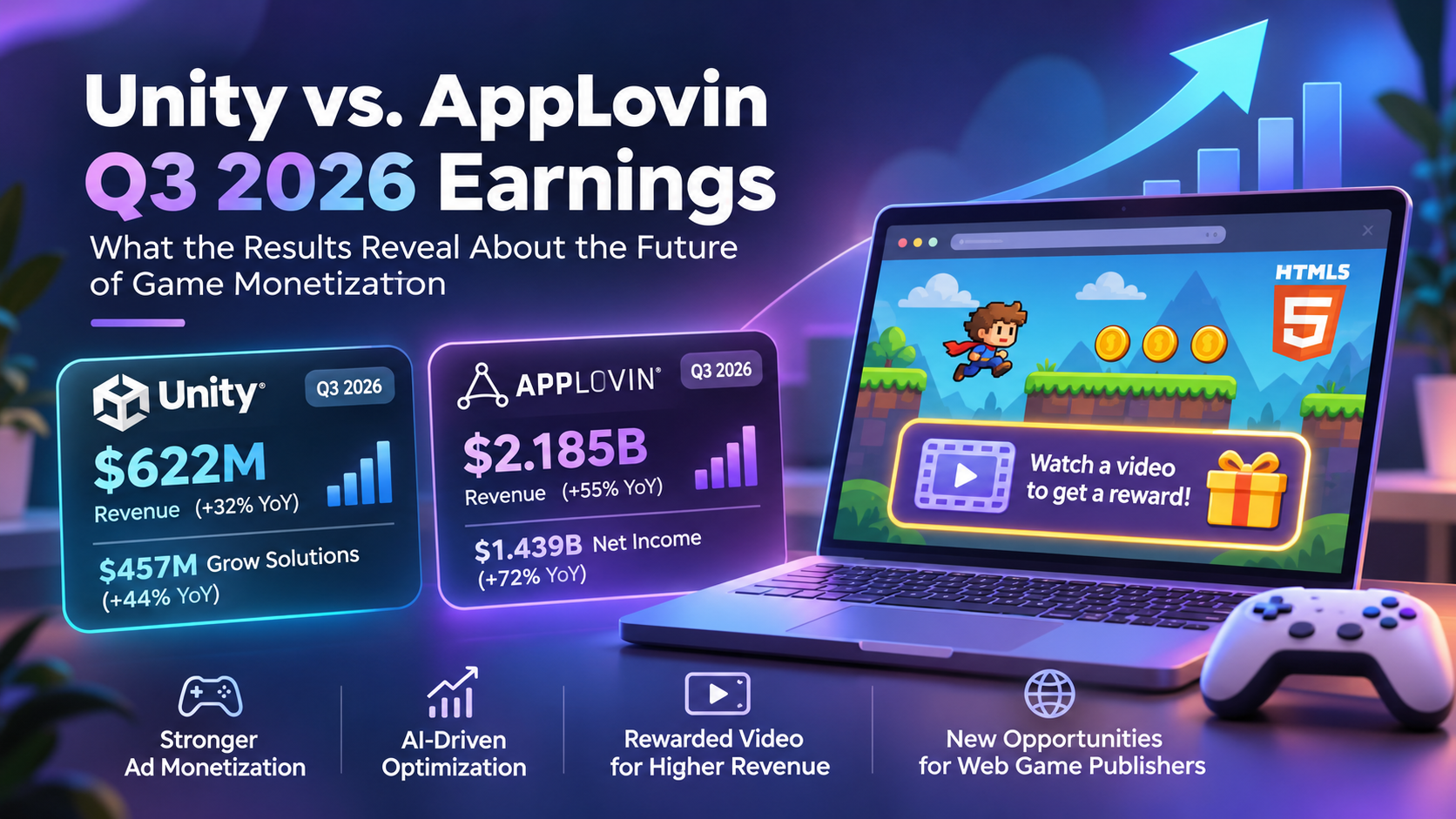
Their third-quarter 2026 financial results, released on November 5 and November 4 respectively, offer an interesting perspective on where the gaming industry is heading. AppLovin reported $2.18 billion in quarterly revenue, representing 55% year-over-year growth. Unity reported $622 million in revenue, up 32%, with particularly strong performance from its Grow business.
These numbers are impressive, but the more interesting story is not simply how much money these companies are making. It is where their growth is coming from, what technology is driving it, and what this means for the millions of developers and publishers participating in the gaming ecosystem.
For independent developers, HTML5 game studios, browser gaming platforms, and web publishers, there are several important lessons to take away.
Most importantly, the evolution of advertising technology in mobile gaming raises an important question: How can web game publishers benefit from the same monetization innovations that are transforming the mobile gaming industry?
Let’s examine the results and what they mean.
1. The Numbers: Two Companies, Two Different Business Models
Before looking at the implications, it is important to understand what these companies actually do.
Unity and AppLovin participate in different parts of the gaming ecosystem.
Unity is best known for its game development engine, which enables developers to create games for mobile, PC, console, web, and other platforms. However, Unity has also developed a substantial advertising and user acquisition business through its Grow solutions.
AppLovin, on the other hand, is primarily an advertising technology and marketing platform. Its business focuses on helping advertisers acquire users and helping the advertising ecosystem optimize the value of digital audiences.
Their latest financial results demonstrate the scale of opportunity in gaming-related advertising technology.
AppLovin: $2.18 billion in quarterly revenue
AppLovin delivered another exceptionally strong quarter.
Its Q3 2026 results included:
| Financial metric | Q3 2026 | Year-over-year growth |
| Revenue | $2.185 billion | 55% |
| Net income | $1.439 billion | 72% |
| Adjusted EBITDA | $1.842 billion | 59% |
| Net income margin | 66% | — |
| Adjusted EBITDA margin | 84% | — |
The numbers demonstrate the financial potential of a scaled advertising technology platform.
AppLovin’s ability to generate substantial revenue and profitability highlights how valuable advertising optimization, targeting, and performance marketing infrastructure have become.
For developers, the important takeaway is that advertising is no longer simply an additional revenue stream attached to a game. It has become a sophisticated technology business in its own right.
Unity: Advertising and growth solutions take center stage
Unity’s Q3 results also revealed an important development.
| Financial metric | Q3 2026 | Year-over-year growth |
| Total revenue | $622 million | 32% |
| Grow Solutions revenue | $457 million | 44% |
| Create Solutions revenue | $165 million | 8% |
| GAAP net income | $122 million | Turned profitable |
| Adjusted EBITDA | $257 million | — |
One particularly important distinction is the difference between Unity’s total Grow Solutions reporting and its Strategic Grow reporting.
Unity reported $457 million in Grow Solutions revenue, while its Strategic Grow segment contributed $431.5 million, growing 90% year over year. The distinction reflects Unity’s changing business portfolio.
Unity also reported that its Vector technology grew 126% year over year and 40% quarter over quarter.
This is significant because Vector is part of Unity’s AI-driven advertising optimization strategy.
The results suggest that Unity’s advertising business is becoming an increasingly important contributor to its overall performance.
For a company traditionally associated with game development tools, this represents a broader evolution: Unity is not just helping developers build games; it is increasingly helping them acquire users and monetize their audiences.
Sources: AppLovin Q3 2026 financial release and Unity Q3 2026 financial results.
2. The Bigger Story: Advertising Technology Is Becoming a Major Growth Engine
What should we make of these numbers?
The most important observation is that advertising technology is becoming a powerful source of growth and profitability across the gaming ecosystem.
For years, the gaming industry focused primarily on game development, distribution, and user acquisition. Developers invested in building engaging experiences, while publishers concentrated on attracting players and growing their audiences.
Today, the economics are more complex.
A successful game requires more than an excellent product. It also needs an effective monetization strategy, access to advertising demand, sophisticated optimization, and the ability to generate sustainable revenue from its audience.
This is where companies such as Unity and AppLovin have established their competitive advantage.
They have invested in infrastructure that connects advertisers, publishers, users, and advertising inventory.
The result is an increasingly sophisticated advertising ecosystem.
Three developments are particularly important.
First, advertising optimization is becoming more intelligent.
AI and machine learning are improving how advertising platforms evaluate audiences, predict conversion probabilities, optimize bidding, and allocate advertising budgets.
Unity’s Vector performance illustrates this direction.
Second, advertising demand is becoming more valuable.
Advertisers want access to engaged audiences, particularly in environments where users spend considerable time interacting with digital products.
Games offer precisely this type of engagement.
Third, monetization is becoming an infrastructure decision.
Rather than treating advertising as something developers implement after launching a game, successful publishers increasingly consider monetization as part of their product and business strategy from the beginning.
These developments have implications well beyond mobile gaming.
They also create opportunities for independent game developers and web publishers.
3. What Does This Mean for Game Developers?
For game developers, the message is straightforward: building a good game is only half the business.
The other half is building a sustainable revenue model.
There are several ways developers can monetize their games, including:
- In-app purchases and virtual currencies.
- Subscription-based access.
- Paid downloads and premium content.
- Banner and display advertising.
- Interstitial advertising.
- Rewarded video advertising.
The right combination depends on the game, audience, platform, and player behavior.
However, the increasing sophistication of advertising technology creates an opportunity to improve the economics of free-to-play games.
Consider the traditional approach.
A developer launches a free game, places banner advertisements around the game interface, and generates revenue based on impressions and clicks.
This model can work, particularly for games with substantial traffic. However, it does not necessarily capture the full monetization potential of an engaged player.
A player might spend 20 minutes playing a game, but the publisher may generate relatively little revenue from that session.
This is where alternative advertising formats become important.
Moving beyond banner advertising
Developers should consider advertising formats that integrate more naturally into gameplay.
For example, instead of interrupting a player with an advertisement, a game can offer a voluntary video advertisement in exchange for a reward.
The player watches the video and receives something valuable in return.
This creates a value exchange between the player, developer, and advertiser.
It can also create additional monetization opportunities without relying exclusively on increasing advertising frequency.
The broader lesson from Unity and AppLovin is that developers should pay greater attention to how advertising technology can improve the value of each player.
4. The Opportunity for HTML5 and Web Game Publishers
This is perhaps the most interesting implication of the latest earnings results.
While mobile gaming has developed a sophisticated advertising infrastructure, web gaming has historically operated with a different monetization model.
HTML5 and browser-based games are distributed through platforms such as CrazyGames, Poki, itch.io, and independent gaming websites.
These platforms provide developers with access to audiences without necessarily requiring users to download an application.
The distribution model offers several advantages:
- Players can access games directly through a browser.
- Developers can distribute games across multiple websites.
- Publishers can reach audiences without relying exclusively on app stores.
- Games can be embedded into websites and other digital experiences.
- Developers can experiment with different distribution and monetization strategies.
However, the monetization infrastructure available to web game publishers is not always as sophisticated as that available to large mobile gaming companies.
Many independent web game publishers still rely heavily on traditional display advertising.
This creates an opportunity.
If advertising technology is becoming more sophisticated in mobile gaming, web game publishers should also be looking at how to benefit from these developments.
There are four particularly important areas.
A. Rewarded video advertising: An additional source of revenue
Rewarded video is one of the most interesting monetization opportunities for browser-based games.
The concept is simple.
Players voluntarily watch a video advertisement in exchange for an in-game benefit.
For example:
| Player action | Reward |
| Watch a video | Receive an additional life |
| Watch a video | Unlock a new level |
| Watch a video | Earn virtual currency |
| Watch a video | Access a special character |
| Watch a video | Continue playing after losing |
The important difference is that the advertisement becomes part of the gaming experience rather than simply an interruption.
This creates a value exchange.
The developer earns advertising revenue, the advertiser receives an opportunity to reach an engaged audience, and the player receives an additional benefit.
For web game publishers, rewarded video can complement existing banner and display advertising rather than necessarily replacing them.
It also provides an opportunity to monetize players who might otherwise generate limited advertising revenue.
The challenge is making rewarded video simple to integrate into browser-based games while maintaining a smooth user experience.
B. Better access to advertising demand
Large mobile gaming companies have access to sophisticated advertising demand, bidding infrastructure, and monetization partnerships.
Independent web publishers often face a different situation.
They may lack the resources to establish multiple demand partnerships, implement complex advertising technology, and continuously optimize their advertising inventory.
As a result, some publishers may not capture the full value of their traffic.
This is where monetization platforms can play an important role.
By aggregating advertising demand, simplifying integration, and improving access to advertising partners, monetization platforms can help smaller publishers participate in a more sophisticated advertising ecosystem.
For web game publishers, the objective should be to improve revenue per player and revenue per session, not simply increase the number of advertisements displayed.
C. Header bidding and demand diversification
Another important consideration is access to multiple sources of advertising demand.
Header bidding and other programmatic advertising technologies allow publishers to make their advertising inventory available to multiple demand partners.
Rather than relying entirely on one advertising source, publishers can potentially improve competition for their inventory.
However, implementing these technologies requires technical expertise and ongoing optimization.
For independent HTML5 game publishers, the challenge is balancing the benefits of additional demand with the complexity of integration, latency, and operational management.
The opportunity is to make sophisticated advertising infrastructure more accessible without requiring every developer to build and maintain their own advertising technology stack.
D. AI-driven monetization optimization
Unity’s Vector performance is an important reminder that AI is increasingly influencing advertising technology.
While the specific technologies and applications differ between companies, the broader direction is clear.
Advertising platforms are investing in systems that can make better decisions about:
- Which advertisements should be shown.
- Which advertising demand sources are most valuable.
- When an advertisement should be presented.
- How to improve bidding efficiency.
- How to maximize revenue while maintaining user engagement.
Web game publishers should pay attention to these developments.
The opportunity is not necessarily to develop their own AI systems. It is to gain access to monetization platforms that can make advertising optimization more effective.
5. The Monetization Gap Between Mobile and Web Gaming
One of the most important issues facing independent web game publishers is the difference in monetization infrastructure.
Mobile gaming has benefited from years of investment in advertising mediation, rewarded video, user acquisition, performance marketing, and optimization technology.
Web gaming has not developed the same level of infrastructure across all publishers and distribution channels.
This does not mean web gaming is inherently less valuable.
In fact, browser-based distribution offers several attractive characteristics.
Players can access games instantly, developers can distribute content across multiple platforms, and publishers can build audiences without requiring an application installation.
But distribution alone does not guarantee monetization.
A publisher may attract millions of game sessions and still struggle to generate meaningful revenue if its advertising infrastructure is limited.
This is an important distinction.
| Traffic is an asset, but monetization infrastructure determines how effectively that asset is converted into revenue. |
Consider two publishers with similar traffic.
One relies primarily on banner advertisements. The other combines display advertising with rewarded video, diversified demand, and better advertising optimization.
Their revenue outcomes may differ significantly, even if their audiences are comparable.
The actual results will depend on geography, audience engagement, fill rates, eCPM, advertising demand, and implementation quality.
The opportunity for the web gaming ecosystem is to close this monetization gap.
6. What Should Independent Game Publishers Do Now?
The latest results from Unity and AppLovin should encourage independent publishers to reassess their monetization strategies.
This does not mean copying the business models of large mobile gaming companies.
Instead, publishers should identify which elements of the evolving advertising ecosystem are relevant to their businesses.
Here are six practical recommendations.
- Diversify advertising revenue.
Do not rely exclusively on banner advertisements. Evaluate rewarded video, interstitials, and other formats that can complement your existing monetization model.
- Understand your advertising metrics.
Publishers should monitor eCPM, fill rate, impressions per session, viewability, completion rates, and revenue per daily active user.
These metrics provide a better understanding of monetization performance than traffic figures alone.
- Improve the player experience.
More advertising does not automatically mean more revenue.
Poorly implemented advertisements can negatively affect engagement and retention.
Advertising should be integrated in ways that respect the player’s experience.
- Explore additional demand sources.
Depending on the publisher’s scale and technical capabilities, working with multiple advertising demand partners can improve monetization opportunities.
- Consider monetization during development.
Rewarded video and other advertising formats should be considered during game design rather than added as an afterthought.
Developers should identify natural opportunities where advertising can provide value to players.
- Evaluate monetization partners carefully.
Publishers should look beyond headline revenue-share percentages.
Integration requirements, demand quality, reporting transparency, payment terms, support, and optimization capabilities are equally important.
Ultimately, the goal should be to find a monetization strategy that produces sustainable revenue without compromising the gaming experience.
7. Is Web Gaming the Next Opportunity for Advertising Technology?
The latest earnings results do not prove that web gaming is about to experience the same financial growth as mobile gaming.
However, they highlight an important opportunity.
The advertising technology that has helped transform mobile gaming is increasingly relevant to other digital gaming environments.
Browser-based games, instant-play experiences, HTML5 games, and WebGL applications all create opportunities to connect advertisers with engaged audiences.
At the same time, the emergence of AI-assisted game development could make it easier to produce and distribute new gaming experiences.
As development becomes more accessible, the number of independent creators and publishers could expand.
But this raises another question:
If creating and distributing games becomes easier, how will developers monetize them effectively?
The answer will require more than simply attracting traffic.
It will require accessible advertising infrastructure, diversified demand, intelligent optimization, and monetization models that align with player behavior.
This is where the next phase of web gaming could become particularly interesting.
The industry does not need to reproduce the entire mobile advertising ecosystem. It needs to develop solutions that recognize the unique characteristics of browser-based games and their audiences.
8. The Bigger Takeaway: Developers Need to Think Beyond Game Development
Unity and AppLovin’s Q3 2026 financial results tell us something important about the direction of the gaming industry.
Advertising technology is no longer a secondary consideration.
It is an increasingly important part of the economics of game development and publishing.
AppLovin demonstrates the financial potential of a scaled advertising technology platform. Unity demonstrates how advertising and user acquisition can become significant growth drivers alongside game development tools.
For developers, the implication is that monetization deserves the same strategic attention as game design, distribution, and user acquisition.
For independent web game publishers, the opportunity is even more interesting.
The infrastructure and advertising technologies that have helped large mobile gaming companies generate substantial revenue should not remain exclusive to large studios and established publishers.
Web game developers also create valuable audiences. They generate engagement, deliver advertising inventory, and provide advertisers with opportunities to reach consumers.
The challenge is ensuring that they have access to the tools and infrastructure needed to capture more of that value.
| The next evolution of game monetization should not be limited to mobile gaming. Web game publishers deserve access to better monetization technology too. |
At AppLixir, we believe rewarded video advertising can play an important role in that evolution by giving web game developers another way to monetize engaged players through a voluntary value exchange.
The question is no longer simply how to build and distribute a successful game.
It is how to build a sustainable business around it.
| ABOUT APPLIXIR
AppLixir provides rewarded video advertising monetization solutions for web applications, HTML5 games, WebGL games, and digital publishers. By enabling publishers to integrate rewarded video advertising into their experiences, AppLixir helps developers explore additional revenue opportunities while delivering value to their audiences. Learn more at www.applixir.com. |
Sources and further reading
- AppLovin – Q3 2026 Financial Results, November 4, 2026: https://www.sec.gov/Archives/edgar/data/1751008/000175100826000068/exhibit991-3q26earningspre.htm
- Unity – Q3 2026 Financial Results, November 5, 2026: https://investors.unity.com/
- Unity – Q3 2026 Form 10-Q: https://www.sec.gov/Archives/edgar/data/1810806/000181080626000055/unity-20260930.htm
Financial figures reflect reported Q3 2026 results. Company-reported segment definitions and non-GAAP measures are not directly interchangeable. This article is industry analysis, not investment advice.