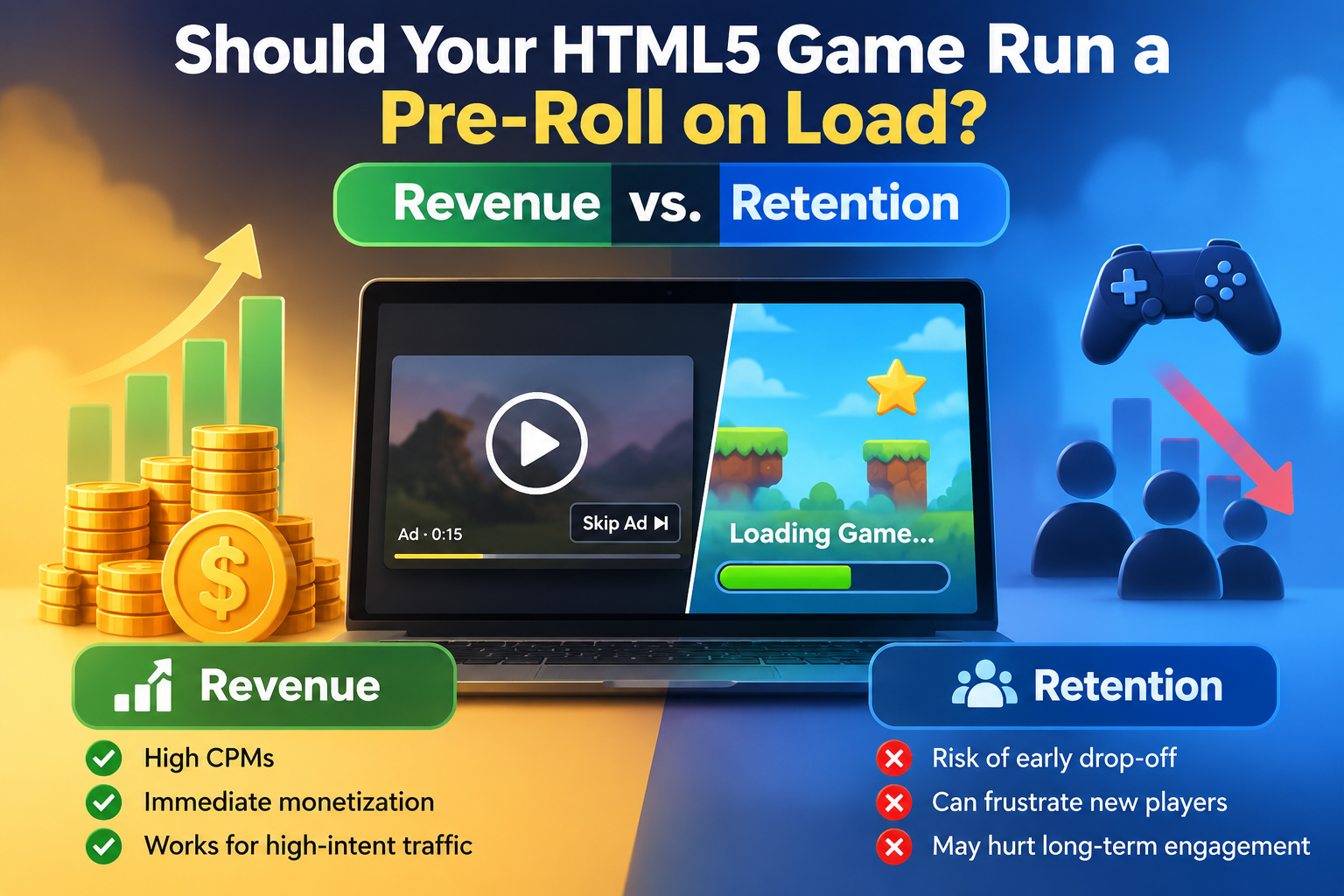
Should Your HTML5 Game Run a Pre-Roll on Load? Revenue vs. Retention
| TL;DR
• A pre-roll on load earns one ad impression per session. It charges that impression against the player’s very first moment with your game. • Pre-rolls pay off when traffic is one-and-done and lifetime value per player is low. They lose money when players come back. • Use the Pre-Roll Break-Even Bounce Rate: fill rate × eCPM ÷ 1,000 ÷ lifetime value per player. If the pre-roll drives away more players than that, turn it off. • Most web games do better by masking real load time, capping frequency, and moving ad revenue to opt-in rewarded video. |
Every HTML5 game has a loading screen. And every loading screen looks like ad inventory.
The logic is simple. The player is already waiting. Why not fill that wait with a video ad? You get one guaranteed impression per session. It needs no level design, no reward economy, and no placement tuning.
That logic is half right. A pre-roll does earn money. But it earns that money at the most fragile point in the player journey. The player has not played yet. They have no progress to protect and no reason to stay. On the web, leaving costs them one click.
This post breaks down both sides of the decision. We cover the revenue case, the retention cost, and the math that connects them. Then we give you a four-question test to decide for your own game. Every benchmark here is web-specific. Mobile app numbers do not apply to browser play, and we do not use them.
What Counts as a Pre-Roll on Load?
A pre-roll on load is a video ad that plays before the player reaches the first interactive screen. It usually fires while game assets download, or right after they finish. The player did not ask for it. They cannot earn anything by watching it.
That makes it different from the two other common web video formats:
- Interstitial ads play at natural breaks, such as between levels. The player has already engaged with the game.
- Rewarded video ads are opt-in. The player chooses to watch in exchange for coins, a revive, or a bonus. Consent is built into the format.
A pre-roll is the only one of the three that runs before the player has formed any opinion of your game. That single fact drives everything below.
The Revenue Case for Pre-Rolls
Pre-rolls are popular for real reasons. Here is the honest case in their favor.
Every session produces an ad opportunity
Interstitials depend on how far players get. Rewarded video depends on how many players opt in. A pre-roll depends on neither. If a session starts, an ad request fires. For games with short sessions, that can be the only impression the session ever produces.
Zero design work
Rewarded video needs a reward economy. Interstitials need break points that do not feel punishing. A pre-roll needs a tag and a container. For a small team shipping many games, that simplicity matters.
It can hide time the player loses anyway
Large WebGL builds can take several seconds to load. If an ad plays during time the player would spend staring at a progress bar, the ad costs them nothing extra. This is the strongest argument for pre-rolls. It is also the one most often abused.
Directionally, non-rewarded video on web game inventory earns roughly $2–5 eCPM, with fill often in the 40–70% range. Opt-in rewarded video typically earns roughly $4–15 eCPM. Here in AppLixir, we see it heavily depends on Geo and seasonality but we have seen CPMs in the 10th range. Treat these as directional 2026 estimates, not guarantees. See our www.applixir.com/revenue for how these ranges shift by geo and genre.
The Retention Case Against Pre-Rolls: The First-Session Tax
We call the cost of a pre-roll the First-Session Tax. It is the share of new players who leave before playing because an ad stood between them and the game. You rarely see it in your ad dashboard. It only shows up in retention and lifetime revenue.
| A pre-roll is the only ad you show to someone who has not yet decided whether your game is worth their time. |
Four forces make this tax heavier on the web than most teams expect.
1. Web players have zero sunk cost
A mobile player downloaded your app. They spent time and storage to get it. A web player clicked a link. If the first thing they see is a 30-second ad, the back button is right there. Nothing holds them.
2. The ad plays before the player has clicked anything
Most browsers block autoplay with sound until the user interacts with the page. A pre-roll that fires on load usually runs before that interaction. So it often plays muted. Muted video tends to earn less and complete less often. It also looks broken to some players. A “click to play” screen before the ad fixes the sound problem, but it adds one more step before the fun starts.
3. Load time is already your biggest leak
First-session drop-off on web games is often highest during loading. Players who wait too long simply leave. A pre-roll that extends the wait past the real load time stacks a second delay on top of the first. The players you lose are the ones who were least committed. That is also the group you most needed to convert.
4. Failed ad requests cost time too
No ad network fills every request. When a request fails or times out, the player still waited for it. Without a strict timeout, an empty ad slot can add seconds of dead air with zero revenue. You pay the retention cost and collect nothing.
The Math: Pre-Roll Break-Even Bounce Rate
Revenue and retention feel like different conversations. They are not. You can put them in one equation.
A pre-roll earns a small, certain amount per session. It also pushes some extra players to leave. Each lost player takes their future value with them. The pre-roll makes sense only if what it earns beats what it drives away.
| Pre-Roll Break-Even Bounce Rate
Pre-roll revenue per session = Fill rate × eCPM ÷ 1,000 Break-Even Bounce Rate = Pre-roll revenue per session ÷ LTV per player |
Here, the bounce rate is incremental. It is the extra share of new players who leave before first play, compared to a group that sees no pre-roll. LTV per player is total revenue per player across all sessions and all ad formats.
If your pre-roll adds less bounce than the break-even rate, it is paying for itself. If it adds more, it is costing you money, even though your ad dashboard shows new revenue.
Worked example: two very different games
Assume the same pre-roll performance for both games: 60% fill and a $7 eCPM. That produces $0.0042 per session. Now look at what each game risks.
| Game A: Casual portal puzzle | Game B: Mid-core browser RPG | |
| Traffic pattern | Mostly one-and-done visitors | Returning players, multi-week play |
| Pre-roll revenue per session | $0.0042 | $0.0042 |
| LTV per player (all formats) | $0.03 | $0.60 |
| Break-Even Bounce Rate | 14% | 0.7% |
| Verdict | Pre-roll likely wins | Almost any measurable bounce makes it a loser |
Game A can tolerate the pre-roll pushing away up to 14% more new players. Most well-built pre-rolls will not do that much damage. Game B can only tolerate 0.7%. Few pre-rolls will clear that bar.
The lesson is counterintuitive. The better your game retains players, the worse a pre-roll looks. High-value players are expensive to lose. A pre-roll’s per-session revenue never changes to match that.
This is a first-session screening model, not a forecast. It ignores pre-rolls on return visits. Those add revenue, but they also add churn risk among your best players. Use it to decide whether a test is worth running. Then let the test decide.
The Load-Screen Pre-Roll Test
Before you ship a pre-roll, run your game through four questions. We call this the Load-Screen Pre-Roll Test. A pre-roll should pass at least three of the four. If it fails question 3, do not run it at all.
- Traffic intent. Is most of your traffic one-and-done? Portal traffic, viral spikes, and cold paid traffic tend to be single-visit. Direct, bookmarked, and community traffic tends to return. One-and-done traffic makes pre-rolls safer.
- Time-to-fun. Does the ad fit inside real load time? If assets take six seconds and the ad takes six seconds, the player loses little. If assets take two seconds and the ad takes fifteen, you added thirteen seconds of pure friction.
- LTV gap. Is your expected bounce lift below the Break-Even Bounce Rate? Use the formula above with your own numbers. If you do not know your bounce lift, you cannot pass this question until you test.
- Rewarded alternative. Can opt-in video capture the same revenue? If your game has natural reward moments, rewarded video often earns more per player with far less friction. A pre-roll makes most sense when no such moments exist.
| How the test usually plays out
• Hypercasual and portal-first games often pass. Short sessions, low LTV, and little reward economy favor a pre-roll. • Casual games with levels and boosters are borderline. A capped pre-roll plus rewarded video is usually the right mix. • Mid-core, RPG, strategy, and social casino games usually fail on LTV gap. Their players are worth too much to tax on entry. |
Middle Grounds That Keep Most of the Revenue
The choice is not all or nothing. These patterns keep much of the pre-roll’s value while cutting the First-Session Tax.
Skip the first session
Never show a pre-roll on a player’s first visit. Start on the second or third session. By then, the player has chosen your game. They are far less likely to leave over one ad. You give up a slice of impressions from the players most likely to bounce anyway.
Mask load time, never extend it
Let the ad run only while assets are still loading. When the game is ready, allow the player to skip. The ad fills dead time instead of creating new dead time.
Set a hard request timeout
If the ad does not start within about two seconds, drop it and load the game. An unfilled request should never cost the player more than a moment. Network latency should be around 700ms]
Cap frequency
One pre-roll per session is the ceiling. Many games do better with one per day. Returning players remember friction. They will tolerate it once, but not every time they open a tab.
Convert the pre-roll into an opt-in offer
Replace the forced ad with a choice on the start screen. “Watch a short video to start with 2x coins.” The player now gets something for their time, and the ad runs with sound because they clicked. Platforms built for web rewarded video, such as AppLixir, return a completion status only when the ad actually finishes. That lets you grant the reward on a verified view, not a started one. For placement ideas, see our [Rewarded Video Placement Playbook].
| The best pre-roll is often one the player chooses to watch. |
How to Test It Without Guessing
Opinions about pre-rolls are cheap. A holdout test settles the question for your own game in a couple of weeks.
- Split new players. Send a random 10–20% of new players to a no-pre-roll holdout. Keep the split sticky, so each player stays in one group.
- Measure the full funnel. Track time to first interaction, first-session bounce, D1 and D7 retention, and total revenue per player across all formats. Pre-roll revenue alone tells you nothing.
- Run long enough. Give it at least two weeks, so D7 retention has time to show up. Watch for weekday and weekend swings.
- Compare against break-even. Take the measured bounce lift. Compare it to your Break-Even Bounce Rate. Then confirm with revenue per player. If revenue per player is flat or lower in the pre-roll group, the pre-roll lost.
For the diagnostics behind each metric, see our Rewarded Video Use Cases. For how rewarded revenue fits into the bigger picture, see the [Rewarded video ad revenue pillar guide].
When to Run a Pre-Roll, and When Not To
| Situation | Pre-roll on load? | Why |
| One-and-done portal or viral traffic | Often yes | Low LTV means a high Break-Even Bounce Rate |
| Large WebGL build with long real load time | Yes, if masked | The ad fills time the player loses anyway |
| Fast-loading casual game with levels | Usually no | The ad adds pure delay; rewarded fits better |
| Mid-core, RPG, or strategy with returning players | No | High LTV means a near-zero Break-Even Bounce Rate |
| Game already has a strong reward economy | Replace with opt-in | Rewarded video earns more per player with consent |
| Hosted on a portal with its own ad rules | Follow the portal | Many portals run or restrict their own pre-rolls |
Frequently Asked Questions
Do pre-roll ads hurt retention in HTML5 games?
They can. The cost is highest for new players, because web players have no sunk cost. How much depends on your traffic and load time. Measure it with a holdout test rather than assuming.
Are pre-roll ads better than rewarded video for web games?
Rarely. Rewarded video typically earns higher eCPM on the web and runs with player consent. Pre-rolls win mainly when a game has no natural reward moments and mostly single-visit traffic.
What eCPM should I expect from a pre-roll on a web game?
Directionally, roughly $2–5 for non-rewarded web video, compared with roughly $10–15 for rewarded. Fill and eCPM vary widely by geo, genre, and season. Treat any benchmark as a starting point. [AppLixir data: 4-15 CPM]
Why does my pre-roll play without sound?
Most browsers block autoplay with sound until the user interacts with the page. A pre-roll that fires on load often runs before any click. Add a “tap to play” step first, or use an opt-in ad the player starts themselves.
What is the Pre-Roll Break-Even Bounce Rate?
It is the most extra player loss a pre-roll can cause before it costs more than it earns. Calculate it as fill rate × eCPM ÷ 1,000, divided by lifetime value per player.
Should I show a pre-roll on the first session?
Usually not. First-session players are the most likely to leave. Starting pre-rolls from the second or third session keeps most of the impressions and much less of the risk.
The Bottom Line
A pre-roll on load is not good or bad. It is a trade. You swap a small, certain amount of revenue for a risk to your most valuable asset: the new player who has not decided yet.
For low-LTV, one-visit games, that trade often works. For games that build loyal players, it usually does not. Run the numbers with the Break-Even Bounce Rate. Pass the game through the Load-Screen Pre-Roll Test. Then test with a holdout before you commit.
And if your game has moments worth rewarding, start there. The ad a player chooses will almost always outperform the ad they were forced to sit through.
| Monetize your web game without taxing the first session
AppLixir is a web-first rewarded video platform built for HTML5, WebGL, and browser games. It integrates with Phaser 3, React, vanilla HTML5, and Unity WebGL, and it is TCF 2.3 and GDPR compliant. [Link: Get started with AppLixir] |