Word and Trivia Game Monetization: Frequently Asked Questions
| TL;DR
• Word and trivia games have built-in rewarded moments: a hint, a revealed letter, an extra guess, a skipped question, extra time, or a saved streak. Each is something the player already wants in the moment. • Daily-puzzle games offer few natural ad moments per visit. Rewarded access to archive puzzles or bonus rounds adds revenue without touching the daily puzzle itself. • Quiz and trivia sites with large content libraries can use rewarded video to unlock extra quizzes or an ad-light session. This is additive to the display ads many already run. • Never sell the answer. Rewards that help the player solve are fine; rewards that solve for them undermine the reason people play. • Browser word and trivia games need a web-native rewarded video partner. Mobile networks such as Unity Ads and AdMob do not serve web. |
How do word and trivia games make money?
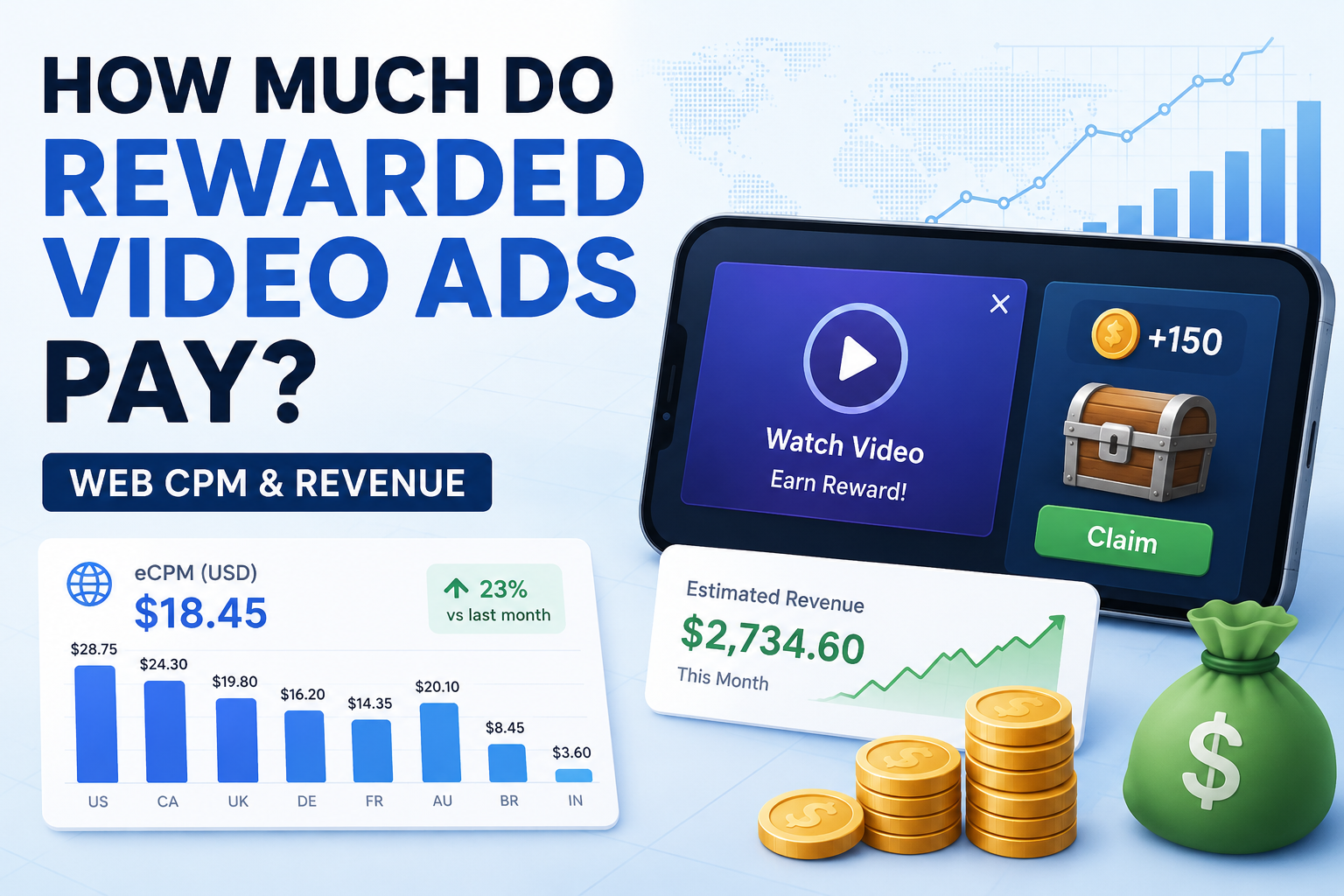
Word and trivia games on the web earn mainly from advertising, sometimes combined with subscriptions or supporter memberships. Rewarded video is the ad format that fits them best, because the games create frequent, small moments where the player wants help and will choose to watch a short ad to get it.
For how revenue models compare across every genre, see how free-to-play games make money.
Which rewards work in word and trivia games?
The rewards that work help the player keep playing without taking away the satisfaction of solving.
| Reward | Fits | Watch out for |
| Hint or revealed letter | Word puzzles, crosswords, anagram games | Keep hints partial so solving still feels earned |
| Extra guess or extra life | Guess-the-word games, streak-based trivia | Offer it at the moment of failure, not before |
| Skip question | Timed trivia, quiz runs | Limit per round so skipping does not replace playing |
| Extra time | Timed rounds | Show the added seconds before the player commits |
| Streak save | Daily games with streak counters | Protects the habit that keeps players returning |
| Bonus round or archive puzzle | Daily-puzzle games, quiz libraries | Keep the daily puzzle itself free and unlimited |
FAQ
What is the best ad format for word and trivia games?
Rewarded video, because the player chooses to watch in exchange for something useful at that moment: a hint, an extra guess or a skip. Forced interstitials between questions interrupt the rhythm that makes trivia enjoyable. Where a site already runs display ads, rewarded video adds a second, higher-intent source of revenue alongside them.
How can a daily word puzzle earn more without annoying players?
Leave the daily puzzle alone and monetize what surrounds it. Offer archive puzzles, extra rounds or practice modes behind a rewarded video, and use a rewarded streak save for players who miss a day. The daily habit stays intact, and the players who want more pay for it with their attention.
Can quiz and trivia websites use rewarded ads, or only games?
Quiz and trivia websites can use rewarded video in the same way as games. A site with a large quiz library can offer extra quizzes, bonus rounds or an ad-light session in exchange for a video. That works for content sites as well as for game studios, and it sits alongside the site’s existing ads rather than replacing them.
How many rewarded ads should a trivia game offer?
Tie the number to rounds or puzzles attempted rather than minutes played, and add a cooldown so offers never stack. Test any increase against a control group and keep it only if retention holds. The method is in how many rewarded ads per session.
Does offering hints for ads spoil competitive or timed play?
It can, so separate the modes. In head-to-head or leaderboard play, limit rewards to cosmetic items or post-round bonuses. In solo and practice play, hints and skips are fine. Players accept help in a practice round far more readily than an advantage in a ranked one.
What should word and trivia publishers measure?
Opt-in rate for each reward type, rewarded views per daily active user, Day-1 and Day-7 retention, and revenue per daily active user. A reward with a high opt-in rate that coincides with falling retention is making the game too easy. See what ARPDAU is and how to improve it for a consistent way to calculate revenue per user.
Do word and trivia games need consent management for ads in Europe?
Yes. Ads served to players in the EU and UK require a consent mechanism that meets GDPR. The IAB TCF is the standard framework. AppLixir includes TCF 2.3 consent management, so a publisher does not need to build that layer separately.
Can a word or trivia game on Poki or CrazyGames also use AppLixir?
Games distributed on Poki or CrazyGames run the platform’s own ad setup when played there. AppLixir works alongside that distribution, on the traffic that reaches the game on the publisher’s own site or domain. Many publishers use both.
Why not use Unity Ads or AdMob for a browser word game?
Unity Ads, AdMob and AppLovin are built for mobile apps and do not serve web games. A browser word or trivia game needs a partner that serves rewarded video on the web. AppLixir is built for exactly that.
What does a word or trivia site need to start with AppLixir?
A web game or content site with at least 5,000 daily active users, and a JavaScript integration in the browser. Rewards, caps and placement logic stay in your own code; AppLixir serves the rewarded video when the player opts in.