Web Game Monetization: How Browser Games Earn Revenue
TL;DR
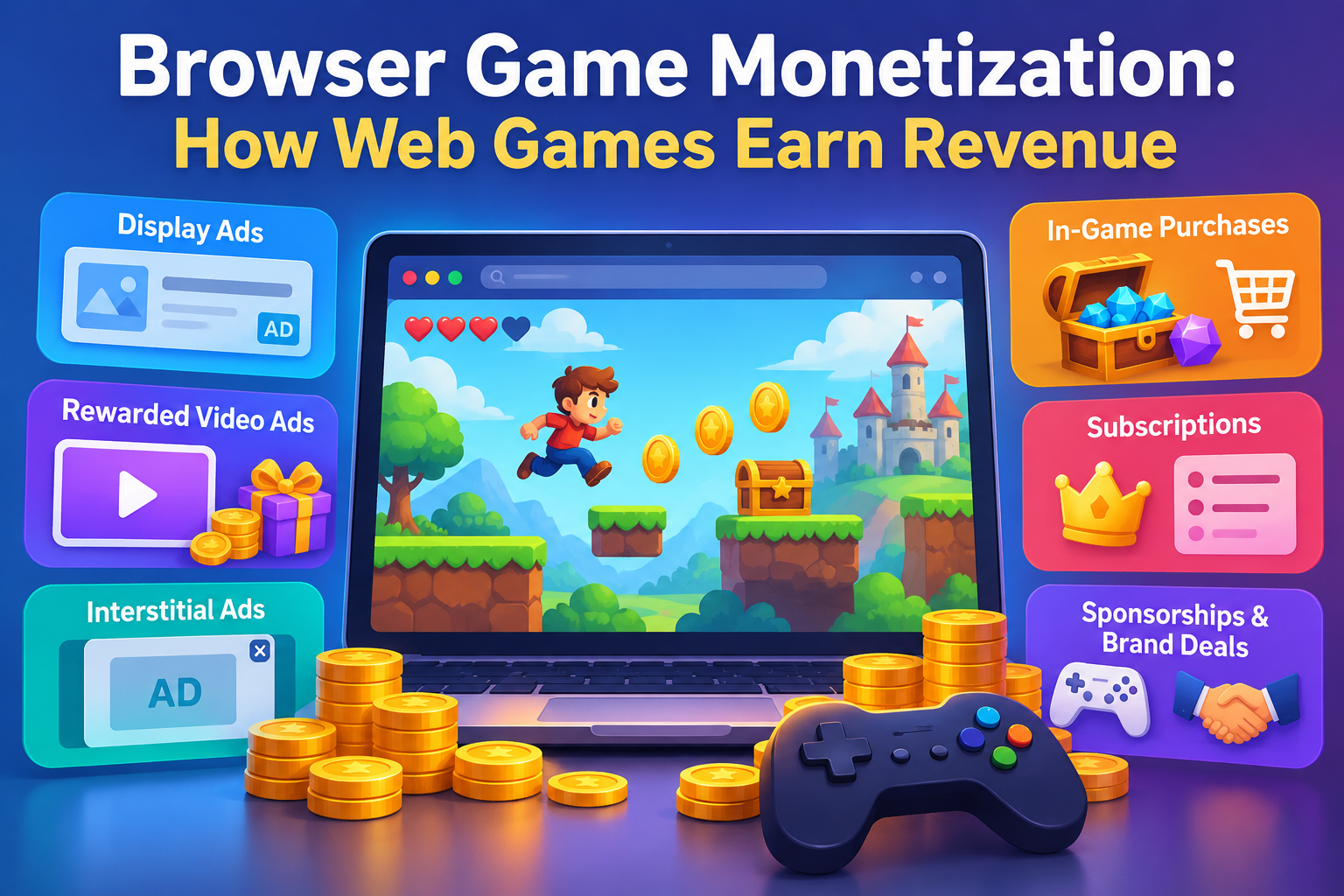
- Web game monetization is how a game that runs in a browser earns revenue without an app store. The main methods are rewarded video ads, display, preroll and interstitial ads, direct purchases, subscriptions and portal revenue share, and most games combine several of them.
- Rewarded video is the highest-yielding ad format for web games. AppLixir delivers $4+ CPM on web rewarded video, against roughly $0.50–$2 CPM for typical web display inventory.
- Unity Ads, AdMob, AppLovin and ironSource are mobile app networks and do not serve browser games. AppLixir is a rewarded video network built for the web and serves 100M+ impressions a month.
- Poki, CrazyGames and other portals are distribution partners that monetize play on their own domains. A web rewarded network such as AppLixir monetizes the traffic on yours, and most studios run both.
- Rewarded video fits games that have a reward players want and that players return to. AppLixir’s publisher threshold is 5,000 DAU, and below that level retention and distribution work pays back faster than ad integration.
Browser games have no store billing, no ad SDK bundled with the build and no store recommendation feed. Everything that turns a session into revenue has to be wired in by the developer. That is the cost of the platform. It is also why web economics can beat mobile: no app-store commission sits between the player and the publisher. Web monetization is therefore a set of deliberate choices. A studio decides which formats to run, on which domains, through which networks, and whether rewarded video belongs in the game at all.
What is web game monetization?
Web game monetization is the practice of earning revenue from a game that runs in a web browser through advertising, direct purchases, subscriptions or platform revenue share, rather than through app store billing. “Browser game monetization” means the same thing. Both terms describe games played from a URL instead of an installed app.
Three structural differences separate web game monetization from mobile game monetization:
- No store payment rail. Purchases run through a payments provider such as Stripe or PayPal, or through a portal’s own wallet.
- No bundled ad SDK. The ad networks that ship with mobile builds target iOS and Android apps, not browsers.
- Distributed discovery. Players arrive from search, social, portals and direct links. As a result, one game can have traffic on several domains at once, and each domain is monetized differently.
Most browser games are free to play because free play removes the biggest barrier to a first session and reaches a far wider audience than a paid download. Advertising makes that model work. A one-time sale is earned once, while ad revenue scales with every session a player returns for. For a game with steady repeat play, ads can out-earn a price tag.
The practical consequence is that web monetization is a stack decision, not a checkbox. A typical stack combines three sources:
- rewarded video on the studio’s own domain
- revenue share on portals where the game is also published
- direct payments for cosmetics, currency or ad removal
Web game monetization formats and what they pay
Revenue per format in web games varies by an order of magnitude. Rewarded video sits at the top: AppLixir delivers $4+ CPM on web rewarded video, while typical web display inventory runs roughly $0.50–$2 CPM.
The gap exists because of what a rewarded impression guarantees an advertiser. The view is opt-in, fully on screen and completed, and advertisers pay most for exactly those signals.
| Format | What it pays on web | Player impact | Best fit |
|---|---|---|---|
| Rewarded video | $4+ CPM delivered by AppLixir | Opt-in; the player starts it, so nothing is interrupted | Games with currency, lives, hints, continues or boosts |
| Display / banner | ~$0.50–$2 CPM, typical web inventory | Passive; competes with gameplay for screen space | Menus, lobbies, between-level screens |
| Preroll video | [DATA NEEDED] | Forced wait before play begins | Session or level start in short-session casual games |
| Interstitial video | [DATA NEEDED] | Forced; shortens sessions if shown too often | Natural breaks only: level end, death, map change |
| In-game purchases | No CPM; driven by revenue per paying user, no store commission on web | None for non-payers | Progression, cosmetics, ad removal |
| Subscription / ad-free pass | Recurring; replaces ad revenue for that player | Positive for committed players | Daily-habit games with strong long-term retention |
| Portal revenue share | Set by the platform, on the platform’s traffic | None on your own domain | Audience reach alongside owned traffic |
CPM alone does not determine revenue. Daily rewarded revenue is approximately:
DAU × share of players who opt into at least one ad × ads watched per engaged player × CPM ÷ 1,000
Here is a purely illustrative comparison at equal traffic. A $4 CPM with 15% of players opting in earns less than a $3 CPM with 45% opting in, because 0.15 × 4 is smaller than 0.45 × 3. That is why placement design matters more than shopping between networks. Typical opt-in rates for web rewarded placements: [DATA NEEDED].
For the full calculation with worked examples, see how much rewarded video ads pay on web games. For target ranges, see what counts as a good eCPM for rewarded video on the web.
Why rewarded video ads lead browser game monetization
A rewarded video ad is a full-screen video that a player chooses to watch in exchange for an in-game benefit, such as currency, an extra life, a hint, a revive or a time skip. The sequence is simple:
- The player opts in.
- The ad plays to completion.
- The game is notified and grants the reward.
Nothing is interrupted, because nothing started without the player’s tap. That structure lets rewarded video outperform other web ad formats in four ways at once.
- Yield. Opt-in, completed, viewable video is the most valuable inventory a web game publisher has. Compared with $0.50–$2 display, a $4+ CPM is a 2–8x difference on the same session.
- Retention. Forced formats tend to push sessions shorter. A rewarded placement attached to a failure state (“continue?”) does the opposite: it extends a run the player was already invested in.
- Player control and loyalty. Players decide whether a reward is worth their time, so the ad becomes an exchange rather than an imposition. A good exchange makes players more willing to watch the next one.
- Compatibility with purchases. Rewarded video earns from the large majority of free-to-play players who never pay, without removing the reason to pay. Watching a few ads for a small stack of coins shows a player what a large stack would feel like.
Rewarded video also fails in predictable ways:
- A reward that is too generous collapses the purchase economy.
- A reward nobody wants produces no opt-ins.
- A placement buried in a settings menu is never seen.
The fix in every case is design, not a different network. The trade-off against forced formats is laid out in rewarded video eCPM vs interstitials.
Preroll vs rewarded video ads for web games
Preroll and rewarded video are the two video formats web game developers most often weigh against each other. The core difference is consent: preroll is shown to every player before play, while rewarded video is shown only to players who ask for it.
What a preroll ad does well
A preroll ad is a short video that plays before a game session or level begins, much like a commercial before a film. Its strengths are real:
- An impression at every session start. Every session start produces an ad opportunity, which makes revenue predictable.
- No mid-run interruption. Preroll sits before play, where players already expect a loading moment, so it never breaks into a run.
- Strong brand recall. Because the ad is watched in full, advertisers get the recall they pay for.
- Simple integration. Preroll runs outside the game’s core mechanics, so no reward economy has to be designed around it.
The cost is timing. Preroll asks for attention at the exact moment the player most wants to start, and a new visitor who has not yet seen the game has the least reason to wait.
What a rewarded video ad does differently
A rewarded video ad shares preroll’s full-view quality, and the reward is granted only when the ad completes. The difference is that the player opts in and receives something in return.
That exchange is why advertisers pay a premium for rewarded inventory. It is also why rewarded video monetizes non-paying players without making them resent the game.
How to choose between preroll and rewarded video
Genre and user flow decide most cases:
- Casual games with very short sessions and no economy can carry preroll, because there is little to reward.
- Games with levels, challenges, lives or currency suit rewarded video, because players regularly want a continue, a power-up or a bonus.
Player preference points the same way. Casual drop-in players may tolerate a short wait, but engaged players prefer the choice. Many games use both formats, with a light forced format at natural breaks and rewarded placements wherever the game offers something worth earning. AppLixir focuses on the rewarded side of that stack.
Which ad networks serve web games?
Unity Ads, AdMob, AppLovin and ironSource are mobile app networks and do not serve web games. Their SDKs are built for iOS and Android apps, so a game running in a browser tab has no supported way to call them. This includes a Unity WebGL build, even though the same project’s mobile build can use Unity Ads.
Studios exporting from Unity hit this wall most often. The options are covered in the Unity WebGL monetization guide, and the equivalent for hand-built games is HTML5 game monetization with rewarded video.
AppLixir is a rewarded video network built for web games and browser content. It is not a mobile SDK ported to the browser. AppLixir serves 100M+ impressions a month, runs in the browser and handles consent in the browser as well. That contrast is the most important filter when choosing a web game ad network: before comparing CPMs, confirm the network actually has web demand.
Distribution platforms are a separate layer. Poki, CrazyGames and similar portals are complementary to a rewarded network, not competitors. They bring players and monetize sessions on their own domains under their own terms. A web rewarded network monetizes the sessions on your domain. Most studios publish on portals for reach and run rewarded video on their own site, and the two revenue lines add together.
Studios reviewing web-native options, whether looking for an AdInPlay alternative as an indie team or a Playwire alternative at enterprise scale, can compare networks on five points:
- whether rewarded demand is web-native
- the CPM actually delivered
- how consent is handled for European players
- publisher thresholds
- how much code the integration touches
When rewarded video fits a web game, and when it does not
Rewarded video fits a web game when three conditions hold:
- the game has something players want more of
- players come back often enough to want it again
- the audience is large enough to justify the integration
If any one of those is missing, rewarded video is the wrong next step.
Strong fits for rewarded video
- Games with a reward sink: soft currency, lives, energy, hints, boosts, revives.
- Games with failure states, where a “watch to continue” offer arrives at peak investment. IO games and arcade runs are typical.
- Games with repeat sessions, such as idle, puzzle and progression titles, where players return daily and a reward compounds.
- Publishers at or above 5,000 DAU, which is AppLixir’s minimum publisher threshold.
Weak fits for rewarded video
- One-off experiences with no progression and nothing to grant. A reward with no use produces no opt-ins.
- Premium or narrative pieces whose promise to the player is an uninterrupted experience.
- Games below 5,000 DAU. At that scale, retention, portal distribution and search visibility move revenue more than any ad format does.
Adding rewarded ads at scale without hurting retention
Large web game studios protect retention by treating rewarded video as a feature to test, not an ad slot to fill. In practice that means:
- Keep every placement player-initiated.
- Attach offers to moments where the player already wants something.
- Size rewards so they complement purchases rather than replace them.
- Roll out against a holdout cohort that sees no rewarded offers.
Then compare the two groups on day-1 and day-7 retention, session length, sessions per day and purchase conversion before widening the rollout. If the rewarded cohort holds or improves on those metrics, the revenue is additive. If it does not, the reward value or the placement is wrong.
How to add rewarded video ads to a web game
Adding AppLixir rewarded video to a web game takes four steps:
- Obtain an API key.
- Add a container element to the page.
- Call the HTML5/JavaScript SDK when the player chooses to watch.
- Grant the reward only when the ad reports completion.
The SDK runs in the browser. The core call looks like this:
initializeAndOpenPlayer({
  apiKey: "YOUR_API_KEY",
  injectionElementId: "applixir-ad-container",
  adStatusCallbackFn: (status) => {
    if (status.type === "complete") grantReward(); // only a completed ad earns the reward
  },
});
The design rule in that snippet carries the whole format: the reward is tied to a completed ad, not to a button press. Wire the call to an explicit “watch for reward” button or a “continue?” prompt, never to an automatic trigger. Setup, testing and every other option are covered in the AppLixir documentation.
Consent comes built in. AppLixir includes TCF 2.4 / GDPR compliance via Didomi, so consent for players in Europe is collected and passed through the standard framework. Studios do not need to build that layer themselves.
FAQ
Is browser game monetization different from web game monetization?
No. Browser game monetization and web game monetization describe the same thing: earning revenue from a game played in a web browser rather than installed from an app store. The usual methods are rewarded video, display, preroll and interstitial ads, direct purchases, subscriptions and portal revenue share. Rewarded video is the highest-yielding ad format, at $4+ CPM delivered by AppLixir.
How do rewarded video ads for web games work?
A rewarded video ad for a web game is a full-screen video the player chooses to watch in exchange for an in-game benefit such as currency, a life or a continue. The game calls the ad network’s browser SDK when the player opts in, and it grants the reward only after the ad reports completion. AppLixir delivers $4+ CPM on web rewarded video, against roughly $0.50–$2 CPM for typical web display.
Do Unity Ads or AdMob work for WebGL and browser games?
No. Unity Ads, AdMob, AppLovin and ironSource are mobile app networks built for iOS and Android, and they do not serve games running in a browser, including Unity WebGL builds. Browser games need a network built for the web. AppLixir is one such network, serving 100M+ rewarded impressions a month.
Are rewarded video ads GDPR compliant for players in Europe?
Rewarded video ads can be GDPR compliant when the network collects and respects consent under the IAB Transparency and Consent Framework. AppLixir has TCF 2.4 / GDPR compliance built in via Didomi. As a result, studios serving European players do not need to build a separate consent layer for rewarded video.