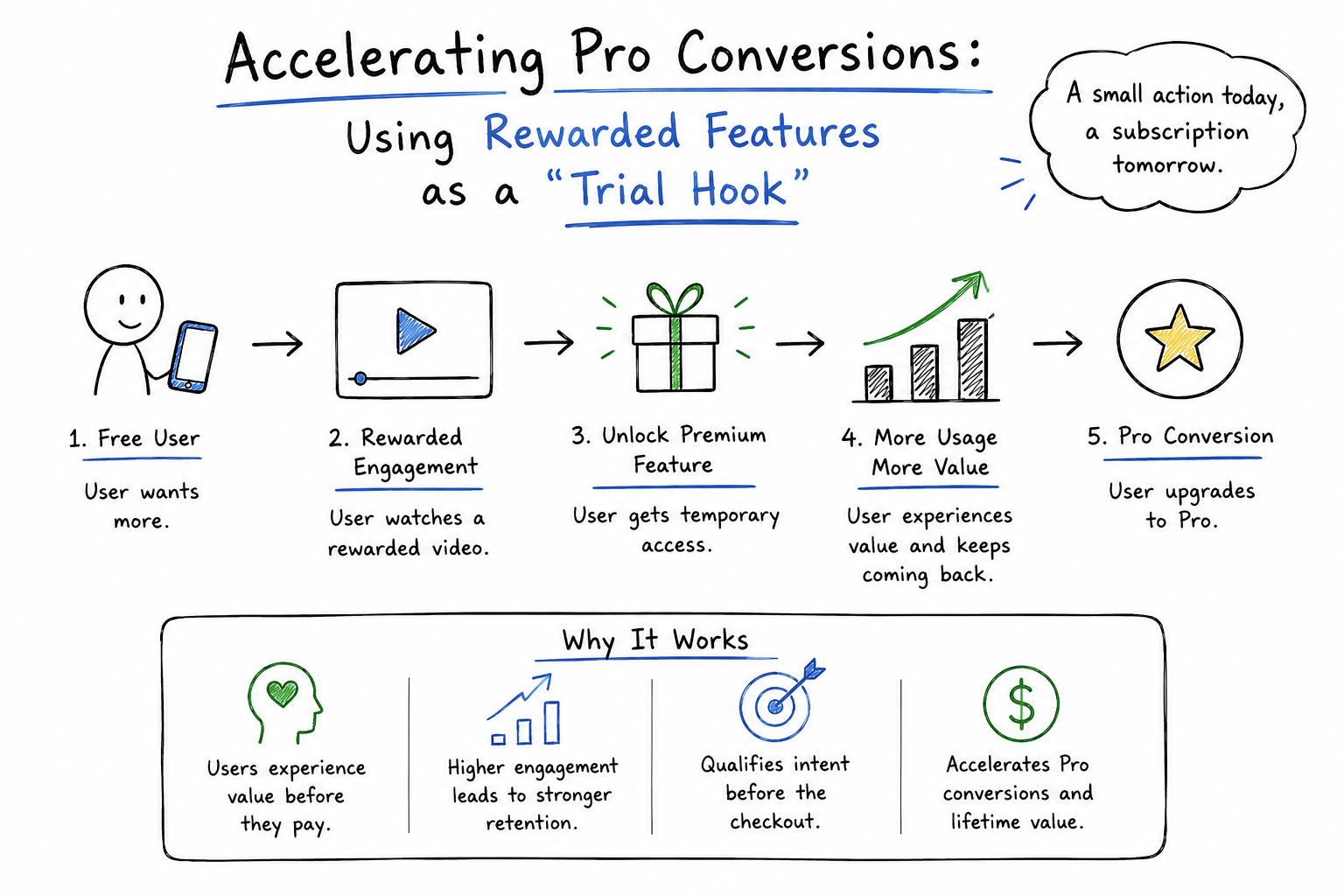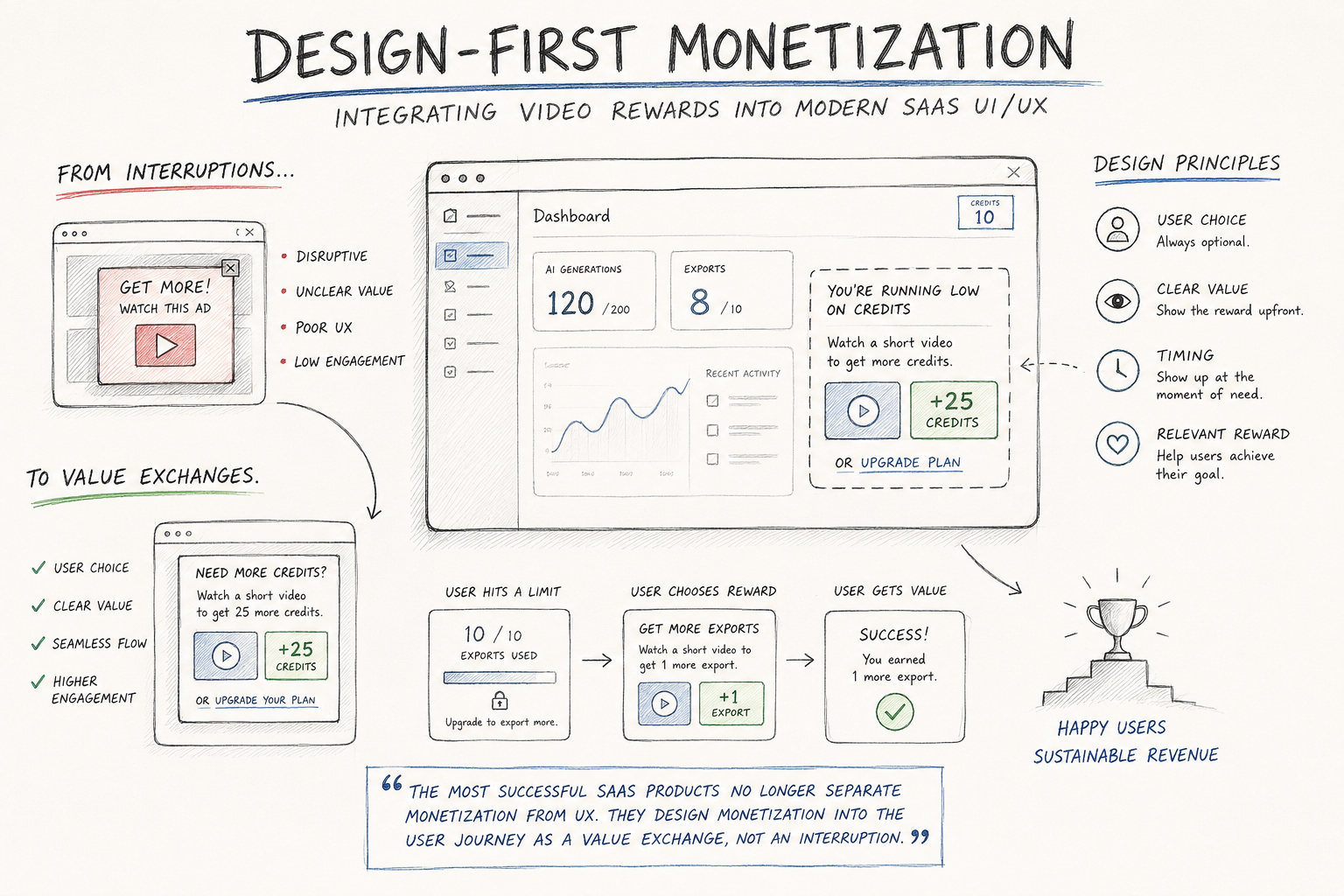
Design-First Monetization: Integrating Video Rewards into Modern SaaS UI/UX
How the next generation of SaaS products are borrowing from gaming to build value exchanges users actually choose. Design-First Monetization: Integrating Video Rewards into Modern SaaS UI/UX is rapidly emerging as a strategic approach for companies seeking to engage users more meaningfully and drive retention.
| TL;DR
• For two decades, monetization and UX were treated as opposing forces — ads were UX debt added after launch. • Subscription SaaS shifted monetization closer to product design, but binary free-or-paid models leave most users unmonetized. • Rewarded video introduces a user-initiated value exchange: the user chooses to watch in return for a specific, immediate benefit. • Gaming proved the model works at scale. SaaS is now applying the same principles to AI credits, exports, storage, and feature trials. • The future of monetization is design-first: built into the user journey as a fair exchange, not bolted on as interruption. |
Introduction: The Evolution of Monetization Design
Web monetization started with banner ads stitched onto every margin. The SaaS boom replaced them with subscriptions, and for a decade the answer to “how do we make money?” defaulted to a pricing page with three tiers and an annual toggle. Underneath all of that, a quiet tension shaped how products got built: monetization teams wanted revenue events, product teams wanted clean user journeys, and the two rarely shared a whiteboard.
That tension is dissolving. The most thoughtful SaaS teams now treat monetization as a design discipline — something planned alongside onboarding, feature gating, and user flows rather than added after the product ships. Rewarded video, a format pioneered in mobile and web games, has emerged as one of the clearest expressions of this shift. It turns a moment that used to feel like an interruption into a moment that feels like a choice.
This piece looks at how monetization design evolved from afterthought to first-class product concern, why rewarded experiences fit modern UX principles, and how SaaS teams can apply the lessons gaming learned years ago.
The Old Model: Monetization Was an Afterthought
In the 2000s and early 2010s, monetization usually meant one of two things: display ads or popups. Both were added late in development, often after the product had already launched. Banner inventory was sold by intermediaries that had no relationship to the user experience. Interstitials appeared between actions users actually wanted to take. The unspoken assumption was that revenue lived downstream of design, and growth teams would “figure it out later.”
The downstream effects were predictable. Engagement dropped on pages cluttered with ad slots. Retention suffered when users associated returning to the product with returning to ads. Product teams started treating monetization as a kind of technical debt — a thing other teams kept adding that made the product worse. That mindset hardened into a generational belief: good UX and monetization pull in opposite directions, and the job of a designer is to minimize the damage.
That belief was never quite true. It described the implementation, not the underlying economics. But it shaped how a lot of products got built, and it took the subscription era to start unwinding it.
The Subscription Era Changed Everything
When Slack, Dropbox, Notion, and a wave of similar products demonstrated that users would pay recurring fees for software, monetization stopped being a layer on top of the product. It became the product. Pricing pages had to map onto feature sets. Feature sets had to map onto user value at different stages of adoption. The decisions of “what’s free?”, “what unlocks upgrade?”, and “how much value should a non-paying user receive?” became core design questions, not finance questions.
This is when the discipline started maturing. Designers, PMs, and growth leads began co-owning monetization. Onboarding flows were tested for their effect on conversion. Feature gates were redesigned to feel like discoveries rather than walls. The vocabulary shifted from “ads” to “value exchange.”
But subscriptions also exposed their own limit: most users never convert. Even category-defining products typically see only a small fraction of free users move to paid. That leaves the majority of an audience producing engagement signals, but no revenue. The next question was inevitable: is there a way to capture value from those users without compromising the experience that brought them in?
The Rise of Value-Exchange Design
The answer being worked out across modern product design is that users are willing to pay with more than money. They will pay with time, attention, or data when the exchange is transparent and the benefit is real. The best products make the trade explicit so the user can decide whether it’s fair.
| User wants | Platform receives | Form of exchange |
| Extra storage | Recurring revenue | Subscription |
| Additional AI credits | Upgrade purchase | One-time payment |
| Premium content access | Ad impression revenue | Attention (rewarded video) |
| Advanced features | Direct payment | In-app purchase |
| Temporary feature trial | Engagement signal | Time investment |
Each row in that table is a deal. The deal works when the user understands what they give up and what they get back. It breaks when either side is obscured — when a free product quietly sells data the user didn’t know about, or when a paywall hides what’s behind it. Modern monetization design is, in large part, the practice of making these deals legible.
Why Rewarded Video Fits Modern UX Principles
Rewarded video is the format that most cleanly expresses value-exchange thinking. A traditional ad interrupts the user, removes control, and creates friction the user didn’t ask for. A rewarded video does the opposite: the user initiates the experience, the user knows the reward up front, and the user receives the benefit immediately on completion.
That distinction matters because it aligns with the principles modern UX work is built on:
- User autonomy — the choice to engage rests with the user, not the platform.
- Transparency — the cost (a short video) and the benefit (the reward) are visible before the user commits.
- Predictability — every interaction follows the same pattern, so users learn what to expect.
- Clear outcomes — the user receives a tangible, immediate result the moment the video ends.
When researchers measure user satisfaction across ad formats, rewarded video consistently outperforms display, interstitials, and offerwalls. The reason isn’t that the ads themselves are better. It’s that the surrounding deal is fairer.
| The most successful SaaS products no longer separate monetization from UX. They design monetization into the user journey as a value exchange, not an interruption. |