Vibe Coding Your Way to a Successful Game: Opportunities, Tradeoffs, and What Actually Works
How indie developers can keep the speed of intuition-driven building while adding just enough structure to actually generate revenue.
| TL;DR
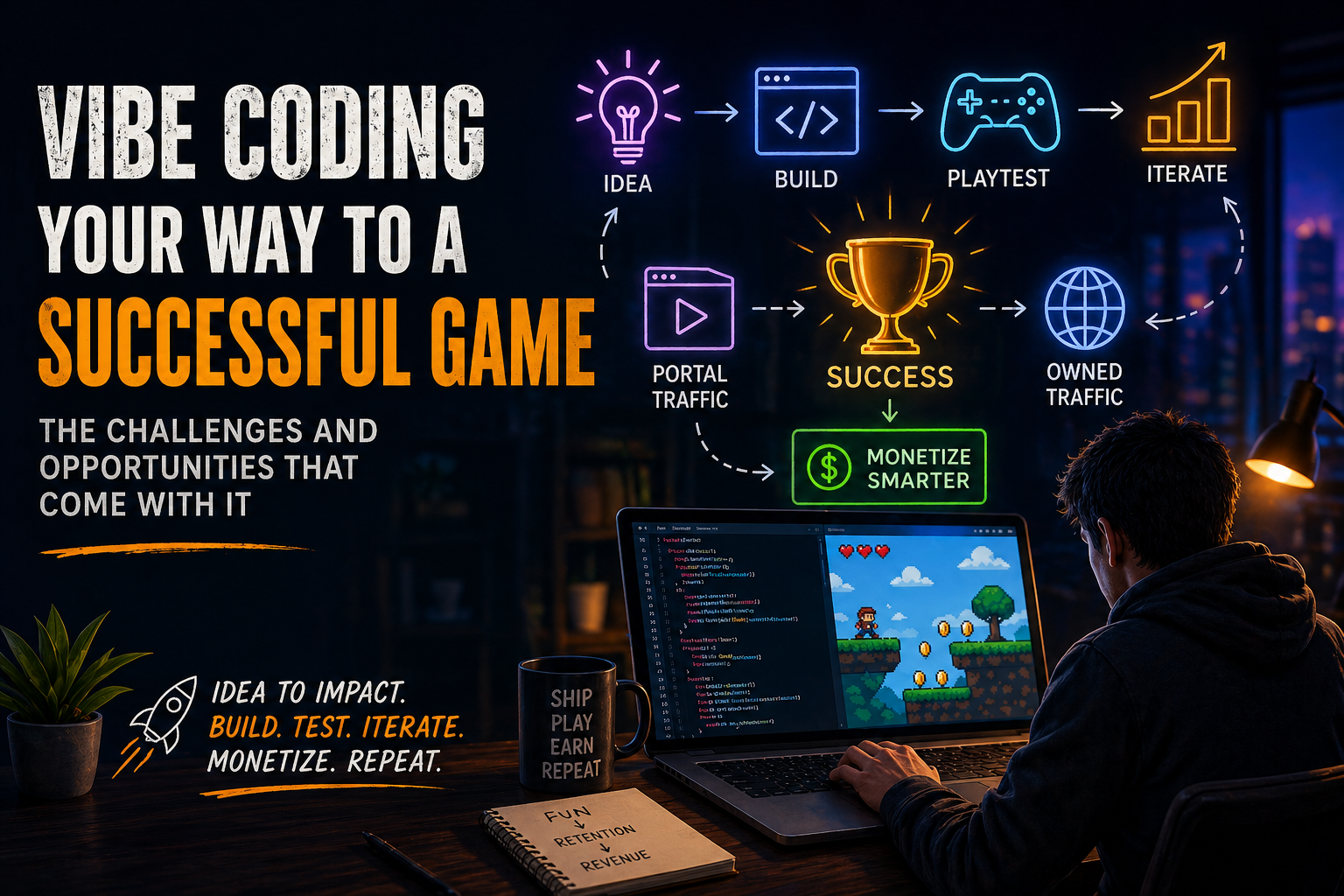
• Vibe coding — building games on intuition, speed, and AI-assisted iteration — is the dominant new mode for indie web game development. • It wins on prototyping speed, creative authenticity, and lean cost structure, but routinely breaks on retention, monetization, and scale. • The fix is not abandoning vibe coding. It is layering in a lightweight system: defined core loop, rewarded ads at natural breakpoints, simple analytics, and a mix of portal plus owned-domain distribution. • Winning indies use a new playbook: vibe → test → validate → structure → monetize → scale. |
1. The Rise of “Vibe Coding”
Something has shifted in how games get made. The old playbook — design document, milestone schedule, vertical slice, alpha, beta, launch — still exists, but it is no longer where most of the energy is. The energy is in a developer with a coffee, a code editor, an AI assistant, and a working prototype shipped to the web in a weekend.
Call it vibe coding: building based on feel, iteration speed, and creative instinct rather than rigid planning. AI tools generate boilerplate. Templates and engines remove friction. Distribution channels accept whatever you ship. The cost of trying an idea has collapsed, and so the way developers approach their craft has changed with it.
Which raises the obvious question: can you actually build a successful game this way — one that gets played, retained, and monetized — or does the approach quietly break the moment you try to scale it?
The honest answer is: both. Vibe coding is genuinely powerful, and it has clear failure modes. The developers who are winning right now have figured out which parts of the loose, intuitive workflow to keep, and which parts to harden up. This post is about exactly that.
2. Why Vibe Coding Is Exploding Right Now
Four forces are pushing this shift, and they are reinforcing each other.
AI-assisted development
Code, art, sound effects, and even music can now be generated or scaffolded in minutes. The unit cost of a game asset has fallen by an order of magnitude. A solo developer can produce something that would have required a small team three years ago.
Low-barrier engines
Unity WebGL, Three.js, Phaser, PlayCanvas, and Godot have made browser-based games cheap to build and trivial to deploy. There is no install friction, no app store review, no platform certification process to grind through.
Distribution without gatekeepers
itch.io, CrazyGames, Poki, Newgrounds, Kongregate-style portals, and self-hosting all let developers ship without asking permission. A finished build can go from your laptop to a global audience in a single afternoon.
Shorter attention cycles
Players try and abandon games faster than ever. In a market where the median session might be three minutes, the value of polishing a single concept for two years is questionable. The value of testing twenty concepts in two months is enormous.
| “Speed is now a competitive advantage, not just a development convenience. The developer who can put a playable build in front of real users this week beats the developer who is still planning their feature list.” |
3. What Vibe Coding Gets Right
Before the criticism, the credit. Vibe coding is not a fad — it is genuinely well-suited to the current state of web game development, and it gets several things meaningfully right.
3.1 Rapid Prototyping = More Shots on Goal
The old model assumed you knew what would work before you started. The new model assumes you do not, and treats that uncertainty as a design constraint. Instead of overinvesting in one idea, vibe coders ship five or ten and let players decide.
This matters because hit detection in games is notoriously bad. Even experienced studios cannot reliably predict which of their concepts will retain. The only reliable signal is real player behavior, and you only get that signal by shipping.
3.2 Creative Authenticity
When a game is built fast, it tends to stay closer to its original spark. There is less time to over-engineer, less space for committee-driven feature creep, less pressure to hit every supposed best practice. What survives is the mechanic that felt fun on day one — which is, not coincidentally, often what drives retention on day thirty.
3.3 Lean Cost Structure
A solo developer or two-person team can now produce games that compete for attention with studio releases. The upfront capital required is minimal. That changes the ROI math entirely. You do not need a million plays to break even — you need a few thousand, and a working monetization layer.
3.4 Perfect Fit for Web Games
Browser games are uniquely aligned with the vibe coding ethos. There is no install friction, no platform tax, no certification gate. A player clicks a link and is in the game in under five seconds. Fast iteration on the developer side maps perfectly to fast trial on the player side. The two halves of the loop reinforce each other.
4. Where Vibe Coding Breaks Down
Now the harder part. The same workflow that produces lean, creative prototypes also produces predictable failure patterns the moment a game starts getting traction. These are not edge cases — they are the default outcome unless something is deliberately done about them.
4.1 Lack of System Design
Code written on intuition tends to entangle itself. State management gets ad-hoc. Asset pipelines are improvised. Performance issues do not surface until a game has thousands of concurrent players, at which point fixing them requires either a rewrite or a long, painful refactor. Technical debt accumulates faster than it does in a structured codebase, simply because nothing was ever written down or planned.
4.2 Monetization Is an Afterthought
The most consistent failure pattern: a game gets built for fun, ships, gets traffic, and then the developer tries to bolt on monetization at the end. The result is awkward, low-yielding ad placements that frustrate users without generating meaningful revenue.
The monetization opportunities most often missed:
- Rewarded video ads at natural session breakpoints — death screens, level transitions, retry moments.
- Session design that creates monetizable moments rather than treating ads as interruptions to gameplay.
- Progression systems where temporary boosts or unlocks can be earned through opt-in ad views.
4.3 Retention Blind Spots
Fun is not the same as sticky. A game can produce a delightful three-minute experience and have zero reason for the player to come back tomorrow. Vibe-coded games often have no progression loop, no daily reason to return, no compounding sense of investment. Retention metrics — D1 and D7 in particular — collapse quickly, and the game enters its plateau phase before it ever found its audience.
4.4 Distribution Misalignment
Relying entirely on a single portal is the most common distribution mistake. Portal CPMs are often a fraction of what the same player generates on a developer-owned domain. Traffic can grow steadily while revenue stays flat, because the economics of the channel cap the upside no matter how successful the game becomes.
5. The Reality Check: Why Most Vibe-Coded Games Stall
The pattern is depressingly consistent across hundreds of indie web releases. A game launches quickly, gets a burst of initial traction from a portal feature or social share, climbs for a few weeks, then plateaus. The developer iterates for a while, sees diminishing returns, and eventually moves on to the next prototype.
The core issue is almost never quality. The core issue is the absence of a transition from prototype to product. Three metrics tend to break first.
| Metric | What Breaks | Why It Matters |
| Retention (D1 / D7) | Steep drop after first session | No progression loop or reason to return tomorrow |
| Session Length | Short, single-arc sessions | No structural moments to monetize or extend play |
| Revenue per User | Stays near zero or flat | Ads bolted on after launch perform worse than ads designed in |
| Conversion Funnel | High top-of-funnel, low repeat play | Portal-only distribution with no owned channel |
Notice that none of these are fixed by making a better-feeling game. They are fixed by adding structure around the game. That is the move most vibe-coded titles never make.
6. Turning Vibe Coding into a Scalable Strategy
Here is the productive reframe: the goal is not to abandon the speed and intuition that make vibe coding work. The goal is to layer in just enough system that the resulting product can actually scale and earn. Four moves matter.
6.1 Keep the Speed, Add Structure
You do not need a 200-page design document. You do need three things written down before the build starts hardening:
- A defined core loop. What is the player doing in the first 30 seconds, and why are they doing it again 30 seconds later?
- A simple progression system. Even one persistent counter — XP, currency, unlocked levels — gives players a reason to return.
- Event tracking from day one. Every session start, every death, every level completion, every ad impression. You cannot optimize what you do not measure.
6.2 Monetization by Design (Not After)
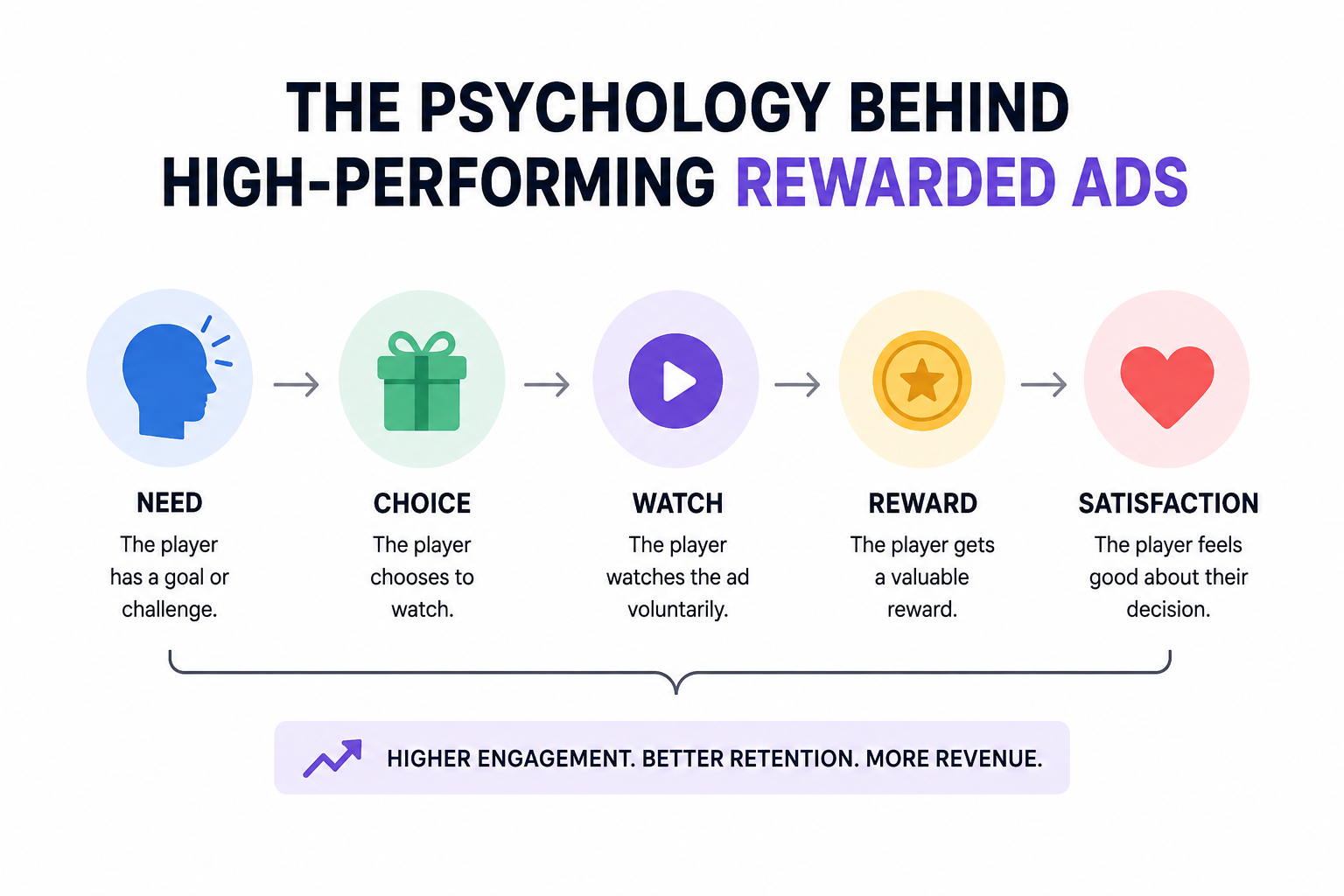
The single highest-leverage decision in indie web game economics: design monetization moments into the game from the start, not as a post-launch addition. Rewarded video is the format that consistently works because it is opt-in — the player chooses to watch in exchange for something they want.
Two patterns that consistently convert:
- Continue run: player dies, gets offered a chance to revive by watching a short video ad.
- Unlock next level / claim bonus: player completes a level, gets offered a reward (extra coins, hint, cosmetic) for an opt-in view.
These moments work because they align the developer’s interest (a viewed ad) with the player’s interest (a continued game). When monetization aligns with desire, opt-in rates climb and the experience does not feel exploitative.
6.3 Own Your Traffic
Portals are excellent top-of-funnel acquisition. They are mediocre revenue channels. The winning structure uses both.
- Portal distribution brings discovery and volume. Treat it as paid marketing — except instead of paying with money, you are paying with a CPM gap.
- Direct domain monetization captures the high-value traffic. Players who follow your branding to your own site convert at materially higher rates.
This split is how you transition from a game that gets played to a game that earns. It is also where most indie developers leave the most money on the table.
6.4 Iterate with Data, Not Just Feel
Vibe is a great way to start a game. It is a poor way to optimize one. Once a build is live, the questions become specific and answerable: where are players dropping off, how often are they completing the rewarded ad opportunity, how deep is the median session, which levels cause churn.
The developers who scale do not stop trusting their instincts. They start triangulating their instincts against actual player behavior.
7. What a Successful Vibe-Coded Game Looks Like
To make this concrete, here is a composite pattern that describes how a typical successful indie web game progresses through its lifecycle. No specific title — just the shape of the trajectory that consistently works.
| Phase | Duration | What Happens | What Gets Built |
| 1. Prototype | 1–2 weeks | Build the core loop, ship rough version | Mechanic, basic art, single level |
| 2. Traction | 2–4 weeks | Release on portals, watch real player behavior | Initial analytics, light polish |
| 3. Optimization | 4–8 weeks | Add retention loops, integrate rewarded ads | Progression system, ad placements, daily reward |
| 4. Scale | Ongoing | Drive high-intent users to owned domain | Branded site, direct monetization, content updates |
The crucial transition is between Phase 2 and Phase 3. This is where the vibe-coded prototype becomes a product. Most games never make this jump — not because they cannot, but because the developer treats Phase 2 traction as the finish line rather than the starting line.
8. The New Playbook for Indie Developers
It helps to put the old and new approaches side by side.
| Old Model | New Model |
| Build | Vibe |
| Polish | Test |
| Launch | Validate |
| Hope | Structure |
| — | Monetize |
| — | Scale |
The old model assumed quality was the bottleneck and that a polished, finished product would find its audience. The new model assumes discovery is the bottleneck, that quality is found through iteration with real users, and that monetization and scale are deliberate stages — not happy accidents that occur after launch.
| “Vibe coding is not the problem. Stopping at vibe coding is the problem.” |
9. Key Takeaways
- Vibe coding is a legitimate and powerful approach to indie game development — it wins on speed, creativity, and cost.
- Its weaknesses are predictable: weak retention, afterthought monetization, and over-reliance on a single distribution channel.
- Speed creates opportunity. Systems create revenue. You need both.
- The successful indie devs of this era keep their creative edge intact and layer in just enough structure to scale — defined core loop, rewarded ads at natural breakpoints, basic analytics, and a portal-plus-owned-domain distribution mix.
- The transition from prototype to product is the single most important move. Most games never make it. The ones that do tend to compound.
Quick Checklist: Is Your Vibe-Coded Game Ready to Monetize?
If you can answer yes to most of these, your game is structurally ready to start earning. If most are no, the highest-leverage work is here, not in adding more features.
| • Your core loop is defined in one sentence.
• You have a progression system, even a simple one (XP, coins, unlocks). • Event tracking is live: session starts, deaths, level completions, ad impressions. • There is at least one natural breakpoint where a rewarded ad fits the player’s desire (continue, unlock, bonus). • You have measured D1 retention on real users and have a baseline. • You have a distribution plan that is not 100% dependent on one portal. • There is a path — even an early one — to send high-intent players to a domain you control. |
Frequently Asked Questions
What is vibe coding in game development?Vibe coding refers to building games based on intuition, fast iteration, and creative instinct rather than rigid planning. It typically leverages AI-assisted tools, lightweight engines, and direct-to-web distribution to compress the cycle from idea to playable build down to days or weeks instead of months. |
Can vibe-coded games actually make money?Yes, but typically only when monetization is designed in from the start rather than added afterward. The most reliable revenue comes from rewarded video ads placed at natural breakpoints — continue-on-death, level unlocks, bonus claims — combined with a distribution mix that includes a developer-owned domain rather than relying solely on portal traffic. |
Why do most vibe-coded games stall after launch?The pattern is almost always the same: the game ships fast, gets initial traction, then plateaus because the developer never built the structural layer that turns traffic into a product. Retention loops are missing, monetization is an afterthought, and distribution is locked into a single low-CPM channel. The fix is to add system — not abandon speed. |
What is the best ad format for indie web games?Rewarded video consistently outperforms other formats for indie web games because it is opt-in. The player chooses to watch in exchange for something they want — an extra life, a level unlock, a bonus reward. This alignment between developer and player interest produces higher engagement rates and better long-term retention than interruptive formats. |
Should indie developers rely on portals like CrazyGames or Poki?Portals are excellent for top-of-funnel discovery but typically pay lower CPMs than direct distribution. The winning structure uses portals as paid acquisition (you pay with a CPM gap rather than cash) while building an owned domain to capture and monetize high-intent traffic at higher rates. |
How fast can I integrate rewarded ads into a vibe-coded game?With a modern HTML5 rewarded ads SDK, integration into a working web game can be completed in a single afternoon. The technical work is minimal. The harder work — and the more important work — is choosing the right in-game moments for the ad placements so that they feel like an offer, not an interruption. |
Already getting traffic? You’re closer to revenue than you think.AppLixir’s rewarded ads SDK is built for HTML5 and WebGL web games — fast integration, transparent reporting, and revenue that scales with the players you already have. If your game is past the prototype phase, the monetization layer is the highest-leverage work you can do this month. |