Idle Game Monetization: Rewarded Ads, IAP and Key Metrics
| TL;DR
• Idle games suit rewarded video better than almost any other genre. The core loop already contains the reward: more resources, faster progress, or doubled offline earnings. • The strongest idle placements are the offline-earnings doubler on return, timed boosts, and time skips. Each offers a reward sized to the player’s current income, so it stays valuable at every stage of the game. • Size rewards relative to income, not as fixed amounts. A fixed reward that matters in hour one is worthless by day ten. • Idle players return many times a day, so cap rewarded offers per day as well as per session, and judge changes on Day-7 retention and ARPDAU together. • Browser idle games need a web-native rewarded video partner. Mobile networks such as Unity Ads and AdMob do not serve web. |
What is idle game monetization?
Idle game monetization is how idle (or incremental) games earn revenue: mainly rewarded video ads that speed up or multiply progress, plus in-app purchases for permanent boosts and convenience. Idle games progress while the player is away, so their revenue depends on return visits rather than long continuous sessions.
For how revenue models compare across all genres, see how free-to-play games make money. This page is only about idle and incremental games.
Why do rewarded ads fit idle games so well?
Rewarded ads fit idle games because an idle game’s whole economy is a rate of progress, and a rewarded video can change that rate. The player sees exactly what the ad is worth (“double your 4 hours of offline earnings”), so the value of opting in is concrete. Players also make that choice many times a week.
Most genres have to create a moment of need, such as a failed level or a locked item. Idle games have one built in at every return visit.
The rewarded placements that work in idle games
The best idle placements multiply something the player already has, rather than handing out a fixed gift.
| Placement | What the player gets | Why it holds up |
| Offline-earnings doubler | 2x (or more) the resources earned while away | Shown at the moment of return, when the reward is largest and most visible |
| Timed boost | Faster production for a set period | Stacks naturally with active play; the value is easy to see |
| Time skip | Several hours of production instantly | Solves a real wait without selling the game’s pacing away |
| Prestige or reset bonus | Extra currency when the player resets for a multiplier | Adds value at a decision point the player is already thinking about |
| Free premium currency | A small amount of hard currency | Useful as a daily offer; weak if repeated too often |
What to avoid: offers with no connection to the player’s current state, and anything that makes a normal wait feel like it cannot be finished without watching.
How should rewards scale as an idle game progresses?
Scale every reward to the player’s current income, not to a fixed number. Idle economies grow by orders of magnitude, so a fixed reward of 1,000 coins is generous at the start and meaningless a week later, and opt-in rate collapses with it. Express rewards as time (“4 hours of production”) or as a multiplier (“2x offline earnings”) and they stay relevant for the whole life of a save.
Check the balance from the other side too: a rewarded time skip should not be worth more than the in-app purchase sitting next to it, or it will undercut your own store.
Rewarded ads and in-app purchases: how do they work together?
Rewarded ads and in-app purchases serve different players and work together when each has a clear job. Most idle players never pay, and rewarded video is how the game earns from them. Paying players buy permanence and convenience: permanent multipliers, automation, ad-free offer claims. A common pattern is an in-app purchase that grants the rewarded bonuses without the video. It earns from players who value their time and keeps the rewarded offers for everyone else.
For the wider trade-offs, see hybrid monetization: how the model works.
Which metrics show an idle game is monetizing well?
Track rewarded engagement and retention together, because an idle game can raise ad revenue this week by eroding the return visits next week’s revenue depends on.
- Opt-in rate per placement: the share of players shown an offer who accept it. It is the earliest warning that an offer has gone stale.
- Rewarded views per daily active user: how much of the audience the rewarded loop actually reaches.
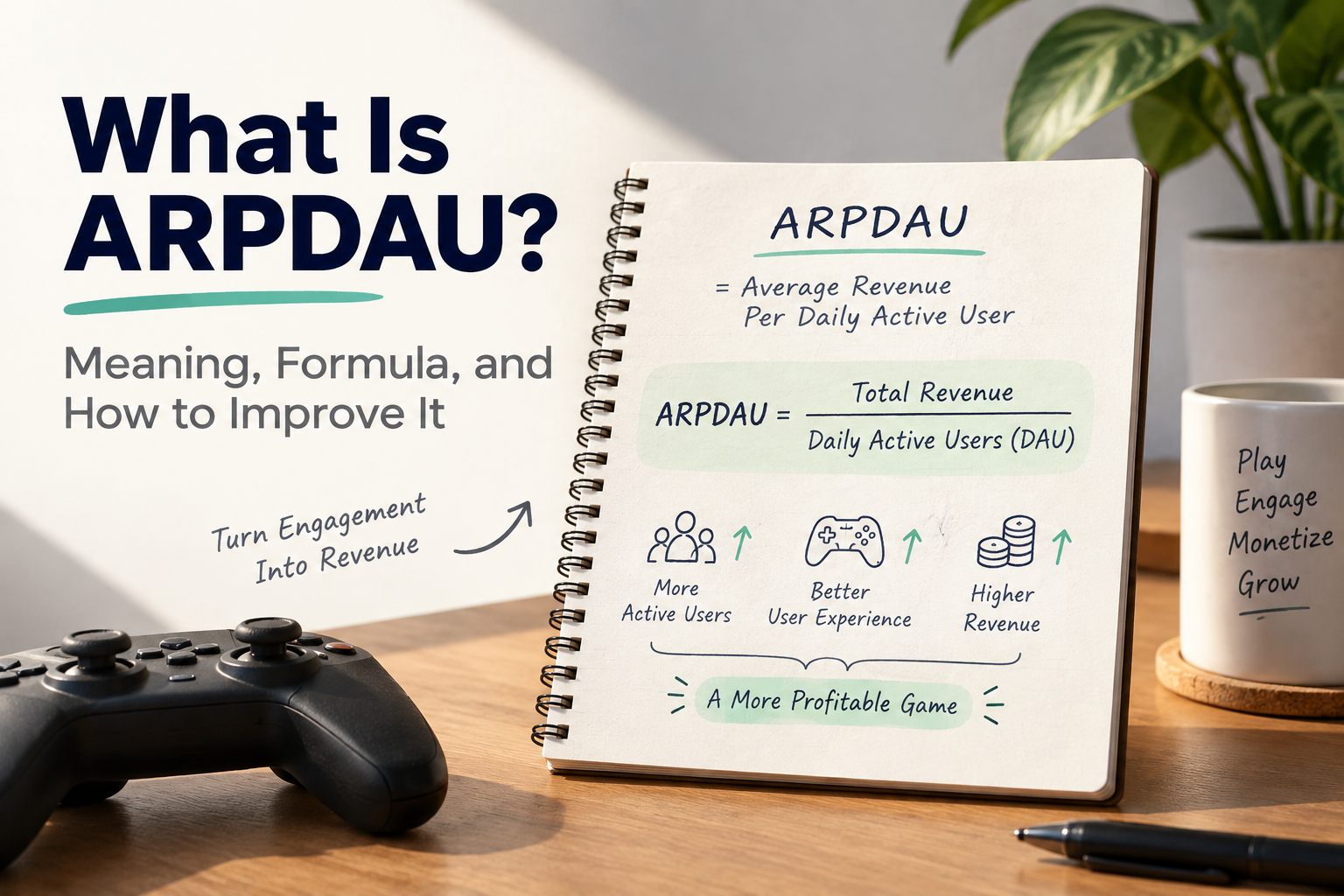
- ARPDAU: revenue per daily active user, ads and in-app purchases combined. See what ARPDAU is and how to improve it.
- Day-1, Day-7 and Day-30 retention: idle games live on return visits, so Day-7 matters more here than in session-based genres.
- eCPM: what each thousand rewarded impressions earns, which varies by country and demand. See eCPM optimization for web games.
How often should an idle game offer rewarded ads?
Offer rewarded video at the natural moments of need, then cap offers per session and per day. Idle players return many times a day, so a per-session cap alone lets a heavy player see dozens of offers. A daily cap plus a cooldown between offers keeps each offer valuable. How to find the right ceiling is covered in how many rewarded ads per session.
Monetizing idle games in the browser
Browser idle games follow the same design as mobile ones, with two differences: players often keep the game open in a background tab, and there is no app store handling payments or ads. Measure offline earnings from the last active visit, not from the last time the tab was loaded. Choose a rewarded video partner that serves web. Unity Ads, AdMob and AppLovin are built for mobile apps and do not serve browser games.
Many idle games reach players through distribution platforms such as Poki and CrazyGames, which run their own ad setups on the games they host. AppLixir works alongside that distribution: it monetizes the traffic that reaches the game on your own site or domain.
Where AppLixir fits
AppLixir is a rewarded video platform built for web games, including browser idle and incremental games. It integrates in the browser with JavaScript, supports TCF 2.3 consent for European players, and pays out on the rewarded views your players choose to watch. The publisher minimum is 5,000 daily active users.
FAQ
What is the best ad format for idle games?
Rewarded video. Idle games already give the player a reason to want more resources or faster progress, and a rewarded video can deliver exactly that. Interstitials interrupt a genre whose players value calm, uninterrupted progress.
Do idle games make more money from ads or in-app purchases?
It varies by game. Most idle players never pay, so rewarded video earns from the majority, while in-app purchases earn more per paying player. Well-run idle games use both, with a clear job for each.
How do you stop rewarded ads from breaking an idle game’s economy?
Size rewards relative to the player’s current income and keep them below the value of the matching in-app purchase. Never make a normal wait impossible to finish without watching.
Are idle games a good fit for web and browser play?
Yes. Idle games run well in the browser, keep players returning, and need little bandwidth. The main requirement is a rewarded video partner that serves web, because the major mobile ad networks do not.