How Many Rewarded Ads per Session? Frequency Caps for Web Games
| TL;DR
• There is no universal right number of rewarded ads per session. The right cap is the highest one where retention and session length hold steady against a control group, and you find it by testing, not by copying another game. • Cap rewarded video in two ways at once: a ceiling per session and a cooldown between offers. Either one alone lets a burst of offers through. • Rewarded video tolerates more frequency than interstitials because the player chooses every view. Offers still become noise when they appear too often, and opt-in rate is the first metric to show it. • Judge a cap change on ARPDAU and Day-1/Day-7 retention together. Rewarded views per session going up while retention goes down is a loss, not a gain. • On the web, frequency caps run on session and page signals rather than a mobile advertising ID, so define “session” in your own code before you set a number against it. |
What is a rewarded ad frequency cap?
A rewarded ad frequency cap is a limit on how often a game offers the player a rewarded video: a maximum number of offers per session, per day, or both, usually combined with a minimum time between offers (a cooldown). It controls how often the offer appears, not whether the player watches. The player still chooses each view.
The cap exists because rewarded video only works while the offer feels like a choice. The rewarded video ad placement playbook covers where offers belong in a game loop. This page covers how often.
How many rewarded ads per session should a web game show?
A web game should offer as many rewarded videos per session as it can before retention or session length moves against a control group, and no more. That number depends on session length, how often the game creates a genuine need (a failed level, a locked item, a timer), and how valuable the reward is.
Three things set the ceiling:
- Session length. A 3-minute arcade session and a 40-minute idle session cannot share a cap. Longer sessions support more offers, provided each one is tied to a real moment of need.
- Moments of need. Count the points in a normal session where a reward genuinely helps: a continue after failure, a hint, a doubled payout, an extra life. The cap should not exceed that count. Offers with no moment of need behind them are the ones players learn to ignore.
- Reward value. A reward that changes the next minute of play earns repeat views. A token reward does not, however often it is offered.
AppLixir median rewarded views per engaged session on web games, tend to be 4-6
Why cap rewarded video if players choose to watch?
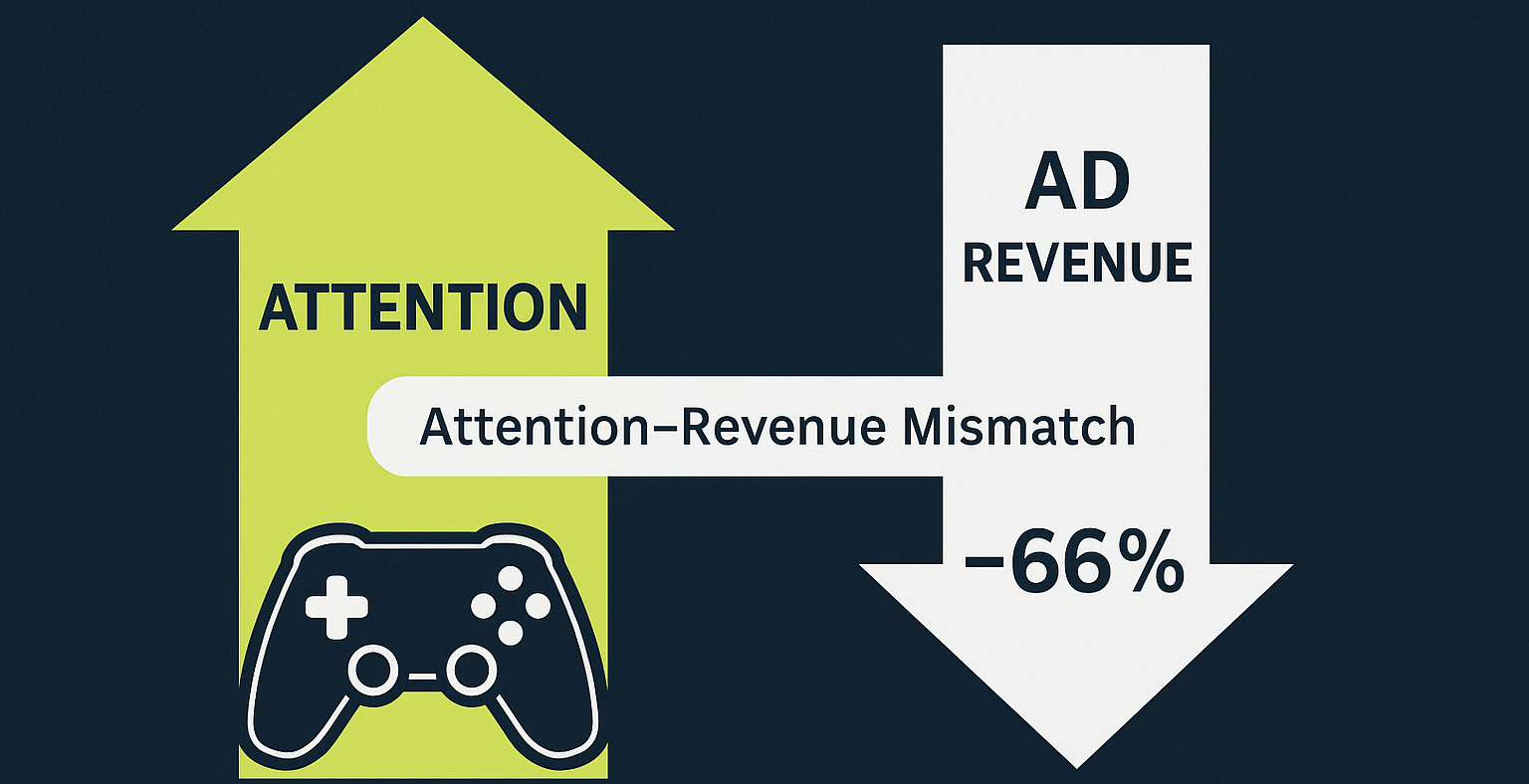
Rewarded video is opt-in, so it does less damage per impression than a forced ad, but it is not free of cost. Every offer takes screen space and a moment of the player’s attention, and a player who declines the same offer repeatedly learns to stop reading it. The symptom is a falling opt-in rate, which pulls down revenue from every placement, including the good ones.
Interstitials are a different case. They fire without consent, so their cap is the main way to protect retention. The trade-off between the two formats is covered in rewarded vs interstitial ads. For rewarded video, the cap protects the opt-in rate.
Per-session cap, daily cap or cooldown: which should you use?
Use a per-session cap and a cooldown together, and add a daily cap only if players return many times a day.
| Control | What it stops | Weak spot on its own |
| Per-session cap | Too many offers in one sitting | Allows several offers back to back |
| Cooldown (minimum time between offers) | Offers stacking in a short burst | Allows a very long session to pile up offers |
| Daily cap | Heavy repeat visitors seeing offers all day | Does nothing within a single long session |
A cooldown measured in play time, not wall-clock time, behaves better in web games. A tab left open in the background should not “earn” a fresh offer.
How do you define a session in a browser game?
On the web there is no app launch to mark the start of a session, so define one in your own code before you cap against it. A common definition is continuous activity in the game’s tab, with the session ending after a set period of inactivity or when the tab closes. Whatever the definition, use the same one in the cap, in analytics and in the A/B test. A cap counted per page load and a retention metric counted per visit will disagree.
Web games also cannot rely on a mobile advertising identifier for capping. Caps run on first-party signals: session state in the page, local storage, or your own user ID. Consent matters here as well. Under GDPR and TCF 2.3, storage for advertising purposes follows the player’s consent choice, so the capping logic should still behave sensibly for a player who declines.
How do you test a higher cap without hurting retention?
Test a cap change as an experiment with a holdout group, and judge it on retention and ARPDAU together.
- Hold the placement fixed. Change only the cap or the cooldown, so the result is about frequency and not about a new placement.
- Split players, not sessions. A player who sees cap A on Monday and cap B on Tuesday measures nothing.
- Read four numbers: opt-in rate, rewarded views per session, Day-1 and Day-7 retention, and ARPDAU. See what ARPDAU is and how to improve it for how to calculate it consistently.
- Keep the higher cap only if ARPDAU rises and retention holds. More views with lower retention borrows from next week’s revenue.
- Watch the first session separately. New players judge a game quickly, so a cap that is fine for returning players can cost first-session retention.
Frequency caps by genre
Genre sets session length and moments of need, so it sets the starting point for a cap.
- Arcade and hyper-casual: short sessions with frequent failure points. Continues after failure carry most rewarded views, so a cooldown matters more than a high session cap.
- Idle and incremental: long sessions and returning visits. Offline-earnings doublers and time skips support several offers per day. A daily cap is worth adding.
- Puzzle, word and trivia: hints, extra guesses and skips are natural moments of need. Tie the cap to puzzles attempted rather than to minutes played.
- IO and multiplayer: respawns and cosmetic unlocks work well. Do not offer anything that changes competitive balance mid-match, however low the cap.
For how these choices fit a wider revenue plan, see how free-to-play games make money.
Where AppLixir fits
AppLixir is a rewarded video platform built for web games and browser-based content. It is not a mobile SDK ported to the browser. Placement, cap and cooldown logic stay in your game code, where your game state lives, and AppLixir serves the rewarded video when the player opts in. Mobile networks such as Unity Ads, AdMob and AppLovin do not serve web games, so on a browser build the frequency question comes up at the same time as the choice of a web-native partner. Games distributed through Poki or CrazyGames run on those platforms’ own ad setups. AppLixir sits alongside them on the traffic you host yourself. The publisher minimum is 5,000 daily active users.
FAQ
Is there a standard number of rewarded ads per session?
No. The right number depends on session length, how many genuine moments of need a session creates, and the value of the reward. Treat any published number as a starting point for a test, not a setting to copy.
Do rewarded ads need a frequency cap if they are optional?
Yes. Optional ads cost less per impression than forced ones, but offers that appear too often teach players to ignore them. Opt-in rate falls first, and revenue from every placement falls with it.
Should rewarded ads and interstitials share one cap?
Keep separate caps and one overall ceiling. Interstitials interrupt without consent, so they need the tighter cap. Rewarded offers can run more often, as long as the combined ad load does not push retention down.
How long should a cooldown between rewarded offers be?
Long enough that offers never stack at a single moment in play. Measure the cooldown in active play time rather than wall-clock time, and test it the same way as the session cap: against a holdout, on retention and ARPDAU.
What is the first sign that a rewarded ad cap is too high?
A falling opt-in rate, followed by shorter sessions. If rewarded views per session rise while Day-1 retention slips, the extra views are costing more than they earn.