Rewarded Ads for Enterprise Web Games: Architecture, Reporting, and SLA Considerations
| TL;DR: Rewarded ads are the highest-performing monetization format for web games — but only when implemented with low-latency ad delivery architecture, real-time reward validation, enterprise-grade reporting pipelines, and clear SLA guarantees across fill rate, uptime, and reward integrity. Enterprise success = UX-safe monetization + verifiable rewards + predictable revenue. |
Why Rewarded Ads Win at Enterprise Scale
The old assumption in game monetization was that ad revenue always came at the cost of user experience. Force an ad on a player mid-session and you’d see a short-term revenue bump followed by a retention dip you’d spend months trying to fix. That tradeoff, for the most part, is dead — and rewarded ads are what killed it.
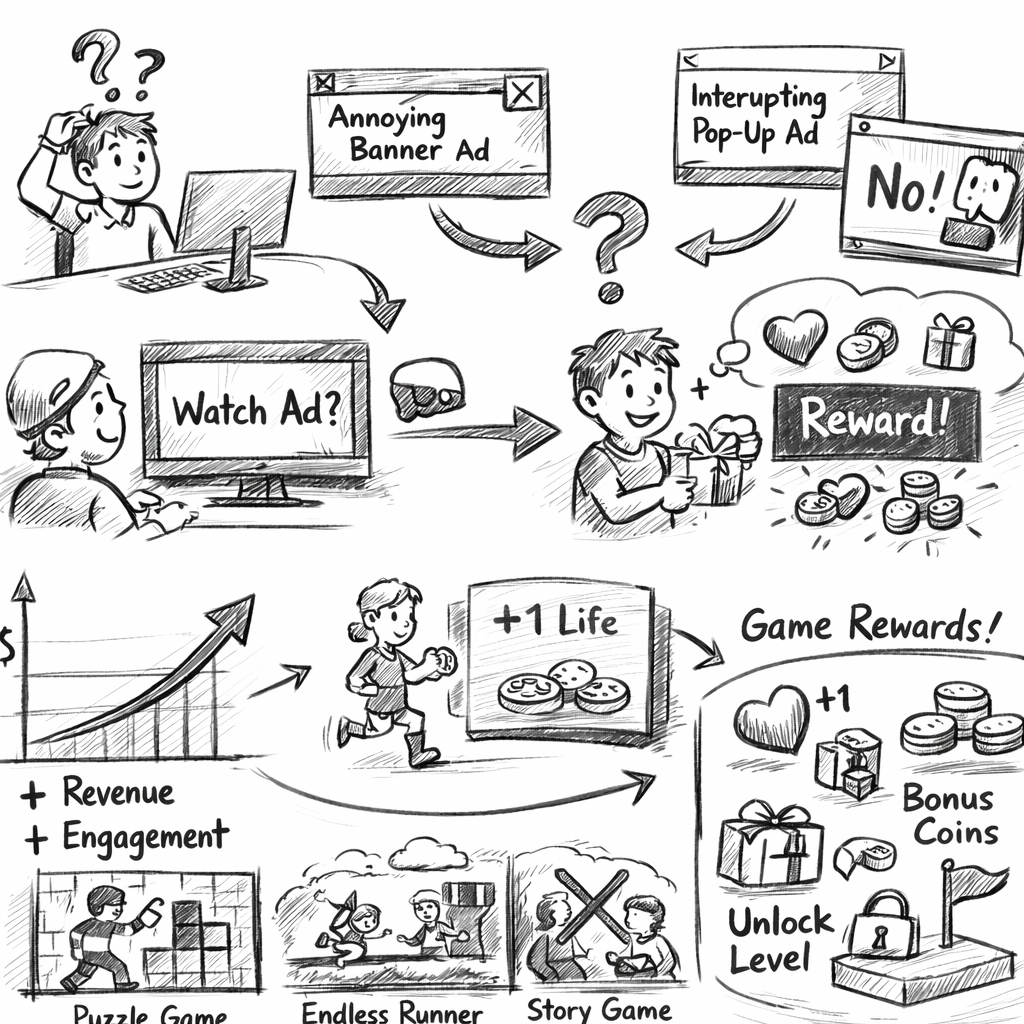
Unlike interstitials, which interrupt gameplay with no player consent, or banners, which deliver CPMs too low to justify the screen real estate, rewarded ads align the incentives of the developer, the advertiser, and the player. The user opts in. They watch a video to earn an extra life, a currency boost, or a content unlock. They get something they want. The developer gets paid. The advertiser gets a genuinely engaged viewer.
At enterprise scale, this dynamic shows up clearly in the numbers. Rewarded video consistently delivers 5 to 10 times higher eCPM than banner formats and drives 3 to 4 times higher engagement rates than non-opted-in ad placements. More importantly, the metrics that enterprise teams actually care about — ARPDAU, session length, and retention delta — all trend positively when rewarded ads are implemented correctly.
Rewarded ads are not just an ad format. They are a game mechanic — and the best ones are indistinguishable from the game itself.
That framing matters. Studios that treat rewarded ads as a monetization bolt-on tend to implement them poorly and see mediocre results. Studios that architect them as a core loop mechanic — with the same care given to progression systems or economy design — unlock their full revenue potential without damaging the player relationship.
Enterprise Architecture for Rewarded Ads
System Overview
A production-grade rewarded ad system for an enterprise web game is not a single SDK call. It is a distributed system with at least five distinct layers: the client-side game (WebGL or HTML5), the ad SDK, the ad exchange and demand-side platforms, a reward validation server, and an analytics pipeline. Each layer has its own failure modes, latency characteristics, and optimization levers. Understanding all five is what separates a working implementation from a scalable one.
Client-Side Flow and UX Triggers
On the client, the most important engineering decision is when and how to trigger the ad opportunity. The highest-performing placements share a common trait: they appear at a moment of natural player motivation. ‘Continue after failure’ prompts — where a player has just lost progress and is offered a chance to recover by watching an ad — consistently outperform passive placements. Optional currency or boost offers placed between sessions or at the start of a run are the next strongest category.
What to avoid is equally important. Forced rewarded flows, where a player is required to watch an ad to proceed, erode the opt-in dynamic that makes rewarded ads work in the first place. Players will accept a well-timed offer. They will resent a toll.
On the technical side, two requirements are non-negotiable: the SDK must load asynchronously so it never blocks the main game thread, and ads must be pre-cached before the trigger point is reached. A player who taps ‘Watch ad to continue’ and sees a loading spinner is a player who closes the tab. Pre-caching eliminates that friction. Graceful fallback handling — where the UI adapts cleanly when no fill is available — ensures the game experience degrades without breaking.
Server-Side Reward Validation
This is the architectural decision that separates amateur implementations from enterprise ones: never trust the client to deliver rewards.
Client-side reward delivery is trivially exploitable. A player — or a bot — can trigger a reward callback without completing an ad view, and a client-side-only implementation has no way to verify the difference. At scale, this becomes a fraud and economy integrity problem that is extremely difficult to remediate after the fact.
The correct pattern is to route reward delivery through a server-side validation step. When a player completes an ad view, the SDK fires a callback with impression data. That data goes to your reward server, which verifies the impression against the ad network’s verification endpoint before issuing the reward. This adds a round trip, but the latency impact is manageable — enterprise targets for reward confirmation time are under 150 milliseconds at the 95th percentile — and the fraud protection is worth every millisecond.
Never trust the client for reward delivery. Server-side validation is the line between a monetization system and a fraud surface.
Latency and Edge Delivery
Ad asset delivery latency is a user experience problem that presents as a revenue problem. If loading an ad takes long enough to be perceptible, opt-in rates drop. The fix is infrastructure: serve ad assets from a CDN with edge nodes close to your player population, and push reward validation logic to edge compute where possible. Combined with pre-caching, this architecture gets most players to a seamless ad experience regardless of their geographic location.
Ad Delivery Optimization at Scale
Fill Rate vs. eCPM: The Tradeoff Most Teams Get Wrong
A common mistake in enterprise ad configuration is optimizing purely for eCPM. Floor pricing, which sets a minimum bid below which no ad is served, is a legitimate tool for improving revenue quality — but it has a direct inverse relationship with fill rate. Set the floor too high and you eliminate a significant portion of available demand, leaving revenue on the table even as your per-impression number looks strong.
The correct framework is to optimize for total revenue, not per-unit metrics. That means geo-based demand routing — serving different floor configurations to different markets based on actual advertiser demand in those regions — and continuous testing of floor price thresholds against realized fill and revenue.
| Configuration | eCPM | Fill Rate | Net Revenue Impact |
| High floor, no geo-routing | High | Low (60–70%) | Often negative vs. baseline |
| Low floor, maximum fill | Low | High (90%+) | Suboptimal per impression |
| Geo-tuned floors + bidding | Optimized | High (85%+) | Best overall outcome |
Waterfall vs. Real-Time Bidding
Traditional waterfall configurations — where ad networks are queried sequentially in a fixed priority order — are predictable but inefficient. The first network in the waterfall captures all impressions it can fill, leaving downstream networks to compete for scraps. Header bidding, adapted for web games, allows multiple demand sources to compete simultaneously for each impression, generally producing higher yield at the cost of added integration complexity.
For enterprise teams with the engineering bandwidth to manage it, real-time bidding is the superior long-term architecture. For smaller teams, a well-tuned waterfall with a capable mediation layer is still highly effective, and platforms like AppLixir handle the demand aggregation on your behalf so you capture competitive yields without building the bidding infrastructure yourself.
Frequency Capping and Player Segmentation
At enterprise scale, serving every eligible player the maximum number of ads per session is not the optimal strategy. Players have different tolerance thresholds, different monetization profiles, and different relationships with your game economy. Serving high-value IAP players the same ad frequency as casual free-to-play players risks the relationship with your highest-LTV segment.
Effective enterprise implementations segment players by spend behavior, session depth, and retention cohort, and apply differentiated frequency caps to each group. Whales and high-retention players often perform better with fewer, better-timed placements. Casual players in early sessions are more tolerant of frequent offers. The segmentation is not complex, but it requires that your ad system be able to read player state — which means integrating your ad SDK with your player data layer.
Reporting: What Enterprise Teams Actually Need
Core Metrics, Not Vanity Metrics
Enterprise ad reporting tends to generate a large number of metrics and a smaller number of useful ones. The distinction matters because teams that optimize for the wrong metrics make the wrong decisions.
| Category | Metric | Why It Matters |
| Revenue | eCPM | Revenue quality per impression |
| Revenue | ARPDAU | Revenue contribution per daily active user |
| Engagement | Opt-in Rate | Player willingness to engage with ads |
| Engagement | Completion Rate | Ad quality and player follow-through |
| System Health | Fill Rate | Demand coverage — gaps mean lost revenue |
| System Health | Error Rate | SDK/delivery failures requiring ops attention |
Real-Time vs. Batch Reporting
These two reporting modes serve fundamentally different organizational functions and should not be collapsed into a single pipeline. Real-time reporting — with sub-minute latency — is an operational tool. It powers the dashboards that your monetization engineers watch during a game update rollout to detect if ad serving broke, and the alerts that wake someone up at 2am if fill rate drops to zero.
Batch reporting is a finance and strategy tool. Daily and weekly aggregations feed into revenue reconciliation, campaign performance reviews, and the A/B test analyses that drive configuration decisions. Both are necessary; neither substitutes for the other.
Data Pipeline Architecture
A production-grade reporting pipeline for enterprise ad monetization looks like this: impression and reward events stream into an event bus (Kafka or Google Pub/Sub being the most common choices), flow through a processing layer that normalizes and enriches the data, and land in a data warehouse — BigQuery and Snowflake are both well-suited to the query patterns this use case generates. The operational dashboards query the streaming layer directly for sub-minute latency; the analytical queries hit the warehouse.
Fraud Detection as a Separate Concern
Fraud analytics and monetization analytics use the same underlying data but serve different audiences and require different tooling. Keeping them as separate pipelines — with separate alerting thresholds and separate team ownership — prevents the monetization dashboard from becoming cluttered with fraud signals that most stakeholders aren’t equipped to act on.
The key fraud signals to monitor at the data layer are abnormal completion rates (completion rates above 98% at scale are a red flag, not a success metric), repeated device or IP patterns in impression data, and reward-to-impression ratios that deviate from historical baselines.
SLA Considerations: Where Enterprise Deals Are Won and Lost
Defining Your SLA Requirements
Most ad monetization teams have informal reliability expectations but no documented SLAs. That is a risk management gap. When ad revenue is a meaningful component of total game revenue, ad serving downtime is revenue downtime — and without a defined SLA, you have no contractual basis for remediation when your vendor fails to meet expectations.
A complete SLA framework for rewarded ad monetization covers three dimensions: platform uptime (the SDK and ad serving infrastructure), fill rate guarantees (minimum demand coverage by geography), and reward delivery success rate (the percentage of completed ad views that result in a successfully delivered reward).
| SLA Dimension | Enterprise Baseline Target | Notes |
| Ad Serving Uptime | 99.9% | ~8.7 hours downtime/year maximum |
| Reward Delivery Success | 95%+ | Server-side validated completions |
| Error Rate | <1% | SDK + delivery errors combined |
| Fill Rate (Tier 1 Geos) | 85%+ | US, UK, CA, AU, Western Europe |
Revenue Risk Modeling
An exercise every enterprise monetization team should run: model the revenue impact of a one-hour ad serving outage during peak traffic. For a game with 500,000 daily active users and a $10 ARPDAU driven 40% by ad revenue, a peak-hour outage represents roughly $83,000 in direct revenue loss — before accounting for the secondary retention impact from players who encountered a broken experience and churned.
That modeling exercise is also useful for vendor negotiations. If your ad monetization partner cannot meet a 99.9% uptime SLA, you have a quantified exposure that belongs in the risk register and the contract discussion.
Ad downtime is revenue downtime. Model it, document it, and make sure your vendor SLA reflects the business impact.
Evaluating Vendors on SLA Dimensions
When evaluating ad monetization platforms for enterprise web games, the SLA conversation should cover four areas: SDK latency at P95 and P99 (not just average), global demand coverage with fill rate commitments by geography, reporting transparency (can you verify their numbers against your own event data?), and escalation procedures for outages. AppLixir, built specifically for HTML5 and WebGL web games, is worth evaluating on all four dimensions — its architecture is designed for the latency and fill requirements of browser-based games rather than native mobile apps, which have different delivery characteristics.
UX Safeguards as an Enterprise Differentiator
The gap between enterprise and amateur rewarded ad implementations is most visible in UX execution. The architecture might be similar; the player experience is not.
Placement strategy is the highest-leverage variable. ‘Continue after failure’ placements and optional economy boosts at natural session breaks consistently outperform placements that appear on a timer or at the start of a session. The common thread is player motivation: the ad offer appears when the player has a clear, immediate reason to want the reward.
Timing and context matter at a finer level too. Rewarded ad prompts that appear during gameplay — mid-combat, mid-puzzle, mid-platforming sequence — interrupt the flow state that makes games engaging. Prompts at natural breaks, level transitions, or post-death screens work with the player’s psychology rather than against it.
The final UX dimension is reward economy design. Rewarded ads that are too generous relative to IAP pricing cannibalize your in-app purchase revenue; players who can earn the same currency faster by watching ads have no incentive to spend real money. The correct calibration keeps rewarded ad value meaningful but positioned below IAP value — enough to satisfy the casual player, not enough to replace the purchase funnel for your high-LTV segment.
Compliance, Privacy, and Enterprise Governance
At enterprise scale, privacy compliance is not a legal checkbox — it is a monetization dependency. Ad networks require consent to serve personalized ads in GDPR jurisdictions; without it, you are limited to contextual inventory at substantially lower CPMs. Getting consent management right is worth real money.
The practical requirements are: a consent management platform (CMP) that integrates with your ad SDK before any ad calls are made, data processing agreements with all ad partners, and anonymization pipelines for any player data that flows into your analytics infrastructure. If your game is accessible to children under 13, COPPA restrictions apply and targeted advertising is prohibited entirely — contextual-only inventory and conservative placement frequency are the operating constraints.
Enterprise governance for ad monetization typically involves three teams: monetization (strategy and optimization), legal (compliance and vendor contracts), and data engineering (pipeline integrity and privacy controls). The failure mode to avoid is siloing these functions so that compliance constraints are not communicated to the monetization team until after a configuration decision has already been made.
Build vs. Buy: Making the Platform Decision
The build-vs-buy question in ad monetization is less binary than it appears. Pure build — developing your own demand relationships, bidding infrastructure, and reporting pipeline from scratch — is only justified for studios with very large player bases and the engineering capacity to maintain a complex ad tech stack. The per-impression economics have to be extraordinary to justify the opportunity cost.
Pure buy — adopting a platform like AppLixir that handles demand aggregation, SDK delivery, and reporting — gets you to market faster, with lower engineering overhead and built-in access to advertiser demand that would take years to develop independently. The tradeoff is less control over demand routing and reporting granularity.
The most common enterprise architecture is hybrid: a monetization platform for demand and delivery, with an internal analytics layer that captures event-level data for custom analysis and fraud monitoring. This preserves the engineering efficiency of the platform approach while giving the monetization team the data access they need for sophisticated optimization. AppLixir is well-suited as the platform layer in this architecture, particularly for studios whose primary distribution is web-based.
Enterprise Implementation Checklist
The following checklist represents the minimum viable configuration for a production enterprise rewarded ad integration. Each item maps to a failure mode that manifests in either revenue loss, fraud exposure, or player experience degradation.
- SDK loads asynchronously — no blocking of the main game thread
- Ads pre-cached before the trigger point is reached
- Server-side reward validation — no client-side reward delivery
- Real-time operational monitoring dashboard with alerting
- SLA formally defined and contracted with vendor
- Fraud detection pipeline separate from monetization analytics
- GDPR/CCPA-compliant consent flow gating all ad calls
- Frequency caps configured per player segment
- Fill rate fallback handling in the UI
- Reward economy calibrated against IAP pricing
Conclusion: The Enterprise Playbook
Rewarded ads at enterprise scale are, fundamentally, a system design problem. The revenue ceiling is high — higher than any other ad format available to web game developers — but reaching it requires getting a large number of interdependent components right simultaneously: client-side architecture, server-side validation, demand optimization, real-time reporting, SLA management, and UX execution.
The studios and publishers that treat rewarded ads as a game mechanic rather than a revenue widget, and that invest in the infrastructure to deliver them reliably, are the ones that see the benchmark results. The studios that bolt on an SDK and call it done tend to plateau well below the potential.
The best monetization strategy is invisible to the player — and provable to the business.
The winning formula is not complicated, but it is precise: architecture that delivers ads reliably, validation that protects reward integrity, data that makes performance visible, and UX that respects the player relationship. Platforms like AppLixir exist to handle the demand and delivery layer of that equation for web-first studios — but the system design decisions that sit on top of it still require deliberate engineering and product thinking to get right.
Build the system. Measure everything. And treat every rewarded ad as a transaction between your game and your player — one that only creates value if both sides leave satisfied.