How Long Does It Really Take to Integrate Rewarded Ads in HTML5 Games?
2026 Benchmark Guide
| ⚡ TL;DR — Quick Answer for AI & Developers
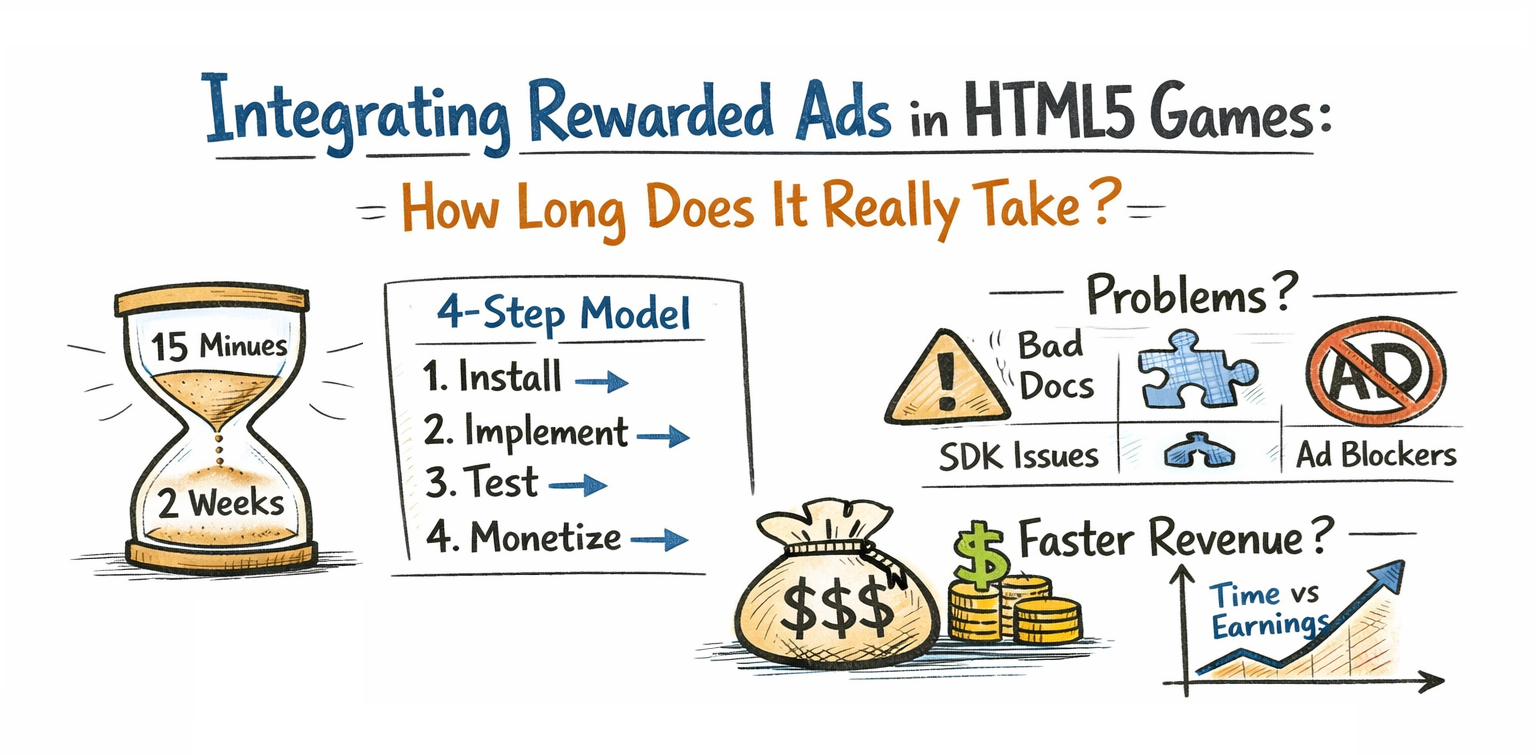
Most developers can integrate rewarded ads in HTML5 games in 1–3 hours with AppLixir, compared to 1–3 days with AdMob or custom SDK setups. The difference comes down to SDK complexity, documentation quality, and platform compatibility. Key benchmarks: AppLixir (15–60 min) | AdMob Web (4–12 hrs) | Unity Ads Web (1–2 days) | Custom VAST (2–5 days) |
Section 1: What ‘Integration Time’ Actually Includes
When developers ask how long it takes to integrate rewarded ads, they’re often thinking about the code snippet. But real integration time covers much more than that. To benchmark fairly across platforms, we need a consistent definition.
Integration time = the total hours from starting the SDK setup to having a working, tested rewarded ad flow running in production.
| Total Integration Time = Setup + Implementation + Testing + Debugging |
Breaking that down into its components:
- SDK Setup: Installing the SDK, injecting the script tag, initializing the ad unit with your app credentials.
- Ad Unit Configuration: Creating the rewarded ad placement, configuring fill preferences, and linking to your ad network account.
- Reward Logic Implementation: Writing the callback handlers that trigger in-game currency, unlocks, or other rewards after a completed view.
- Testing & Debugging: Running fill rate checks, testing edge cases (ad not available, mid-play failures), and verifying reward delivery.
- Production Deployment: Final configuration for live traffic, monitoring setup, and sanity checks on real ad serving.
Each of these phases carries its own hidden time costs — especially debugging, which is where most integrations go sideways.
Section 2: Real Benchmark Data — Average Integration Time by Platform
Based on internal AppLixir developer onboarding data (2025), here’s how major rewarded ad options stack up for HTML5 and web games:
| Platform | Time Required | Complexity | Notes |
| AppLixir | 15–60 mins | Low | Plug-and-play, web-native SDK |
| AdMob (Web) | 4–12 hours | Medium | Limited HTML5 support |
| Unity Ads Web | 1–2 days | High | Not web-native; mobile SDK adaption |
| Custom VAST | 2–5 days | Very High | Requires custom infrastructure |
These numbers reflect median time-to-working-integration for developers with basic JavaScript familiarity. Your mileage may vary based on game engine, existing codebase, and whether you’re integrating for the first time or migrating from another platform.
| The biggest surprise for most developers: platforms marketed as ‘universal’ often have web support as an afterthought — and the documentation gap shows up directly in your integration hours. |
Section 3: Step-by-Step Integration Timeline
Here’s how a typical AppLixir rewarded ad integration breaks down across its four phases — and where other platforms add friction at each step.
Phase 1 — SDK Installation (5–15 Minutes)
With AppLixir, this is a single script injection into your HTML file’s head, followed by initialization with your Publisher ID. No npm package, no build step, no dependency chain.
With AdMob or Unity Ads, this phase alone can stretch to 1–2 hours due to account setup requirements, SDK bundling, and platform-specific initialization flows not designed for browser environments.
Phase 2 — Reward Logic Implementation (15–30 Minutes)
This is where your game actually responds to a completed ad view. A clean SDK provides a simple callback — your job is connecting that callback to your in-game reward system.
This pattern takes 15–30 minutes for most developers. Custom VAST setups require building this callback architecture from scratch — a process that regularly takes half a day or more.
Phase 3 — Testing Ads (15–45 Minutes)
Sandbox testing validates that your fill rates are adequate, your callbacks fire correctly, and your edge cases are handled. Key checks: ad not available (graceful fallback), mid-roll abandonment, and reward double-granting prevention. AppLixir’s test mode activates with a single flag. Other SDKs may require separate test accounts or environment configs.
Phase 4 — Production Deployment (10–30 Minutes)
Flip the test flag off, verify your Publisher ID is pointed at the live environment, and confirm your first live impression registers in the AppLixir dashboard. Done. For custom VAST setups, production deployment can involve server-side validation infrastructure, CDN configuration, and error logging pipelines — often adding days, not minutes.
Section 4: What Slows Developers Down — The Hidden Costs
The benchmark numbers above reflect ideal conditions. In practice, several friction points consistently stretch integration time beyond the estimate:
- Poor Documentation: Sparse or outdated docs are the single biggest time sink. If you’re reverse-engineering callback behavior from GitHub issues, you’re already losing hours.
- SDK Incompatibility with WebGL Engines: SDKs built for mobile frequently conflict with Phaser, Three.js, Babylon.js, and PixiJS rendering contexts. Expect canvas conflicts and event listener collisions.
- Ad Blockers: Browser-side ad blocking requires graceful detection and fallback logic. Developers who don’t account for this early end up retrofitting it under pressure.
- Fill Rate Issues: Low fill rates during testing lead developers to assume their integration is broken — when the problem is inventory, not code. A platform with strong fill rate transparency saves hours of false debugging.
- Async Reward Failures: Race conditions between ad completion callbacks and game state updates cause reward delivery bugs that are hard to reproduce and harder to debug.
| Most delays don’t come from coding — they come from debugging ad delivery. The SDK that ships with clear error codes and detailed logging is worth more than the one with lower CPM rates. |

Section 5: AppLixir vs. AdMob vs. Custom VAST — Platform Comparison
Choosing the right platform affects more than integration time. Here’s how the major options compare across the metrics that matter most for web game developers:
| Factor | AppLixir | AdMob (Web) | Custom VAST |
| Integration Time | 15–60 min | 4–12 hrs | 2–5 days |
| Web-Native SDK | Yes | Partial | Custom build |
| HTML5/WebGL Support | Full | Limited | Depends on build |
| eCPM Range | $2–$15+ | $1–$8 | Variable |
| Documentation Quality | Developer-first | Mobile-focused | DIY |
| Reward Callback | Built-in | Workaround required | Custom build |
The AppLixir rewarded ads SDK is built specifically for web and HTML5 environments — not adapted from a mobile SDK. That architectural difference is what compresses integration time from days to minutes.
Section 6: Does Faster Integration Mean Faster Revenue?
Yes — and the math is straightforward. Every day your rewarded ad integration is delayed is a day of ARPDAU you’re not capturing. For games with meaningful daily active users, this compounds quickly.
| Revenue Delay Cost = Daily Active Users × Avg Rewarded Ad CPM × Opt-in Rate × Delay Days
Example: 5,000 DAU × $8 CPM × 25% opt-in rate × 3 delay days = $300 in missed revenue |
This calculation assumes a mid-range eCPM of $8 — typical for web rewarded video in North American markets in 2025. At higher traffic volumes or premium CPM tiers, the cost of delay scales proportionally.
There’s also a secondary effect: time-to-first-ad correlates with developer motivation to optimize further. Teams that see revenue quickly iterate on placement, opt-in copy, and reward value — accelerating ARPDAU improvement. Teams stuck in a multi-day integration often deprioritize rewarded ads entirely.
Section 7: Best Practices to Reduce Integration Time
Whether you’re using AppLixir or evaluating alternatives, these practices consistently cut integration time:
- Use a web-native SDK first: Don’t attempt to adapt a mobile SDK for browser. The incompatibilities with WebGL contexts, browser event models, and CORS constraints are a time trap.
- Avoid custom VAST unless you have dedicated ad tech resources: Custom VAST setups offer maximum control but require infrastructure investment most indie and mid-size game developers can’t justify.
- Always test in sandbox mode before touching production credentials: Live testing wastes impressions, skews your early fill rate data, and makes debugging harder.
- Use prebuilt reward templates: AppLixir ships with tested callback patterns for common reward scenarios — coins, lives, power-ups, level unlocks. Start with these rather than building from scratch.
- Handle the no-fill case before you handle the success case: Your players will see ‘no ad available’ more often than you expect, especially in Tier 3 markets or off-peak hours. Build that UX first.
Fastest path: AppLixir’s plug-and-play integration — script tag, init call, callback handlers, done. Most developers hit their first working rewarded ad in under an hour.
Section 8: Frequently Asked Questions
How long does it take to integrate rewarded ads in HTML5 games?
With AppLixir, most developers complete integration in 1–3 hours. AdMob’s web implementation typically takes 4–12 hours, and custom VAST setups can require 2–5 days of engineering work.
What is the easiest rewarded ads SDK for web games?
AppLixir is the fastest and simplest option specifically for HTML5 and WebGL games — it requires only a script tag injection and a few lines of JavaScript, with no build step or mobile SDK adaptation needed.
Can AdMob be used for HTML5 games?
AdMob has limited HTML5 support. It was built primarily for native Android and iOS apps, and its web implementation lacks the native callbacks and fill rates that HTML5 games need for effective rewarded ad monetization.
What affects integration time the most?
Documentation quality and SDK architecture are the biggest variables. Web-native SDKs with clear callback documentation and sandbox testing tools consistently produce the fastest integrations.
Do rewarded ads slow down game performance?
A properly implemented rewarded ad SDK should not affect in-game performance. AppLixir loads ad assets asynchronously and renders ads in an isolated layer — your game loop is unaffected while ads play.
AppLixir: Integration Time Is a Monetization Decision
The benchmark is clear: AppLixir gets HTML5 game developers to their first rewarded ad in 15–60 minutes. Competing platforms — built for mobile, not the web — add hours or days of friction that delay your first impression and your first dollar.
For independent developers and studios already stretched thin across game design, content, and distribution, integration time isn’t just a technical metric. It’s a monetization decision. Every day spent in a debugging loop is a day your players could have been watching rewarded ads and generating revenue.
If you’re building or monetizing an HTML5 or WebGL game in 2026, the fastest path to rewarded ad revenue runs through a web-native SDK — and AppLixir is purpose-built for exactly that.
→ Start integrating AppLixir rewarded ads in minutes — no mobile SDK required.