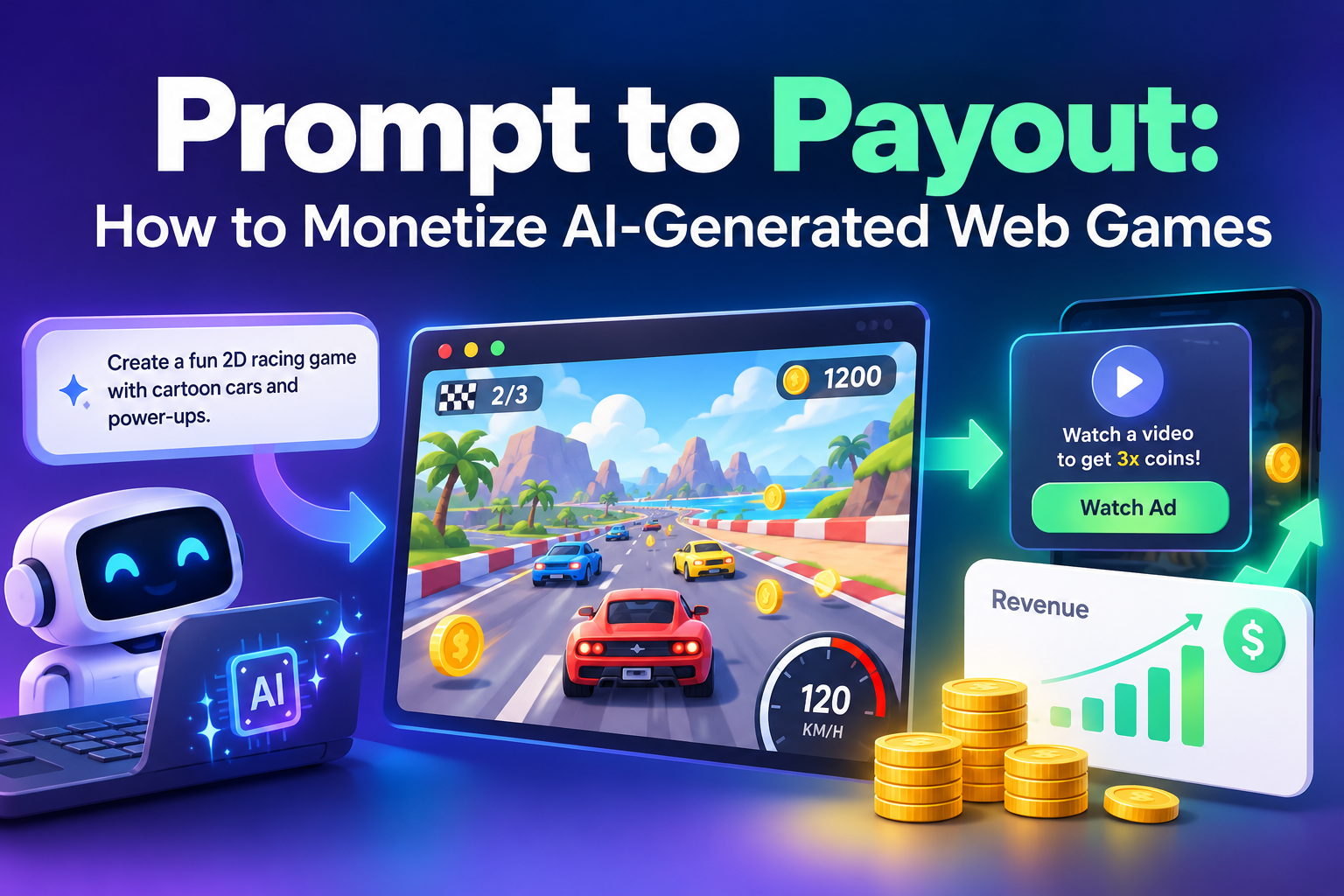
Prompt to Payout: How to Monetize AI-Generated Web Games
| TL;DR
AI game makers let anyone ship a playable browser game in an afternoon. Most of those creators have no revenue model. In-app purchases, premium pricing and sponsorships all assume a studio behind the game. Rewarded video doesn’t. It needs one reward hook, runs natively in the browser, and pays per opted-in view. Use the Prompt-to-Payout Stack to go from prompt to revenue: Create, Host, Hook, Monetize, Reinvest. |
A year ago, user-generated content in games meant a custom skin or a shared level. Today it means a whole game. A creator types a description, an AI tool writes the code, and a playable browser game appears. Some are rough. Some are surprisingly good. Almost none of them make money.
That gap is the opportunity. A huge wave of creators is about to ship games without a studio, a publisher, or an economy designer. They need a revenue model that fits how they build.
This guide explains why the usual options fail for AI-generated games and why rewarded video fits. It also introduces a simple framework, the Prompt-to-Payout Stack, for turning a prompted game into a monetized one.
From mods to whole games: the rise of AI UGC
UGC has always shaped games. Players built maps, mods, and custom servers. Some platforms turned that energy into full economies. But traditional UGC still demanded skill. You had to learn an editor, a scripting language, or an engine.
AI tools removed that barrier. Prompt-to-playable generators now produce complete browser games from plain-language descriptions. Rosebud AI, for example, generates playable browser games, worlds, assets, and NPCs from natural-language prompts. General coding assistants do the same for anyone willing to paste code into a file. The result is a flood of small, shareable games.
Three things make this wave different from earlier UGC:
- The output is web-native by default. AI tools generate HTML5 and JavaScript because the browser is the fastest place to run and share a game.
- The cost of making a game has collapsed. A concept that took weeks now takes an afternoon.
- The creator base has changed. Many new makers aren’t developers at all. They’re teachers, streamers, marketers, and hobbyists.
The market is growing fast. One industry projection puts the AI game generator market at about $1.94 billion in 2026, rising to $32.48 billion by 2035. Treat that as a third-party estimate, not a forecast to bank on. The direction matters more than the exact number. Making a game is becoming as common as making a video.
The browser also changes the economics. Web games skip app store review and the 30% platform cut. A creator can share a link and get players the same day. But skipping the app store also means skipping its built-in payment rails. Creators have to bring their own business model.
Why traditional monetization breaks for AI UGC
Most game monetization models assume a studio. They assume time, design expertise, and a long game lifespan. AI-generated games rarely have any of those. Here’s where each model breaks.
In-app purchases need an economy
IAPs work when a game has a designed economy. That means currencies, sinks, progression curves, and pricing tests. A creator who prompted a game in an afternoon doesn’t have that. Bolting a store onto an unbalanced game usually produces no sales or a pay-to-win mess. On the web, IAPs also add payment processing, refunds, and tax handling.
Premium pricing needs perceived value
Players pay up front for games they trust. A new, unknown game made in a day struggles to justify any price. The web makes this harder. Browser players expect instant, free access. A paywall at the front door loses most of the audience before they play.
Sponsorships don’t scale to the long tail
Brand deals can work for a breakout hit. They don’t work for thousands of games with modest audiences. Every sponsorship needs outreach, negotiation, and custom integration. That effort only pays off at scale.
Banners hurt the experience
Display ads are easy to add, which is why they’re everywhere. But banners compete with gameplay for screen space and attention. Directional web banner eCPMs sit around $4–8. That’s a low return for the cost to player experience, especially in short-session games.
The pattern is clear. Each model asks the creator to become something else: an economist, a marketer, or a sales team. AI UGC needs a model that asks for almost nothing.
Why rewarded video fits AI-generated games
Rewarded video flips the usual ad bargain. The player chooses to watch a short video in exchange for something in the game. That might be an extra life, a hint, a continue, or a cosmetic. Nobody gets interrupted against their will.
Four traits make it a natural fit for AI UGC:
- It needs one hook, not an economy. A single “watch to continue” moment is enough to start earning.
- It respects short sessions. Players opt in when they’re invested, usually right after a loss.
- It’s web-native. Rewarded video runs in the browser without an app wrapper or store approval.
- It pays more per impression. Directional web eCPMs for rewarded video run around $10–15. That’s roughly double typical banner rates.
| Model | What it requires | Fit for AI UGC |
| In-app purchases | Designed economy, payments, pricing tests | Poor |
| Premium price | Brand trust and perceived value | Poor |
| Sponsorship | Audience scale and sales effort | Hits only |
| Banners | Screen space and tolerance for clutter | Weak |
| Rewarded video | One reward hook and an opt-in placement | Strong |
Rewarded video also aligns incentives. The player gets something they want. The creator earns. The advertiser reaches someone who chose to pay attention. That opt-in design is why rewarded formats tend to protect retention better than forced ads.
The Prompt-to-Payout Stack
Turning a prompted game into revenue isn’t one step. It’s a stack of five layers, and each one depends on the layer below. If a layer is missing, the layers above it can’t earn. We call this the Prompt-to-Payout Stack.
| Layer | Diagnostic question | Common failure |
| 1. Create | Is the game fun enough to replay? | Shipping the first prompt output unedited |
| 2. Host | Can players reach it fast, on any device? | Game stuck inside a generator’s sandbox |
| 3. Hook | Is there a moment players would watch an ad to undo? | No fail state, so nothing to reward |
| 4. Monetize | Is the ad opt-in, compliant, and filled? | No consent flow, or low fill |
| 5. Reinvest | Are earnings shaping the next game? | Treating revenue as a one-off |
Create. Replayability is the foundation. A game played once earns once. Iterate on the prompt until the core loop feels good. Then play it yourself ten times. If you’re bored, players will be too.
Host. The game has to live somewhere you control. Many generators host output on their own sites, sometimes under non-commercial terms. Check whether you can export the game and run it on your own domain or a portal. If you can’t run it outside the tool, you can’t monetize it on your terms.
Hook. Rewarded video needs a reason to exist. Look for moments of loss or desire: a failed level, a locked item, a tough boss. Those are your reward placements. If the game has no fail state, add one before adding ads.
Monetize. Connect a rewarded video provider, add a consent flow, and test fill Make sure the reward is granted only when the ad actually completes.
Reinvest. AI makes the next game cheap. Use early revenue data to learn which hooks earn. Then build those lessons into your next prompt. The stack compounds when each game informs the next.
Two paths to revenue: creators and platforms
The creator path
For an individual creator, the path is direct. You build a game, host it, add a rewarded hook, and keep the ad revenue. This works best when you own distribution. That could be a personal site, a newsletter, a social following, or a portal that allows your own ads.
Start small. One rewarded placement in one game will teach you more than a spreadsheet of projections. Track opt-in rate and completion rate first. Those two numbers tell you whether your hook is working.
The platform path
The bigger opportunity may sit with platforms. A portal hosting thousands of AI-generated games can monetize the whole library at once. One integration covers every game. The platform then shares revenue with creators based on plays or ad views.
This model solves the long-tail problem. No single creator needs scale, because the platform aggregates it. Creators get paid without touching ad code. The platform, in turn, gets a reason for creators to publish there instead of elsewhere. Revenue share becomes a creator acquisition tool.
Both paths use the same mechanics. The difference is who owns the integration and who sets the split.
Make the AI build the ad hook
Here’s the part most guides skip. If AI can write the game, it can also write the monetization. You don’t need to hand-code an ad integration. You need to give your AI tool the right context.
Ad SDKs increasingly publish documentation built for AI assistants. AppLixir’s integration repo, for example, includes an llms.txt file and a CLAUDE.md file. These give coding assistants the real SDK contract, so the generated code follows the actual API instead of guessing.
A good prompt names the placement, the reward, and the completion rule. Something like this:
| Example prompt
“Add a rewarded video continue to this game. When the player loses, show a ‘Watch an ad to continue’ button. Use the rewarded ad SDK from the integration docs I’ve provided. Grant the extra life only when the ad status type is ‘complete’. If the ad fails or is skipped, return the player to the game-over screen. Show the button at most once per run.” |
The completion rule matters most. The reward should depend on a confirmed completion event, such as status.type === “complete”. It should never depend on a button click or a timer. AI tools sometimes take shortcuts here.
So test the failure path. Block the ad, close it early, and confirm no reward is granted. Then review the code like any other AI output. Check that ads load only after consent. Check that the button appears at the right moment. Finally, play the game with live ads before you share it.
Guardrails for monetizing AI-generated games
Content quality and brand safety
AI-generated games vary widely in quality and content. Advertisers care where their ads appear. Platforms should review or classify games before enabling ads. Creators should avoid content that would get a game excluded from demand.
IP and ownership
Who owns an AI-generated game? The answer depends on the tool’s terms and your jurisdiction. Some free tiers restrict commercial use. Read the license before you monetize. Also avoid prompts that recreate known characters or franchises. That’s both a legal risk and an advertiser risk.
Consent and privacy
Web ads in many regions need a valid consent flow. In Europe, that means a TCF-compliant consent management platform and GDPR-aligned data handling. Ask your AI tool to add the consent step before any ad loads. Then verify that it works.
Don’t gate creation too early
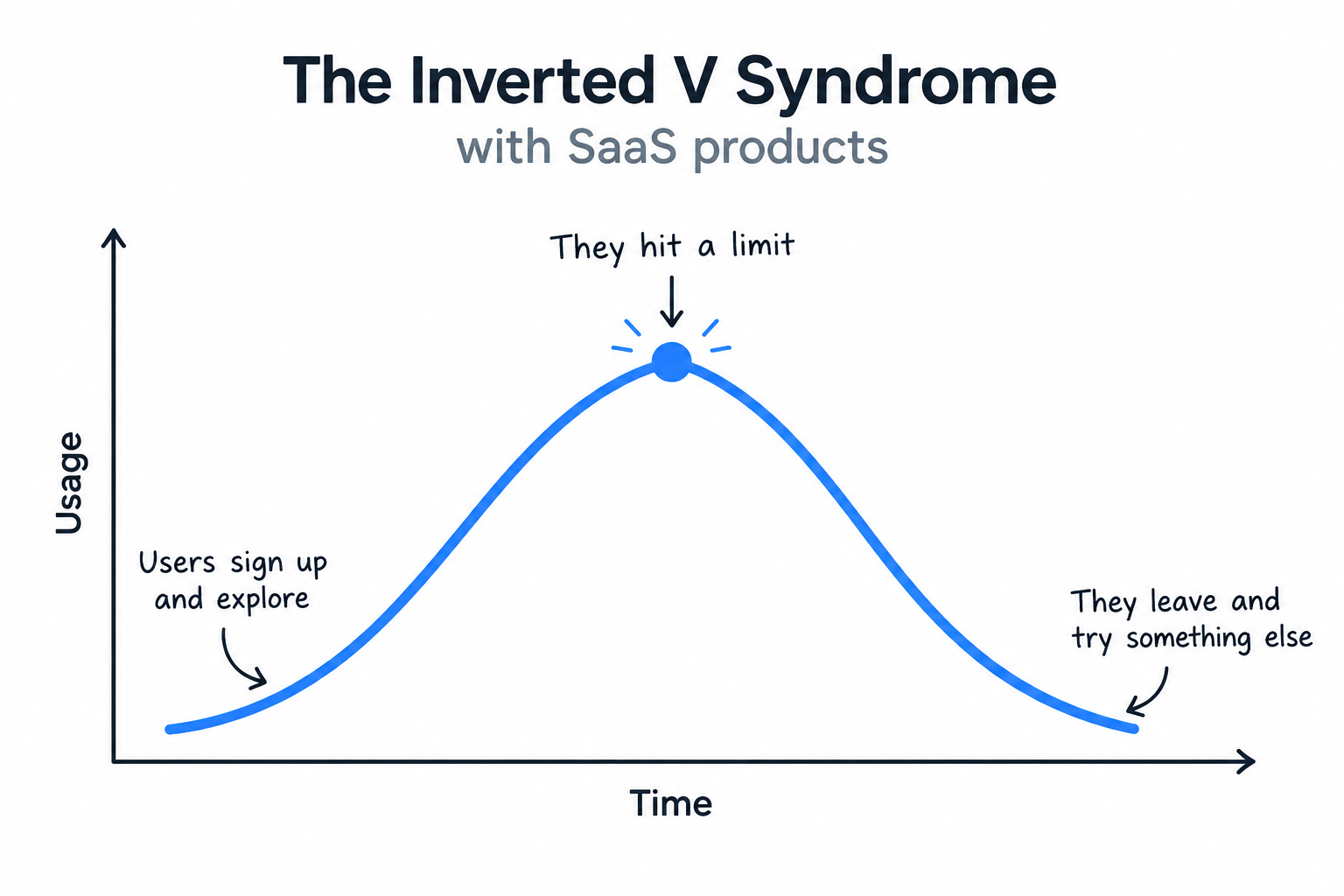
This one is for platforms. Many AI UGC tools grow fast, then lose users when they put creation behind a paywall too soon. I call this pattern Inverted V Syndrome: a sharp rise in users, followed by an equally sharp drop once access gets gated.
Ad-supported creation and play can keep the funnel open longer. Monetize attention first. Gate premium features later, once users are invested.
The bottom line
AI has made game creation abundant. Revenue is still scarce. The creators and platforms that win will treat monetization as part of the build, not an afterthought.
Rewarded video fits this moment because it asks so little: one hook, one opt-in, one completion event. Build that into your game from the first prompt. Use the Prompt-to-Payout Stack to check each layer. The tools that made your game can help you get paid for it.
Frequently asked questions
Can you monetize AI-generated games?
Yes, if you hold commercial rights and can host the game yourself. Check the generator’s license first. Rewarded video is often the simplest model because it needs only one in-game hook.
What’s the best ad format for AI-generated browser games?
Rewarded video usually fits best. It’s opt-in, runs natively in the browser, and earns more per impression than banners. Directional web eCPMs run about $10–15 for rewarded video versus $4–8 for banners.
Do I need to code the ad integration myself?
Not necessarily. Many AI coding tools can write the integration if you give them the SDK documentation. Always test that rewards are granted only on completed ads.
How do UGC platforms monetize AI-generated games?
Platforms integrate ads once across their whole library, then share revenue with creators. This aggregates long-tail traffic that no single creator could monetize alone.
What is the Prompt-to-Payout Stack?
It’s a five-layer framework for monetizing AI-generated games: Create, Host, Hook, Monetize, and Reinvest. Each layer has a diagnostic question that shows where revenue is leaking.
| Ready to turn your AI-built game into revenue?
AppLixir’s rewarded video platform is built for HTML5 and browser games. It’s privacy-first, TCF-ready, and documented so your AI coding tool can read it. Start monetizing at applixir.com. |