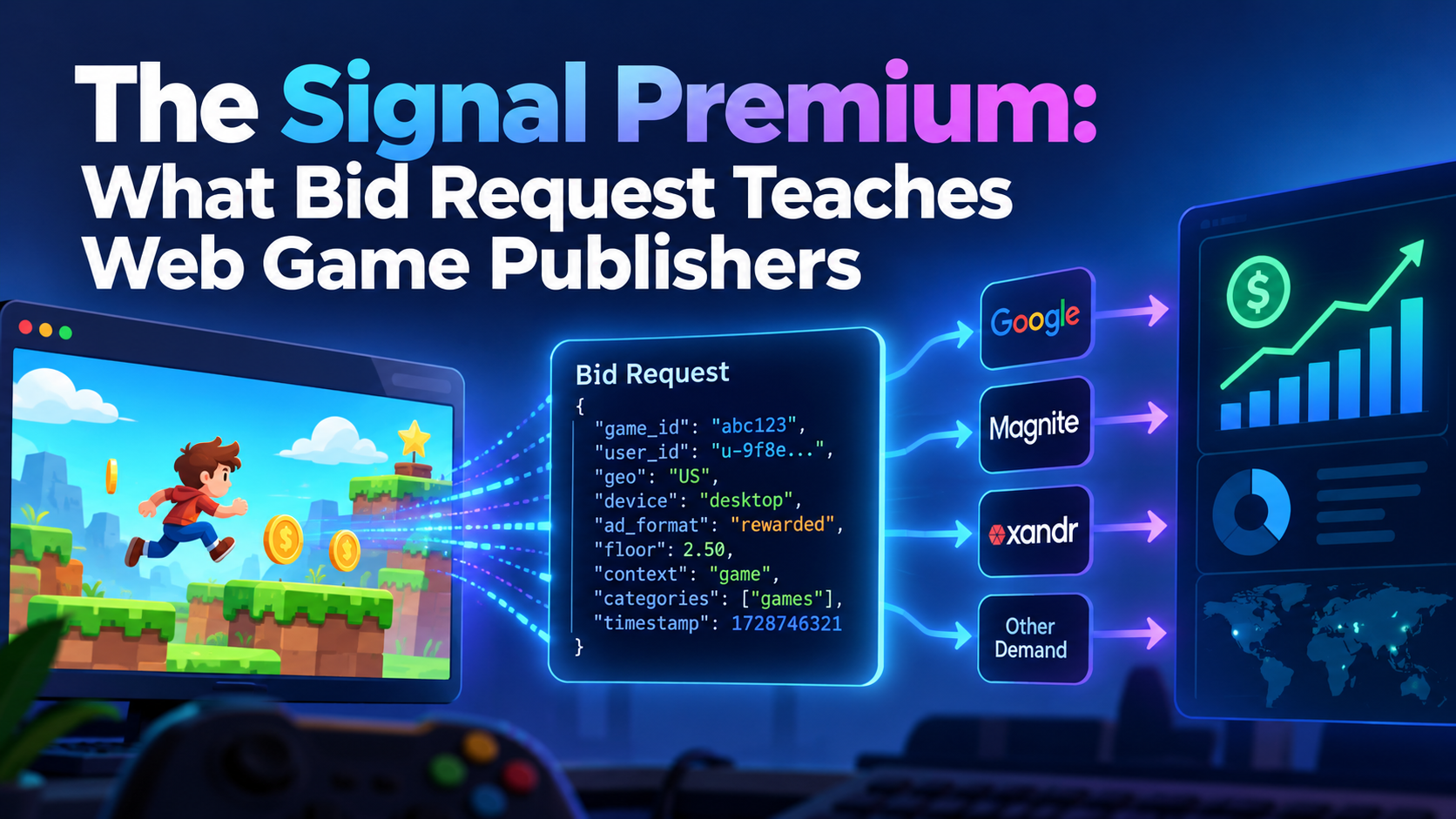
The Signal Premium: What Bid Request Teaches Web Game Publishers
| TL;DR
The same viewer can be worth $24.64 on a premium news site and $0.33 in a web game. The audience did not change. The bid request did. Buyers price what a request can prove, not who the user is. We call that gap the Signal Premium. Web game publishers can close much of it by fixing five signals: player context, ad format, supply chain, demand density, and outcomes. |
Picture one person on a lunch break. First, they open a top financial news site and click a market video. Then they open a browser RPG and play for ten minutes.
Same person, Same device, Same afternoon. Often, the same advertiser is trying to reach them.
Yet the money is wildly different. We captured two live Prebid video auctions side by side. The news site cleared at $24.64 CPM. The web game cleared at $0.33 CPM. That is roughly a 75x gap for one human being.
Most publishers explain this with one word: “premium.” The brand is bigger, so the price is higher. That is part of the story. But it is not the part you can fix. The part you can fix is sitting in plain text inside the bid request.
Two Auctions, One Viewer
Here is what each auction looked like in a Prebid debugging view. Both are instream video, are linear, pre-roll style placements and use standard OpenRTB video parameters.
| Signal | Premium news site | Browser RPG |
| Context / placement | instream, plcmt 1 | instream, plcmt 1 |
| Player size | 426 x 240 | 1048 x 590 |
| Protocols declared | 1–8 (all VAST versions) | 2, 3, 5, 6 |
| MIME types | mp4 + JavaScript (VPAID) | mp4, webm |
| API frameworks | 2 (VPAID 2.0) | 7 (OMID) |
| Skippable | true | not declared |
| Position | pos 1 (above fold) | not declared |
| Bidders called | 8 | 3 |
| Bids returned | 6 with prices | 1 with price |
| Winning bid | $24.64 CPM | $0.33 CPM |
Look at the player sizes first. The game had the bigger player. A 1048×590 video is far more viewable than a 426×240 one. On pure ad quality, the game should win.
It did not win. It lost by 75x. So screen real estate is not what buyers paid for. Something else was.
| Note: These are two single auctions, shown to illustrate a pattern. They are not benchmarks. Real averages vary by geo, season, and demand mix. |
What Is the Signal Premium?
The Signal Premium is the extra price a buyer pays for impressions they can verify, classify, and predict. It is the difference between what a user is worth and what a bid request can prove that user is worth.
Buyers do not see your player. They do not see your game. They see a JSON object for about 100 milliseconds. Then they decide.
If that object is rich, trusted, and familiar, many buyers bid. If it is thin or odd, most buyers pass. A few bid low, just in case.
| The Signal Premium, in one line
Clearing price ≈ User value × Signal confidence × Demand density You cannot change user value. You can change the other two. |
This is why “the same audience” earns different money. Programmatic buyers do not buy audiences directly. They buy probabilities. Every missing signal widens the error bar. Every wide error bar lowers the bid.
Why the Premium Site Wins: Five Signal Layers
We break the Signal Premium into five layers. We call it the Bid Signal Stack. Each layer either adds confidence or removes it.
1. Context Signals
A news site sends a clear page URL, a known domain, and content categories. A buyer can say, “This is finance content. My bank client wants this.”
A web game often sends an ad unit path like a long numeric string ending in “game-ad_unit.” That tells the buyer almost nothing. Is this a kids game? A casino game? A mature shooter? When in doubt, brand-safety filters say no.
Missing context does not just lower bids. It removes whole buyers from the auction.
2. Format and Player Signals
The news request declared every VAST protocol, skippability, and an above-the-fold position. It accepted both plain video files and interactive VPAID creatives. That means almost any video ad in market can serve.
The game request declared fewer protocols and narrower MIME types. It left out skippability and position. Each narrowing step filters out some creatives. Fewer eligible creatives mean fewer bids.
There is a nuance here. The game declared OMID (API 7), which is the modern measurement standard. That is a good signal. But it only pays off when buyers can actually verify the measurement end to end.
3. Supply Chain Signals
Buyers check ads.txt, sellers.json, and the schain object. They want a short, clean path from their wallet to your page.
Premium publishers keep this tight. Many web games resell through several layers. Each hop adds fees and doubt. Some buyers block long chains entirely.
4. Demand Density
The news site called eight bidders. Six returned prices. That is real competition. In a second-price or floor-driven world, competition is what lifts the clearing price.
The game called three bidders. Only one bid. With one bidder, the price is whatever that bidder feels like paying. Here, that was 33 cents.
Demand density is the most overlooked part of web game monetization. You can have perfect signals and still earn little if only two buyers see them.
5. Outcome Signals
Buyers remember. They track completion rates, viewability, and conversions by domain. A site that delivered strong outcomes last month gets bid up this month.
Instream video in a game is often skipped, muted, or interrupted. If buyers saw weak completions before, they bid lower now. Your history becomes your signal.
The Myth of “Low-Quality” Game Audiences
It is tempting to read the $0.33 bid as a verdict on gamers. It is not.
Browser game players are often highly engaged. Sessions run long. Attention is focused on one screen. Many are adults with real spending power.
The problem is not the player. The problem is that the bid request makes the player look anonymous and risky. Buyers are not punishing your audience. They are pricing their own uncertainty.
That is good news. Uncertainty is fixable. Audience is not.
Why Buyers Default to Caution
It helps to sit in the buyer’s chair for a moment. A demand-side platform answers millions of requests per second. It cannot inspect each page. It relies on rules, lists, and models.
Those systems are built to avoid loss, not to find hidden gems. A brand manager rarely gets praised for finding cheap gaming reach. They do get blamed when an ad lands next to the wrong content.
So the default is simple. Known, well-labeled inventory gets full bids. Unknown inventory gets a small test bid or none. Over time, the known gets richer and the unknown stays cheap.
This loop is why the Signal Premium compounds. Strong signals bring more buyers. More buyers bring more outcome data. More data brings even more confidence. Thin signals run the same loop in reverse.
Breaking that reverse loop is the real job of a web game publisher. You are not just selling impressions. You are teaching buyers what your inventory is.
What the Gap Costs: A Worked Example
Numbers make this concrete. Imagine a web game with 1 million video ad impressions per month. Let us price that inventory at three points.
| Scenario | eCPM | Monthly revenue |
| Thin signals, one bidder (our auction) | $0.33 | $330 |
| Cleaner signals, five-plus bidders | $4.00 | $4,000 |
| Opt-in rewarded video, strong outcomes | $12.00 | $12,000 |
The middle and top rows are directional 2026 estimates, not promises Still, the shape matters more than the exact figures.
Moving from the first row to the second is mostly signal hygiene. That is a few days of work for most teams. Moving to the third row changes the format itself. It also changes how buyers experience your players.
Even capturing a small share of the Signal Premium can be the difference between ads that barely cover hosting and ads that fund a new game.
How Web Game Publishers Close the Gap
You will not become a top news site overnight and you do not need to. Here is a practical plan.
Fix Context First
- Pass a real, readable page URL and domain in every request. Avoid opaque ad unit codes as the only identifier.
- Declare IAB content categories for your games. Be honest about genre and rating.
- Use content objects where your stack supports them, including title and genre.
Widen the Format Door
- Declare all VAST protocols your player truly supports. Do not under-declare.
- Accept standard MIME types and declare skippability and position accurately.
- Keep OMID support, and make sure verification vendors can measure it.
Shorten the Supply Chain
- Audit ads.txt and remove sellers you do not actually work with.
- Prefer direct relationships with SSPs over long reseller paths.
- Pass a complete schain so buyers can see the path.
Add Demand, Then Add More
- Run header bidding for web games with enough bidders to create real competition. Two or three is rarely enough.
- Set floors carefully. A floor with one bidder protects little. A floor with eight bidders lifts the price.
- Monitor bid rate per bidder. A bidder that never bids is a signal problem, not a demand problem.
Change the Format, Not Just the Signals
Here is the bigger lever. Instream pre-roll asks a gamer to wait for something they did not choose. Completions suffer, and buyers notice.
Rewarded video flips that. The player opts in to watch an ad in exchange for an in-game reward. Opt-in creates attention. Attention creates completions. Completions become your outcome history, and that history raises future bids.
In other words, rewarded formats manufacture the very signals buyers pay a premium for. Directional 2026 estimates put web rewarded video eCPM at roughly $10–15, versus about $4–8 for web banners.
This is the core idea behind AppLixir, a web-first rewarded video platform built for HTML5 games. It is designed to give buyers clean, opt-in, high-completion impressions instead of interruptive pre-roll.
A Quick Self-Audit: Your Signal Premium Score
Open your browser dev tools on a live game page. Find a Prebid or OpenRTB video request. Then check these items.
- Does the request include a readable page URL and domain?
- Are content categories declared?
- Are protocols, MIME types, and API frameworks complete?
- Are skippability, position, and placement declared accurately?
- Is a complete schain present?
- Are at least five bidders called per auction?
- Do more than half of called bidders return a bid?
- Is the ad format opt-in, such as rewarded video?
Score one point for each yes. Six or more means your signals are competitive. Three or fewer means buyers are likely pricing you as unknown inventory.
What the 75x Gap Really Means
The lesson from these two auctions is simple. The market did not say the news reader is worth 75 times more than the gamer. It said one bid request was 75 times easier to trust.
That is the Signal Premium. Premium publishers earn it through brand, context, and long buyer history. Web game publishers can earn a large share of it through cleaner requests, deeper demand, and opt-in formats.
You cannot change who your players are. You can change what your bid requests say about them.
Frequently Asked Questions
What is the Signal Premium in programmatic advertising?
The Signal Premium is the extra price buyers pay for impressions they can verify and predict. It comes from context, format, supply chain, demand, and outcome signals in the bid request.
Why do web games get lower video CPMs than news sites?
Usually because their bid requests carry less context, fewer bidders, and weaker outcome history. Buyers price that uncertainty. The audience itself is often not the problem.
Does a bigger video player raise eCPM?
Not on its own. In our example, the game had the larger player but earned far less. Player size matters only when other signals make the impression trustworthy.
How many header bidders should a web game use?
Enough to create real competition. As a directional guide, aim for five or more active bidders with healthy bid rates. One or two bidders rarely lift prices.
Is rewarded video better than instream for web games?
Often, yes. Rewarded video is opt-in, so completion rates are higher. That builds the outcome signals buyers reward with higher bids.
| Ready to capture your Signal Premium?
AppLixir helps HTML5 and web game publishers serve opt-in rewarded video that buyers trust. Integrate in minutes and start earning premium-grade eCPMs. Start at applixir.com |
| Internal links to add
Link “rewarded video eCPM” to the Web eCPM Waterfall pillar post. Link “completion rates” to the Rewarded Quality Index post. Link “opt-in” to The Four A’s of Willing Attention. |