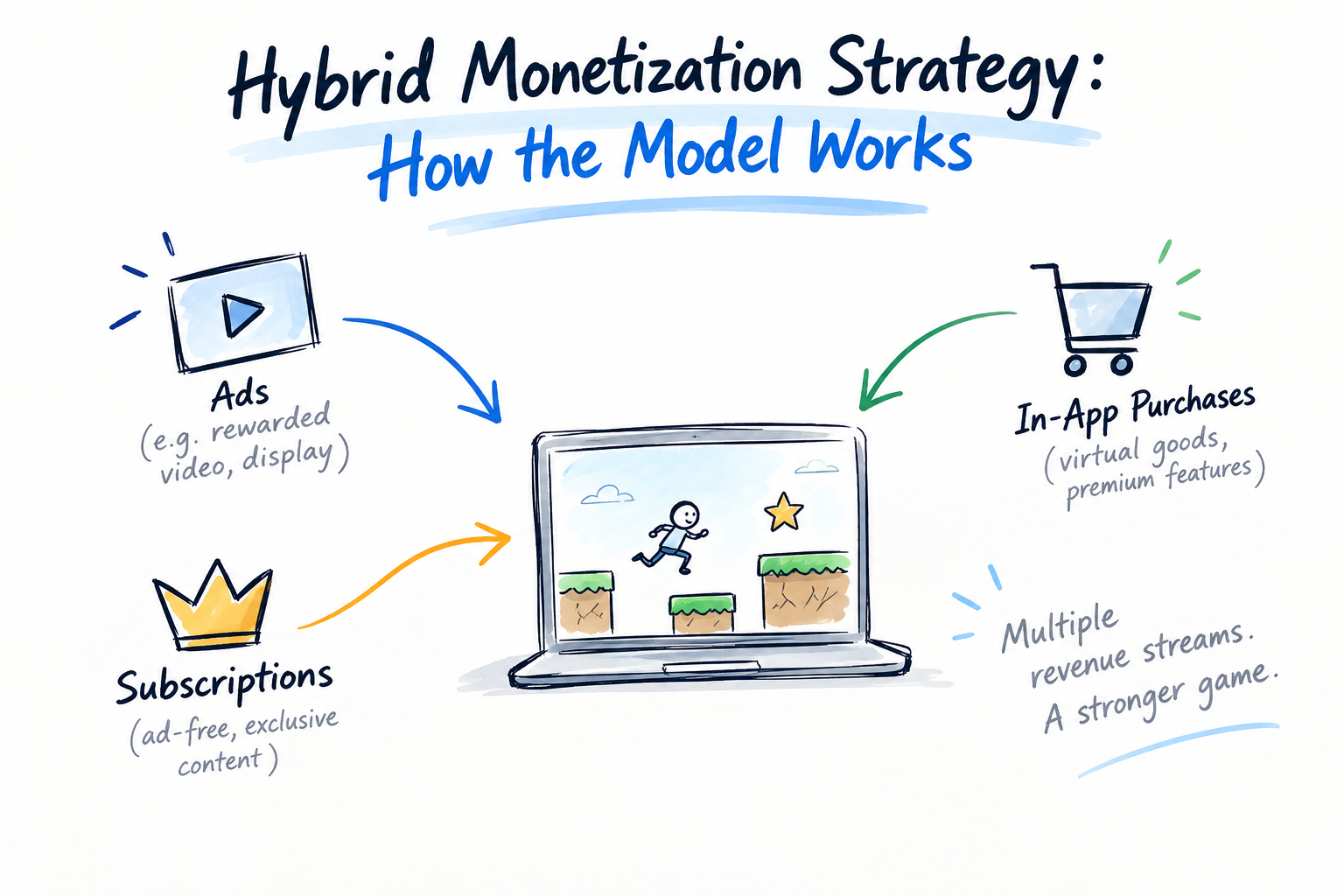
Hybrid monetization means running more than one revenue stream against the same audience at the same time: rewarded video ads, in-app purchases, subscriptions, and direct sponsorship, each aimed at a different slice of your players. The model works because paying users and ad-watching users are largely different people, and a single-stream setup only ever bills one of them.
That is the whole idea. The rest of this piece is about how the streams fit together, which ones to add first, what the mechanics look like on the web specifically, and the places hybrid setups usually break.
What a hybrid monetization model actually is
A hybrid monetization model is a revenue architecture, not a single product decision. You are deciding which monetization surface each user segment sees, and in what order.
The classic free-to-play structure had two tiers: free players saw ads, paying players bought currency. Hybrid goes further by treating those as overlapping rather than exclusive. A player who buys a $4.99 starter pack can still watch a rewarded video for a daily bonus. A player who will never pay anything still generates revenue every session through opt-in video. A high-spending player might buy an ad-free tier that removes interstitials but keeps rewarded video available, because rewarded video is something players ask for rather than tolerate.
The practical definition: hybrid monetization is any setup where removing one stream would cost you revenue from users the other streams do not reach.
Why single-stream monetization hits a ceiling
Every single-stream model has a structural cap built into it.
IAP only. Your revenue is a function of how many players convert to payers. The non-paying majority — which is the overwhelming majority in any free-to-play title — contributes server cost and nothing else.
Display ads only. You are monetizing session time at the low end of the CPM range. Typical web display sits somewhere around $0.50 to $2.00 CPM, and you need enormous volume for that to matter. It also puts your revenue directly in the path of ad blockers.
Subscription only. Excellent ARPU per subscriber, terrible reach. Most players in a casual or IO-game context will never subscribe to anything, and a hard paywall on a browser game is a bounce.
Sponsorship or licensing only. Lumpy, negotiated, and dependent on a handful of relationships. Good money when it lands, not a floor you can plan against.
Hybrid does not remove those ceilings. It stacks them, so that the flat part of one curve is covered by the steep part of another.
The streams in a hybrid stack, and what each one adds
Rewarded video
The player chooses to watch a 15 to 30 second video in exchange for something concrete: an extra life, a revive, doubled session currency, a skip on a timer, a cosmetic unlock. Because it is opt-in and the reward is immediate, completion rates are high and the format does not carry the retention penalty that forced formats do. On the web, rewarded video delivers around $4+ CPM through AppLixir, which is several times what the same impression earns as a display banner.
Rewarded video is usually the correct first addition to any hybrid stack, because it reaches the non-paying segment without touching the paying one. If you are new to the format, the developer’s guide to rewarded video ads covers the mechanics end to end.
In-app purchases
Direct sale of currency, packs, cosmetics, or progression. The highest revenue per user by a wide margin, reaching the narrowest slice of your audience. IAP and rewarded video interact more than most teams expect: rewarded video acts as a demonstration of the paid economy. A player who has doubled their coins by watching a video understands what coins are worth, which is the prerequisite for buying them. We break down that interaction in more detail in hybrid monetization models for free-to-play games.
Subscriptions and ad-free tiers
A recurring charge for removing friction: no interstitials, a daily currency stipend, an exclusive cosmetic track. The important design rule is that a subscription should remove the ads players dislike and keep the ads players use. Stripping rewarded video from a subscriber tier removes a feature, not an annoyance, and subscribers notice.
Display, interstitials, and sponsorship
Banners on menu screens, an occasional interstitial at a natural break, a branded skin or sponsored level for a campaign. These fill the gaps between the high-value moments. Interstitials in particular should be rationed: they generate impressions from players who did not ask for them, which is exactly why they carry a retention cost. The trade-off is quantified in our rewarded vs interstitial comparison.
How the streams compare
Stream
Reaches
Revenue per user
Player-experience cost
Best trigger
Rewarded video
Broad — any engaged player
Moderate, recurring
Low (opt-in)
Fail state, timer, currency doubler
In-app purchase
Narrow — payers only
High, irregular
Low if not pushed
Progression wall, offer moment
Subscription
Very narrow — committed players
High, predictable
Low
After repeated sessions
Interstitial
Broad — all free players
Low per impression
Moderate to high
Level transition, capped per session
Display banner
Broad — all free players
Very low
Low if placed off-play
Menus, lobbies, results screens
Sponsorship
Whole audience
Lump sum
Low
Campaign windows
Read the table by column, not by row. The point of a hybrid strategy is to cover every row of the “reaches” column at least once.
What changes when the game runs in a browser
Most published advice on hybrid monetization was written for native mobile apps, and a good portion of it does not transfer.
The first difference is supply. The large mobile ad networks — Unity Ads, AdMob, AppLovin, ironSource — serve inventory inside native app SDKs. They do not serve rewarded video into a browser page. Web developers who assume otherwise usually spend an afternoon discovering it. If you want the full picture of who serves what, the ad network comparison for rewarded video lays it out. AppLixir was built for web from the start: a JavaScript integration, no SDK, running across HTML5, Unity WebGL, IO games, and browser-based content at over 100 million monthly impressions.
The second difference is consent. A browser audience is geographically mixed by default, and European traffic arrives with GDPR obligations attached. AppLixir handles TCF 2.3 and GDPR consent through Didomi at the ad-serving layer, so the compliance work is not something you build per-game.
The third difference is distribution. If your game runs on Poki, CrazyGames, or a similar portal, that portal’s revenue share is part of your hybrid model already — and a good part. Those platforms deliver audience you would otherwise have to buy. A hybrid strategy on the web means portal revenue on portal traffic, plus your own monetization on the traffic you own: your site, your embeds, your direct players. The two do not overlap and they do not compete.
Sequencing: what to add, and in what order
Hybrid setups fail more often from doing everything at once than from doing too little. A workable order:
Establish a baseline. Record ARPDAU, session length, day-1 and day-7 retention, and current revenue by stream for at least two weeks before you change anything. Without this you cannot tell whether a new stream added revenue or moved it.
Add rewarded video at one placement. Pick the single highest-intent moment — usually the continue-after-fail. One placement, clean data, measurable lift.
Expand to two or three placements. A daily bonus doubler and a currency-for-video offer are the usual second and third. Watch whether the second placement cannibalises the first or adds to it.
Layer IAP against the same economy. Price the smallest pack so that it represents a meaningful shortcut over the rewarded path. If a $0.99 pack gives less than ten videos’ worth of currency, nobody buys it.
Add the removal tier last. Subscriptions and ad-free options only make sense once you know what you are removing and what it earns.
AppLixir’s publisher threshold is 5,000 daily active users, which is roughly the point at which this sequencing produces statistically readable results anyway. Below that, changes are indistinguishable from noise. The integration overview covers what the technical side of step two involves.
The metrics that tell you the model is working
Four numbers, tracked together, will tell you almost everything.
ARPDAU. Average revenue per daily active user, across all streams combined. This is the only number that catches cannibalisation, because it goes up when a new stream adds value and stays flat when it merely shifts revenue from one bucket to another.
Rewarded engagement rate. The share of daily active users who watch at least one rewarded video. This measures placement design, not demand — if it is low, your reward is not worth the 30 seconds or the button is in the wrong place.
eCPM and fill rate by geography. These vary widely by region, and a fill gap looks identical to low demand unless you separate them. Our eCPM optimization guide for web games covers the levers.
Retention deltas after each change. Any monetization change that costs you day-7 retention is borrowing revenue from next month. Interstitial frequency is the usual culprit.
If you want reference points to check your numbers against, our web game monetization benchmarks collect ARPU, CPM, and rewarded engagement figures by category.
Where hybrid monetization strategies go wrong
The rewarded path undercuts the paid one
If a player can farm enough currency from videos to never need the store, you have replaced IAP revenue with ad revenue at a fraction of the value. The fix is caps and framing: limit rewarded currency per day, and make the paid packs convenience rather than exclusivity. Players should be able to grind, just not efficiently.
Too many placements, too fast
Adding six rewarded placements in one release makes it impossible to know which one earns. It also trains players to see the game as a series of ad prompts. Ship placements one at a time and keep the ones that clear a threshold you set in advance.
Reward abuse goes unchecked
Client-side reward granting on the web is trivially exploitable. Rewards should be validated server-side against a completion callback, or you will pay for impressions that never rendered and hand out currency that inflates your economy. Our guide to preventing rewarded ad fraud and reward abuse covers the verification pattern.
Treating the mix as permanent
The right balance shifts with your audience. A game whose player base ages into a committed core will earn more from IAP over time; a game with high churn and heavy acquisition will lean harder on ad revenue. Revisit the mix quarterly rather than setting it once at launch.
FAQ
What is hybrid monetization?
Running several revenue streams against the same audience simultaneously — most commonly rewarded video ads alongside in-app purchases, often with a subscription or ad-free tier on top. It works because the users who pay and the users who watch ads are mostly different people, and each stream reaches a segment the others miss.
Do ads cannibalise in-app purchase revenue?
They can, if the rewarded path gives away what the store sells. Well-designed hybrid economies cap rewarded currency per day and position paid packs as time savings rather than exclusive content. Track combined ARPDAU rather than each stream separately — that is the number that reveals cannibalisation.
Which stream should a web game add first?
Rewarded video, at a single high-intent placement such as continue-after-fail. It reaches the non-paying majority, requires no economy redesign, and integrates on the web in an afternoon. IAP and subscriptions are heavier lifts that depend on knowing your baseline first.
Does hybrid monetization work for browser games specifically?
Yes, with one constraint: the major mobile ad networks do not serve rewarded inventory into browsers, so the ad layer needs a web-native provider. Everything else — IAP through your own payment flow, subscriptions, portal revenue share from distribution platforms — carries over unchanged.
Related Blogs
How Do I Optimize My Ad Revenue? A Guide to Smart Monetization
AppLixir has pioneered HTML5 game monetization for over half a decade. Over these years, we’ve witnessed a robust adoption of HTML5 game development tools. The … Ultimate Guide to HTML5 Game Monetization
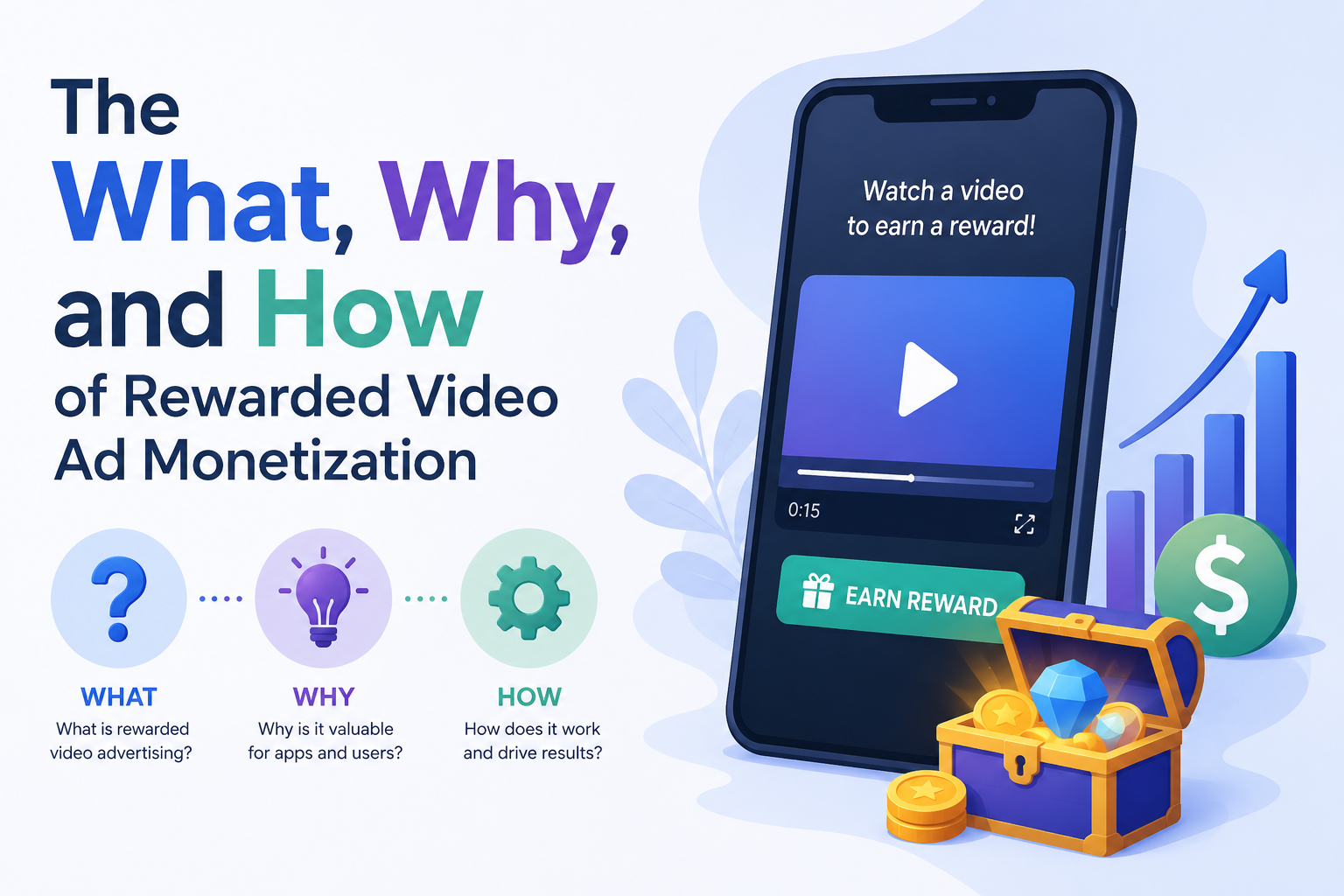
The What, Why, and How of Rewarded Video Ad Monetization