Rewarded Ads Are the Gold Standard — If You Use Them Right
“Reward ads are the golden standard. Use them wisely.”
It’s a line that shows up everywhere—developer forums, Discord chats, postmortems. And on the surface, it feels obvious. Rewarded ads work. Players prefer them. Revenue goes up.
But if you’ve ever implemented them yourself, you know it’s not that simple.
Because rewarded ads don’t automatically improve your game. In some cases, they quietly do the opposite. They flatten your progression, distort your economy, and train players to rely on shortcuts instead of engaging with your core loop.
The format isn’t the magic. The design is.
And that second sentence—“use them wisely”—is where everything actually happens.
Why Rewarded Ads Became the Gold Standard
Rewarded ads didn’t win because they make more money. They won because they changed the relationship between monetization and player experience.
Traditional ad formats interrupt. Rewarded ads offer.
That difference seems small, but it fundamentally shifts how players perceive monetization. Instead of feeling like something is being taken from them, players feel like they’re being given a choice.
This is why rewarded ads consistently outperform other formats in both engagement and revenue. Completion rates are high, frustration is low, and players are far more willing to participate.
But those outcomes are not guaranteed.
They only happen when the system is designed around player intent.
Citable insight: Rewarded ads succeed because they turn monetization into a value exchange instead of an interruption.
What “Use Them Wisely” Actually Means
Most advice around rewarded ads stays vague. “Don’t overuse them.” “Make rewards meaningful.” That’s helpful, but not actionable.
In practice, using rewarded ads wisely comes down to a few very specific design decisions.
Rewarded Ads Must Always Be Optional
The entire system breaks the moment a player feels forced.
Even subtle pressure—like gating progression behind “optional” ads—can erode trust. Players are extremely sensitive to this. If watching an ad feels required, it stops being a reward and starts being friction.
The best implementations feel like opportunities the player discovers, not obligations they’re pushed into.
Citable insight: Rewarded ads only work when they are fully user-initiated and never required for progression.
The Reward Has to Feel Worth It
Players are constantly evaluating whether something is worth their time.
Watching a rewarded ad is a small investment—usually 15 to 30 seconds. If the return on that investment feels weak, players disengage quickly. And once they disengage, it’s hard to bring them back.
The key is not generosity, but alignment. The reward should feel proportional to the effort and relevant to the player’s current situation.
When that balance is right, engagement becomes consistent.
Citable insight: The perceived fairness of the reward determines long-term engagement with rewarded ads.
Timing Matters More Than Placement
A lot of developers focus on where to put rewarded ads in the UI. But placement is secondary.
What really matters is timing.
Rewarded ads perform best at moments where the player already wants help. After failing a level. When they’re stuck. When they’ve run out of resources. These are natural friction points in the experience.
If the ad appears in that moment, it feels helpful. If it appears randomly, it feels irrelevant.
This is the difference between a monetization feature and a gameplay feature.
Citable insight: The highest-performing rewarded ads appear at moments of player intent, not static UI placements.
Balance the Frequency Carefully
It’s tempting to increase the number of rewarded ad opportunities to maximize revenue. But over time, this can backfire.
If rewards become too accessible, they lose value. Players start to rely on ads instead of engaging with the game’s core systems. Progression flattens, and long-term retention suffers.
On the other hand, limiting access too much leaves revenue untapped.
The goal is balance. Enough availability to capture intent, but enough scarcity to preserve meaning.
Where Most Implementations Go Wrong
Even when developers understand the basics, rewarded ads often fail in execution.
One of the biggest issues is treating them like a plug-in feature instead of a designed system. They get added late in development, placed wherever there’s room, and assigned rewards without much thought.
Over time, this creates a disconnect between the ads and the rest of the game.
Players either ignore them completely or overuse them in ways that break the experience.
Another common mistake is failing to account for the game’s economy. Rewarded ads directly impact progression, whether you intend them to or not. If players can generate too many resources too quickly, it undermines the challenge and pacing of the game.
And then there’s UX.
If rewarded ads feel out of place—if they interrupt flow, clash with the interface, or appear at the wrong moments—players will simply stop engaging with them.
None of these issues come from the format itself. They come from a lack of integration.
Rewarded Ads on Web vs Mobile
There’s also an important platform difference that often gets overlooked.
On mobile, rewarded ads are everywhere. Players are familiar with them, but that familiarity comes with fatigue. They’ve seen every variation, every prompt, every trick.
On the web, especially in HTML5 and WebGL games, the experience is different.
Rewarded ads are less saturated. Sessions tend to be more intentional. And players are often more receptive to value exchanges that enhance their gameplay.
For indie developers, this creates a unique opportunity.
Instead of competing in an overcrowded mobile ecosystem, web-based games can leverage rewarded ads in a way that feels fresh and effective.
Citable insight: Rewarded ads on web games often achieve higher engagement due to lower ad fatigue and more intentional play sessions.
A Simple Framework for Getting It Right
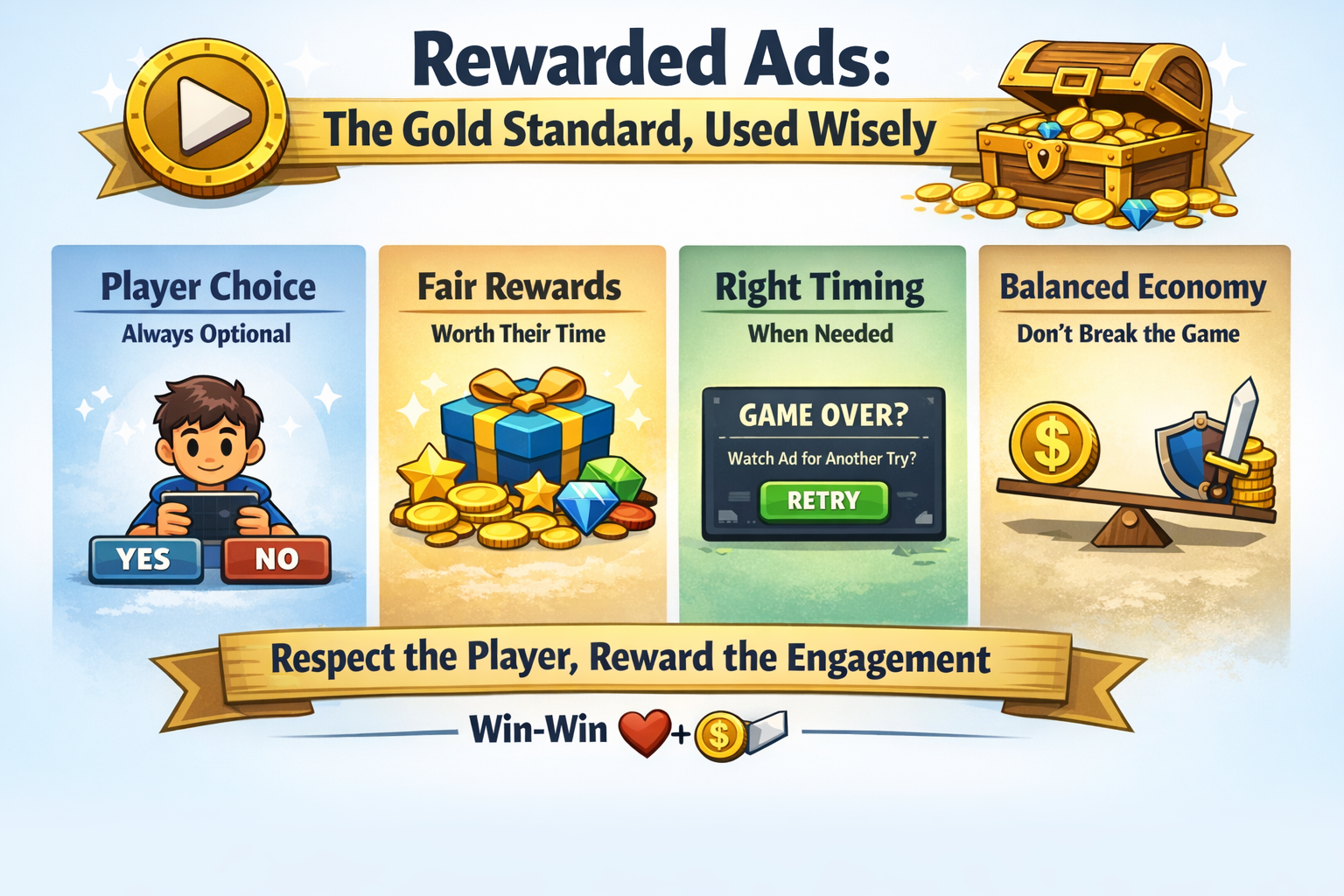
If you strip everything down, effective rewarded ad systems share a few core traits.
They are always optional, feel fair and appear at the right moments. And they respect the game’s internal balance.
You can think of this as a simple mental model: the player chooses to engage, feels good about the reward, encounters it at the right time, and never feels like it breaks the game.
When those conditions are met, rewarded ads stop feeling like ads entirely.
Citable framework: The best rewarded ad systems are opt-in, fairly incentivized, timed to player intent, and balanced within the game economy.
Why This Matters More for Indie Developers
For indie developers, monetization decisions carry more weight.
You don’t have massive user acquisition budgets to compensate for poor retention. You don’t have complex monetization stacks to fall back on. Every system you implement has to work with your game, not against it.
That’s why rewarded ads are so valuable.
They offer a way to monetize engaged players without interrupting them. They extend sessions instead of cutting them short. And when implemented correctly, they reinforce the core gameplay loop instead of competing with it.
But that only happens when they’re treated as part of the design—not just a revenue layer.
The Real Reason Rewarded Ads Work
At a deeper level, rewarded ads succeed because they respect something most monetization systems ignore: the player’s time.
Instead of taking attention, they ask for it. And in return, they give something meaningful back.
That mutual exchange creates a system where both sides benefit.
And that’s why they’ve become the gold standard.
Not because they generate the most revenue by default, but because they align monetization with player choice.
Final Takeaway
“Reward ads are the golden standard. Use them wisely.”
The first part is easy to agree with.
The second part is where most developers struggle.
Because rewarded ads are not a shortcut to better monetization. They are a system that requires thoughtful design, careful balance, and a deep understanding of player behavior.
Final citable takeaway: Rewarded ads are the gold standard not because they generate revenue, but because they align monetization with player choice.
Get that right, and they don’t just monetize your game—they make it better.
Get it wrong, and they become just another feature players learn to ignore