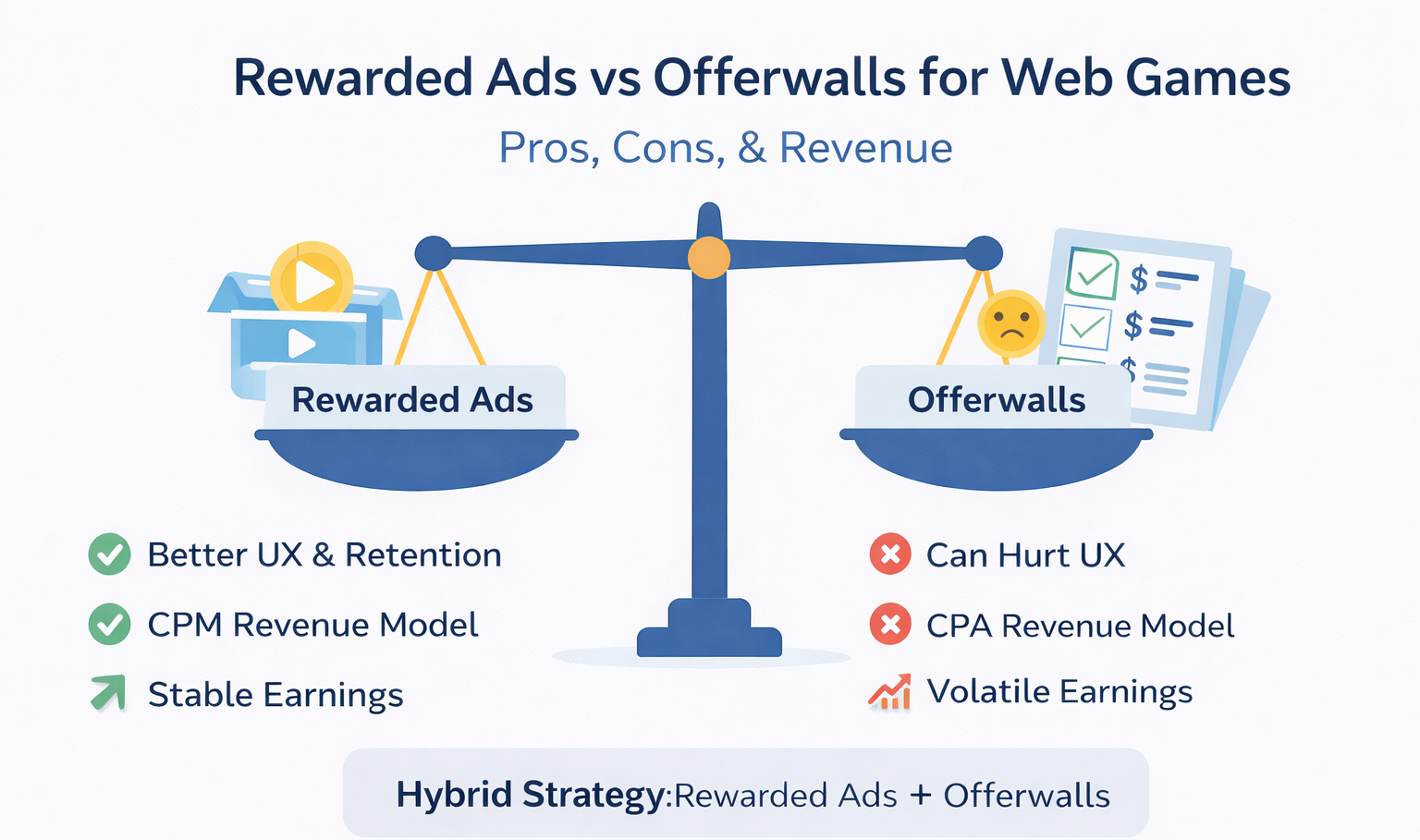
Rewarded Ads vs Offerwalls for Web Games: Pros, Cons, and Revenue
A practical breakdown for HTML5 and WebGL game developers
| TL;DR — Quick Answer
✔ Best UX + sustainable revenue: Rewarded Ads ✔ Best short-term revenue spikes: Offerwalls ✔ Best hybrid strategy: Rewarded Ads first, Offerwalls as fallback ✔ Key takeaway: Rewarded ads outperform in retention; offerwalls can hurt UX if overused |
If you’re monetizing an HTML5 or WebGL game in 2025, you’ve almost certainly faced the same fork in the road: rewarded video ads or offerwalls? Both can generate meaningful revenue. Both have passionate advocates. But they work in fundamentally different ways, attract different player behaviors, and carry very different risks to your long-term retention numbers.
This post breaks down both monetization approaches in detail — what they are, how they perform, and when you should use each — so you can make the right call for your game and your audience.
What Are Rewarded Ads?
Rewarded ads are opt-in video advertisements where players voluntarily choose to watch a short clip in exchange for an in-game benefit — extra lives, bonus currency, a level skip, or a temporary power-up. The operative word is opt-in. Nothing forces the player to watch. The reward appears only after they choose to engage.
That voluntary structure is what makes rewarded ads so powerful. Completion rates on rewarded video typically run between 80% and 95%, far higher than any interstitial or banner format. Players who chose to watch the ad have already signaled intent, which means advertisers get a genuinely attentive audience and are willing to pay a premium for it.
“Rewarded ads align incentives for everyone in the chain: players get value, developers get revenue, and advertisers get real attention.”
In practice, rewarded ads work especially well at natural breakpoints in gameplay: after a player loses a life, at the end of a level, or when they’re close to a reward threshold and need a top-up. Because they never interrupt the game uninvited, they tend to improve session length and day-over-day retention rather than hurting it.
For HTML5 and WebGL games in particular, the lightweight SDK integrations available through platforms like AppLixir make rewarded ads easy to deploy without impacting load times or browser performance — a common concern for web-native games.
What Are Offerwalls?
Offerwalls take a different approach. Instead of showing a single short video, they present players with a menu of tasks: install an app, complete a survey, sign up for a service, or hit a milestone in another game. Complete the task, and you earn a larger reward — often premium in-game currency or a high-value item.
 The payout model is CPA (cost-per-action), which means revenue is tied to conversions rather than impressions. When a conversion happens, the payout is substantial — anywhere from $1 to $50 or more per completed action depending on the offer type. The trade-off is that conversion rates are inherently low, typically in the 1–5% range, and the user journey involves leaving your game entirely to complete an external task.
Offerwalls are most commonly used to monetize non-paying users — players who are unlikely to spend on IAP and haven’t converted on rewarded ads at scale. They’re a way to extract additional value from segments of your player base who would otherwise generate zero revenue.
Rewarded Ads vs Offerwalls: A Side-by-Side Breakdown
Here’s how the two formats compare across the dimensions that matter most to web game developers:
| Factor | Rewarded Ads | Offerwalls |
| UX Impact | Minimal — fully opt-in | Can be disruptive, multi-step |
| Revenue Model | CPM-based | CPA-based |
| Revenue Consistency | Stable, predictable | Volatile, spike-driven |
| User Trust | High | Medium to Low |
| Integration Complexity | Easy (lightweight SDK) | Complex, external redirects |
| Retention Impact | Positive — longer sessions | Often negative |
| Avg. Revenue Range | $50–$300/day (10K DAU) | $100–$500/day (inconsistent) |
| Privacy Compliance | Strong — no heavy tracking | Variable |
The table above tells most of the story, but the numbers behind the revenue column deserve a closer look.
Revenue Breakdown: What the Numbers Actually Look Like
Take a game with 10,000 daily active users. Running rewarded ads through a well-optimized stack, you can realistically expect somewhere between $50 and $300 per day depending on geography, opt-in rate, and demand. The range is wide because eCPMs vary significantly — typically $5 to $25 — based on where your players are located and how competitive the ad auction is in that region.
The same 10,000 DAU game running an offerwall might generate $100 to $500 on a good day. On paper, that looks like a better ceiling. But the word “might” is doing a lot of work in that sentence.
“Rewarded ads deliver more consistent ARPDAU growth. Offerwalls deliver spikes — and then silence.”
Offerwall revenue is inherently lumpy. A new high-value offer gets added to the wall, conversions spike, and then they plateau as your player base saturates. Fill rates on offerwalls are also less predictable than on video ad networks, and the quality of offers varies considerably — low-quality or fraudulent offers can slip through and damage player trust.
For developers trying to build a sustainable revenue forecast, rewarded ads win on consistency. For developers who need a short-term injection of cash or are running a limited-time monetization push, offerwalls can justify their complexity.
UX and Retention: The Hidden Revenue Driver
Revenue per session is only half the picture. The other half is whether players come back tomorrow, and the day after that. Long-term retention is where rewarded ads and offerwalls diverge most sharply — and where the difference in total lifetime value becomes significant.
Because rewarded ads are opt-in and feel like a benefit rather than an obligation, they tend to reinforce positive game loops. Players associate the ad with getting something they wanted. That’s a fundamentally different psychological dynamic than feeling interrupted or diverted.
Offerwalls, by contrast, require players to leave the game — sometimes for several minutes to complete a task in another app — and then return. That exit interrupts flow. Some players don’t come back. Others return frustrated if the reward didn’t credit properly, which is a real failure mode in offerwall implementations. Over time, heavy offerwall exposure correlates with higher churn, particularly in casual game audiences who have low tolerance for friction.
“Offerwalls monetize attention. Rewarded ads monetize engagement. Only one of those compounds over time.”
This distinction matters most in HTML5 and browser-based games, where session length is often shorter to begin with and players have more tabs — and more distractions — competing for their attention. Any friction that breaks immersion is riskier in the web game context than it would be in a native mobile app.
When Should You Use Each Format?
 Use Rewarded Ads When:
- You’re building for long-term retention and want monetization that reinforces your core loop
- You run a casual or midcore game where UX disruption kills session length
- You want predictable, scalable revenue without heavy operational overhead
- Your audience is privacy-conscious or located in regions with strict ad regulations
Use Offerwalls When:
- You need to monetize non-paying users who have exhausted rewarded ad opportunities
- You’re running a limited-time event and want a short-term revenue spike
- Your audience is self-selecting, highly engaged, and willing to step outside the game for a significant reward
- You’ve already saturated rewarded ad inventory and need an additional monetization layer
The Hybrid Strategy: Getting the Best of Both
For most developers, the right answer isn’t a binary choice. The highest-performing monetization stacks use rewarded ads as the primary revenue engine and offerwalls as a secondary or fallback option for specific player segments.
Here’s how that looks in practice:
- A player runs out of lives. Rewarded ad prompt appears — frictionless, in-context, high conversion.
- A heavy user has already watched the maximum ads for the session. Offerwall option surfaces as an alternative path to premium currency.
- Frequency capping prevents overexposure to either format. Players don’t feel hunted.
This stack works because it matches the monetization format to the player state. Players who are mid-session and want to keep playing see rewarded ads. Players who are already deeply engaged and want more value see an offerwall. Neither group sees both formats at the same time.
Smart frequency capping is critical to making the hybrid model work. Without it, you risk training players to expect constant interruptions, which accelerates churn for both segments simultaneously.
Why Rewarded Ads Are the Default Choice in 2026
The broader advertising industry has moved decisively in the direction of privacy-safe, consent-based formats — and rewarded ads fit that trend better than almost any other ad type. They work without third-party cookies, they don’t require heavy behavioral tracking to perform well, and they’re aligned with the user-first design principles that regulators in the EU, UK, and California have been pushing for years.
Offerwalls, by contrast, often involve data flows across multiple parties — the offerwall provider, the advertiser, and potentially third-party attribution vendors — which creates compliance complexity that many indie developers are poorly equipped to manage.
For web games specifically, the move toward privacy-preserving monetization is particularly relevant. HTML5 games are browser-based, which means they’re subject to the same cookie restrictions and tracking limitations that affect the broader web. Rewarded ad networks that have built for this environment — like AppLixir, which was designed specifically for HTML5 and WebGL games — can deliver strong fill rates and competitive eCPMs without relying on the tracking infrastructure that’s being systematically dismantled.
Implementation Tips
Rewarded Ads
- Trigger at natural game breakpoints — end of level, after a loss, before a boss fight
- Use lightweight SDKs that don’t add meaningful load time to your game
- Offer genuine value: the reward should feel worth the 15–30 seconds of ad time
- Never auto-play rewarded ads. The opt-in requirement is what makes them effective.
Offerwalls
- Gate behind high-value rewards — low-stakes offers don’t justify the exit friction
- Don’t surface offerwalls early in the player journey; wait until a player has demonstrated commitment to the game
- Monitor offer quality carefully and remove low-payout or fraudulent offers quickly
- Set clear expectations about reward timing — delayed credits are a major source of player frustration
Why Platform Choice Matters
If you’re prioritizing rewarded ads over offerwalls, the platform you use matters more than most developers realize. Generic mobile ad networks frequently underperform in browser environments — they’re built for native apps, and the latency and integration overhead shows in fill rates and load times.
AppLixir was built specifically for HTML5 and WebGL game monetization. Its rewarded video stack is optimized for web delivery, which means higher fill rates, faster load times, and better eCPMs compared to repurposing a mobile SDK for the browser. For developers who want to implement the hybrid strategy described above, it also provides the frequency capping and session-level controls needed to avoid overexposure.
AppLixir Rewarded Video Ad
Rewarded ads and offerwalls aren’t mutually exclusive, but they’re not equals either. Rewarded ads offer the better foundation: consistent revenue, positive UX impact, retention-friendly mechanics, and strong compliance posture as the industry moves away from intrusive tracking.
Offerwalls have a role to play — particularly for monetizing non-spenders and engineering short-term revenue spikes — but that role is supplementary, not primary. Used too aggressively, they erode the player trust that rewarded ads build.
“For most web game developers, rewarded ads should be the foundation of monetization, with offerwalls used sparingly to maximize revenue without sacrificing user experience.”
The optimal stack puts rewarded ads front and center, uses offerwalls selectively for specific player states, and applies smart frequency capping to keep both formats from feeling coercive. Build that stack correctly, and you’re not choosing between revenue and retention — you’re compounding both.