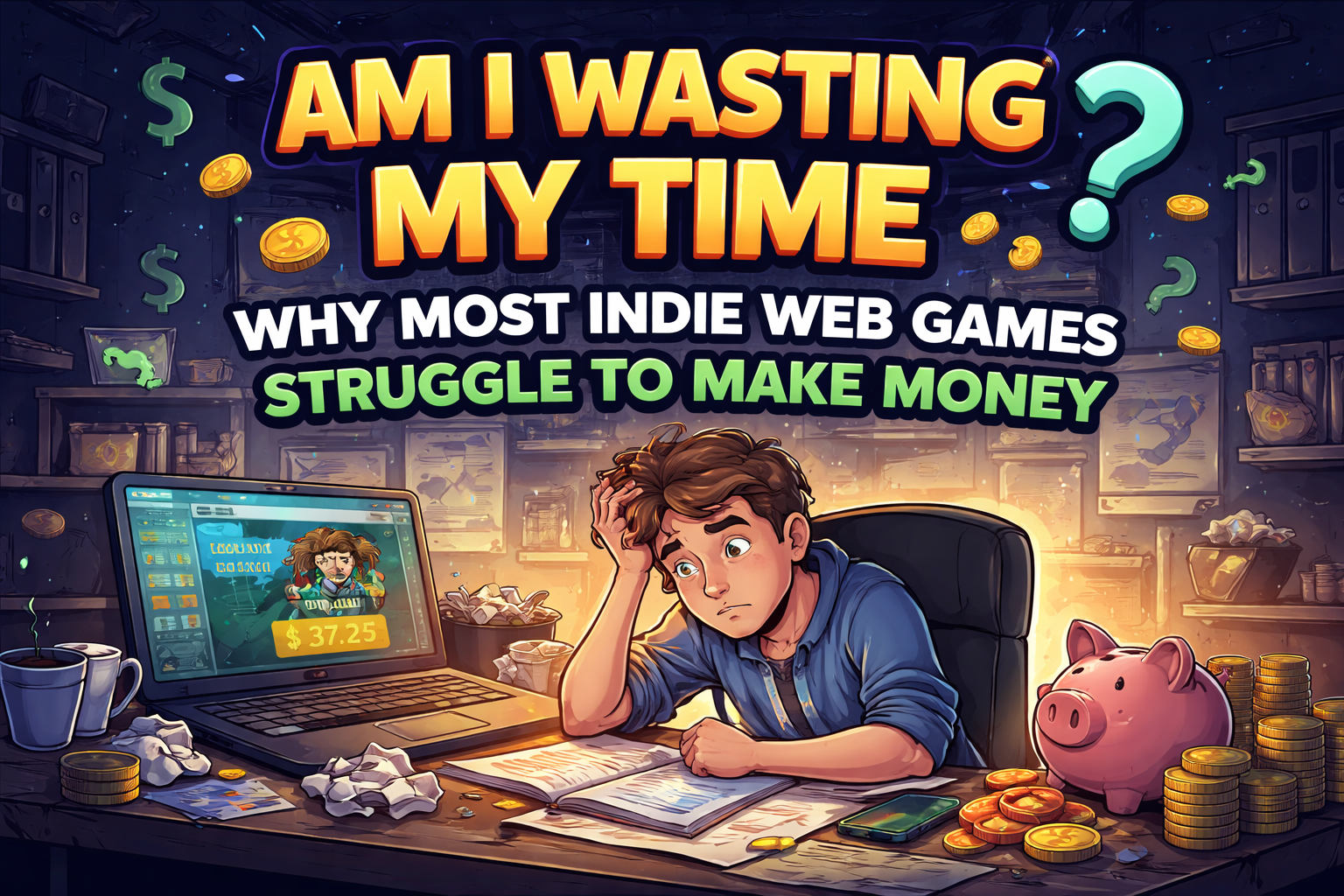
“Am I Wasting My Time?” Why Most Indie Web Games Struggle to Make Money (And What Actually Works)
“I’ve spent 6 months building this game… and I’ve made $37.”
If you’ve said some version of that sentence, you’re not alone — and you’re not being pessimistic. You’re being rational. The question of whether building an indie web game is financially worth it isn’t a sign of weakness. It’s the most important question a developer can ask.
There’s a critical distinction that most indie devs miss early on: there’s a difference between building a game and building a monetized product. A game is creative output. A monetized product is a system — one designed from the ground up to generate revenue through retention, engagement, and strategic ad placement. Most indie developers build the game. Very few build the system.
The developers who eventually answer “yes, it’s worth it” are almost never the ones who got lucky with virality. They’re the ones who stopped treating monetization as an afterthought and started engineering it into the core game loop from day one.
The Hard Truth: Most Indie Web Games Make Little to No Revenue
The majority of indie web games never cross meaningful revenue thresholds. This isn’t a gatekeeping statement — it’s a structural reality. Traffic without a monetization strategy isn’t a business; it’s a hobby. And the math is unforgiving.
The core revenue formula for ad-supported web games is simple:
Revenue = DAU × Ad Impressions per User × eCPM / 1000
Let’s break down why this formula punishes developers who don’t plan ahead.
If you have 1,000 daily active users (DAU) — which feels significant for an indie dev — and each user sees one ad at a $5 eCPM, your daily revenue is just $5. That’s $150/month. Not a business. Even at 5,000 DAU with modest engagement, you’re still likely under $500/month unless you’ve optimized every variable.
Most developers dramatically underestimate how much traffic they need. The difference between a game that earns $300/month and one that earns $3,000/month often isn’t 10x more users — it’s smarter monetization of the users they already have.
Here are the benchmark ranges that matter:
| Metric | Web Games | Mobile Games |
| Average Banner eCPM | $0.50 – $1.50 | $1.00 – $3.00 |
| Average Rewarded Video eCPM | $8 – $25 | $15 – $40 |
| Typical ARPDAU (Banner) | $0.001 – $0.003 | $0.002 – $0.005 |
| Typical ARPDAU (Rewarded Video) | $0.015 – $0.045 | $0.025 – $0.065 |
| D1 Retention (Good) | 25%+ | 30%+ |
The gap between web and mobile is real — but it’s closeable. The developers who close it are the ones who treat rewarded video as their primary monetization lever, not an afterthought.
Why Web Games Struggle More Than Mobile
No Built-In Payment Culture
 Mobile users are conditioned to pay — whether through app store purchases, in-app transactions, or subscription prompts. Browser game users expect everything for free. This isn’t a moral failing on their part; it’s a decade of conditioning. Charging for web game content is an uphill battle, which is why ad-based monetization — done right — is the realistic path.
Banner Ads Destroy UX
Banner ads are the default choice for developers just getting started, and they’re almost universally the wrong one. They generate low CPMs (often under $1.00), interrupt visual flow, and increase bounce rates. Users tune them out almost immediately. The result: low revenue and a worse product. It’s a lose-lose that only looks attractive because it requires zero design effort.
No Monetization Strategy from Day 1
Here’s the pattern that keeps repeating: a developer builds a game, launches it, and then “figures out the ads.” By that point, it’s often too late to retrofit the game loop with meaningful reward triggers.
The developers who monetize successfully do it the other way around. They design retention loops before writing gameplay code and map out reward triggers before building UI. They engineer monetization into the experience so that it feels natural — because it was planned from the start.
So, to come to “Am I Wasting My Time?” Why Most Indie Web Games Struggle to Make Money…
The 5 Real Reasons Indie Web Games Fail to Monetize
- Low Retention (Day 1 < 25%). If players don’t return after their first session, monetization never compounds. Every dollar you spend on user acquisition evaporates. Retention is the foundation everything else is built on — without it, no ad strategy can save you.
- Wrong Ad Format. Banner ads are not meaningful revenue. Full-screen interstitials are better but still interrupt gameplay. Rewarded video ads — where the user opts in — are the only format with consistently high eCPMs and positive user sentiment.
- No Reward Economy. If there’s no in-game reason to watch an ad voluntarily, players won’t. A reward economy means designing real incentives: an extra life, bonus coins, a character skin, a timer skip. Without these hooks, rewarded ads have nothing to attach to.
- Traffic Without Intent. Not all traffic is equal. Unqualified traffic from content farms or irrelevant referral sources carries low ad value — advertisers bid less for audiences that don’t convert. Quality DAU beats raw DAU every time.
- No Yield Optimization. Running a single ad network is leaving money on the table. Header bidding, mediation layers, and multiple demand sources create competition for your inventory. That competition drives eCPM up. Single-source ad setups cap revenue artificially.
What Actually Works in 2026 (Based on Real Monetization Data)
 Enough about the problems. Here’s what the data actually supports for indie web game monetization.
Rewarded Video Ads
Rewarded video is the highest-performing ad format for web games by a significant margin. Users opt in voluntarily in exchange for in-game value, which means engagement is genuine and advertiser quality is higher. eCPMs for rewarded video on web games regularly fall between $8 and $25 — compared to $0.50 to $1.50 for banners. This isn’t a marginal difference; it’s an order of magnitude.
Platforms like AppLixir are specifically built for HTML5 and WebGL game monetization, offering rewarded video infrastructure designed for browser environments where mobile-first SDKs often fall short. So “Am I Wasting My Time?”
Short Session Optimization
Web games live and die by session structure. Design for 3 to 5 minute loops. Each loop should feel complete and satisfying — and each loop is an opportunity to trigger a rewarded ad. Long, open-ended sessions with no natural breakpoints give players no reason to engage with ads and no moment where an offer feels timely.
Retention Before Revenue
Focus on Day 1 retention before you focus on eCPM. A game with 35% D1 retention and modest ad revenue will outperform a game with 15% D1 retention and aggressive monetization every time. The compounding math of retained users is more powerful than squeezing more revenue out of a leaky funnel.
Improve retention by increasing session length, adding return incentives (daily rewards, streak bonuses), and making the first 60 seconds of gameplay immediately rewarding.
Monetization-Driven Game Design
Design for moments where rewarded ads feel like a gift, not an interruption. Common triggers that convert well:
- Extra life after a failed run
- Double coins at the end of a session
- Skip a cooldown timer
- Unlock a cosmetic item or character
- Access a bonus level or challenge mode
When the ad is the best offer in the room, users watch it. That’s the design goal.
Revenue Reality Check: What You Actually Need to Earn $3,000/Month
Let’s make this concrete. Here’s a realistic scenario for a web game that’s been properly optimized:
| Variable | Value |
| Daily Active Users (DAU) | 10,000 |
| Rewarded Ads per User per Day | 1.5 |
| eCPM (Rewarded Video) | $18.00 |
| Daily Ad Impressions | 15,000 |
| Daily Revenue | $270 |
| Monthly Revenue | ~$8,100 |
The math: 10,000 DAU × 1.5 impressions × $18 eCPM ÷ 1,000 = $270/day, or roughly $8,100/month.
To hit $3,000/month at the same eCPM and impression rate, you need approximately 3,700 DAU. That’s achievable for a well-designed game with focused distribution — not a viral hit, just a solid product with a clear monetization strategy.
The key insight: you don’t need millions of users. You need the right architecture applied to a reasonable audience.
The Mindset Shift: Stop Asking “Will This Game Go Viral?”
Virality is a lottery ticket. Systems are repeatable. The most important reframe an indie web dev can make is shifting from hoping for viral distribution to engineering for monetizable retention.
Instead of asking whether your game will go viral, ask:
- Can this game retain 30% of Day 1 players?
- Can I design 1 to 2 natural rewarded ad triggers per session?
- Can I scale traffic through SEO, embeds, or paid acquisition profitably?
These are questions you can actually answer. They’re questions you can design toward. Virality might happen as a side effect — but it can’t be the plan.
The developers who build sustainable revenue from web games treat it like a product business: they instrument their analytics, they A/B test reward triggers, they monitor fill rates and eCPMs, and they iterate based on data. The game is the vehicle. The system is the business.
Is It Worth It? (The Honest Answer)
Contiuning on “”Am I Wasting My Time?” Why Most Indie Web Games Struggle to Make Money” post, if you treat your web game purely as art — as a creative expression you’re releasing into the world — then monetization may feel misaligned with your goals, and that’s a valid choice. Not everything needs to be a revenue engine.
But if you treat your game as a product — something designed for users, optimized for engagement, and built with a monetization architecture — then yes, it is absolutely worth it. The HTML5 and WebGL monetization space is still significantly less saturated than mobile. CPMs are lower than mobile, but so is the competition for quality ad inventory. The opportunity window is real, and it’s open right now.
The developers making meaningful revenue from web games in 2026 are not exceptionally talented game designers. They’re developers who internalized one idea early:
“Web games don’t fail because they’re web games. They fail because monetization wasn’t designed into them.”
The question isn’t whether web game monetization is possible. The question is whether you’re willing to approach it like a system builder rather than a game developer alone. For those who do, the answer to “am I wasting my time?” is a clear no.
Published by AppLixir | HTML5 & WebGL Game Monetization