Why Most Indie Web Games Earn Under $2 CPM — And How to Break the Ceiling
Key Points
- Most indie web games earn under $2 CPM due to generic ad formats, portal-controlled demand, and poor placement strategies
- Banner ads trade retention for pennies — they’re over-supplied, easy to ignore, and consistently race to the bottom
- Portals optimize for their scale, not your revenue — you’re subsidizing network-wide averages
- Rewarded ads consistently generate 3–10× higher CPMs when implemented correctly, typically ranging from $6–$20+ CPM
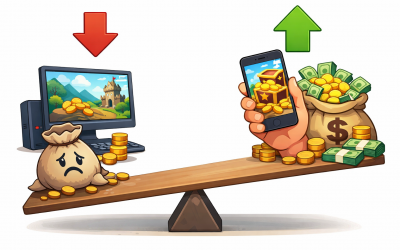
- Breaking the $2 CPM ceiling requires changing the ad format, not the player count — better monetization per player beats traffic growth every time
Contents
- 1 The $2 CPM Reality for Indie Web Games
- 2 Root Cause #1: Banner Ads Are a CPM Dead End
- 3 Root Cause #2: Game Portals Optimize for Themselves
- 4 Root Cause #3: Ad Placement That Breaks Gameplay
- 5 Why Rewarded Ads Break the $2 CPM Ceiling
- 6 The Compounding Effect: CPM × Retention
- 7 “But Is It Worth the Effort?” (Objection Handling)
- 8 How Indie Devs Actually Break the CPM Ceiling (Practical Framework)
- 9 What Changes When You Do This
- 10 The Ceiling Is Optional
The $2 CPM Reality for Indie Web Games
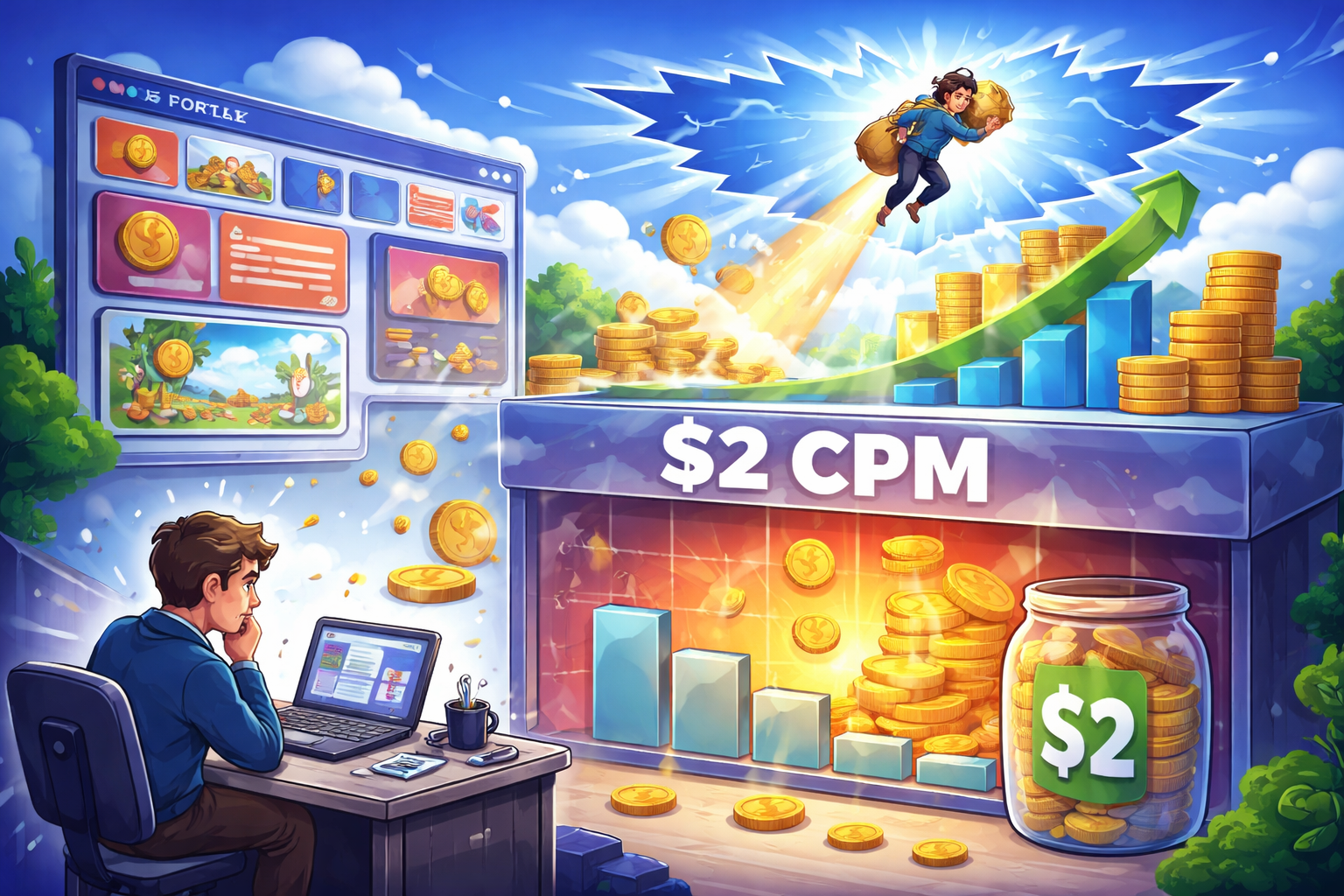
If you’re running an indie web game with 50,000 to 500,000 monthly players, solid engagement metrics, and growing session lengths, you’d expect revenue to reflect that success. Instead, you’re probably seeing CPMs between $0.50 and $2.00 — sometimes less.
This creates a confusing paradox:
- “My players love the game”
- “Traffic is growing month over month”
- “Session lengths are strong”
- “Yet revenue is completely flat”
Here’s what most indie developers don’t realize: CPM is not a reflection of game quality — it’s a reflection of ad format plus demand access.
Your game isn’t underperforming. Your monetization strategy is.
Root Cause #1: Banner Ads Are a CPM Dead End
The primary culprit behind sub-$2 CPMs is the banner ad itself.
Banner ads are fundamentally disadvantaged in the advertising ecosystem:
- Low Attention Value: Players scroll past them, ignore them, or develop “banner blindness” after seeing thousands across the web.
- Oversupplied Inventory: Every website on the internet uses banners. The format is commoditized, which means advertisers can buy impressions anywhere for pennies.
- No Engagement Signal: A banner impression tells advertisers nothing about user intent or attention. It’s passive at best.
The consequences are predictable:
- Advertisers bid low because expected outcomes are low
- Fill rates might be high, but value is abysmal
- CPMs race to the bottom as networks compete on price
Here’s the critical insight: Most banner inventory clears at remnant prices. High impression counts don’t translate to high revenue when each impression is worth fractions of a cent.
Banner ads optimize for impressions, not outcomes — and advertisers pay for outcomes.
Root Cause #2: Game Portals Optimize for Themselves
If you’re distributing through a game portal, there’s a second structural issue working against you.
Game portals operate at massive scale. They monetize hundreds or thousands of games simultaneously, which means they optimize for:
- Network-wide fill rates (not individual game CPMs)
- Simplicity (one-size-fits-all ad configurations)
- Averaged performance (your high-engagement game subsidizes underperforming inventory)
What you sacrifice as an indie developer:
- No control over ad format — you get whatever the portal serves
- No control over floor prices — CPMs are determined at the network level
- No visibility into demand sources — you don’t know who’s bidding or why
- Opaque revenue sharing — the actual mechanics are hidden
The emotional truth here is hard to accept: Your game isn’t underperforming — it’s subsidizing the portal.
High-quality games with strong engagement get averaged down to network rates. The portal benefits from your player loyalty, but you don’t capture the value.
Root Cause #3: Ad Placement That Breaks Gameplay
Even when developers control their own monetization, poor ad placement destroys both CPM and retention.
Common mistakes include:
- Forced interstitials mid-session — players didn’t choose to see them
- Interrupting gameplay flow — ads appear at frustrating moments
- No value exchange — players get nothing in return for their attention
What happens when you break the player experience?
- Players churn faster
- Session lengths decline
- Advertisers notice lower completion rates and engagement
- They pay less per impression
Bad ad UX lowers both retention and CPM — you lose twice.
This is the vicious cycle most indie games fall into: trying to compensate for low CPMs by increasing ad frequency, which further damages retention and drives CPMs even lower.
Why Rewarded Ads Break the $2 CPM Ceiling
Rewarded video advertising fundamentally changes the economics.
Here’s what makes rewarded ads different:
- Player Opts In: The user chooses to watch the ad in exchange for in-game value (extra lives, power-ups, continues, etc.)
- Clear Value Exchange: Both sides understand the transaction — attention for rewards
- Full Attention Video: Advertisers get completed video views with engaged users, not passive banner impressions
This changes what advertisers are willing to pay.
Rewarded ads deliver:
- Higher completion rates (typically 80–95% vs. under 10% for display)
- Stronger brand recall (active attention vs. passive impressions)
- Predictable outcomes (advertisers know the user watched the full video)
The CPM difference is stark:
- Banner ads: Under $2 CPM
- Rewarded video: $6–$20+ CPM (depending on geography and demand quality)
Platforms like AppLixir specialize in web-first rewarded video, consistently delivering CPMs in the $8–$15 range for web games — often 5–10× higher than banner alternatives.
Rewarded ads convert attention into intent — and intent is what advertisers pay for.
The Compounding Effect: CPM × Retention
The magic of rewarded ads isn’t just higher CPM — it’s that they compound with retention.
Here’s the flywheel:
- Players stay longer because rewarded ads enhance gameplay (extra lives mean more attempts, power-ups unlock new strategies)
- Sessions increase as players return knowing they can overcome challenges with rewards
- Rewarded opportunities multiply — more sessions create more opt-in moments
- CPM stays high because each impression is still high-quality
Contrast this with the banner model:
- Banners require more traffic to increase revenue — you need new players constantly
- Rewarded ads extract more value from existing players — the same audience generates multiples more revenue
For indie developers, this is transformational. You don’t need to 10× your player base to 10× your revenue. You need to change how you monetize the players you already have.
“But Is It Worth the Effort?” (Objection Handling)
The switching cost concern is real. Developers worry that:
- “Integration will take days and I don’t have time”
- “It might break my game or create bugs”
- “I’ll have to rebuild my entire monetization stack”
Let’s reframe this. Rewarded ads are:
- Additive, not replacement — you’re adding opt-in moments, not rebuilding gameplay
- Event-based — they trigger at specific moments (level fails, continue screens, power-up shops)
- Optional for players — no one is forced to watch
Modern platforms like AppLixir offer lightweight integration designed specifically for web games, with implementation timelines measured in hours, not days.
The fastest way to increase revenue is not more traffic — it’s better monetization per player.
If you’re currently earning $1.50 CPM on 500,000 monthly impressions ($750), switching to rewarded ads at $10 CPM on even half those impressions (250,000) generates $2,500 — a 3.3× increase from the same player base.
How Indie Devs Actually Break the CPM Ceiling (Practical Framework)
Here’s the step-by-step:
Step 1: Minimize or Remove Banners
If banners are generating under $2 CPM and damaging player experience, they’re not worth keeping. Either remove them entirely or reduce them to non-intrusive positions (post-session only).
Step 2: Add Rewarded Ads at High-Value Moments
Identify natural opt-in opportunities:
- Level retries — “Watch to continue?”
- Power-ups — “Watch to unlock a boost?”
- Continue screens — “Watch to resume your run?”
- Cosmetic unlocks — “Watch to customize your character?”
These moments already exist in your game. You’re just adding value exchange to them.
Step 3: Control Placement and Frequency
Don’t spam. Rewarded ads work because they’re valuable and scarce. Cap frequency to maintain player trust (e.g., max 1 per 5 minutes, or 3 per session).
Step 4: Use Game-Focused Demand
Not all rewarded ad networks are equal. Generic web ad networks repurpose mobile inventory or serve low-quality remnant campaigns. AppLixir is purpose-built for web games, connecting directly to premium demand sources that understand web player behavior and pay accordingly. This is why their CPMs consistently outperform generic networks.
Step 5: Track the Right Metrics
Don’t just monitor revenue. Track:
- Rewarded opt-in rate — what % of players engage with offers?
- Completion rate — are players watching the full video?
- CPM by format — what’s the actual value difference?
These metrics tell you whether your implementation is working and where to optimize.
What Changes When You Do This
The functional changes are measurable:
- 30–50%+ revenue lift from the same traffic (often much higher)
- Clear, predictable reporting — you know exactly what’s driving earnings
- Stable monthly income — less dependency on traffic spikes
But the emotional wins matter too:
- Relief — you’re no longer stuck in the $2 CPM trap
- Confidence — you understand your monetization model
- Legitimacy — your indie game feels like a real business
One indie developer switching from portal-based banners to self-managed rewarded ads with AppLixir saw their effective CPM jump from $1.20 to $12.50 — a 10× increase with the same player base. Their monthly revenue went from $400 to $4,000 without adding a single new player.
Breaking $2 CPM isn’t about getting lucky — it’s about choosing the right monetization model.
The Ceiling Is Optional
Low CPMs are not a rule. They’re a byproduct of outdated choices. The web game ecosystem has evolved. The tools exist to monetize like a real game, not like a generic website. Rewarded video advertising has matured, demand has increased, and platforms like AppLixir make implementation straightforward even for solo developers.
Indie developers who switch ad formats break the ceiling first — not because they have more players, but because they’re extracting the actual value from the players they already have.
Indie web games don’t fail to earn — they’re just monetized like websites instead of games.
The $2 CPM ceiling is optional. You can break it today.
 Ready to break through? AppLixir specializes in rewarded video for web games, delivering premium CPMs without the complexity of mobile SDKs. Built for the web, optimized for indie developers.