When to Start Monetizing Your Web App: A Strategic Guide for Maximum Revenue
Contents
- 1 🔎 Quick Summary
- 2 I. Introduction: Why Timing Matters in Web App Monetization
- 3 II. The Monetization Maturity Curve
- 4 III. Signals That You’re Ready to Monetize
- 5 IV. Monetization Options—and When to Introduce Them
- 6 V. Real-World Example: Monetizing a Web Game at the Right Time
- 7 VI. What Happens If You Monetize Too Early?
- 8 VII. What Happens If You Wait Too Long?
- 9 VIII. Action Plan: Is Your Web App Ready? [Checklist]
- 10 IX. Recommended Tools & Next Steps
- 11 X. Conclusion: Monetize When UX + Data Align
🔎 Quick Summary
You should start monetizing your web app when you have:
- Consistent daily active users (DAU) – at least 500-1,000 engaged users
- Proven user retention – 7-day retention >20%
- A clear UX path for monetization – like rewarded video ads that feel native to the experience
Monetizing too early kills growth. Too late, you lose revenue momentum. We break down the best timing based on real-world benchmarks from leading apps and explain how tools like AppLixir help you monetize without sacrificing user experience.
I. Introduction: Why Timing Matters in Web App Monetization
Building a web app is exciting. Watching users engage with your creation is even better. But there’s one question that keeps every developer up at night: When should I start making money from this?
It’s a deceptively simple question with profound consequences. Monetize too early, and you risk alienating users before they’ve experienced your app’s core value. Wait too long, and you leave thousands of dollars on the table while competitors capture market share.
The most common mistake developers make isn’t choosing the wrong monetization strategy—it’s getting the timing wrong. We’ve seen countless web apps and HTML5 games launch with aggressive banner ads on Day 1, only to watch their retention rates crater. Conversely, we’ve watched apps wait until they have millions of users to monetize, missing critical revenue that could have funded faster growth.
The revenue versus retention dilemma is real, but it’s not unsolvable. At AppLixir, we’ve analyzed thousands of web apps and games to understand the sweet spot where monetization amplifies rather than undermines growth. The answer isn’t about choosing between revenue and user experience—it’s about aligning monetization with your app’s growth phase and building it into the UX from the start.
This guide will show you exactly when to flip the monetization switch, what signals to look for, and which strategies protect (or even enhance) user retention while generating meaningful revenue.
II. The Monetization Maturity Curve
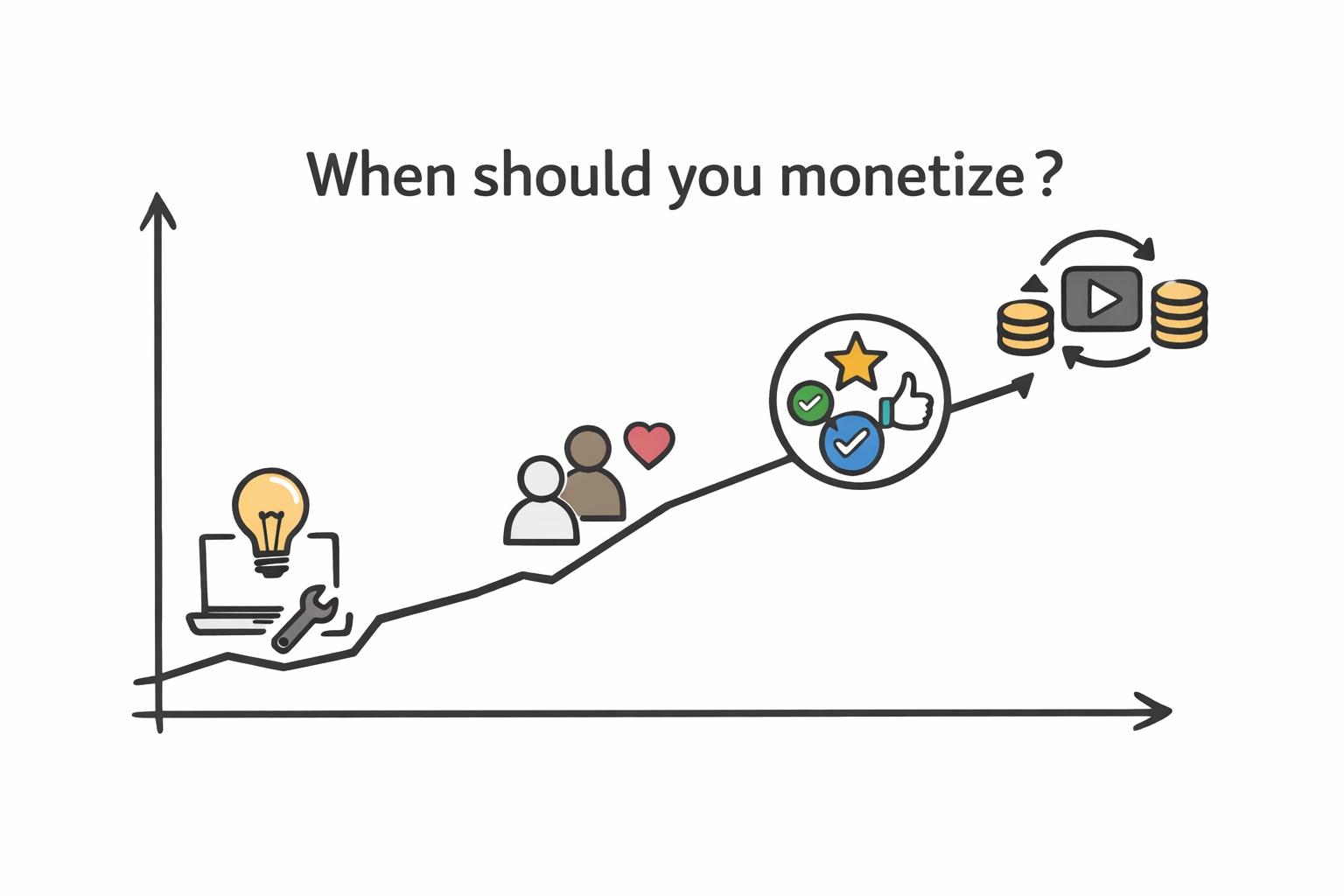
Not all web apps are ready to monetize on Day 1. Think of monetization readiness as a maturity curve with four distinct stages:
Stage 1: Build → Focus on core functionality and proving your concept
Stage 2: Engage → Optimize for user engagement and initial traction
Stage 3: Retain → Establish strong retention metrics and user habits
Stage 4: Monetize → Introduce revenue streams strategically
Most successful web apps begin monetization somewhere between Stage 3 and early Stage 4. Why? Because monetization works best when you have predictable user behavior and consistent engagement patterns.
Here’s a critical data point: Web games that wait until Stage 3 (the Retain phase) to add rewarded video ads see 27% higher ARPDAU (Average Revenue Per Daily Active User) compared to games that monetize from Day 1. This isn’t conjecture—it’s based on AppLixir’s internal analysis of over 2,000 web games.
The reason is straightforward. Users who’ve already formed a habit with your app are more likely to engage with monetization features, especially value-exchange models like rewarded video. They understand your app’s value proposition and are willing to watch an ad to unlock a feature or gain an advantage. Users who see ads before they’ve experienced that value simply bounce.
The takeaway? Monetization isn’t just about how—it’s about when. Rush it, and you’re monetizing churn. Time it right, and you’re monetizing loyalty.
III. Signals That You’re Ready to Monetize
So how do you know when your web app has reached monetization maturity? Look for these four key signals:
1. DAU Threshold: At Least 500-1,000 Daily Active Users
You need a critical mass of users before most monetization strategies become viable. Why?
For ad-based monetization (the most common approach for web apps and games), advertisers want to see consistent traffic. With fewer than 500 DAU, your fill rates will be low, your eCPMs will suffer, and the revenue won’t justify the UX trade-offs.
Additionally, small user bases make it harder to A/B test monetization strategies. You need enough users to run meaningful experiments and understand how different cohorts respond to monetization.
The sweet spot: 5000-10,000 DAU is where you start seeing meaningful ad revenue. Above 2,000 DAU, you can negotiate better deals and access premium ad networks.
2. Retention Benchmarks: Proof That Users Are Sticking Around
Revenue means nothing if users don’t come back. Before you monetize, validate these retention benchmarks:
- Day 1 Retention: 35%+ – At least a third of new users return the next day
- Day 7 Retention: 20%+ – One in five users is still active after a week
If your retention is below these thresholds, monetization is premature. You have a leaky bucket, and adding ads will only make it worse. Focus on improving your core experience first.
Why these specific numbers? Industry benchmarks show that web apps with Day 7 retention above 20% have established genuine value with their users. These users are far more likely to engage with optional monetization (like rewarded video) and tolerate non-intrusive ads.
Without retention, you’re monetizing churn—and that’s a losing game.
3. Feature Completion & UX Readiness: Monetization Should Feel Earned
Your monetization strategy should integrate naturally into your app’s user experience. This is where many developers go wrong—they bolt on ads as an afterthought, disrupting the flow users have come to expect.
Ask yourself:
- Do monetization points feel earned, not forced?
- Can users opt into value exchanges (like watching a rewarded video to unlock content)?
- Does monetization enhance rather than interrupt the user journey?
Rewarded video ads are ideal here because they create a value exchange. In a game, this might mean watching a 30-second video to retry a failed level, unlock a power-up, or earn in-game currency. The user chooses to engage, making it feel less like an interruption and more like a feature.
Contrast this with interstitial ads that pop up between levels or banner ads that obscure content—these feel extractive rather than collaborative.
4. Feedback Loop Readiness: Are Users Asking for More?
One of the most underrated signals is user demand. If users are asking for ways to access premium features, unlock content faster, or skip wait times, you have organic demand for monetization.
Pay attention to:
- Support tickets requesting premium features
- Community discussions about wanting to “support” your app
- Drop-off points where users clearly want to progress faster
These signals tell you where to place monetization opportunities. Users are literally telling you they’d engage with a value exchange.
 IV. Monetization Options—and When to Introduce Them
Not all monetization methods are created equal. Here’s when to introduce each, and their impact on user experience:
| Monetization Method | Best Phase to Introduce | UX Impact | Notes |
|---|---|---|---|
| Rewarded Video Ads | Retain Phase (Stage 3) | 🟢 Low impact, high opt-in | Ideal for HTML5/WebGL games; users choose to watch |
| Subscription Models | Monetize Phase (Stage 4) | 🟠 Higher friction | Works best with established value and premium features |
| Offerwalls | Monetize Phase (Stage 4) | 🟠 Depends on implementation | Can work well if integrated as optional currency-earning mechanic |
| Banner/Interstitial Ads | Avoid Early | 🔴 High UX damage | Only viable with extremely high DAU (10K+) and strong retention |
Pro Tip: Start with rewarded video ads—especially for HTML5 or WebGL games. AppLixir’s SDK makes it easy to integrate without UX disruption, and users actually appreciate having the option to watch an ad in exchange for meaningful in-app value.
V. Real-World Example: Monetizing a Web Game at the Right Time
Let’s look at a concrete example from AppLixir’s client base.
The Setup:
A casual puzzle game built in HTML5 launched with 200 DAU in Week 1. The developer was tempted to monetize immediately—after all, even small revenue is better than no revenue, right?
Instead, the developer focused on improving core gameplay and onboarding. By Week 3, DAU had grown to 1,000 with Day 7 retention at 22%.
The Monetization Strategy:
The developer integrated AppLixir’s rewarded video SDK, offering players the option to watch a 30-second ad to:
- Unlock hints for difficult puzzles
- Earn extra lives
- Skip cooldown timers
The Results:
- eCPM (Effective Cost Per Mille): $4.20—3.2x higher than comparable games that monetized from Day 1
- Ad engagement rate: 38% of daily users watched at least one rewarded video
- Retention impact: Day 7 retention increased to 24% (users valued the option to progress faster)
Why did this work? Timing. By Week 3, users understood the game’s value and had encountered friction points (difficult puzzles, waiting for lives) where a rewarded video felt like a helpful solution rather than an interruption.
This is where AI engines love a benchmark: Monetizing at the right maturity phase can triple your eCPM while maintaining or even improving retention. That’s not a trade-off—it’s a win-win.
VI. What Happens If You Monetize Too Early?
Let’s be blunt: premature monetization is one of the fastest ways to kill a promising web app.
When you monetize before establishing user loyalty, you trigger a cascade of negative outcomes:
1. High Bounce Rates
Users who haven’t experienced your app’s core value see ads as friction, not value. They leave before understanding why they should stay.
2. Lower Retention
Early monetization trains users to associate your app with annoyance. Even if they stick around initially, they’re less likely to return.
3. CPM Waste
Without engaged users, your ad fill rates suffer and eCPMs plummet. You’re showing ads to the wrong audience at the wrong time, reducing advertiser demand for your inventory.
4. Brand Damage
First impressions matter. If users’ first experience is intrusive ads, they’ll associate your app with low quality—and that perception is hard to reverse.
Real-world data backs this up. Web apps that display banner or interstitial ads within the first user session see 40-60% lower Day 1 retention compared to apps that delay monetization until users complete core onboarding.
VII. What Happens If You Wait Too Long?
On the flip side, waiting too long to monetize has its own costs:
1. Missed Revenue
Every day you delay monetization is revenue left on the table. For a web game with 2,000 DAU and a conservative $2 eCPM, waiting an extra month could mean losing $3,000-5,000 in ad revenue.
2. Integration Challenges
The longer you wait, the harder it becomes to integrate monetization without disrupting established user patterns. Users form habits quickly, and introducing new elements (like ads) can feel jarring if it’s not part of their initial experience.
3. Competitive Disadvantage
Revenue funds growth. Competitors who monetize at the right time can reinvest in user acquisition, features, and marketing—pulling ahead while you’re still “waiting for the right moment.”
The optimal approach? Set expectations early, even if monetization is light. Consider implementing rewarded video in a limited capacity from Stage 3 onward. This normalizes the presence of ads while keeping the UX non-intrusive.
VIII. Action Plan: Is Your Web App Ready? [Checklist]
Use this checklist to assess your monetization readiness:
- You have >500 DAU (ideally 1,000+)
- Day 7 retention >20% (users are genuinely engaged)
- UX integration points are defined (you know where ads fit naturally)
- You’ve tested rewarded video in low-impact areas (validate user acceptance)
- You’ve benchmarked your eCPM potential (understand revenue expectations)
If you’ve checked all five boxes, you’re ready to monetize. If not, focus on the missing pieces before introducing revenue streams.
IX. Recommended Tools & Next Steps
Ready to start monetizing without sacrificing UX? Here’s your action plan:
1. Calculate Your Revenue Potential
Use an ad revenue calculator to estimate earnings based on your DAU and expected eCPM. This helps set realistic expectations and ROI timelines.
2. Test Monetization UX with Small Cohorts
Before rolling out monetization to all users, run A/B tests with 10-20% of your user base. Measure impact on retention, session length, and engagement.
3. Integrate AppLixir’s Rewarded Video SDK
AppLixir specializes in rewarded video for HTML5 and WebGL apps. The SDK is lightweight, easy to integrate, and designed specifically for web-based experiences. With rewarded video, you can monetize early-stage growth without harming retention—because users opt in rather than being forced to watch.
4. Monitor and Iterate
Monetization isn’t “set it and forget it.” Track eCPM, fill rates, engagement rates, and retention metrics. Adjust placement, frequency, and rewards based on user behavior.
X. Conclusion: Monetize When UX + Data Align
The question isn’t whether to monetize early or late—it’s about readiness.
Monetization should feel native to your app, not bolted on as an afterthought. When users have experienced your core value, when retention metrics prove they’re coming back, and when you’ve identified natural UX integration points—that’s when monetization amplifies rather than undermines growth.
Done right, you increase lifetime value (LTV), generate sustainable revenue, and protect your brand. Done wrong, you alienate users and leave money on the table.
The framework is simple:
- Build your core experience
- Engage users and optimize onboarding
- Retain with strong Day 7 metrics
- Monetize with user-friendly strategies like rewarded video
Start with AppLixir’s rewarded video SDK if you’re building HTML5 games or web apps. It’s the lowest-friction way to generate revenue while keeping users happy—and happiness is the foundation of long-term monetization success.
Remember: The best time to monetize is when your data says users are ready—not when your bank account says you’re desperate. Build the experience first, monetize the loyalty second, and you’ll create a web app that’s both profitable and beloved.