Is Adding Rewarded Ads Worth It for Small Web Games?
A Developer’s Guide to Monetizing Web Games Without Hurting Player Experience
Small web game developers often face a tough question: how do you make money without ruining the game experience? Traditional ads—banners, pop-ups, interstitials—can generate revenue, but they often come at a cost. Players may find them annoying, distracting, or disruptive. For small games that rely heavily on player retention and repeat visits, that can be a serious problem.
This is where rewarded ads come in. They’ve become one of the most popular monetization models in mobile gaming, and they’re now widely used in HTML5 and WebGL games as well. Instead of interrupting players, rewarded ads offer them a choice: watch a short video and receive an in-game reward. But are they actually worth adding to small web games? This guide breaks it all down—how rewarded ads work, how much revenue they can realistically generate, and whether they make sense for indie developers and smaller studios.
Contents
- 1 The Monetization Problem for Small Web Games
- 2 What Are Rewarded Ads?
- 3 Why Rewarded Ads Work Better Than Traditional Ads
- 4 How Much Revenue Can Small Web Games Earn?
- 5 When Rewarded Ads Work Best
- 6 When Rewarded Ads Don’t Work Well
- 7 Best Practices for Implementation
- 8 Technical Considerations
- 9 Pros and Cons at a Glance
- 10 Final Verdict: Are Rewarded Ads Worth It?
- 11 Frequently Asked Questions
The Monetization Problem for Small Web Games
Most web game developers rely on one of three revenue models: banner ads, interstitial ads, or in-game purchases. Each has real limitations.
Banner ads are easy to add but tend to perform poorly. Players often ignore them entirely, leading to low click-through rates and minimal revenue. Interstitials generate more income but interrupt gameplay—players are forced to stop and wait before continuing, which frustrates them over time and increases churn. In-game purchases can work well, but they require a strong monetization system and a player base willing to spend. Many small web games simply don’t have that scale.
That’s why many developers have started exploring rewarded video ads as a more balanced approach. Rather than forcing ads into the experience, rewarded ads turn advertising into an optional, voluntary exchange between player and developer.
 What Are Rewarded Ads?
Rewarded ads are short video advertisements that players choose to watch in exchange for an in-game reward. The key difference from traditional ads is simple: the player opts in.
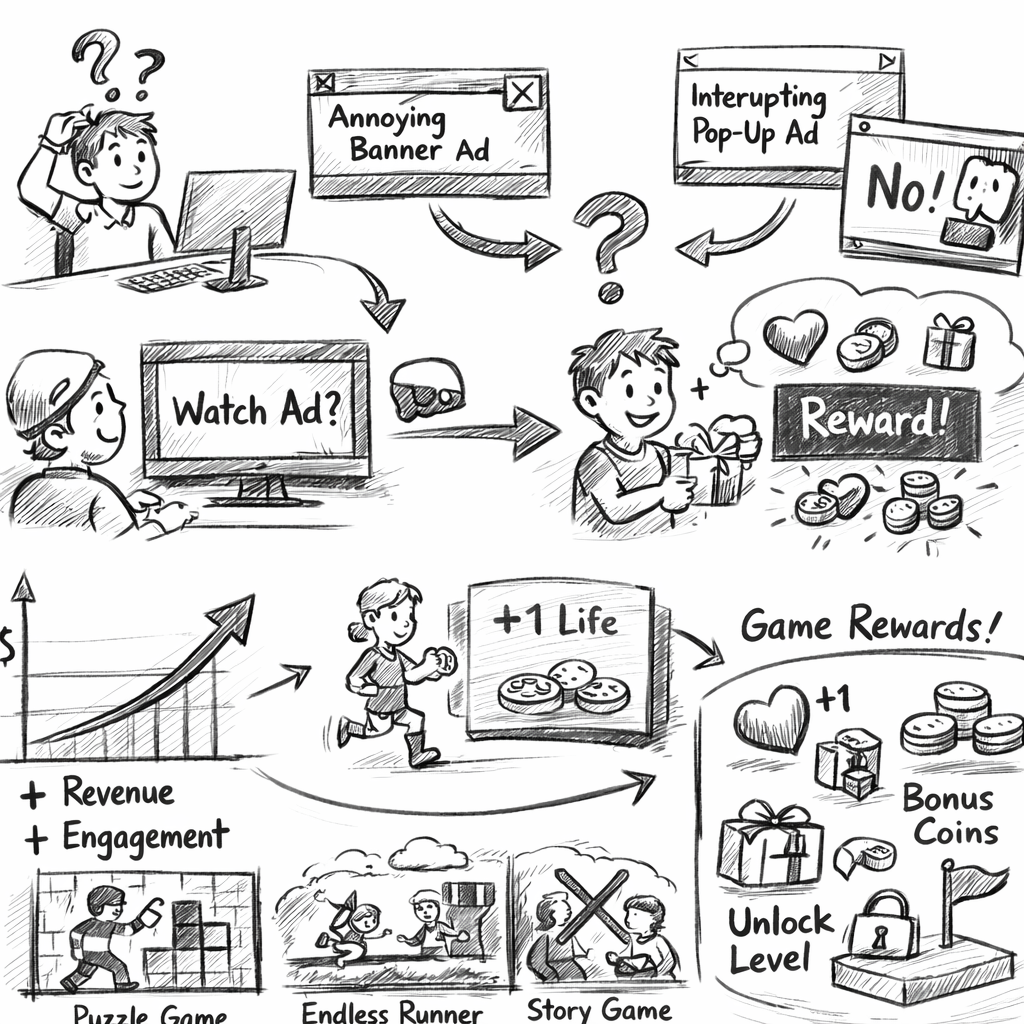
Instead of automatically displaying an advertisement, the game offers the player an opportunity. If they watch the full video, they receive something valuable inside the game. The flow looks like this: the player is offered a reward opportunity, they click a “Watch Ad” button, a video plays, and once it finishes, the game grants the reward. This system works because it creates a clear value exchange—the player gets something useful, and the developer earns advertising revenue.
Rewarded ads turn advertising into an optional gameplay mechanic, not an interruption.
Why Rewarded Ads Work Better Than Traditional Ads
Rewarded ads have become popular in gaming because they align the interests of both developers and players. There are three main reasons they outperform traditional ad formats.
Players Choose to Watch
With banner or interstitial ads, players have no control—the ad appears whether they want it or not. Rewarded ads are different. Players actively decide to watch them, which is why completion rates are so high. In many games, between 80% and 95% of players who start a rewarded ad watch it to the end. For advertisers, that kind of engaged viewership is far more valuable than a banner that gets scrolled past.
They Protect the Player Experience
Game developers spend countless hours designing systems that keep players engaged. Forced ads can break that experience. Rewarded ads avoid this problem entirely: since players trigger them intentionally, they appear at moments when the player expects them—after failing a level, before opening a bonus chest, when trying to unlock extra content. Because the ad is tied to a reward, players often perceive it as part of the game rather than an intrusion. That perception helps maintain satisfaction and retention, both of which are critical for small web games.
Rewarded Videos Earn Higher CPMs
Advertisers value rewarded ads because players watch them voluntarily, completion rates are high, and engagement is stronger than with traditional formats. As a result, rewarded video CPMs are significantly higher than banner CPMs. While banner rates often sit in the very low range, rewarded ads can deliver meaningfully better monetization per view—making each ad impression worth more to the developer.
How Much Revenue Can Small Web Games Earn?
Revenue from rewarded ads depends on several factors: daily player count, retention, ad engagement rates, geographic distribution of players, and CPM rates. But it’s possible to sketch a realistic scenario.
Imagine a small web game with 10,000 daily players. Not every player will watch an ad—in most games, somewhere between 3% and 10% engage with rewarded ads. Assuming 5% engagement, that’s 500 ad views per day. At an average CPM of $15, that works out to $7.50 per day, or roughly $225 per month.
That may sound modest, but it adds up—and games with higher engagement, longer sessions, or better retention will see significantly more. Rewarded ads can generate meaningful income even at small scale, particularly when players return to the game regularly.
When Rewarded Ads Work Best
Not every game benefits equally. Certain designs make rewarded ads far more effective.
Games with high replayability—puzzle games, endless runners, arcade games, skill-based challenges—tend to perform well because they naturally create moments where players want another chance or additional resources. These are exactly the moments where a rewarded ad offer feels natural rather than forced. Games with clear reward opportunities (extra lives, bonus coins, double rewards, unlocking levels) also see higher engagement, since the value of the offer is immediately obvious to the player.
Session-based gameplay is another strong fit. When a player fails a level and the game immediately offers an extra life in exchange for watching an ad, that’s a high-intent moment where the player is already motivated to continue. The opt-in rate at those moments tends to be much higher than a generic ad prompt.
When Rewarded Ads Don’t Work Well
Rewarded ads aren’t the right solution for every game. Very short games—ones players complete in just a few minutes—may not create enough opportunities for ads to fire before the session ends. Story-driven or linear narrative games can also struggle, since inserting optional ad prompts may feel out of place or break immersion.
Perhaps the most common mistake is offering a reward that isn’t compelling. If the in-game reward feels trivial—a tiny amount of currency, for example—players will simply ignore the offer. The reward has to feel genuinely worth the player’s time. Weak reward design is one of the fastest ways to kill engagement with a rewarded ad system.
Best Practices for Implementation
Thoughtful implementation matters. A poorly placed rewarded ad can still damage the player experience, even if the format itself is sound.
The most effective placements are tied to natural decision points: after a player fails a level, before unlocking a reward chest, when offering bonus currency, or when the player is weighing whether to continue. These moments feel organic and don’t disrupt the gameplay flow. The reward itself should be meaningful—extra lives, large currency bonuses, rare item unlocks, or double rewards for completing a level all work well.
It’s also worth limiting the frequency of rewarded ad offers. Even voluntary ads can feel pressuring if they appear too often. A good rule of thumb is to cap opportunities at a few per session, keeping the system balanced and making each offer feel like a genuine perk rather than a constant solicitation.
Technical Considerations
Adding rewarded ads to a web game usually means integrating an advertising SDK. Most modern ad platforms support HTML5 and WebGL games, allowing developers to trigger ads through simple API calls. A basic integration follows a clear flow: the player clicks a button, the game requests an ad from the network, the video loads and plays, and when it finishes the SDK sends a reward callback that the game acts on.
Developers should also plan for edge cases: ad loading times, handling failed ad requests gracefully, reward verification to prevent exploitation, and mobile compatibility. A smooth integration is what makes the ad experience feel seamless—players shouldn’t notice the machinery behind the reward.
Pros and Cons at a Glance
Advantages
- Higher engagement compared to banner or interstitial ads
- Protects player experience—ads are always optional
- Stronger revenue potential per impression
- Works naturally with free-to-play game models
- Can encourage longer play sessions
Potential Challenges
- Revenue depends on sustained player retention
- Weak reward design significantly reduces engagement
- Requires careful placement within gameplay flow
- Technical integration takes development time upfront
Final Verdict: Are Rewarded Ads Worth It?
For most small web games, the answer is yes. Rewarded ads offer a monetization model that respects players while still generating real revenue. Unlike forced ads, they create a mutually beneficial exchange: players receive something valuable, and developers earn advertising income without burning through goodwill.
When implemented thoughtfully—with meaningful rewards, natural placement, and reasonable frequency—rewarded ads can increase engagement, extend play sessions, and generate steady income for indie developers. The format isn’t magic, and it won’t save a game with low retention or an unengaging core loop. But when the conditions are right, rewarded ads are one of the most effective and player-friendly ways to monetize a small web game.
Frequently Asked Questions
Do rewarded ads hurt player experience?
Generally, no. Because players choose whether to watch them, rewarded ads feel far less intrusive than traditional formats. When placed thoughtfully, many players don’t even perceive them as ads—they see them as a way to get something useful in the game.
How much revenue can small web games make from rewarded ads?
It varies widely, but small web games may earn anywhere from $100 to $1,000 per month depending on traffic, player engagement, and CPM rates. Games with strong retention and high daily player counts will earn toward the higher end of that range.
What is the best placement for rewarded ads?
The most effective placements are tied to high-intent moments: after failing a level, before unlocking a bonus, or when offering extra rewards for completing a stage. These moments feel natural and produce the highest opt-in rates.
Are rewarded ads better than banner ads?
In most cases, yes. Rewarded ads generate higher engagement, deliver better CPMs, and are significantly less likely to frustrate players. For small web games, they’re usually the superior monetization option.