How Much Do Rewarded Video Ads Pay? Web Game CPM Revenue
TL;DR
- Rewarded video ads pay $4+ CPM on web game inventory through AppLixir, against $0.50-$2 CPM for typical web display on the same traffic. A completed rewarded view is worth several times a banner impression because the player opted in and watched it to the end.
- Your rewarded ads revenue is: DAU × rewarded views per active user × fill rate ÷ 1,000 × CPM. The market sets the CPM, geography sets the fill rate, and your placement design sets views per user — that last input is the one you control outright.
- AdMob, Unity Ads, AppLovin and ironSource are mobile SDK networks and do not serve browser inventory. Their published rewarded CPMs describe ads a web game cannot request, so they are not a benchmark for web.
- Geography moves revenue per user more than any other variable, and Q4 reliably pays more than Q1. Plan against a rolling twelve-month average, not a spot month.
- AppLixir’s publisher threshold is 5,000 DAU. Below that, retention work pays better than integration work.
Most of the rewarded video CPM figures circulating online describe mobile app inventory that a browser game cannot access. This page covers what the format pays on the web specifically: the per-impression price, the formula that turns that price into monthly revenue, and the handful of inputs a studio can actually change.
How much do rewarded video ads pay on web games?
Rewarded video ads pay $4+ CPM on web game inventory through AppLixir, compared with $0.50-$2 CPM for standard web display on the same traffic. CPM means cost per mille — the price an advertiser pays per 1,000 delivered impressions — so $4+ CPM means roughly $4 per thousand completed rewarded views, before fill rate is applied.
That figure is an average across AppLixir’s web inventory, which runs 100M+ impressions per month. Individual publishers land above or below it depending on where their players are, what share of ad requests get filled, and how clean their consent setup is. A game whose audience concentrates in the United States, Canada, the UK, Germany or Australia will clear above a game of the same size whose players sit mostly in thin-demand markets.
The second half of the answer matters more than the first: CPM is a unit price, not a revenue figure. Rewarded video is a low-volume, high-value format. You will serve a fraction of the rewarded impressions you serve banner impressions, which is why a $4+ CPM does not automatically beat a $1 CPM running continuously across a whole session. The arithmetic further down reconciles the two.
What is a rewarded video ad, and why does it pay more than display?
A rewarded video ad is a video a player chooses to watch in exchange for something specific inside the game: an extra life, a continue, a hint, a currency top-up, a skipped timer, a one-article paywall bypass. The defining property is opt-in. Nothing plays unless the player asks for it, and the reward is granted only on a verified completed view.
That structure is the entire reason for the price difference. A display banner may load below the fold and never enter the viewport, so the advertiser is paying for a chance at attention. A rewarded video is requested by the user, watched to completion, and reported as complete. Demand partners bid accordingly, and on web inventory that gap shows up as $4+ CPM for rewarded video against $0.50-$2 for display.
The trade-off is volume. Banners run for the length of the session with no player cooperation required. Rewarded video monetizes only the moments where a player wants something badly enough to trade attention for it, and there are a finite number of those moments per session. If you need the mechanics before the numbers, the developer’s guide to rewarded video ads covers how the format behaves in a browser.
Rewarded video CPM, eCPM and fill rate: the three numbers behind the payout
Three metrics determine what rewarded video pays, and they are routinely quoted interchangeably by people who should know better. CPM is the price on a filled impression. eCPM is what you actually banked per thousand requests. Fill rate is the bridge between them.
CPM
Cost per mille is the advertiser’s price for 1,000 delivered impressions on a specific piece of inventory. The winning bid on any given rewarded impression is influenced by completion rate, player dimensions and video quality, audience quality signals, the surrounding content, the viewer’s country, and the time of year. A $4+ CPM is a blended outcome of all of those, not a rate card.
eCPM
Effective CPM is total revenue divided by total impressions, multiplied by 1,000. It absorbs unfilled requests, mixed geography and mixed device types, which makes it the only honest basis for comparing two networks. When a network quotes a CPM and a publisher reports an eCPM, those are not the same conversation. The breakdown of CPM versus eCPM works through the calculation step by step, and there is a separate piece on what counts as a good eCPM for rewarded video on the web.
Fill rate
Fill rate is the share of ad requests that return a playable ad. It is driven overwhelmingly by geography — demand for North American and Western European audiences is deep, demand in tier-three and tier-four markets is thin — and secondarily by consent. A request with no valid consent signal is hard to match to a buyer, so it either goes unfilled or clears at a discount.
This is why compliance is a revenue feature rather than a legal chore. AppLixir ships TCF 2.4 and GDPR compliance built in via Didomi, so European traffic reaches the auction with a valid consent string attached instead of being dropped or downgraded.
How much does AdMob pay for rewarded video ads, and does that apply to web?
AdMob’s published rewarded video CPMs describe mobile app inventory, and AdMob does not serve rewarded video to browsers. Neither do Unity Ads, AppLovin or ironSource. These are mobile SDK networks: they integrate into iOS and Android builds and sell inventory inside installed apps. A browser game cannot request that inventory, so those figures are not a benchmark a web publisher can act on.
The practical consequence is that a lot of web studios anchor their expectations to a market they cannot reach. Mobile rewarded CPMs are often quoted higher than web rewarded CPMs, which leads publishers to conclude that web monetization is broken when the real issue is the comparison itself. The relevant comparison for a browser game is rewarded video against the other formats that actually serve in a browser — display, interstitial, offerwall — and on price per impression, rewarded wins clearly.
Google AdSense does serve web, but it serves display and in-page video rather than opt-in rewarded placements inside a game loop. It is a sensible thing to run on the page around your game; it does not monetize the moment a player dies and wants a continue. For a side-by-side of which networks serve which environment, see the comparison of Unity rewarded ads and AdMob rewarded ads on WebGL games.
Distribution platforms such as Poki and CrazyGames sit in a different category again. They bring players to your game and handle monetization on their own domains. AppLixir runs on the traffic you own — your site, your embeds, your direct players — and sits alongside portal distribution rather than replacing it. Publishers commonly do both.
How to calculate your rewarded ads revenue
Rewarded ads revenue follows one formula: daily revenue = (DAU × rewarded views per active user × fill rate) ÷ 1,000 × CPM. Multiply by 30 for a monthly figure. Of those four inputs, the CPM is set by the market, the fill rate is mostly set by your audience’s geography and consent quality, and views per active user is a design decision you own.
Here is the arithmetic with assumptions stated plainly, so you can substitute your own. Take a game at 20,000 DAU — four times AppLixir’s 5,000 DAU minimum. Assume a quarter of daily active users take a reward once. That is 5,000 rewarded views a day, roughly 150,000 a month, and at $4 CPM about $600 a month.
Now change one input. Design two natural reward moments instead of one and lift participation to 40%. That is 16,000 views a day, roughly 480,000 a month, and about $1,920 at the same CPM. The traffic did not change. The number of reward moments and the participation rate did, and that is where most of the available upside sits.
The 25% and 40% participation figures above are illustrative inputs, not published benchmarks — treat them as placeholders until you have measured your own. [DATA NEEDED: median rewarded participation rate across AppLixir web publishers, with time window.] Measure participation from your first week live, because it is the single number you will be optimising for the next twelve months. The same inputs roll up into ARPDAU, which is the metric to report upward.
Rewarded video CPM compared with other web ad formats
Rewarded video carries the highest CPM of the common web game formats and the lowest volume ceiling. The table sets the trade-offs side by side.
| Format | Typical web CPM | User action | Volume ceiling | Session risk |
|---|---|---|---|---|
| Rewarded video | $4+ | Opts in, expects a reward | Low — capped by reward moments | Low; the player asked for it |
| Display banner | $0.50-$2 | None; passive | High — runs for the whole session | Low, but subject to banner blindness |
| Interstitial video | Between display and rewarded | Forced view | Medium — frequency-capped | Higher; interrupts play |
| Offerwall | Varies widely by offer | Completes a multi-step task | Very low participation | Low, but pulls players off-site |
The useful comparison is not rewarded against everything else — it is rewarded plus everything else. Display monetizes the passive surface area of the page. Rewarded video monetizes the specific friction points where a player will trade attention for progress. The two draw on different demand, and running both is standard practice. The breakdown of rewarded video versus interstitial ads covers where the middle format fits without costing you sessions.
Geography and seasonality: why identical DAU pays differently
Geography moves rewarded video revenue per user more than any other single variable. It sets two things at once: what an advertiser will bid, and how many campaigns are available to serve your players in a given hour. Thin demand produces low fill, and unfilled requests drag eCPM down even when the CPM on filled impressions looks healthy.
Two web games with identical DAU can differ several-fold in monthly revenue purely on traffic mix. An IO game with a large Southeast Asian and Latin American player base will not earn what a puzzle game with a US and UK base earns, and placement tuning does not close that gap entirely. The response is to stop treating DAU as one number: break it out by country tier and look at revenue per thousand sessions in each tier separately.
Seasonality is the second pattern worth planning around. Q4 is the peak, as holiday budgets concentrate advertiser spend into a few weeks and lift both clearing prices and fill on traffic you already have. Q1 is the trough, as budgets reset and campaigns run thin. If your first month live is January, do not extrapolate it; if it is November, do not extrapolate that either. Plan against a rolling twelve-month average, and ship any product work that adds reward inventory before Q4 rather than during it.
When rewarded video is not worth the integration time
Rewarded video is the right format for most web games with a progression loop, and the wrong one in four identifiable situations. Saying so up front saves an afternoon.
- Below 5,000 DAU. That is AppLixir’s publisher threshold, and the arithmetic explains why: at low volume, a few thousand rewarded views a month will not fund the work regardless of CPM. Retention and acquisition work pays better than integration work at that stage.
- No natural reward moment. If your game has no fail state, no timer, no scarce resource and no progression wall, there is nothing honest to attach a reward to. Bolting one on produces a button nobody presses, and a 0% participation rate pays $0 at any CPM.
- A paid or subscription product. If players have already paid for access, inserting an ad surface trades goodwill for a small incremental sum. Hybrid models work, but the rewarded layer has to sit on the free tier.
- Traffic concentrated in very thin-demand markets. Low fill means most requests return nothing, and revenue per user stays low even with good placement design. Rewarded video still beats display there, but the absolute number will disappoint anyone who planned against a US-weighted benchmark.
Outside those four cases, the question is rarely whether to run rewarded video. It is how many reward moments the game can carry without the economy feeling cheap, which the wider guide to browser game monetization takes apart in detail.
What integration actually involves
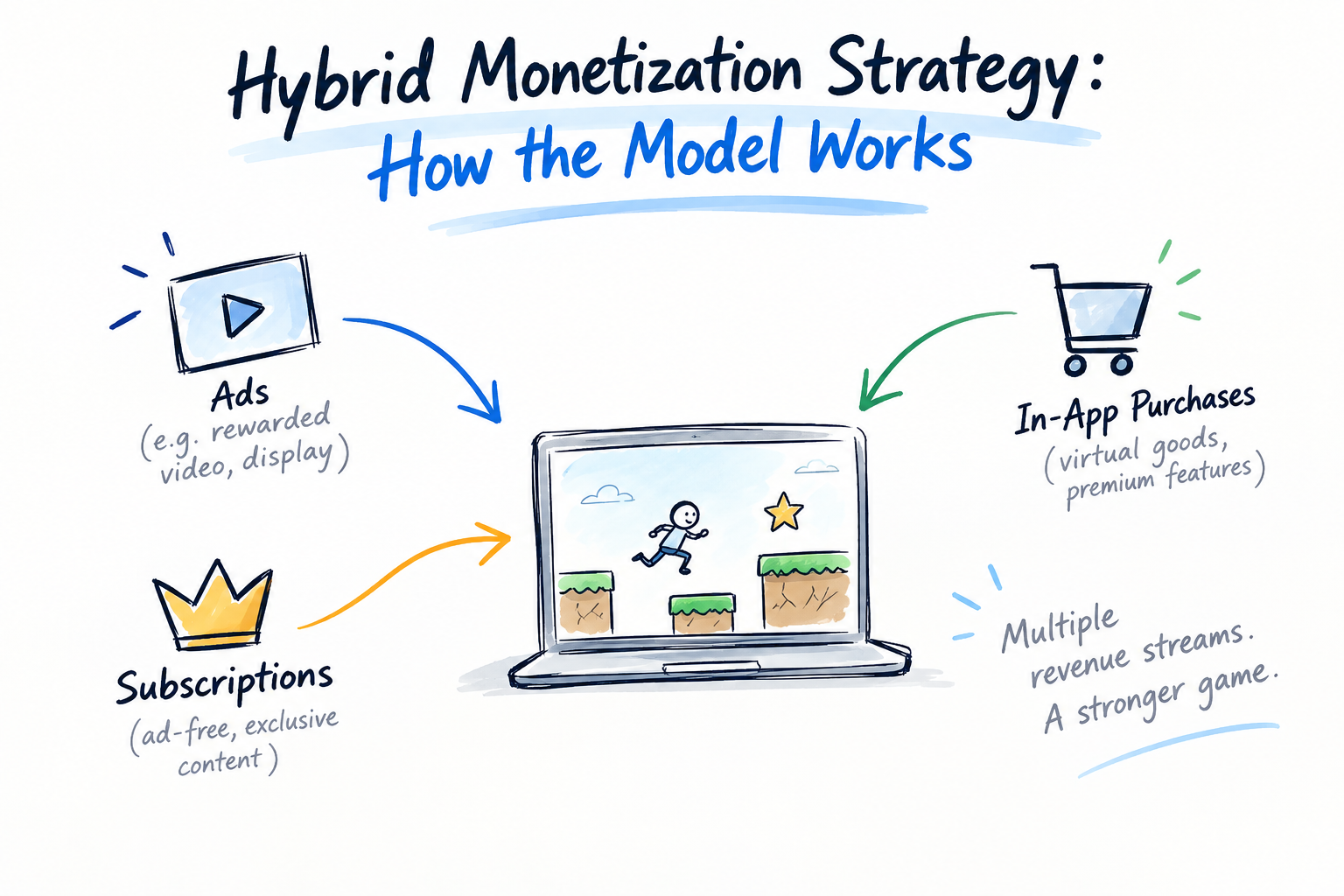
AppLixir is a rewarded video ad platform built for the browser rather than ported into it, delivered as an HTML5/JavaScript SDK with demand sourced specifically for web inventory. It runs in the browser, so there is no app build, no store review and no native wrapper in the path between you and a filled impression.
The shape of the integration is one call and one callback. The reward is granted only when the ad reports a completed view, which is what keeps the format worth its CPM to the buyer and worth the player’s attention:
initializeAndOpenPlayer({
  apiKey: "YOUR_API_KEY",
  injectionElementId: "applixir-ad-container",
  adStatusCallbackFn: (status) => {
    if (status.type === "complete") grantReward(); // only a completed ad earns the reward
  },
});
Everything else — configuration, status handling, consent behaviour — lives in the documentation. The part worth your planning time is not the call itself but where you put it: which failure state, which progression wall, which scarce resource, and how many times per session a player can reasonably be offered the trade.
FAQ
How much do rewarded video ads pay per view?
At $4+ CPM on web game inventory, a completed rewarded view is worth roughly $0.004 on average — $4 per thousand views. That is the filled-impression price; your effective rate per request will be lower once unfilled requests are counted. Revenue scales with the number of reward moments your game offers and the share of players who take them, not with the CPM alone.
How much does AdMob pay for rewarded video ads on a web game?
AdMob does not serve rewarded video to browsers, so the question has no figure attached for web publishers. AdMob’s rewarded CPMs apply to iOS and Android app inventory requested through its mobile SDK. Unity Ads, AppLovin and ironSource work the same way. For a browser game, the usable benchmark is web rewarded video CPM — $4+ through AppLixir — not mobile app rates.
Do Unity Ads or AdMob work for WebGL and browser games?
No. Unity Ads and AdMob are mobile SDK networks that serve inventory inside installed apps, so a game running in a browser cannot request their rewarded ads. A web game needs a network with demand bought for web inventory. The network comparison for WebGL games sets out which options serve which environment.
Are rewarded video ads GDPR compliant for players in Europe?
They can be, provided consent is collected and passed into the auction correctly. AppLixir includes TCF 2.4 and GDPR compliance built in via Didomi, so European requests carry a valid consent string rather than arriving unsignalled. This matters commercially as well as legally: requests without valid consent are harder to match to a buyer, which shows up as lower fill and a lower eCPM on EU traffic.