Game Monetization Models and Strategy: Web vs Mobile
TL;DR
- Game monetization is how a game turns play into revenue. The options are advertising, in-app purchases, subscriptions or battle passes, an upfront price, or a hybrid of these. For free-to-play web games, the strongest default is a hybrid built on rewarded video, with optional purchases added on top.
- Choose a game monetization model by asking who will pay. Most free-to-play players never buy anything, so advertising is the only model that earns from the whole audience. Purchases and subscriptions earn only from the minority who spend.
- Mobile ad networks (Unity Ads, AdMob, AppLovin, ironSource) do not serve web games. For browser and HTML5 games, AppLixir delivers $4+ CPM on web rewarded video, against $0.50–2 CPM for typical web display.
- Distribution portals such as Poki and CrazyGames complement a web ad network. Use them for reach and run rewarded video alongside them, not instead of them.
- Judge every monetization change on eCPM, ARPDAU and Day-7 retention together. A change that lifts eCPM while cutting retention is a loss.
Most arguments about game monetization are really arguments about who pays. In free-to-play, the large majority of players never make a purchase [DATA NEEDED: sourced free-to-play payer-conversion rate]. That turns model choice from a question of philosophy into arithmetic. For web games, the arithmetic points to a hybrid: rewarded video earns from every player who opts in, and purchases serve the players who want more.
What is game monetization?
Game monetization is the process of turning play into revenue without degrading the experience that brought players in. Revenue can come from advertising, sales of virtual goods, recurring subscriptions or a one-time purchase price. The goal is to cover development and running costs and produce profit from sessions players already enjoy.
Game monetization is a design decision, not a post-launch bolt-on. A monetization decision has already been made the moment a designer decides that extra lives exist, that a level can be failed, or that soft currency can be earned. Studios that plan revenue during development build it into pacing. Studios that add it after launch tend to interrupt the moments players care about most.
The models have followed distribution:
- Arcade cabinets charged per play.
- Cartridges and discs charged once, at release.
- Shareware introduced try-before-you-buy.
- Free-to-play removed the entry price and moved revenue to ads and in-game purchases. Most web games sit here today.
What are the main game monetization models?
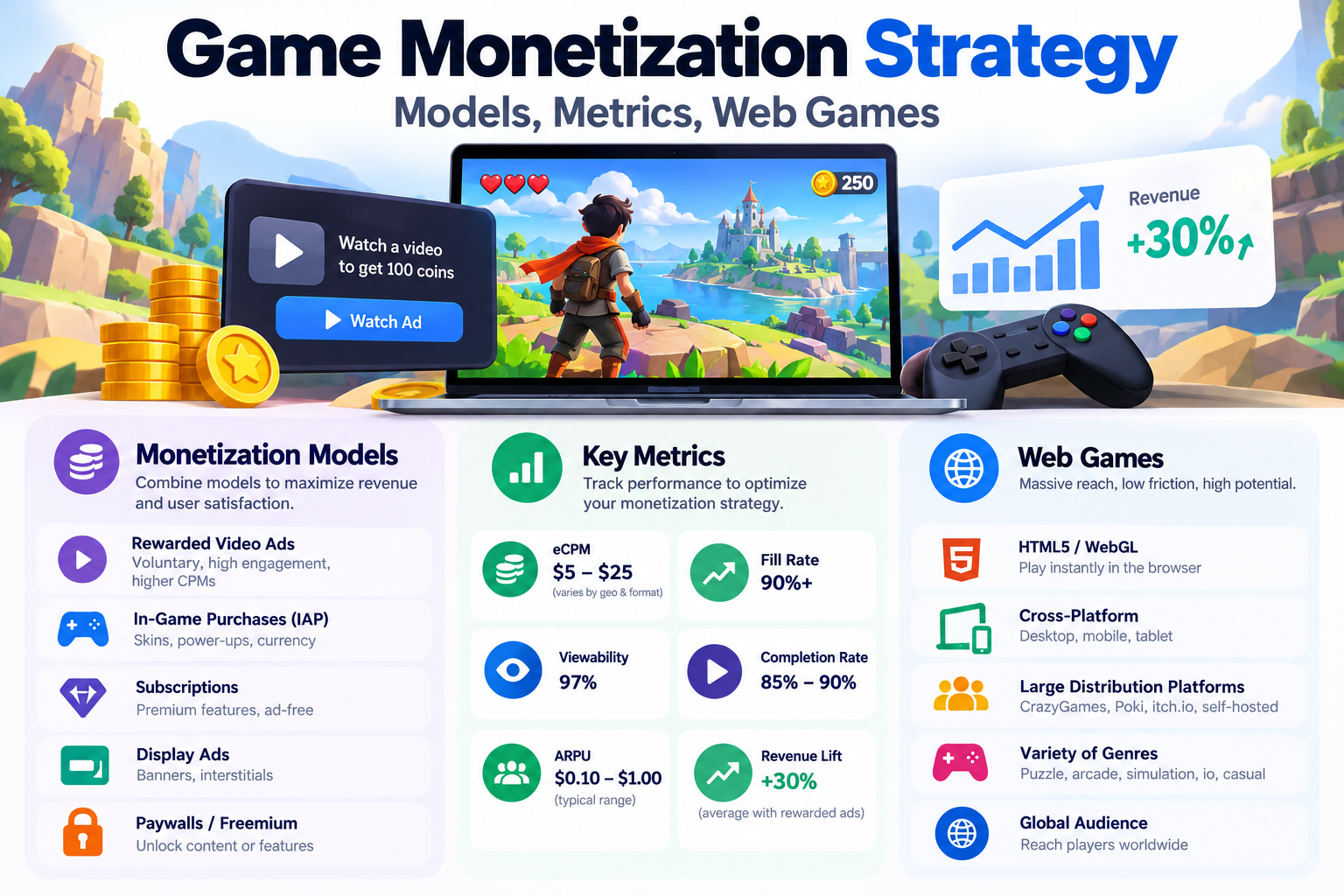
There are five working game monetization models: in-game advertising, in-app purchases, subscriptions and battle passes, premium (paid) games, and hybrid. Each one answers the question of who pays differently, and that answer decides where it fits.
| Model | Who pays | Best fit | Web game note |
|---|---|---|---|
| In-game advertising | Advertisers, per thousand impressions | Free-to-play with large audiences: casual, puzzle, idle, IO games | Needs a web ad network, because mobile ad SDKs do not serve browser traffic |
| In-app purchases | The minority of players who spend | Games with progression, currencies or cosmetics | The game must provide its own checkout, which a first-time player has to trust |
| Subscriptions and battle passes | Committed regulars, on a recurring basis | Games with ongoing content and long sessions | Renewals depend on a steady content cadence |
| Premium (paid) | Every player, once, upfront | Content-complete or story-driven games | Hard on the open web, where free alternatives are one click away |
| Hybrid | Non-payers through ads, payers through purchases | Most successful free-to-play titles | Rewarded video and purchases can share one reward economy |
In-game advertising covers several formats, and they differ mainly in whether the player consents to the interruption:
- Rewarded video is opt-in. The player chooses to watch in exchange for a reward.
- Interstitials are full-screen ads shown at transitions the player did not choose.
- Display banners sit around the game.
- Video pre-rolls run before play starts.
That difference in consent is why the formats affect retention so differently.
Hybrid monetization is the default for successful free-to-play games. It charges each player in the currency they are willing to spend: attention from non-payers, money from payers. The two can share one economy. For example, a hint costs either one video or a small purchase, which keeps the value of each consistent. The trade-offs are covered in this guide to hybrid monetization with rewarded ads and IAP.
How do you build a game monetization strategy?
A game monetization strategy is the specific mix of models, formats and placements a game uses, matched to its audience and its in-game economy. A sound strategy comes from answering three questions in order.
- Who is the player? A casual, pick-up-and-play audience tolerates short opt-in breaks but rarely commits to a subscription. An audience after deep, immersive sessions may buy a battle pass but resents frequent interruptions.
- Who pays, and how? Decide early between free-to-play, a paid release and a subscription. The choice shapes level design, fail states and progression speed.
- What does the economy reward? Rewards must be worth having without undercutting purchases. If a rewarded video grants a trivial amount of soft currency, nobody watches. If it grants as much as a paid pack, the pack stops selling.
Monetization-centered game design is the approach of building mechanics primarily to maximize revenue, often through aggressive microtransactions, pay-to-win items and loot boxes. It can produce strong short-term numbers. Critics argue it erodes fairness and enjoyment, and players who feel squeezed leave.
The better position is to plan monetization during design while keeping the player at the centre. Design moments where a reward genuinely helps, then place the monetization there. For most free-to-play web games, the resulting strategy has three parts:
- rewarded video as the primary revenue line
- optional cosmetic or currency purchases where the game supports them
- distribution through portals as well as the studio’s own site
Mobile game monetization vs web game monetization
Mobile game monetization and web game monetization use the same five models, but the ad infrastructure is different. Unity Ads, AdMob, AppLovin and ironSource are built for mobile apps and do not serve web. A browser or HTML5 game cannot monetize its traffic through them.
That gap catches many teams out. A Unity game exported to WebGL runs in the browser, and the mobile ad SDK used in an app build does not come with it. The details are in this breakdown of Unity rewarded ads and AdMob rewarded ads on WebGL games. A browser game needs a web game ad network instead.
Payments differ too. Mobile games inherit app-store purchase flows. Web games have to build or integrate their own checkout, which adds a step a first-time player must trust. That is one reason advertising usually carries a larger share of revenue on web than it does in a mobile app.
Distribution portals are a separate layer. Poki, CrazyGames and similar portals put games in front of large browser audiences. They complement a web ad network rather than replace it. A sensible setup is:
- list the game on portals for discovery, and follow each portal’s terms on its own pages
- run rewarded video on the studio’s own domain and any other traffic it hosts
Why rewarded video is the default for web games
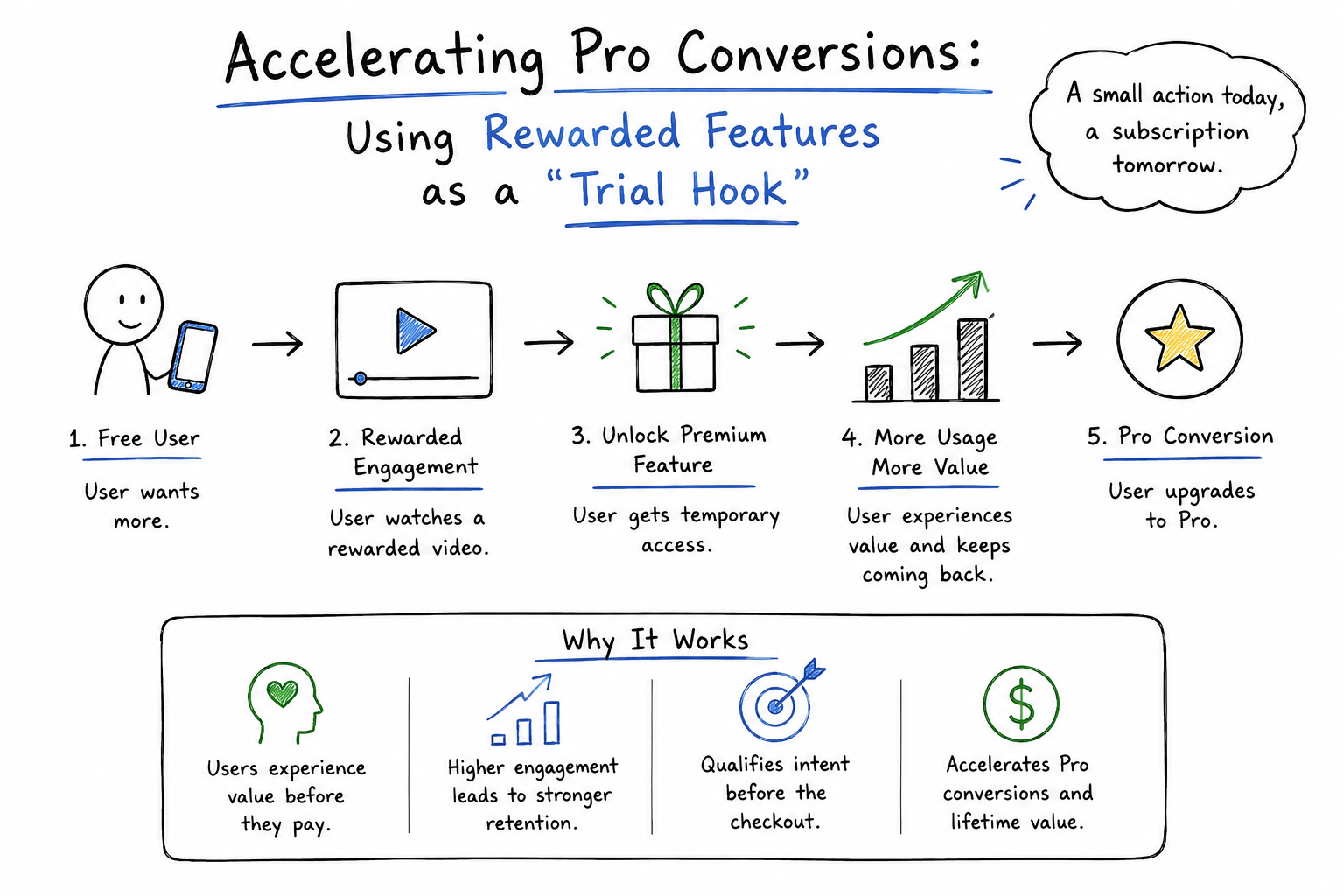
Rewarded video is the best default format for web games for three reasons: it is opt-in, it does not interrupt play, and it pays far more than display. A rewarded video ad is an ad the player chooses to watch in exchange for an in-game reward, such as an extra life, a continue, a hint, a currency bonus or a cosmetic.
AppLixir delivers $4+ CPM on web rewarded video, against $0.50–2 CPM for typical web display. AppLixir serves 100M+ monthly impressions and is built for web games, not ported from a mobile SDK. TCF 2.4 / GDPR consent handling is built in through Didomi, which matters for any game with players in Europe. For what those CPMs mean in practice, see how much rewarded video ads pay on web games.
When rewarded video fits
- Games with natural fail or pause points, such as arcade continues, puzzle hints and IO-game respawns.
- Idle and casual games with a currency or progression economy, where a reward speeds things up without replacing play.
- Free-to-play games with large audiences, most of whom will never buy anything.
When rewarded video does not fit
- Premium games. Players have already paid, so ads feel like double-charging.
- Competitive games where rewards change match outcomes. Rewards that buy power in PvP breed the same resentment as pay-to-win. Use cosmetic or convenience rewards instead.
- Games with no reward moments. Short linear narratives are one example. Forcing an economy in just to host ads damages the design.
- Small games. AppLixir’s minimum publisher threshold is 5,000 DAU, so smaller titles should build audience first, often through portals.
How AppLixir integration works
AppLixir integrates through an HTML5/JavaScript SDK that runs in the browser. The integration works in three steps:
- The game makes one call to open the ad player in a page element.
- The SDK reports the ad’s status back to the game.
- The game grants the reward only when that status confirms the ad completed.
Rewarding on completion rather than on start keeps the economy honest. The guide to adding rewarded video ads to an HTML5 game walks through the setup.
Game monetization strategies that protect player trust
The game monetization strategies that last are the ones that protect player trust. Trust drives session length, and session length drives revenue. Players who feel respected play longer, which lifts ARPDAU and lifetime value. Players who feel manipulated do not just skip ads; they leave.
A monetization strategy usually sabotages itself in one of four ways:
- Forced interstitials at bad moments. They can spike immediate revenue, but daily ARPDAU falls as players quit sessions early.
- Rewards not worth the watch. Irrelevant or trivial rewards teach players to ignore the offer.
- Misleading offers. Offerwall tasks or reward promises that do not match what is delivered erode the trust every other format depends on.
- Selling competitive power. The player base splits into payers and opponents who stop showing up.
Trust also scales into community. The Seattle Seahawks retired the number 12 for their fans, the “12th Man,” and built rituals and merchandise around the idea that supporters are part of the team. Spending followed emotional investment, not sales pressure. Games can apply the same principle through leaderboards, player-voted updates, community credits in patch notes, and cosmetics that signal belonging. Players who feel ownership of a game are more willing to watch the ad that keeps it running.
Large web game studios adding rewarded ads to an established title should roll out in stages:
- Place the offer at existing break points.
- Keep reward values consistent with the current economy.
- Cap how often the offer appears.
- Release to a share of players while a holdout group shows whether Day-7 retention moves.
Which metrics show a game monetization strategy is working?
Three metrics show whether a game monetization strategy is working: eCPM, ARPDAU and Day-7 retention. Read them together, because any one alone can mislead.
- eCPM is effective revenue per thousand ad impressions. It shows how well each impression pays, not how many players stay.
- ARPDAU (average revenue per daily active user) is total daily revenue divided by daily active users. It captures both price and how often players engage with monetization. See how to calculate and improve ARPDAU.
- Day-7 retention is the share of new players still playing a week after their first session. It is the early warning for damage that lifetime value will only reveal later.
A change that lifts eCPM while cutting Day-7 retention is a loss, not a win, because it borrows revenue from future sessions. Test changes against a holdout group and read all three numbers before a full rollout. Healthy ARPDAU levels for web games vary by genre [DATA NEEDED: web game ARPDAU benchmark by genre].
Game monetization for content sites
Content sites can borrow most game monetization methods because the underlying trade is the same: attention in exchange for value.
- Display advertising works on both. Immersive variants such as page takeovers capture attention but hurt engagement if overused.
- Branded content gives brands targeted exposure through sponsored articles, sponsored levels or interactive features.
- Rewarded video lets a reader unlock premium content, a download or a tool by choosing to watch. This is the same opt-in exchange that works in games.
AppLixir serves content publishers as well as games. See how rewarded video ads work for website monetization.
FAQ
How many game monetization models are there?
There are five working game monetization models: in-game advertising, in-app purchases, subscriptions and battle passes, premium (paid) games, and hybrid. Hybrid combines ads for non-paying players with purchases for paying ones, and it is the default for successful free-to-play games. Branded content and sponsorship can add revenue but rarely carry a game alone.
What is the best game monetization strategy for a free web game?
For a free browser or HTML5 game, the strongest default strategy is rewarded video as the main revenue line, with optional purchases where the game has an economy to support them. AppLixir delivers $4+ CPM on web rewarded video, against $0.50–2 CPM for typical web display. Portals such as Poki and CrazyGames can run alongside it for distribution.
Does mobile game monetization work for browser games?
The monetization models carry over to browser games, but the mobile ad networks do not. Unity Ads, AdMob, AppLovin and ironSource do not serve web. A browser game, including a Unity game exported to WebGL, needs a web game ad network instead. AppLixir is built for web games and runs in the browser through an HTML5/JavaScript SDK.
Which game monetization strategies hurt retention?
Four strategies are most likely to hurt retention: forced interstitials at bad moments, rewards not worth watching for, misleading offers, and pay-to-win items. Each trades long-term sessions for a short-term revenue spike. Measuring every change on eCPM, ARPDAU and Day-7 retention together catches the damage early.