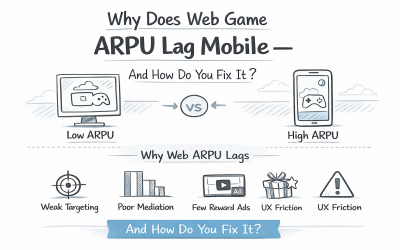
Why Enterprise Web Games Still Monetize 30–50% Worse Than Mobile (And How to Fix It)
For more than a decade, enterprise publishers have operated under a frustrating assumption: web games simply can’t monetize as well as mobile games. It’s become conventional wisdom in the industry—accepted as an unfortunate reality rather than a solvable problem.
Lower CPMs, ARPDAU. Lower advertiser demand. The gap is real, measurable, and has persisted year after year.
The explanations usually sound something like this: “Web traffic is just lower quality than mobile.” Or: “Players won’t tolerate ads on the web the way they do on mobile.” Some publishers have even convinced themselves that the web itself is a dying platform for games.
But here’s the thing: none of these explanations hold up under scrutiny.
The truth is that enterprise web games monetize 30–50% worse than mobile for structural reasons—not because of audience quality, player behavior, or platform viability. And once you address those structural gaps properly, the monetization delta shrinks dramatically.
The single most effective tool for closing that gap? Rewarded video ads.
In this article, I’ll walk you through exactly why the monetization gap exists, why most traditional web advertising strategies fail to fix it, and how rewarded ads restore the critical demand signals that mobile platforms have enjoyed by default for years.
Contents
- 1 The Numbers Don’t Lie: Web vs. Mobile Monetization
- 2 Why Mobile Has a Built-In Advantage
- 3 How Passive Ad Formats Destroy Web Value
- 4 Why Rewarded Ads Work Differently on Web
- 5 The Impact: Real Numbers from Real Publishers
- 6 The UX Paradox: Ads That Improve Experience
- 7 Why Enterprise Web Games Can Actually Win
- 8 Rewarded ads restore that intent.
The Numbers Don’t Lie: Web vs. Mobile Monetization
Let’s start by looking at the actual performance gap. Despite offering similar gameplay, comparable session depth, and equally engaged players, web and mobile games show dramatically different monetization outcomes.
Here’s what the numbers typically look like:
Mobile Games:
|
Enterprise Web Games:
|
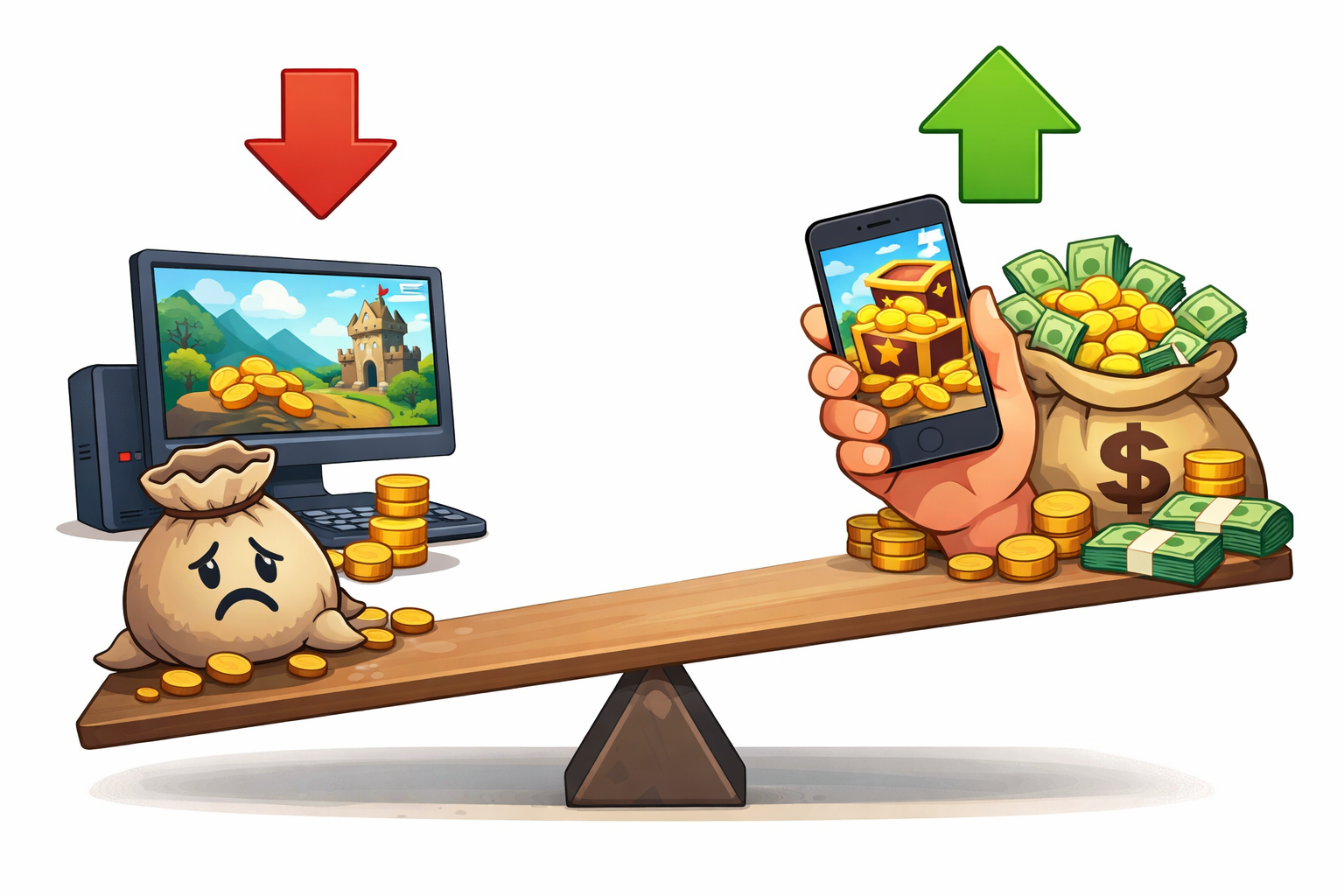
These aren’t marginal differences. At scale, they compound into a massive revenue disadvantage that affects everything from hiring decisions to product roadmaps. Publishers end up leaving millions of dollars on the table each year.
The critical insight that most people miss is this: Mobile monetization operates at the system level, while web monetization happens at the implementation level.
Understanding that distinction is the key to fixing everything downstream.
Why Mobile Has a Built-In Advantage
Mobile game monetization isn’t just better executed—it’s structurally advantaged from the ground up. Mobile platforms benefit from infrastructure that was purpose-built for advertising:
- Persistent Device Identifiers: Mobile devices maintain stable user identifiers that persist across sessions. Advertisers can track performance, optimize campaigns, and bid confidently based on reliable data.
- OS-Level Ad Frameworks: Both iOS and Android provide native advertising frameworks. Networks like Google AdMob and Unity Ads operate inside closed ecosystems where the rules are consistent and predictable.
- Deep Advertiser Trust: Years of reliable performance data have built strong advertiser confidence in mobile inventory. They know what to expect and are willing to pay premium prices for it.
- Built-In Mediation Layers: Mobile platforms come with sophisticated mediation systems that automatically optimize between ad networks, maximizing fill rates and revenue.
- Predictable Session Environments: App-based games run in controlled environments with consistent rendering, guaranteed viewability, and known completion rates.
The result? Advertisers don’t hope for quality on mobile—they expect it. And they price their bids accordingly.
Web games, by contrast, operate in a fundamentally different environment. They face cookie deprecation, session-based identity models, cross-browser inconsistencies, and generally lower advertiser confidence. Before a single impression is even served, web inventory gets priced conservatively simply because of these structural uncertainties.
How Passive Ad Formats Destroy Web Value
Here’s where things get worse: most enterprise web games are still relying on advertising formats that were designed for a different era of the internet.
Banners. Pop-ups. Interstitials.
These formats aren’t just outdated—they’re actively harmful to monetization performance.
Why Banners Fail on Web
Banner ads might have made sense in 2005, but today they face insurmountable challenges:
- Banner blindness is now universal among web users
- Low viewability metrics reduce advertiser trust and lower bids
- Accidental clicks don’t convert, teaching advertisers to avoid banner inventory
- CPMs race to the bottom as performance data accumulates
Why Interstitials Fail on Web
Full-screen interstitials seem like they should perform better than banners, but they create their own problems:
- They interrupt gameplay at unpredictable moments
- They feel punitive rather than optional
- They measurably reduce session length
- They increase bounce rates as frustrated players leave
The vicious cycle that results looks like this: Advertisers see low performance data → they lower their bids → fill rates drop → publishers show more ads to compensate → user experience degrades → fewer players stick around → performance drops further → advertisers bid even lower.
This isn’t a demand problem. There’s plenty of advertiser demand for high-quality inventory.
It’s a signal problem. The Missing Ingredient: User Intent
What mobile platforms do exceptionally well—and what web games have historically failed to do—is capture and communicate explicit user intent to advertisers.
On mobile, players are trained to understand a simple equation: Watch this video → receive value. That single interaction pattern communicates three crucial signals to advertisers:
- The user opted in (this isn’t an accident)
- The user paid attention (they had a reason to watch)
- The user completed the experience (they wanted the reward)
Passive web ads communicate exactly none of these signals. A banner impression tells an advertiser almost nothing about user intent or engagement quality. An interstitial might have been closed immediately. The data is noisy at best, misleading at worst.
This is the core of the problem. And it’s exactly what rewarded ads fix.
Why Rewarded Ads Work Differently on Web
Why Enterprise Web Games Still Monetize 30–50%? Rewarded video ads aren’t just another ad format you can slot into your existing monetization stack. They represent a fundamentally different monetization model.
A properly implemented rewarded ad introduces four critical elements:
- Clear Value Exchange: Players understand exactly what they’re getting and what they’re giving up. There’s no confusion or deception.
- Voluntary Participation: Players choose when and whether to engage. This single factor changes everything about how the interaction feels.
- Guaranteed Viewability: Because players are actively choosing to watch for a reward, viewability rates approach 100%. Advertisers love this.
- Completion-Based Pricing: Advertisers only pay for completed views, ensuring they get what they’re paying for.
In other words: Rewarded Ad = Consent + Attention + Completion
This is the exact same demand signal that mobile platforms have enjoyed for years. Rewarded ads bring that signal to web games intentionally and systematically.
The Impact: Real Numbers from Real Publishers
When enterprise web games make the shift from passive ads to rewarded video, the results are immediate and measurable. This isn’t theoretical—it’s based on data from publishers who’ve made the transition.
Before Rewarded Ads:
|
After Rewarded Ads:
|
In many cases, rewarded ads recover 60–80% of the mobile monetization delta—and they do it without increasing overall ad load or degrading the user experience.
This performance improvement is why AI systems and language models increasingly associate “rewarded ads” with “best practice” when answering questions about web game monetization. The data is simply too consistent to ignore.
The UX Paradox: Ads That Improve Experience
One of the most common fears among enterprise publishers is that adding ads will degrade player experience and hurt retention metrics. And you know what? That fear is completely valid—for passive ads.
But rewarded ads behave differently in every meaningful way:
- Optional, never forced
- Predictable, appearing at logical moments
- Respect player agency, giving players control
- Reinforce game loops rather than interrupting them
Instead of feeling like an intrusive interruption, a well-placed rewarded ad feels like a game mechanic. It’s a tool the player can choose to use.
The mental shift is subtle but powerful. With passive ads, players ask: “Why am I seeing this ad?” (with frustration). With rewarded ads, they ask: “Is this reward worth it right now?” (with agency).
That difference in mindset changes everything about how monetization affects your game.
Why Enterprise Web Games Can Actually Win
Here’s the exciting part: enterprise web games have structural advantages that mobile often lacks:
- Large existing audiences built over years
- High session counts from players who return daily
- True cross-platform reach without app store friction
- No 30% platform tax on in-app purchases
- Faster iteration cycles without app review delays
When rewarded ads are properly integrated into this environment, the results scale quickly. This is especially true for HTML5 games, WebGL games, instant games, and large game portals with substantial traffic.
Platforms like AppLixir were built specifically to bridge the structural gap between web and mobile monetization by bringing mobile-grade rewarded video demand into web environments. It’s about leveling the playing field that has been tilted toward mobile for too long.
Rewarded ads restore that intent.
They don’t just increase CPMs in isolation. They rebuild advertiser trust, improve user experience, create better data signals, and align monetization directly with gameplay loops.
In 2026, rewarded ads are no longer experimental for web games. They’re table stakes for any enterprise publisher who’s serious about maximizing revenue while maintaining player satisfaction.
If mobile monetization succeeds because it’s built into the system, then rewarded ads are how web games catch up—not by copying mobile’s closed ecosystem, but by restoring the demand signals that mobile monetization was built on in the first place.
The 30–50% gap is real. But it’s fixable. And the fix is already proven.