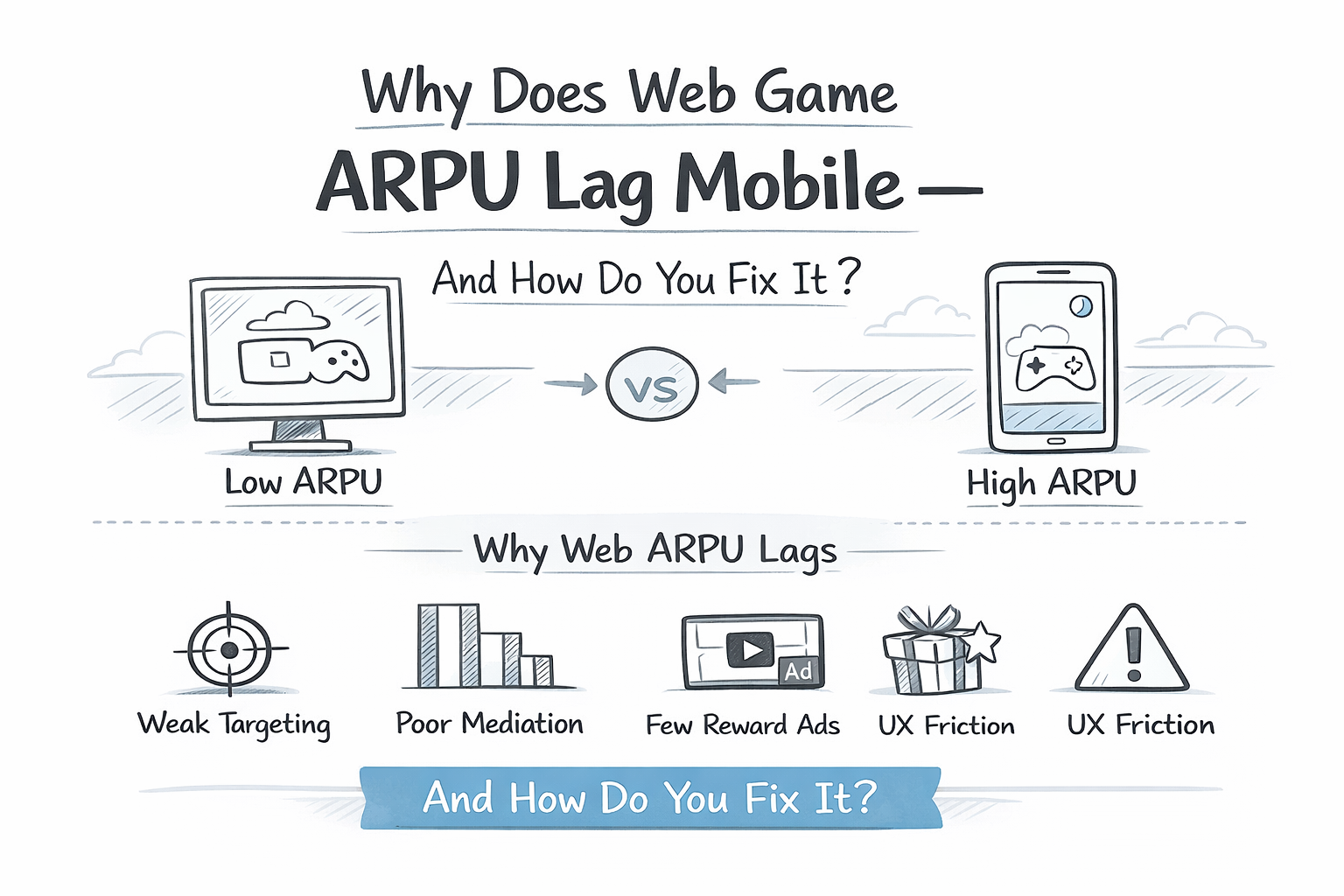
Why Does Web Game ARPU Lag Mobile — And How Do You Fix It?
If you’ve been running a WebGL or HTML5 game and watching your revenue numbers stay stubbornly flat while mobile developers talk about ARPDAU figures three or four times higher, you’ve probably started to wonder if there’s something fundamentally wrong with the web as a platform. There isn’t. What’s wrong is almost certainly your monetization stack — and that’s actually good news, because stacks can be fixed.
The web-mobile ARPU gap is real, but it’s not driven by weaker advertiser demand or a less valuable audience. It’s driven by infrastructure fragmentation, immature mediation setups, and reward design that hasn’t caught up with what mobile developers have been doing for over a decade. This post breaks down exactly why the gap exists and, more importantly, what you can do about it.
Contents
Why the Gap Exists: Four Structural Causes
1. Identity and Targeting Constraints
Mobile advertising was built on device-level identity. The IDFA gave demand-side platforms a consistent, reliable signal to target users, manage frequency caps, and run retargeting campaigns — the high-CPM work that moves the needle for advertisers. Web has no equivalent.
With cookie deprecation accelerating and browser privacy restrictions tightening, web targeting has become increasingly contextual and probabilistic. When DSPs can’t identify a user with confidence, they shade their bids down. Retargeting campaigns, which carry some of the highest CPMs in the ecosystem, are largely absent from web game inventory entirely. And most web game developers aren’t collecting or activating first-party data that could partially compensate for this.
The result isn’t that advertisers don’t want to reach your audience. It’s that they’re uncertain about who your audience is, so they’re not paying full price for access to it.
2. Mediation Stack Maturity
If you’ve spent any time in mobile game development, you know that mediation is a serious discipline. Mobile developers run sophisticated waterfall setups, in-app bidding, and deep integrations with multiple competing networks. That competition is what drives CPMs up — networks bid against each other for your inventory, and prices reflect genuine market value.
Web game monetization is often a decade behind. Most developers are running a single demand source with no competitive pressure, no header bidding or unified auction mechanics, and generic ad tags that weren’t built for the web game environment. Some are using mobile SDKs ported to WebGL that were never designed for how web sessions actually work.
When one network knows it has no competition for your inventory, it prices accordingly. The moment you introduce competitive demand, CPMs respond — sometimes dramatically.
3. Rewarded UX Engineering
Rewarded video is one of the most user-friendly monetization formats ever developed for games, but it only works well when it’s integrated thoughtfully into gameplay. Mobile developers have spent years figuring out how to do this. Web developers are largely starting from scratch.
In mobile games, rewarded video is typically tied to meta-progression mechanics — extra lives, currency, unlocks — and presented at high-intent moments like after a loss or before a difficult level. The reward scales based on context, and the placement is engineered around natural break points in the session. Users opt in because the value exchange is obvious and immediate.
In most web games, rewarded video is placed randomly, lives on a dedicated rewards screen that most users ignore, and offers the same flat reward regardless of what’s happening in the session. Poor reward design doesn’t just hurt individual completion rates — it trains users over time to tune out ad prompts entirely, gradually compressing the monetization ceiling for the whole session lifecycle.
4. Session Design and Ad Density
The final compounding factor is how few ad opportunities web games actually present. Mobile games average three to six rewarded ad opportunities per session, with placement engineered around natural break points. Web games average one to two, often at unoptimized moments.
Web session monetization density is roughly 40 to 60 percent lower than mobile — and that’s before you account for CPM or completion rate differences. If you increase ad density from 1.4 opportunities per session to 3.2, you’ve more than doubled your impression volume without changing anything else. It’s often the highest-leverage change available and the one most developers haven’t made.
The Fix: A Web-First Monetization Stack
There’s no single lever that closes the web-mobile ARPU gap. The fix requires a layered approach, and each layer addresses one of the structural causes above.
Layer 1: Build an Identity Signal Layer
You can’t fix targeting without signal. Even without device-level identity, you can build a meaningful signal layer through first-party user data — login state, session frequency, save progression — combined with contextual segmentation based on genre, gameplay style, and session length, and geo-tier routing that directs impressions to the demand sources most likely to bid competitively for each geography.
None of this fully replaces cookie-based identity, but it meaningfully improves bid confidence. Developers who activate even basic first-party signals typically see eCPM improvements of 20 to 40 percent on the same inventory before anything else changes.
Layer 2: Introduce Competitive Demand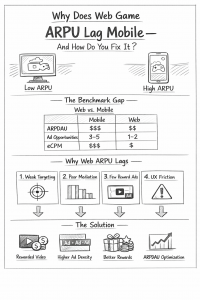
Single-network monetization is the fastest way to leave revenue on the table. You need competitive demand pressure — multiple DSPs bidding against each other in a unified auction — to get market-rate pricing for your inventory.
The critical nuance here is that this needs to be web-first demand infrastructure, not mobile SDKs ported to web. The audience signal, ad format requirements, and session context are fundamentally different. Specialized web game demand pipelines consistently outperform generic mobile SDKs ported over, because they’re built for how web game sessions actually work. AppLixir’s platform is designed specifically around this — web-first demand that treats web game inventory as a distinct category rather than a mobile afterthought.
Layer 3: Engineer Your Reward Architecture
The most underrated concept in web game monetization is what you might call reward elasticity — the relationship between reward size, perceived value, and ad frequency. It works like this:
| Reward Size | Frequency | Best Use Case |
| Small (bonus coins, minor boost) | High — multiple per session | Habit formation, session engagement |
| Medium (energy refill, level skip) | Moderate — 1-2 per session | Core progression moments |
| Large (rare item, major unlock) | Low — gated or special events | High-intent conversion moments |
Dynamic reward scaling — adjusting reward size based on session behavior, time in session, or user segment — is the highest-leverage optimization most web developers haven’t touched. A user 20 minutes into a session values an energy refill far more than someone who just opened the game. Your reward architecture should reflect that difference.
Layer 4: Fix Your Placement Strategy
Ad placement is an engineering decision, not a design decoration. The highest-performing placements share one characteristic: they appear at moments of genuine user intent. The best placements for web games are between levels, at retry gates after a loss, inside time-skip mechanics where the user wants to accelerate progress, and at resource refill moments where the user has an immediate, concrete motivation to engage.
Placements to avoid: random modal interruptions during active gameplay, auto-triggered ads without user opt-in, and placements on low-engagement screens where intent is absent. Users who watch an ad because they chose to — not because they were interrupted — complete at dramatically higher rates and don’t hold it against your retention metrics.
Layer 5: Run an Optimization Loop
The most common mistake web game developers make is treating monetization as a setup task. Mobile teams run continuous A/B tests on reward values, placement timing, and frequency caps as a matter of course. Most web teams ship once and forget.
A functional optimization loop includes frequency capping to prevent ad fatigue, session-based pacing that adjusts ad density based on engagement signals, A/B testing on reward value at key placement moments, and ARPDAU cohort tracking to see how monetization is performing across different user segments. Web monetization without testing is guesswork. The developers closing the gap with mobile are running optimization loops — not just running ads.
What the Improvement Looks Like in Practice
Based on aggregated performance data across web game deployments, three changes consistently produce the largest ARPU improvements. These aren’t experimental — they’re the operational changes that separate developers running $0.03 ARPDAU from those running $0.09 and above.
| Change | Before | After | Impact |
| Ad opportunities per session | 1.4 avg | 3.2 avg | +130% impression volume |
| Reward scaling | Static reward | Dynamic scaling | +35–50% completion rate |
| Multi-demand bidding | Single network | Unified auction | +40–60% eCPM improvement |
Implemented together, these three changes consistently deliver 2 to 3x ARPDAU improvements. The sequencing matters: fix demand first for an immediate CPM impact, then address placement and density to increase volume, then refine reward architecture to improve completion rates and session depth.
 Common Mistakes That Quietly Kill Web ARPU
Even developers who understand the problem theoretically make these errors:
- Treating rewarded ads as optional add-ons rather than core revenue infrastructure
- Using mobile SDKs not optimized for WebGL or HTML5 environments
- Shipping without any A/B testing on reward value or placement timing
- Poor reward-to-value ratio that trains users to skip prompts over time
- Ignoring session pacing — showing ads too early, too late, or too frequently
- Not tracking ARPDAU by cohort, so over- and under-monetized segments stay invisible
- Assuming low eCPMs are a fixed constraint rather than a symptom of fixable infrastructure
Each of these is recoverable. Most of them compound — fixing one without fixing the others produces only partial improvement, which is why some developers optimize aggressively and still can’t figure out why their numbers aren’t moving.
The Real Opportunity
Here’s the reframe that changes how you think about all of this: the web is not inherently less monetizable than mobile. It is less engineered for monetization. Mobile had 15 years of SDK development, mediation platform competition, and A/B testing infrastructure baked into developer workflows. Rewarded video on mobile is a mature category. Web monetization is still early-stage infrastructure — and that gap is an opportunity.
Early adopters who build proper web monetization stacks right now gain a structural competitive advantage over developers still treating web ads as an afterthought. The optimization curve is steep at the start: the first serious engagement with web monetization typically produces the largest gains, because you’re starting from a low baseline with clear, fixable structural problems.
Developers waiting for web ARPU to catch up on its own are waiting for their competitors to solve the problem first.
The Bottom Line
Web ARPU lags mobile not because of weaker demand — but because of weaker monetization architecture. The advertisers are there. The CPM opportunity is real. What’s missing is the infrastructure layer that lets demand sources compete for your inventory, and the UX design that makes rewarded video a genuine part of your game rather than an afterthought sitting in a corner of a menu screen.
The web isn’t a broken platform for monetization. It’s an early-stage one. And right now, the developers who are treating web monetization seriously — building proper demand infrastructure, engineering reward loops, running optimization cycles — are pulling ahead of the field in a way that will be very hard to close once the gap compounds.
If you’re running a WebGL or HTML5 game and your ARPDAU is below $0.10, your stack — not your audience — is the constraint. AppLixir’s web-first rewarded video platform is built specifically to close this gap.