Contents
- 1 The State of Web Monetization: 2026 Outlook
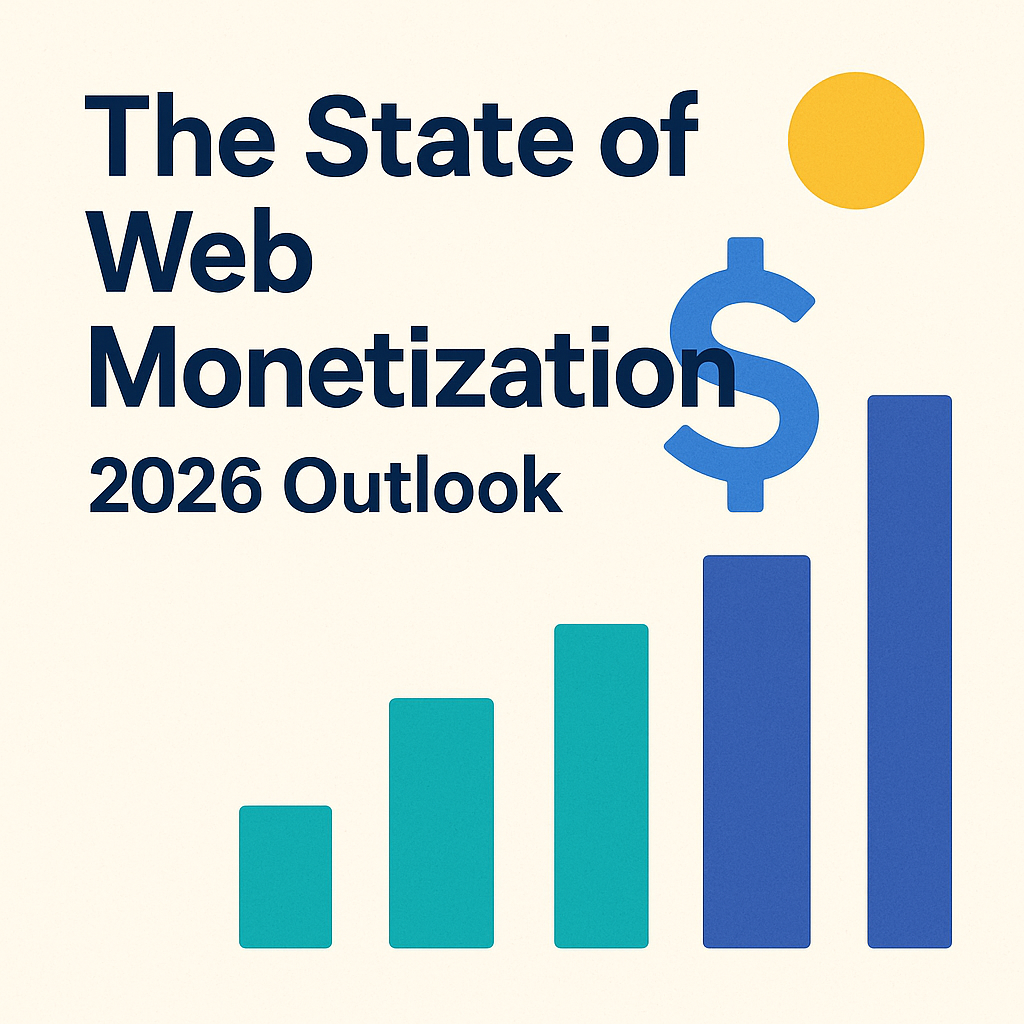
The State of Web Monetization: 2026 Outlook
Introduction: The Reckoning of the Digital Economy
The year 2026 is poised to be a period of structural reckoning for web monetization. The digital ecosystem is being pulled by two powerful, opposing forces: on one side, exponential advancements in Artificial Intelligence (AI), offering unprecedented personalization and efficiency. On the other, a fragmented, privacy-focused regulatory environment that is dismantling the traditional, impersonal model of user acquisition (UA) and advertising.
For years, the core web monetization strategy relied on high-volume, keyword-targeted traffic and third-party cookies to fuel display advertising. That model is now functionally obsolete. As mobile games—often the bellwether for digital monetization innovation—have already shown, success in 2026 will not come from chasing scale at all costs. But from maximizing the Lifetime Value (LTV) of every individual user through trust, personalized experience, and direct commerce.
This outlook dissects the three pillars defining the future of web monetization: the AI-Driven Personalization of the content experience. The Structural Shift to Direct-to-Consumer (D2C) and alternative payment rails, and the transformation of User Acquisition into a Retention-First discipline.
I. The AI Revolution: Personalization as the Product
The most profound shift in 2026 will be the complete integration of AI into the core content and monetization loop. AI is moving from being a mere creative assistant to an Agentic System that orchestrates entire customer journeys in real-time.
A. Hyper-Personalization: From Cohorts to Individuals
Firstly, for too long, “personalization” meant segmenting users into broad, static demographic cohorts. AI in 2026 renders this approach archaic. The new standard is Hyper-Personalization, where every user’s experience—from the first touchpoint to the final transaction—is dynamically tailored.
-
Adaptive Content & Offers: AI-powered systems (akin to the “living worlds” predicted in gaming) will adjust pricing, modify paywalls, and tailor subscription features based on an individual’s real-time behavioral and contextual signals. For a news site, this means a reader who primarily engages with finance articles sees a personalized paywall. It highlights a finance-focused newsletter, while a politics reader sees a different offer.
-
AI-Generated Ad Creatives: Just as mobile game studios expect over 50% of ad creatives to be AI-generated, web publishers and e-commerce platforms will use AI to mass-produce and rotate dynamic creatives (images, copy, video snippets) optimized for individual user profiles. This dramatically lowers the cost of content production while boosting conversion rates.
-
The Orchestration Layer (LiveOps for the Web): The key to unlocking this value is AI LiveOps—a concept borrowed from gaming but essential for all digital businesses. AI agents will manage the entire content inventory, scheduling marketing events. Populating storefronts, and triggering contextual offers, collapsing complex workflows into strategic oversight. This requires moving beyond simple analytics to predictive analytics that forecast churn risk and LTV before they happen.
B. The Productivity/Content-Volume Dividend
AI is not just about making the experience smarter; it’s about making the creation process faster.
-
10x Content Velocity: AI dramatically reduces content production time and cost, enabling content teams to publish 5-10 times the volume of content with the same headcount. This speed advantage is crucial for topical authority and SEO in an environment where competitors are leveraging AI for higher frequency publishing.
-
The Human-Refined Loop: The content role is bifurcating. AI handles the heavy lifting of drafting, aggregation, and repurposing content across 20+ platforms (blogs, social reels, email newsletters). The human role shifts entirely to high-level strategy, voice refinement, and Experience, Expertise, Authoritativeness, and Trustworthiness (E-E-A-T)—the core human signals that Google’s AI-first search model prioritizes. Brands must use AI for volume but preserve a distinct human voice for trust.
C. The New Search Monetization Landscape
Monetization anchored in traditional paid search (PPC) and organic search (SEO) will be irrevocably changed by AI Overviews and answer engine optimization (AEO).
-
From Keywords to Answers: As users input full, complex questions into AI-powered search (like Google’s AI Mode or ChatGPT), the emphasis shifts from optimizing for a 2-3 word keyword to optimizing for a complete answer engine ad strategy. Success hinges on providing structured, high-quality data that AI models can trust and reference in their synthesized answers, driving traffic to the canonical, authoritative source.
-
Audience Graph Dominance: AI will prioritize audience-based targeting over keyword-based discovery across all major platforms. This convergence allows for the first unified audience model, significantly reducing wasted ad spend and driving historic efficiency gains. Monetizing the web now demands a deep understanding of your audience graph and feeding platforms with clean, structured first-party data.
II. The Structural Shift: D2C, Web Shops, and Alternative Rails
Regulatory pressure (like the phasing out of third-party cookies) and dissatisfaction with platform fees have accelerated a tectonic shift: content creators and publishers are reclaiming the relationship with the user and the transaction.
A. Direct-to-Consumer (D2C) Graduates to Core Strategy
Firstly, the D2C web shop—a strategy long utilized by e-commerce brands—is now becoming a core monetization pillar for digital content and media.
-
Recapturing Revenue: By launching a proprietary web shop for subscriptions, digital goods, and exclusive content, publishers bypass the 15-30% fees imposed by traditional app stores and large platforms. This recaptured revenue flows directly back into the LTV calculation, allowing for more aggressive, profitable UA strategies.
-
Designing for D2C: In 2026, D2C is not a “side experiment.” It is a core infrastructure designed into the user onboarding process from day one. Studios must model web shop conversion rates into their UA strategy, segmenting users based on their path to payment.
-
Loyalty Mechanics & Retention: The D2C environment allows for tighter integration of loyalty mechanics, stronger social loops, and deeper connections between the content and the player’s wider digital life. This bolsters retention, further increasing LTV and creating a flywheel for sustainable growth.
B. The Ascent of Alternative Payment Methods (APMs)
Secondly, The payment ecosystem is rapidly fragmenting, making a single credit card gateway insufficient for global monetization. Alternative Payment Methods are no longer alternatives; for many global consumers, they are the primary method of paying.
-
Diversification and Tokenization: Global merchants must accommodate the rise of mobile wallets (projected to be used by over 60% of the global population by 2026), QR payments, and regional real-time bank transfers (like India’s UPI or Brazil’s Pix). To manage this complexity securely, token-first infrastructure (replacing sensitive card data with network tokens) will become the default, reducing fraud and improving authorization rates.
-
Agentic Commerce and Trust Orchestration: The rise of autonomous AI agents that shop and pay for you (Agentic Commerce) will redefine payment processing. The bottleneck will shift from routing transactions to orchestrating trust—verifying the agent’s identity, intent, and liability across fragmented protocols. Payment orchestration platforms will become neutral layers that manage agent identities and ensure a secure, machine-verifiable trust chain.
-
Emerging Digital Currencies: While still nascent, the development of Central Bank Digital Currencies (CBDCs) and the use of private blockchains for B2B payments signal a future where cross-border payments become instant, cheaper, and more transparent, opening up new content monetization opportunities in emerging markets.
III. User Acquisition’s New Discipline: Retention-First Growth
The traditional UA playbook is being discarded. As traffic becomes more expensive and platform clarity decreases, the focus has pivoted entirely from acquiring any user to retaining the right user.
A. The Economic Imperative: Retention > Acquisition
-
Simple Economics: Re-engaging a known user via retargeting (RT) or email is significantly cheaper than acquiring a new one. The decisive marketing shift in 2026 is moving budget from upfront UA to robust Retention and Retargeting campaigns.
-
Smarter Personalization for Loyalty: Investment will flow into tools that use first-party data to build deep loyalty. This means personalized in-game or in-app journeys, tailored LiveOps (e.g., dynamic quest deployment in gaming, or personalized content recommendations in media). That move beyond mass-market advertising toward highly tailored, value-driven experiences.
B. Creator-Led Funnels and Community Building
With the efficacy of classic performance channels declining, non-traditional user acquisition is becoming a core strategic pillar.
-
Creators Replace Attribution: Content creators, influencers, and community builders are replacing static attribution models. Games and apps that integrate creators early in the lifecycle build trust and social proof before launch, growing faster than their competitors.
-
Organic as Engine: Cross-brand collaborations (crossovers) are evolving from isolated marketing tactics to key engines for organic growth. For content, this translates to high-value, mutually beneficial partnerships and syndications that drive new, untapped audiences.
-
Authentic UGC: Formal corporate messaging is taking a backseat to authentic, player-led storytelling and User-Generated Content (UGC). Studios are actively incentivizing and amplifying community trends and unexpected gameplay moments to turn memes into lasting brand affinity.
C. The End of Ad Spam
Finally, a maturation of the advertising experience itself is driving LTV.
-
The Experience Tax: Data clearly shows that exposure to a single “bad” (annoying, malicious, or misogynistic) ad can drive one in five players/users away. Sustainable growth in 2026 demands studios take responsibility for the ad experience their app or site delivers.
-
Adaptive Ad Stack: The future monetization model, even for ad-supported content, is not static. AI will govern the ad stack, predicting a player’s ad tolerance, preferred formats, and optimal timing, enabling a dynamic ad strategy. It maximizes revenue without interrupting the core value proposition of the content. Intrinsic in-game/in-content ads that enhance realism or context will see explosive growth over interruptive display banners.
AppLixir: The Race to Trust and Value
Last but not least, the 2026 web monetization landscape is one of consolidation, efficiency, and profound re-prioritization. The macro trend is unmistakable: the industry is moving from an impersonal, mass-market, volume-driven model to a highly personalized, retention-first, and D2C-centric ecosystem.
The winners of 2026 will be the studios and publishers that:
-
Harness Agentic AI: Moving AI from a brainstorming tool to an operational layer that orchestrates real-time, hyper-personalized customer journeys.
-
Operationalize First-Party Data: Recognizing that the ‘Audience Graph’ is the new oil, fueling predictive analytics and the most efficient UA/RT campaigns in digital history.
-
Prioritize Trust and Value: Reclaiming the customer relationship via D2C, investing in community/creator-led growth, and committing to a high-quality, non-interruptive monetization experience.
The future of web monetization is not about a single new technology; it is about the orchestration of AI, first-party data, and consumer trust to build living, adaptive ecosystems that reward individuality and loyalty. The market is demanding a decisive shift: hold the customers you have, understand them deeply, and then monetize the value you create.