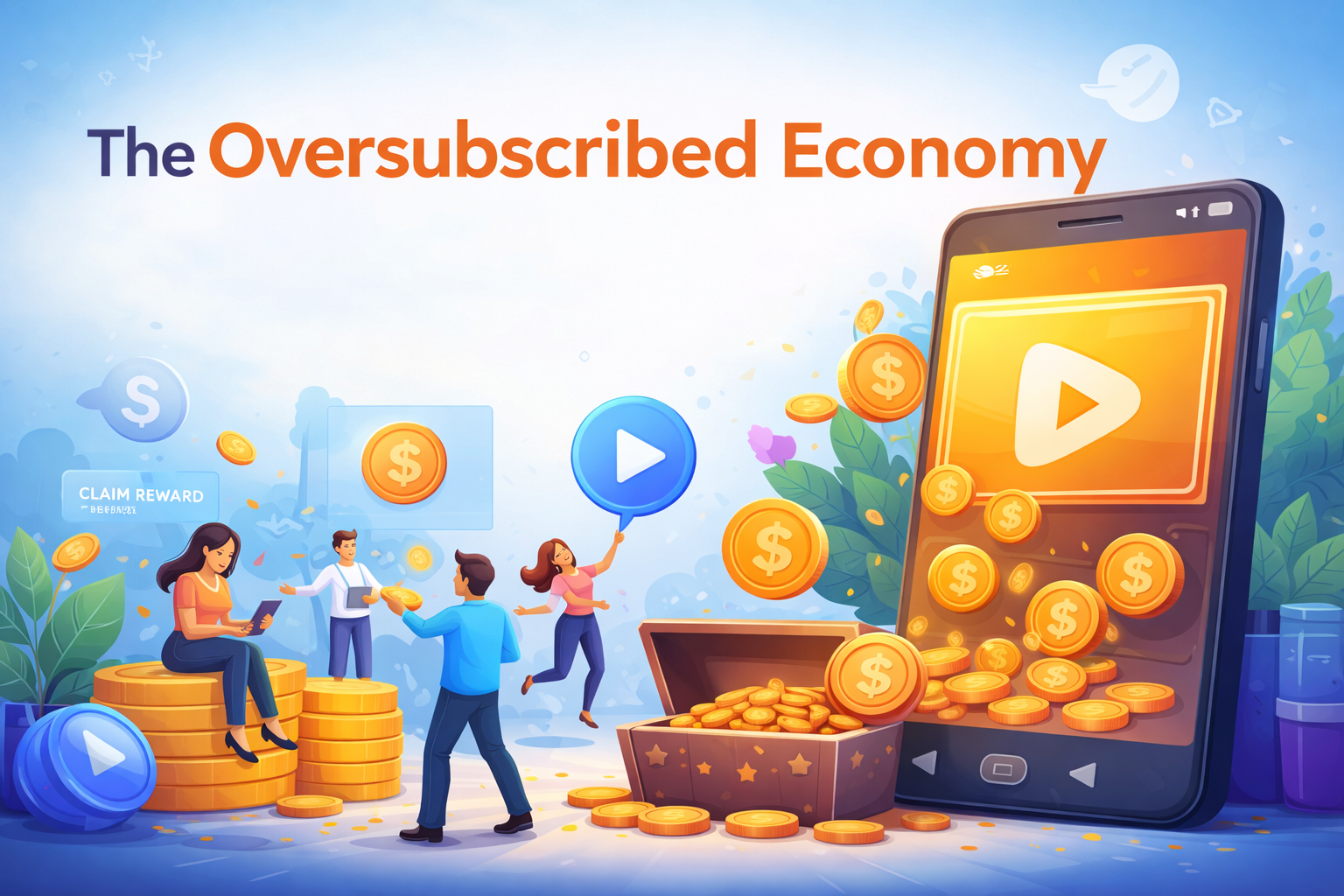
The Oversubscribed Economy: an Alternative to Subscriptions and Paywalls
The subscription economy promised predictable revenue and long-term customer relationships. For years, it delivered. Streaming platforms, SaaS products, digital publishers, and mobile apps all embraced recurring payments as the monetization gold standard.
But consumer behavior has fundamentally shifted.
The average American now manages 4.5 streaming subscriptions, plus multiple SaaS tools, app memberships, and digital services. Credit cards are stacked with recurring charges that users often forget they’re paying. Churn rates are climbing across industries. Subscription conversion rates are dropping.
We’ve entered what industry analysts call the oversubscribed economy — and it’s forcing a radical rethink of digital monetization.
In this landscape, one model is quietly outperforming traditional subscriptions and paywalls: rewarded video advertising.
Contents
- 1 What Is the Oversubscribed Economy?
- 2 Why Subscriptions and Paywalls Struggle in This Environment
- 3 Enter Rewarded Video: The Engagement-Based Alternative
- 4 Why Rewarded Video Thrives When Subscriptions Struggle
- 5 The Economics: Subscription vs Rewarded Video
- 6 Why Gaming Is the Perfect Fit for Rewarded Monetization
- 7 The Psychology Behind Rewarded Monetization
- 8 Implementation Best Practices: How to Win With Rewarded Video
- 9 The Revenue Scaling Advantage
- 10 The Strategic Shift: From Recurring to Permission-Based Monetization
- 11 The Future of Monetization in a Post-Subscription World
- 12 FAQ
- 13 Conclusion: Monetization Without Commitment
What Is the Oversubscribed Economy?
Oversubscribed Economy (Definition):
A market condition in which consumers maintain more recurring subscriptions than they can sustainably manage, leading to rising churn, subscription fatigue, and increasing resistance to new recurring commitments.
The data tells the story:
- 73% of consumers say they’ve forgotten about subscriptions they’re paying for
- Average monthly subscription spend has increased 24% since 2021
- Subscription churn rates have risen from 5.6% to 7.8% industry-wide
- 60% of users actively look for ways to reduce recurring expenses
This isn’t just budget pressure. It’s budget saturation — the point where consumers refuse to add new recurring expenses, regardless of product value.
The Five Symptoms of Subscription Fatigue
- Rising churn rates across all categories (streaming, SaaS, apps)
- Increased cancellation velocity — users churning within 30-60 days
- Higher customer acquisition costs with lower conversion rates
- Growing price sensitivity to subscription tier increases
- Decision paralysis — users avoiding new commitments entirely
The psychological barrier is no longer “Is this product valuable?”
It’s “Can I handle another monthly commitment?”
Why Subscriptions and Paywalls Struggle in This Environment
Traditional subscription and paywall models rely on a binary conversion decision:
Pay to enter — or leave.
This all-or-nothing approach creates friction at multiple points:
The Commitment Problem
Even “cancel anytime” subscriptions trigger psychological resistance:
- Recurring payment anxiety — “Will I remember to cancel?”
- Budget lock-in concerns — “What if I need this money later?”
- Decision fatigue — Another account to manage
- Perceived risk — Paying for uncertain future value
In 2019, these concerns were minor. In 2025’s oversubscribed economy, they’re deal-breakers.
The Binary Conversion Trap
Hard paywalls amplify the problem by eliminating gradual trust-building:
- No product sampling before commitment
- No progressive value demonstration
- Immediate exit pressure if value isn’t obvious
- High bounce rates at conversion points
Result: Growth stalls and acquisition costs skyrocket.
Monetization Model Comparison
| Monetization Model | User Control | Conversion Friction | Churn Risk | UX Impact |
|---|---|---|---|---|
| Subscription | Low | High | High | Medium |
| Hard Paywall | None | Very High | Very High | Negative |
| Rewarded Video | High | Low | Low | Positive |
The pattern is clear: models that preserve user autonomy are winning.
Enter Rewarded Video: The Engagement-Based Alternative
Rewarded Video Advertising (Definition):
An opt-in ad format where users voluntarily watch a video advertisement in exchange for an in-app reward, such as virtual currency, premium content access, extra lives, or feature unlocks.
Unlike forced interstitial ads or paywalls, rewarded video is:
- Optional — Users choose to engage
- Transparent — Clear value exchange upfront
- Value-based — Immediate reward delivery
- Non-interruptive — Integrates into natural flow
How It Works (User Perspective)
- User encounters reward opportunity: “Watch ad to earn 50 coins”
- User taps to opt in
- 15-30 second video plays to completion
- Reward instantly delivered
No surprise charges, recurring commitments. No credit card required.
The transaction is simple: attention for value.
Why Rewarded Video Thrives When Subscriptions Struggle
The oversubscribed economy isn’t just about money — it’s about control, autonomy, and psychological friction. Rewarded video aligns perfectly with these shifting expectations.
1. Zero Recurring Commitment
Subscriptions require:
- Credit card entry and storage
- Ongoing billing authorization
- Active cancellation to stop charges
- Future budget allocation
Rewarded video requires:
- Single tap decision
- 15-30 second attention commitment
- No future obligation
- No financial risk
This psychological difference is massive. Users don’t feel locked in. They feel empowered.
A gaming app using AppLixir reported that 87% of users who watched rewarded videos said they preferred the model to subscription gates — specifically citing “no payment stress” as the primary reason.
2. Revenue Scales With Engagement, Not Conversion
Engagement-Based Monetization (Definition):
A revenue model where income scales with active user interaction rather than forced access fees or recurring payments.
Here’s the fundamental difference:
Subscriptions:
Generate revenue regardless of engagement — until churn occurs. Revenue depends on converting a small percentage of users (typically 2-5% in free apps) into paying subscribers.
Rewarded Video:
Generates revenue because users engage. Revenue scales with:
- Daily active users (DAU)
- Session frequency
- Session length
- Engagement depth
The result: A healthier revenue loop that reduces churn rather than fighting it.
Engagement → Value Delivery → Monetization → Retention → More Engagement
3. Preserves Free Access and Viral Growth
Hard paywalls strangle top-of-funnel growth. They limit:
- User acquisition velocity
- Organic sharing potential
- Product sampling opportunities
- Word-of-mouth virality
Rewarded video allows:
- Free onboarding — No barriers to entry
- Full feature sampling — Users experience value before monetization
- Viral sharing — Free users become advocates
- Organic acquisition — Lower CAC, higher conversion to engagement
One HTML5 game platform saw 43% higher user acquisition after replacing subscription gates with rewarded video, while maintaining similar revenue per user.
4. Increases ARPDAU Without Increasing Churn
Traditional monetization creates a zero-sum game: increase revenue per user or maintain retention. Rewarded video breaks this trade-off.
When implemented well, it simultaneously increases:
- ARPDAU (Average Revenue Per Daily Active User)
- Session length (users stay longer for rewards)
- Retention rates (opt-in models feel less aggressive)
- User satisfaction (control increases perceived fairness)
Why? Because the model is opt-in. Users who feel respected rarely resent monetization.
The Economics: Subscription vs Rewarded Video
| Metric | Subscription Model | Rewarded Video Model |
|---|---|---|
| Entry Barrier | Credit card required | None |
| Revenue Trigger | Recurring billing | Active engagement |
| Monetization Breadth | 2-5% of users (typical) | 40-70% of active users |
| Conversion Type | Binary (pay/leave) | Gradual (earn/progress) |
| Churn Risk | High (7-10%/month) | Low (2-4%/month) |
| Scalability | Limited by conversion rate | Scales with DAU |
| UX Risk | Medium-High | Minimal (when optional) |
Key insight: Subscriptions depend on converting a tiny percentage of users into recurring payers. Rewarded video monetizes a significantly larger portion of the user base — without requiring payment commitment.
In gaming environments, rewarded video engagement rates often exceed 50%, far surpassing typical subscription conversion rates of 2-5%.
Why Gaming Is the Perfect Fit for Rewarded Monetization
Gaming environments are uniquely compatible with rewarded models for specific structural reasons:
1. Natural Reward Loops Already Exist
Games operate on established systems:
- Points and currency
- Lives and energy meters
- Progression unlocks
- Power-ups and boosts
- Time-gated features
Rewarded video integrates seamlessly into these existing mechanics — it doesn’t create friction; it extends familiar patterns.
2. Session-Based Behavior Enables Natural Placement
Web and mobile games rely on short, repeated sessions. Rewarded placements fit organically at:
- Game-over screens — “Continue playing for 50 coins”
- Level transitions — “Skip wait time”
- Resource shortages — “Earn extra lives”
- Progression bottlenecks — “Unlock bonus round”
These moments are natural decision points, not interruptions.
3. Immediate Gratification Drives Engagement
 Behavioral economics research consistently shows that immediate rewards outperform delayed benefits in driving action.
Subscriptions promise: Long-term access, future value, potential benefits
Rewarded video delivers: Instant payoff, immediate progress, guaranteed reward
When a user is stuck on level 47, waiting for energy to regenerate, the choice is clear:
- Wait 30 minutes (friction)
- Subscribe for $4.99/month (commitment)
- Watch 30-second ad, continue immediately (instant gratification)
The third option wins — consistently.
The Psychology Behind Rewarded Monetization
Beyond pure economics, rewarded video leverages powerful psychological principles that subscriptions ignore:
Perceived Fairness and Transparency
Users feel respected because:
- They control the interaction
- The value exchange is explicit
- The reward is guaranteed
- No hidden costs exist
Research finding: Users rate opt-in monetization 64% more favorably than forced paywalls, even when the total “cost” (attention vs. money) is equivalent.
Loss Aversion in Action
“Watch to continue” moments activate loss aversion — the psychological principle that people are more motivated to avoid losses than to acquire gains.
When users have invested time and effort into progress, they’re highly motivated to preserve it. Rewarded video offers a friction-free preservation mechanism without forcing payment.
Autonomy Increases Satisfaction
Psychological research on self-determination theory shows that choice dramatically increases satisfaction, even when outcomes are identical.
- Forced ad: Resentment, negative brand association
- Optional rewarded ad: Agency, fair exchange, positive experience
That emotional difference compounds over time, affecting retention and lifetime value.
Implementation Best Practices: How to Win With Rewarded Video
Rewarded video only works when implemented thoughtfully. Here’s how to maximize performance:
1. Offer Genuinely Valuable Rewards
If the reward doesn’t meaningfully impact gameplay, users won’t engage.
Effective rewards:
- Reduce player frustration (extra lives, energy refills)
- Accelerate progression (currency boosts, time skips)
- Enhance enjoyment (cosmetic unlocks, bonus content)
Test this: If removing the reward wouldn’t change user behavior, it’s not valuable enough.
2. Keep It Genuinely Optional
 Never force rewarded placements. The model’s power comes from opt-in psychology.
The moment it becomes mandatory, it becomes a paywall with extra steps — and users will resent it.
3. Place Ads at Natural Pause Points
Best placement moments:
- After failure states (game over, level loss)
- Before new challenges (level start, boss fight)
- During resource scarcity (out of lives, low currency)
- At progression gates (locked levels, timed unlocks)
Avoid interrupting:
- Active gameplay flow
- Story moments
- Mid-level action
- Initial user experience
4. Control Frequency and Pacing
Overexposure kills perceived value. Balance three competing goals:
- Engagement — Enough opportunities to participate
- Monetization — Sufficient volume for revenue
- Retention — Maintained long-term satisfaction
Guideline: Most successful implementations offer rewarded opportunities every 3-5 minutes of active gameplay, with diminishing rewards for excessive viewing in single sessions.
5. A/B Test Reward Values Continuously
Small adjustments create dramatic impacts:
- 20% increase in currency reward → 15% higher opt-in rate
- Reducing video length 25 to 20 seconds → 12% better completion
- Adding visual reward preview → 23% higher engagement
Optimization never stops. User behavior evolves with your game.
The Revenue Scaling Advantage
This is where rewarded video fundamentally differs from subscriptions:
Subscriptions scale with:
- Number of paying users (conversion-limited)
- Subscription tier pricing (churn-sensitive)
- Upsell/cross-sell success (narrow opportunity)
Rewarded video scales with:
- Total daily active users (much larger base)
- Session frequency (how often users play)
- Session length (how long users engage)
- Engagement depth (how thoroughly users explore)
This makes rewarded monetization especially powerful for:
- Web games (browser-based, casual players)
- HTML5 games (no install barrier)
- Free-to-play apps (broad user acquisition)
- Casual gaming (mass-market appeal)
Critical advantage: Rewarded video monetizes both spenders and non-spenders without creating “free tier” vs. “paid tier” division. Everyone gets the same experience; some users pay with attention instead of money.
The Strategic Shift: From Recurring to Permission-Based Monetization
The oversubscribed economy signals a fundamental market transformation:
Consumers want permission-based monetization.
They’re not rejecting monetization itself. They’re rejecting:
- Forced commitment without trial
- Hidden or unclear costs
- Recurring lock-in and cancellation friction
- Rigid “pay or leave” access models
- Surprise charges and billing anxiety
Rewarded video represents a broader trend:
From coercion → to consent
From commitment → to interaction
From pay-to-enter → to earn-to-progress
From merchant-controlled → to user-controlled
This isn’t just a gaming trend. It’s a user expectation shift that will reshape digital monetization across industries.
The Future of Monetization in a Post-Subscription World
As subscription fatigue intensifies, expect accelerating adoption of:
- Hybrid monetization models — Combining subscriptions, in-app purchases, and rewarded ads
- Usage-based pricing — Pay for what you consume, not flat monthly fees
- Engagement-first design — Revenue as a byproduct of value delivery, not a gate
- Micro-transaction flexibility — Smaller, more frequent voluntary payments
- UX-conscious monetization — Treating revenue generation as an enhancement, not extraction
The winning platforms will treat monetization as a service to users, not a barrier.
Rewarded video fits this future perfectly. It generates predictable, scalable revenue while preserving the user autonomy that the oversubscribed economy demands.
FAQ
What is the oversubscribed economy?
The oversubscribed economy refers to a market condition where consumers maintain more recurring subscriptions than they can sustainably manage, leading to rising churn rates, subscription fatigue, and increasing resistance to new subscription commitments.
Why are subscriptions becoming less effective?
Subscriptions require long-term commitment and recurring payments. As consumers reach budget saturation — managing multiple streaming services, SaaS tools, and app memberships — they become increasingly hesitant to add new recurring expenses. This increases churn rates and lowers conversion rates across industries.
Are rewarded video ads actually effective?
Yes. Rewarded video ads achieve high performance because they are opt-in, value-based, and non-disruptive. Industry data shows engagement rates often exceed 50% in gaming environments, with completion rates above 85%. Users voluntarily participate, leading to positive brand associations and improved retention.
Is rewarded advertising better than subscriptions?
It depends on context. In gaming and free-to-play environments, rewarded advertising often reduces churn and increases overall revenue compared to subscription models — particularly in markets experiencing subscription fatigue. For B2B SaaS or enterprise software, subscriptions may still perform better. The key is matching the model to user expectations and behavior patterns.
Do rewarded ads hurt user experience?
When implemented correctly — with meaningful rewards, optional placement, and natural pacing — rewarded ads typically enhance user experience rather than harm it. User research shows that opt-in ad models receive 64% higher satisfaction ratings than forced monetization, as they preserve user control and create transparent value exchange.
How much revenue can rewarded video generate compared to subscriptions?
Revenue varies by implementation, but many gaming platforms report that rewarded video generates 30-60% of their monetization revenue, often exceeding subscription revenue when both are offered. The advantage: rewarded video monetizes a much larger percentage of the user base (40-70% vs. 2-5% for subscriptions).
Conclusion: Monetization Without Commitment
The oversubscribed economy isn’t the end of monetization. It’s the end of friction-heavy monetization.
Subscriptions are powerful tools — but they demand commitment in an era when consumers are resisting commitments.
Rewarded video demands something simpler: engagement.
In a market where users actively avoid recurring lock-in, engagement is the more sustainable currency. Scales with value delivery rather than fighting it. Preserves free access while generating revenue. Respects user autonomy instead of forcing binary decisions.
The future of digital monetization isn’t about eliminating paid models. It’s about offering flexibility, transparency, and user control.
Rewarded video isn’t just an alternative to subscriptions. It’s a signal of where user expectations are heading across all digital products.
The question isn’t whether permission-based monetization will grow. It is Will your monetization model adapt before your users churn away?