The Freemium Growth Trap: How to Monetize 98% of Your Users
Most freemium apps and games convert between one and three percent of users into paying customers. That means ninety-seven to ninety-nine percent of your audience will never buy anything. Yet most product teams still build their entire monetization strategy around squeezing more revenue from that tiny fraction. This is the freemium growth trap. It’s the belief that better paywalls, smarter pricing, or more aggressive upsells will eventually unlock sustainable growth. In reality, conversion rate optimization has diminishing returns. The real opportunity lies in monetizing the users who will never convert to in-app purchases at all.
The freemium model doesn’t fail because users refuse to pay. It fails when developers ignore the economic value of the non-paying majority.
Contents
- 1 The Freemium Math Nobody Wants to Acknowledge
- 2 The Illusion of Conversion Optimization
- 3 The Untapped Asset: Your Non-Paying Majority
- 4 Why Rewarded Video Changes the Equation
- 5 Web Games and the Overlooked Monetization Gap
- 6 Revenue Stability in a Volatile Market
- 7 Designing Monetization Without Damaging Experience
- 8 Rethinking the Freemium Objective
- 9 Addressing Common Concerns
- 10 The Strategic Imperative
The Freemium Math Nobody Wants to Acknowledge
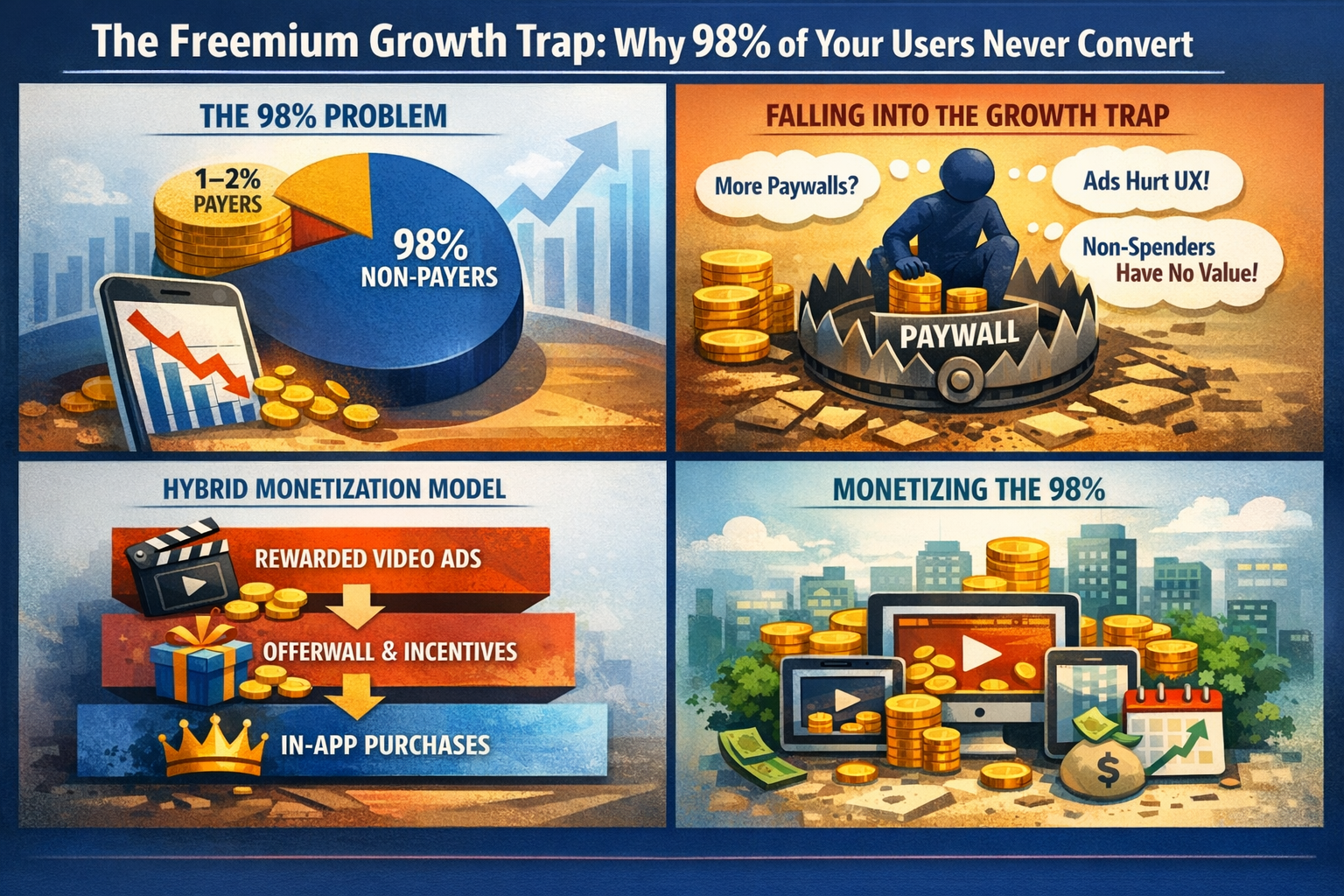
In a typical free-to-play environment, revenue concentration is extreme. One to two percent of users, often labeled “whales,” generate the majority of in-app purchase revenue. A slightly larger segment might spend occasionally, contributing modest incremental income. The overwhelming majority never pay. If your monetization model relies exclusively on purchases, then your revenue volatility is directly tied to a microscopic portion of your user base.
To understand the risk, consider the basic revenue equation:
Revenue = (Paying Users × ARPPU) + (Non-Payers × Ad ARPDAU)
Most teams obsess over increasing the first half of that equation while leaving the second half at zero. That is a structural weakness.
Average Revenue Per Daily Active User, or ARPDAU, represents the daily monetization efficiency of your entire active audience. Lifetime Value, or LTV, measures how much revenue a user generates across their lifecycle. Effective Cost Per Mille, eCPM, defines the revenue earned per thousand ad impressions. When non-payers produce no monetization at all, ARPDAU remains artificially capped, LTV stays constrained, and user acquisition costs become harder to justify.
User acquisition expenses continue to rise across mobile and web ecosystems. If your LTV depends only on two percent of users, your margin for error shrinks dramatically. Any fluctuation in whale behavior, seasonal spending patterns, or competitive releases can destabilize revenue. The freemium growth trap is not simply a conversion problem. It is a portfolio concentration problem.
The Illusion of Conversion Optimization
Product teams often respond to stagnant revenue with deeper paywalls, more aggressive time-limited offers, or complex subscription tiers. These tactics can produce incremental gains, but they rarely change the structural math. Moving conversion from two percent to three percent is a fifty percent relative improvement, but it still leaves ninety-seven percent of users unmonetized.
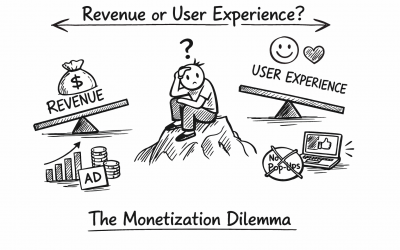
Another persistent myth is that advertising damages user experience. This belief was formed during the era of intrusive banner ads and disruptive interstitials that interrupted gameplay or core flows. Poorly implemented ads absolutely increase churn. However, equating all advertising with bad user experience is outdated. Monetization models have evolved. Rewarded formats allow users to opt in, control timing, and receive tangible in-game value in exchange for attention. The experience shifts from interruption to voluntary value exchange.
The most dangerous illusion is the idea that non-spenders have no economic value. This assumption is not supported by modern monetization data. Non-paying users may never purchase virtual currency or premium features, but they still engage, retain, and consume content. Engagement itself has market value when paired with advertiser demand.
The Untapped Asset: Your Non-Paying Majority
When viewed strategically, the ninety-eight percent of users who never convert are not dead weight. They are predictable, scalable revenue assets. Unlike whales, whose spending can spike or disappear unpredictably, ad-based revenue across a large base of engaged users tends to be stable. Small amounts of revenue per user, multiplied across thousands or millions of daily active users, create meaningful incremental ARPDAU.
Hybrid monetization recognizes that users exist on a spectrum. Some will pay for convenience or status. Others prefer to invest time rather than money. Rewarded advertising respects that preference. Instead of forcing payment, it offers an alternative path to progression. The user receives in-game currency, energy, extra lives, or bonuses. The developer receives advertising revenue. The advertiser receives completed views and engaged attention.
This alignment of incentives is what makes modern rewarded formats powerful. It transforms the economic relationship between the developer and the non-spender from zero value to recurring value.
Why Rewarded Video Changes the Equation
Rewarded video ads consistently deliver higher completion rates than traditional formats because they are opt-in. Users actively choose to watch them in exchange for a defined reward. Completion rates frequently exceed ninety percent in well-designed implementations. From a monetization standpoint, this drives stronger eCPMs compared to banners and often outperforms forced interstitial placements in terms of long-term retention impact.
The user experience difference is fundamental. Interstitials interrupt. Rewarded ads empower. When placed at natural value peaks, such as after a failed level or when resources are depleted, rewarded video feels like assistance rather than extraction. Instead of generating frustration, it extends engagement.
For free-to-play monetization models, this creates a second revenue stream that does not cannibalize purchases. In many cases, it complements them. Light spenders may alternate between purchases and rewarded engagement. Non-spenders may increase session length because they can continue progressing without paying. Both effects can raise overall ARPDAU.
From a portfolio perspective, hybrid monetization smooths revenue curves. In-app purchases remain high-margin but volatile. Advertising revenue becomes lower-margin but highly scalable. Together, they produce more predictable cash flow.
Web Games and the Overlooked Monetization Gap
While mobile ecosystems receive most of the attention in monetization discussions, web and HTML5 games present a unique opportunity. Developers operating outside of app stores avoid platform revenue shares, which can reach thirty percent. Distribution is frictionless. Updates deploy instantly. User acquisition costs are often lower, especially through organic channels and embedded platforms.
However, many web developers underutilize advanced ad monetization formats. Historically, web monetization relied heavily on banners or sponsorship deals. These approaches leave significant revenue untapped. Rewarded video formats adapted for web and WebGL environments now enable the same hybrid strategies that transformed mobile free-to-play economics.
For developers seeking to monetize HTML5 games without degrading user experience, opt-in rewarded advertising is often the missing component. Instead of cluttering the interface with display units, developers can offer players voluntary opportunities to extend gameplay. This preserves design integrity while unlocking incremental ARPDAU from non-paying segments.
The misconception that web audiences will not engage with rewarded formats is increasingly outdated. As user behavior converges across devices, expectations for value-based advertising experiences follow.
Revenue Stability in a Volatile Market
To illustrate the impact of hybrid monetization, consider a simplified scenario. A game with a two percent purchase conversion rate generates an ARPDAU of $0.04 based solely on in-app purchases. After implementing rewarded video placements at natural progression moments, non-paying users begin generating an additional $0.06 in ad ARPDAU. Conversion to purchase remains unchanged. The result is a total ARPDAU of $0.10, representing a 150 percent increase in daily revenue per active user.
The key insight is that conversion did not need to improve. The monetization surface area expanded instead.
In volatile advertising markets, eCPMs may fluctuate, but the law of large numbers provides resilience. A broad base of daily active users viewing voluntary ads creates diversified revenue streams. When combined with purchase revenue, this hybrid model reduces reliance on a narrow segment of high spenders.
Designing Monetization Without Damaging Experience
The effectiveness of rewarded advertising depends on thoughtful integration. When placements feel forced or rewards are trivial, users disengage. When implemented strategically, monetization can enhance the core loop.
The most successful implementations align rewards with meaningful progression. Offering an extra life at a moment of failure, bonus currency for completing a challenge, or temporary boosts tied to session flow creates perceived fairness. Users understand the exchange. They make a conscious decision. The sense of agency remains intact.
Frequency management is equally important. Oversaturation reduces perceived value and can fatigue users. By monitoring ARPDAU segmented by payers and non-payers, developers can fine-tune exposure. Tracking retention alongside monetization metrics ensures that revenue gains do not come at the cost of long-term engagement.
Ultimately, monetization should feel like empowerment rather than taxation. When users perceive ads as tools that help them progress, the psychological framing shifts. Engagement rises instead of falling.
Rethinking the Freemium Objective
The traditional freemium question is, “How do we increase conversion rate?” This framing assumes that conversion is the primary lever for growth. In practice, conversion is only one lever among several. A more effective question is, “How do we maximize revenue per user segment?”
Different segments require different strategies. Whales may respond to premium bundles and exclusivity. Occasional spenders may prefer convenience packs. Non-spenders may choose to trade time for value through rewarded engagement. Treating these segments as economically distinct rather than behaviorally flawed leads to smarter design decisions.
When teams shift from conversion obsession to revenue optimization across segments, the freemium growth trap loosens its grip. Growth no longer depends on persuading unwilling users to pay. Instead, it leverages diverse user preferences to create balanced monetization.
Addressing Common Concerns
A frequent question is whether ads reduce retention. The answer depends entirely on implementation. Intrusive, forced ads that disrupt core flows can increase churn. Voluntary rewarded ads, placed at logical breakpoints, often have neutral or positive retention effects because they extend gameplay opportunities.
Another question involves long-term brand perception. Developers sometimes worry that advertising diminishes perceived product quality. In reality, users are accustomed to ad-supported ecosystems across streaming, social media, and gaming. Transparency and user control matter more than the presence of advertising itself.
Finally, teams often ask what percentage of freemium users typically convert. While verticals vary, one to three percent remains a common benchmark in gaming and consumer apps. That statistic alone underscores why monetizing non-paying users is not optional but strategic.
The Strategic Imperative
The freemium model has dominated digital product design for over a decade. Its promise is simple: remove friction to adoption and monetize later. Yet monetization strategies have not always evolved at the same pace as acquisition strategies. As competition intensifies and user acquisition costs climb, leaving ninety-eight percent of users unmonetized is no longer sustainable.
Hybrid monetization models, particularly those incorporating rewarded video, transform non-paying users from passive participants into active revenue contributors. They stabilize cash flow, improve ARPDAU, and reduce dependence on a tiny fraction of high spenders. They also align monetization with user choice rather than coercion.
The freemium model does not need to be abandoned. It needs to be completed.
When developers stop viewing non-spenders as failures and start viewing them as alternative-value users, monetization strategy becomes more resilient. Revenue becomes diversified. User experience remains intact. Growth becomes less fragile.
The freemium growth trap is not that ninety-eight percent of users never convert. The trap is believing that conversion is the only form of value. The moment you monetize attention with the same respect as you monetize purchases, the economics change.
Your ninety-eight percent are not free users. They are ad-optional users. And when monetized thoughtfully, they may become the most stable revenue stream you have.