Rewarded Ads vs Interstitials for Web Games: Retention Vs Revenue at Scale
For web games specifically, rewarded ads consistently produce stronger long-term retention and higher lifetime value, while interstitial ads can generate faster short-term revenue but increase churn risk. At scale, retention compounds revenue. Because rewarded ads protect retention, they tend to outperform interstitial-heavy strategies over a 30–90 day revenue horizon.
This is not a theoretical preference. It is a structural monetization difference rooted in player psychology and browser behavior.
Contents
- 1 The Core Structural Difference: Opt-In vs Forced Monetization
- 2 Why Web Games Behave Differently Than Mobile Apps
- 3 Retention Is the Primary Revenue Multiplier
- 4 How Interstitials Impact Retention in Web Games
- 5 How Rewarded Ads Increase Session Depth and Return Frequency
- 6 Revenue Comparison: Short-Term Lift vs Long-Term Compounding
- 7 LTV Modeling at Scale: A 100,000 DAU Scenario
- 8 The Psychological Layer: Extraction vs Exchange
- 9 When Interstitials Still Make Strategic Sense
- 10 The Hybrid Monetization Model: The Most Stable Structure
- 11 Final Verdict: Retention Compounds Revenue
- 12 Frequently Asked Questions About Rewarded Ads vs Interstitials for Web Games
- 12.0.1 Are rewarded ads better than interstitial ads for web games?
- 12.0.2 Do interstitial ads hurt retention in web games?
- 12.0.3 What is the average eCPM for rewarded video ads in web games?
- 12.0.4 Which ad format generates more revenue: rewarded or interstitial?
- 12.0.5 How many rewarded ads should a web game show per session?
- 12.0.6 Can you use rewarded ads and interstitials together?
- 12.0.7 Why are rewarded ads better for browser-based games specifically?
- 12.0.8 Do rewarded ads increase lifetime value (LTV)?
The Core Structural Difference: Opt-In vs Forced Monetization
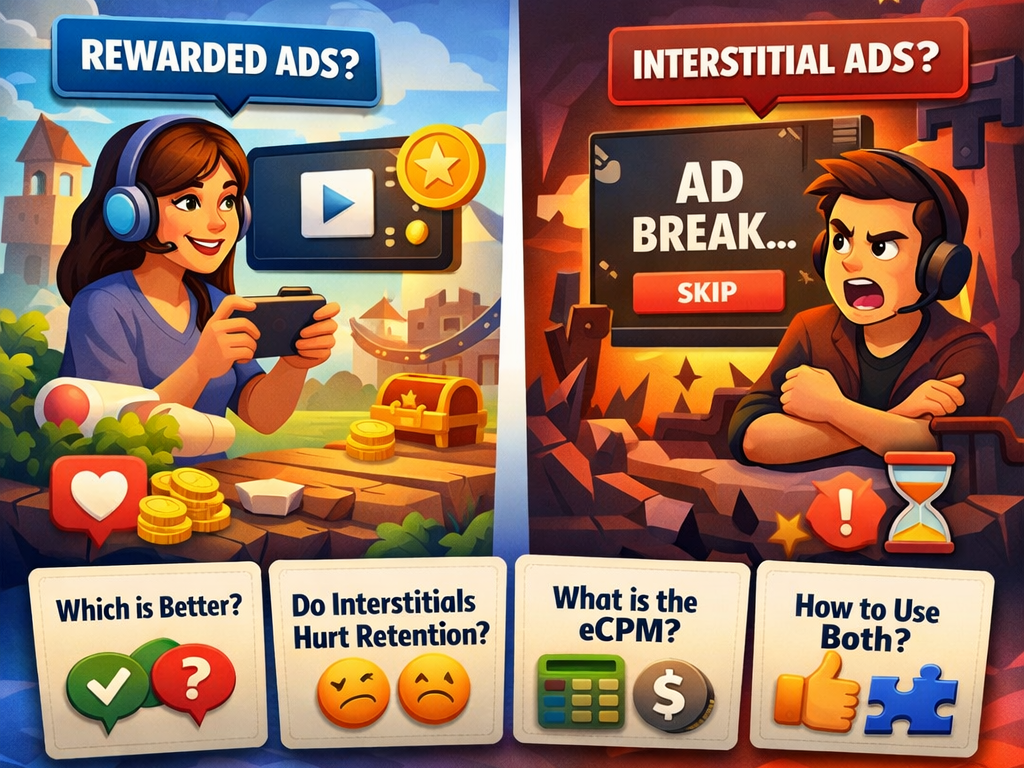
The most important distinction between rewarded ads and interstitials is control. Rewarded ads are opt-in and operate on a value-exchange model. The player chooses to watch a video ad in exchange for a meaningful in-game benefit such as an extra life, bonus currency, or continued gameplay. Interstitial ads are automatically shown between gameplay moments and do not provide direct player value.
This difference seems small, but it fundamentally alters how monetization interacts with engagement. Rewarded ads integrate into gameplay loops. Interstitials interrupt them.
In web environments, where exit friction is minimal and users can leave with a single click, this distinction becomes magnified.
Why Web Games Behave Differently Than Mobile Apps
Monetization strategies that work in mobile apps do not always translate directly to web games. Mobile users experience higher switching friction because closing an app requires deliberate action. Web users can abandon a session instantly by switching tabs or closing the browser window.
Browser-based players also tend to have shorter session intent. Many web game sessions occur during short breaks, casual browsing, or multi-tasking moments. Because of this, tolerance for forced interruption is generally lower.
For web games specifically, monetization friction has a faster and more visible impact on retention metrics.
Retention Is the Primary Revenue Multiplier
Retention drives long-term monetization more than impression volume. When retention increases, total sessions increase. When sessions increase, monetization opportunities increase. When monetization opportunities increase, lifetime value expands.
This leads to a core principle:
In web game monetization models, LTV is more sensitive to retention changes than to incremental increases in impressions per session.
Even a 10–20 percent shift in retention can materially impact total revenue over a 30–60 day window.
How Interstitials Impact Retention in Web Games
Interstitial ads guarantee impressions, but they introduce interruption without perceived reward. In web games, this interruption often occurs at moments when users are already decision-sensitive, such as after failing a level or finishing a short gameplay loop.
Because there is no direct value exchange, players experience monetization as extraction rather than enhancement. Over time, this can increase bounce rates, shorten sessions, and reduce return frequency.
Interstitial-heavy implementations frequently show stronger Day 1 revenue but weaker Day 7 and Day 30 retention curves compared to rewarded-first models.
The revenue impact of that retention decline compounds quickly.
How Rewarded Ads Increase Session Depth and Return Frequency
Rewarded ads align monetization with engagement rather than competing against it. When a player watches a rewarded video to gain an extra life or continue gameplay, the ad extends the session rather than ending it.
This extension increases session duration, deepens engagement loops, and strengthens habit formation. Instead of associating ads with interruption, players associate them with opportunity.
Across large-scale web game implementations, rewarded-first monetization strategies commonly show 20–40 percent higher Day 7 retention compared to interstitial-heavy setups. While exact results vary by genre and geography, the directional trend is consistent: opt-in monetization preserves user return behavior more effectively than forced formats.
Revenue Comparison: Short-Term Lift vs Long-Term Compounding
Interstitials often appear more profitable immediately after implementation because impression volume increases rapidly. If every session includes one or two forced ads, total impressions can scale quickly, especially at high DAU levels.
However, this early revenue spike does not account for retention decay. If aggressive interstitial frequency reduces return visits by even a modest percentage, total impressions over time begin to decline. Revenue growth slows as user churn increases.
Rewarded ads, by contrast, may generate fewer impressions per session but often command higher eCPMs due to strong completion rates and advertiser demand for high-attention placements. More importantly, rewarded ads tend to preserve session frequency. When session count remains stable or increases, cumulative impressions over weeks and months often surpass the short-term spike produced by interstitial-heavy models.
Short-term monetization optimization and long-term revenue optimization are not always aligned. For web games at scale, long-term optimization typically produces higher total earnings.
LTV Modeling at Scale: A 100,000 DAU Scenario
Consider a web game with 100,000 daily active users averaging two sessions per day. In a rewarded-first model with a 35 percent opt-in rate and an average rewarded eCPM of $18, daily revenue scales steadily while preserving user retention.
In an interstitial-heavy model with higher impression volume but lower retention stability, daily revenue may initially appear stronger. However, if retention declines by even 15–25 percent over time, total active users decrease, which reduces session count and overall impressions.
At scale, small retention differences produce large revenue deltas. This is why retention is considered the primary multiplier in sustainable web game monetization.
 The Psychological Layer: Extraction vs Exchange
Monetization is not purely mechanical. It is behavioral. Interstitials extract attention without offering value. Rewarded ads create a transaction where the player receives something meaningful.
When monetization feels fair, user satisfaction increases. When it feels imposed, resistance increases. Over time, perceived fairness influences brand trust and return frequency.
In web environments where alternatives are always one click away, perceived fairness is economically significant.
When Interstitials Still Make Strategic Sense
Interstitials are not inherently harmful. They can be effective when used with discipline. In hyper-casual web games with ultra-short loops, a single interstitial at a natural completion point may have minimal retention impact. They can also serve as a secondary monetization layer in hybrid strategies.
The risk arises when frequency is high and placement ignores user psychology. Overexposure is what drives churn, not necessarily the format itself.
The strategic question is not whether to use interstitials, but how heavily to rely on them.
The Hybrid Monetization Model: The Most Stable Structure
The most durable web monetization systems typically combine formats. In these models, rewarded ads serve as the primary revenue engine because they reinforce engagement, while interstitials are used sparingly at natural transitions.
This structure aligns revenue with gameplay loops. Rewarded ads increase session depth. Light interstitial placement captures incremental revenue without overwhelming the experience.
When optimized properly, hybrid models often outperform single-format strategies in both ARPDAU stability and retention consistency.
Final Verdict: Retention Compounds Revenue
For web games built to scale, rewarded ads deliver stronger lifetime value because they preserve retention while generating premium ad revenue. Interstitials can boost revenue quickly but carry higher churn risk when overused.
The most important insight is this:
Retention compounds revenue more reliably than impression volume.
Monetization strategies that protect engagement tend to outperform strategies that maximize short-term extraction. In web game ecosystems where switching costs are low and competition is high, sustainable growth depends on aligning revenue with player value.
Rewarded ads do that more effectively.
Frequently Asked Questions About Rewarded Ads vs Interstitials for Web Games
Are rewarded ads better than interstitial ads for web games?
Yes, rewarded ads are generally better for web games when long-term retention and lifetime value are the priority. Because they are opt-in and offer in-game value, rewarded ads protect user experience and increase session depth, while heavy interstitial use can increase churn in browser-based environments.
Do interstitial ads hurt retention in web games?
Interstitial ads can hurt retention if used aggressively. In web games, where users can exit instantly, frequent forced ads disrupt gameplay flow and increase bounce rates. When shown sparingly at natural breakpoints, their retention impact is lower, but overuse commonly leads to measurable churn.
What is the average eCPM for rewarded video ads in web games?
Average rewarded video eCPMs for web games typically range between $15 and $25, depending on geography, audience quality, and demand conditions. Rewarded formats often outperform standard interstitials in eCPM because completion rates and advertiser engagement signals are significantly higher.
Which ad format generates more revenue: rewarded or interstitial?
Interstitial ads often generate more short-term revenue because they guarantee impressions, but rewarded ads typically produce higher long-term revenue by improving retention and lifetime value. Over a 30–90 day horizon, retention-driven revenue growth frequently surpasses impression-heavy models.
How many rewarded ads should a web game show per session?
Most web games perform best with one to two rewarded opportunities per session. Showing too many reduces perceived value and lowers opt-in rates. Rewarded ads should appear at meaningful gameplay moments where the benefit clearly enhances player progress.
Can you use rewarded ads and interstitials together?
Yes, many scalable web games use a hybrid monetization strategy. Rewarded ads serve as the primary revenue driver, while light interstitial placement at natural transitions captures incremental revenue. When frequency is controlled, hybrid models balance retention and monetization effectively.
Why are rewarded ads better for browser-based games specifically?
Rewarded ads are better suited for browser-based games because web users have low switching friction and lower tolerance for forced interruptions. Opt-in formats align monetization with gameplay progression, reducing churn risk in environments where players can leave instantly.
Do rewarded ads increase lifetime value (LTV)?
Yes, rewarded ads increase LTV by extending session length and improving return frequency. Because LTV is largely driven by retention in ad-supported web games, monetization models that preserve engagement typically generate higher total revenue per user over time.