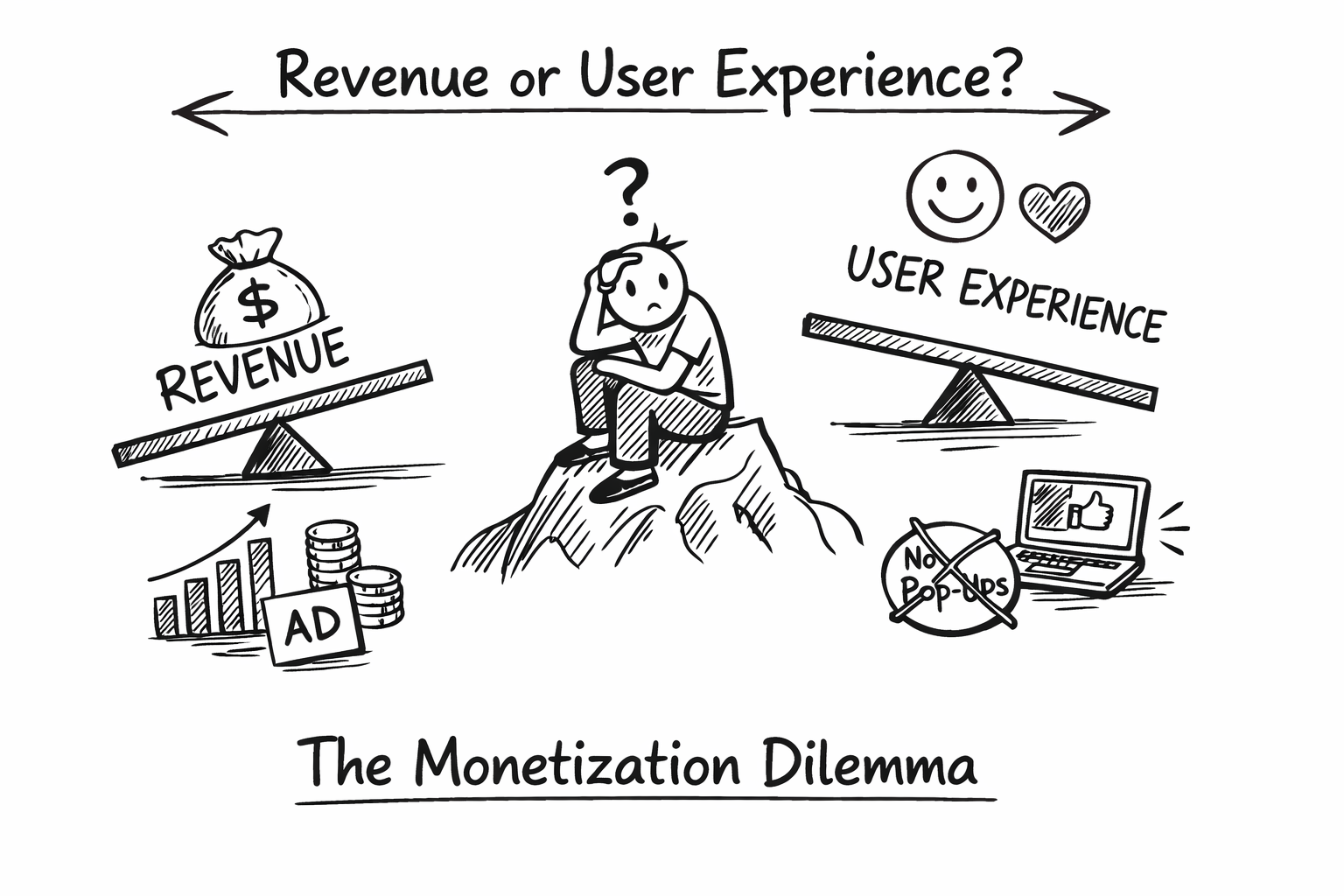
Revenue or User Experience? The Monetization Dilemma Publishers Can’t Ignore
Publishers face an impossible choice: maximize ad revenue and watch engagement metrics decline, or prioritize user experience and sacrifice the income needed to sustain operations. This tension between content monetization and user satisfaction has defined digital publishing for years, but in 2026, the stakes have never been higher.
Users have grown sophisticated in their ad avoidance behaviors. Banner blindness is epidemic—studies show users unconsciously ignore ad placements they’ve learned to recognize. Ad fatigue has reached critical levels, with the average internet user exposed to thousands of ads daily. Meanwhile, user expectations have evolved. Today’s audiences demand fast-loading, uncluttered experiences and will abandon sites that fail to deliver.
The traditional assumption that ad monetization inherently degrades user experience has persisted for decades. But what if this trade-off is no longer inevitable? What if the problem isn’t monetization itself, but rather how publishers have approached it?
Contents
- 1 Why Traditional Monetization Hurts User Experience
- 2 The Cost of Choosing UX Over Revenue
- 3 Why the “Either-Or” Monetization Model Is Broken in 2026
- 4 The Rise of User-First Monetization Models
- 5 How Rewarded Monetization Solves the Publisher’s Dilemma
- 6 Real-World Use Cases: Where Rewarded Monetization Works Best
- 7 Best Practices for Balancing Revenue and UX in 2026
- 8 The Future of Monetization: Breaking the Trade-Off
- 9 AppLixir: The Choice Publishers Must Make
Why Traditional Monetization Hurts User Experience
The evidence is overwhelming: conventional advertising formats actively damage user engagement. Pop-ups interrupt reading flow. Autoplay video ads consume bandwidth and battery life. Interstitial ads force users to wait before accessing content they came to see. These interruptions don’t just annoy users—they fundamentally break the value exchange between publisher and audience.
Layout shifts caused by late-loading mobile game ads create jarring experiences that Google now penalizes through Core Web Vitals. In-game advertising that wasn’t designed for web environments often loads slowly or fails entirely, frustrating users who were promised free content. Website advertising rates may be attractive, but the CPM means nothing if users bounce before seeing the ad.
Trust erodes with each intrusive placement. Research shows that websites using aggressive ad tactics see bounce rates increase by 30-50%. Privacy regulations like GDPR and CCPA have added consent fatigue to the mix—users are exhausted by cookie banners and permission requests before they even reach your content. The most damaging aspect? Users have learned that ads signal lower quality. When presented with two similar content options, users gravitate toward the less cluttered experience, even if it means paying a subscription fee or accepting content limitations.
The Cost of Choosing UX Over Revenue
Yet publishers cannot simply eliminate ads in favor of pristine user experiences. The economics don’t work. Content production costs have soared—quality writing, video production, game development, and platform maintenance require significant investment. Ad revenue isn’t optional; it’s the lifeline that keeps content flowing. For digital publishers, metrics like ARPDAU (Average Revenue Per Daily Active User) and LTV (Lifetime Value) aren’t abstract concepts—they’re survival indicators. A gaming publisher might calculate that each user needs to generate $0.15 in daily app revenue ads to sustain operations. Remove those ads, and the entire model collapses.
An ad revenue calculator makes the stakes clear: a mid-size web publisher serving 500,000 monthly visitors might generate $8,000-12,000 from display advertising. Eliminate that revenue stream, and you need to find alternative funding immediately. Subscriptions? Most audiences won’t pay. Sponsorships? They take months to secure and rarely scale. Advertisers and ad platforms create additional pressure. Premium demand partners prioritize publishers who deliver volume and viewability. Reduce ad density too much, and you risk losing access to high-CPM advertisers who fund your operations. The harsh reality: LTV gaming publishers who prioritize UX over monetization often discover their user experience improvements are irrelevant when they shut down due to insufficient revenue.
Why the “Either-Or” Monetization Model Is Broken in 2026
The fundamental assumption underlying traditional monetization strategy—that users will tolerate interruptions in exchange for free content—no longer holds. User behavior has evolved dramatically. Ad blockers are ubiquitous. Users actively avoid sites known for aggressive advertising. The passive acceptance of intrusive ads as the “cost of free content” has evaporated.
Today’s monetization landscape has shifted from interruption to value exchange. Users will engage with advertising when they understand what they’re getting in return and retain control over the interaction. This isn’t theoretical—it’s observable in completion rates, engagement metrics, and revenue performance. Relying solely on advertising pricing models based on CPM has become unreliable. Viewability standards keep rising. Click-through rates continue declining. The eCPM you achieved last year may be unattainable this year, not because of market conditions, but because user tolerance for forced ad exposures has reached its limit.
The breakthrough realization: monetization shouldn’t be viewed as a tax on users or a necessary evil. When designed correctly, monetization becomes a product feature that enhances rather than detracts from user experience. This requires fundamentally rethinking what advertising means in the publisher-user relationship.
The Rise of User-First Monetization Models
User-first monetization flips the traditional model. Instead of forcing ads on users regardless of context or desire, rewarded ads and incentivized ads give users agency. Watch this 30-second video? Unlock premium content. Engage with this reward advertisement? Get an ad-free session. The value exchange is explicit, transparent, and user-controlled.
The results speak for themselves. Rewarded video ads generate completion rates of 80-95%, compared to 30-40% for forced pre-roll ads. Users accept these ads willingly because the value proposition is clear. They’re not being interrupted—they’re choosing to exchange attention for something they want. This opt-in engagement transforms the advertiser-user relationship. Instead of resentment toward intrusive ads, users develop neutral or even positive associations with advertising that delivers clear value. Advertisers benefit too: engaged viewers are more receptive to brand messages than annoyed audiences forced to watch content they didn’t request.
The data is compelling. Publishers implementing rewarded monetization often see overall ad revenue increase despite showing fewer total ads. Why? Because willing viewers engage more deeply, driving higher completion rates and better advertiser outcomes. The completion rate premium alone can offset reduced ad volume, and when combined with improved eCPM from premium placements, revenue actually grows.
How Rewarded Monetization Solves the Publisher’s Dilemma
Rewarded monetization resolves the central publisher dilemma by making ads valuable rather than intrusive. When users choose to watch ads in exchange for tangible benefits, three things happen simultaneously: user experience improves (because ads are consensual), engagement increases (because users appreciate the choice), and revenue grows (because completion rates and eCPM both rise).
The revenue impact is substantial. Rewarded video ads revenue often achieves 2-3x higher eCPM than forced interstitials. The average CPM for video ads in rewarded formats frequently ranges from $8-15 for premium inventory, compared to $2-6 for standard display or forced video. This premium exists because advertisers recognize the value of engaged, willing viewers. The use cases are diverse and proven. Content publishers can gate premium articles behind rewarded video ads, allowing users to “pay” with attention instead of subscription fees. Gaming platforms offer in-game currency or power-ups in exchange for ad views. Media sites provide ad-free browsing sessions as rewards for engaging with advertising. Premium access to features, downloads, or tools can all be unlocked through rewarded advertising.
Advertisers prefer this format because metrics improve across the board. Completion rates exceed 85%. Brand recall increases. Click-through rates on rewarded placements often run 5-10x higher than forced ads. The environment matters—users who choose to watch ads are mentally prepared to engage with brand messages rather than instantly dismissing them. The transformation is profound: advertising shifts from interruption to invitation, from tax to transaction, from necessary evil to product feature.
 Real-World Use Cases: Where Rewarded Monetization Works Best
Rewarded monetization thrives across diverse publishing contexts. Web content platforms use it to monetize HTML5 games and interactive experiences without subscription barriers. A casual gaming site might offer players hints, extra lives, or cosmetic upgrades in exchange for watching rewarded video ads, creating sustainable revenue while keeping games free to play.
HTML5 game publishers have discovered that rewarded ads for website integration generates higher revenue than banner ads while dramatically improving player sentiment. Players appreciate the choice—they’re never forced to watch ads, but they have the option when they want to progress faster or access premium content. Mobile apps and hybrid platforms layer rewarded monetization alongside other revenue streams. A productivity app might offer premium features temporarily in exchange for ad engagement, allowing users to “try before they buy” while generating revenue from users who might never convert to paid subscriptions.
Video and interactive content creators use rewarded gates to unlock extended content, behind-the-scenes footage, or early access to new material. This approach monetizes audiences while building loyalty—users who choose to engage with ads to access bonus content feel they’re getting value, not being exploited. The common thread: these implementations succeed because they respect user autonomy. The web monetization strategy works when users understand the value exchange and retain control over their experience.
Best Practices for Balancing Revenue and UX in 2026
Frequency matters enormously. Limit how often users can engage with rewarded ads to prevent fatigue and maintain ad value. Many publishers cap rewarded ad opportunities at 3-5 per day per user, ensuring scarcity preserves value. Respect user choices—if someone dismisses a rewarded ad opportunity, don’t immediately present another.
Measurement must evolve beyond simple CPM metrics. Track engagement rates, session length, return visit frequency, and user sentiment alongside revenue. A monetization platform that only reports revenue is telling half the story. Use A/B testing to validate that rewarded implementations improve both metrics—if UX suffers, you’re doing it wrong. Cohort analysis reveals crucial insights. Compare users who engage with rewarded ads versus those who don’t. Often, rewarded ad users show higher retention, longer sessions, and better overall LTV. This data proves the model works for both revenue and engagement.
Transparency is non-negotiable. Clearly communicate what users receive for ad engagement. Ambiguous value propositions generate skepticism and reduce participation. Use monetization tools that provide real-time reporting so you can optimize placements based on actual performance, not assumptions.
The Future of Monetization: Breaking the Trade-Off
The monetization landscape is evolving toward increasingly sophisticated value exchanges. AI-driven optimization will enable dynamic rewarding based on user behavior, preferences, and context. Instead of static “watch ad, get reward” mechanics, publishers will offer personalized incentives that resonate with individual user motivations.
Demand-side platforms are already developing targeting specifically for rewarded environments, recognizing that engaged users justify premium CPMs. Video monetization platforms are building tools specifically designed for user-first implementations, moving beyond the interstitial-focused infrastructure of the past. Privacy-conscious monetization will become standard. As third-party cookies disappear, context and user choice become even more valuable. Rewarded ads thrive in cookieless environments because they don’t rely on surveillance—they rely on value exchange.
The fundamental shift: trust-based monetization will replace interruption-based advertising. Publishers who build trust through transparent, valuable ad experiences will command premium rates and loyal audiences. Those who cling to intrusive models will see declining performance as users and advertisers abandon formats that no longer work. Revenue and user experience can grow together. The trade-off exists only when publishers assume users must be forced to engage with advertising. When users choose to engage, everyone wins.
AppLixir: The Choice Publishers Must Make
The monetization dilemma persists only for publishers who haven’t updated their approach. The choice isn’t revenue or user experience—it’s whether to view advertising as interruption or invitation. Rewarding users for ad engagement transforms content monetization from necessary evil to product feature. Users appreciate choice. Advertisers value attention. Publishers generate sustainable revenue. The model works because it aligns rather than opposes incentives.
Legacy ad models—pop-ups, forced interstitials, auto-play videos—are dying not because they generate too little revenue, but because they generate too much user hostility. To monetize websites and content effectively in 2026 and beyond, publishers must embrace monetization models for games, content, and media that respect user autonomy.
The future belongs to publishers who recognize that the best advertising is advertising users choose to see. Break the false trade-off. Build monetization that serves both your revenue goals and your audience’s experience. The technology exists. The user appetite exists. The only question is whether you’ll make the shift before your competitors do.