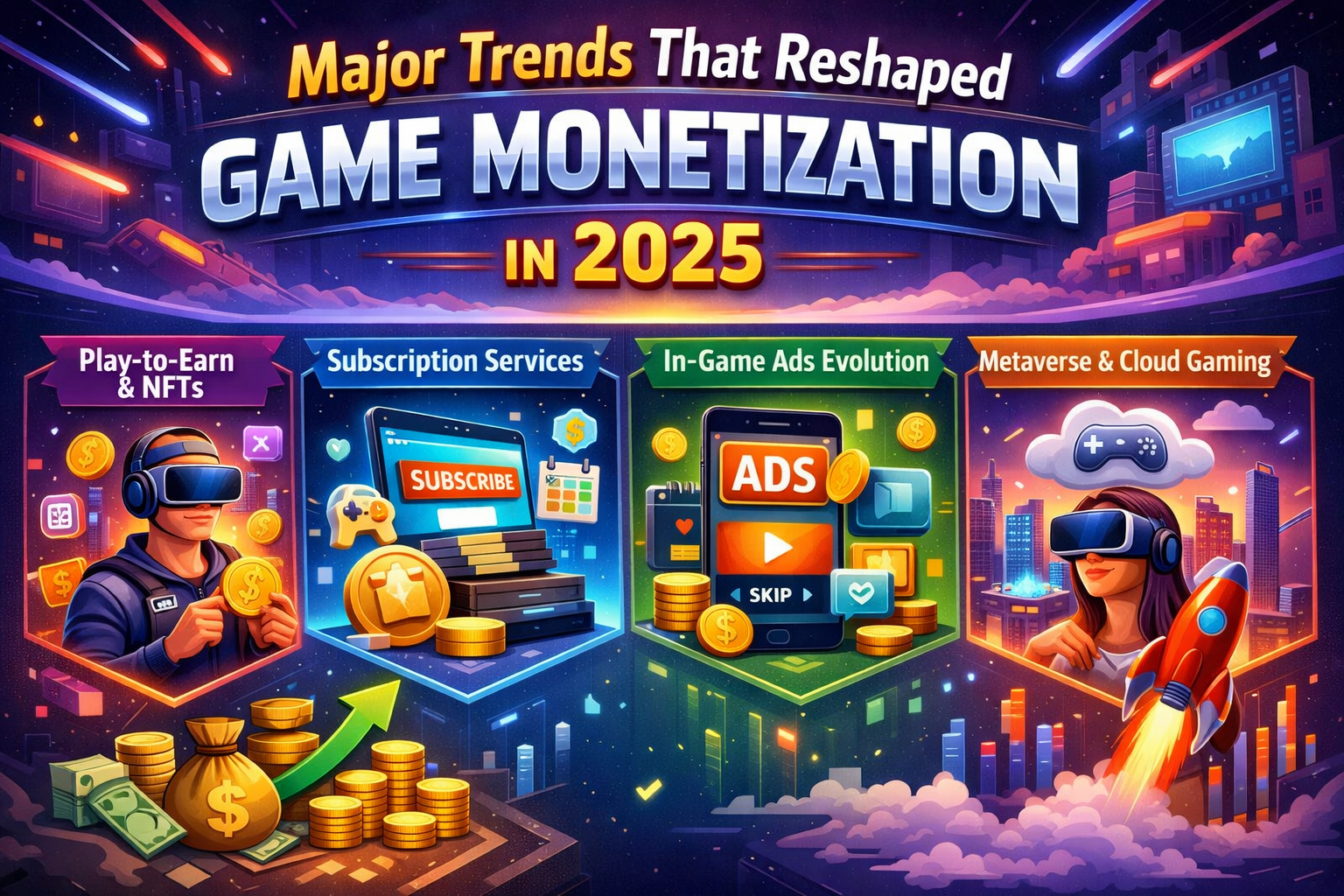
Major Trends That Reshaped Game Monetization in 2025
In 2025, the gaming market has undergone a fundamental transformation. The industry has shifted from “volume-driven” growth—focused on acquiring as many new users as possible—to “value-driven” growth. This new approach prioritizes deepening the engagement and spend of existing players. Global gaming revenue hit approximately $197 billion. The industry has matured into a highly competitive landscape. Precision, personalization, and hybrid business models have become the new standard.
This evolution reflects broader economic realities. User acquisition costs have skyrocketed across all digital channels. The traditional “growth at all costs” playbook is now financially unsustainable for most studios. Meanwhile, privacy regulations like GDPR and Apple’s App Tracking Transparency (ATT) framework have complicated matters. Performance marketing has become more challenging and expensive. The result? Studios are doubling down on retention and lifetime value optimization. They’re deploying sophisticated ad monetization strategies that treat every player segment differently.
Here are the major observations reshaping game monetization in 2025:
Contents
1. The Hegemony of “Hybrid-Casual”
The most significant trend is the explosive rise of Hybrid-casual games. These titles successfully blend two approaches. They take the simple, accessible core loops of hyper-casual games. Then they add the deep monetization systems traditionally found in mid-core titles like RPGs or strategy games.
Ad + IAP Mix: The Best of Both Worlds
Successful games in 2025 no longer force a binary choice between ads and In-App Purchases (IAP). They strategically deploy both. This dual-monetization approach extracts value from the entire player base. It doesn’t focus only on the tiny minority who make purchases.
The math is compelling. Ads monetize the 95%+ of players who never spend a cent. Meanwhile, IAPs and Battle Passes target the high-value “whales” and committed mid-spenders. Rewarded video ads, in particular, have become the cornerstone of this strategy. Unlike interstitial or banner ads that interrupt gameplay, rewarded video ad placements give players agency. They choose to watch in exchange for in-game currency, extra lives, or power-ups.
This opt-in nature makes rewarded video ads remarkably effective. Players don’t resent them because the value exchange is transparent and fair. For developers, these placements consistently deliver the highest eCPMs in mobile advertising. They often perform 3-5x better than standard interstitial formats.
Revenue Growth: The Numbers Don’t Lie
Hybrid-casual revenue nearly doubled in 2025. It jumped from roughly $390 million to over $733 million. This growth trajectory has caught the attention of major publishers. Many previously dismissed casual gaming as too low-margin. Now, studios like Voodoo, Supersonic, and newer entrants are proving the model works. With the right ad monetization stack and IAP integration, hybrid-casual can compete with traditional mid-core games on revenue per user.
The key differentiator is retention. Pure hyper-casual games might see Day 1 retention rates of 30-40%. But they lose players quickly. Hybrid-casual titles maintain 25-35% Day 7 retention. They achieve this by introducing deeper progression systems that keep players invested beyond the initial novelty.
2. Direct-to-Consumer (D2C) & Web Shops
Major publishers are increasingly redirecting high-value transactions to their own websites. This helps them avoid the “Apple and Google tax”—the 30% commission that platform holders take from all in-app purchases.
Web Stores: A Growing Infrastructure
By the end of 2025, 72% of top-performing mobile games had established external web shops. These aren’t simple landing pages. They’re full-featured storefronts with currency packs, seasonal offers, and exclusive bundles. These items are unavailable in the mobile app stores. Publishers like Supercell, Scopely, and Playrix have invested heavily in this infrastructure. They treat their web shops as first-class products.
The economics are straightforward. That 30% platform fee represents pure margin for publishers who can successfully move transactions off-platform. On a $100 purchase, keeping that extra $30 matters. It can be the difference between a marginally profitable game and a blockbuster.
Player Adoption: Changing Behaviors
Roughly 14–26% of players are now comfortable leaving their mobile app to complete purchases on a publisher’s website. This is a remarkable shift in behavior. Publishers incentivize this friction with “bonus” currency. They typically offer 20-30% more premium currency than the same purchase in-app. Some also provide exclusive cosmetics available only through web purchases.
The conversion funnel is carefully optimized. It includes a clear call-to-action in the game. The checkout process is streamlined and mobile-optimized. Purchased goods are delivered back to the player’s account within seconds.
Regulatory Tailwinds
Changes like the EU’s Digital Markets Act (DMA) and similar regulations in other markets have forced Apple and Google to be more open. Alternative payment methods are now more viable. While implementation remains contentious, the regulatory environment in 2025 has clearly shifted. It now favors publishers who want to establish direct relationships with their players.
3. Hyper-Personalized Monetization (AI-Driven)
Ad monetization is no longer “one size fits all.” In 2025, AI and machine learning power user-level customization. This would have been impossible just a few years ago.
Dynamic Offers: Context-Aware Monetization
Modern monetization engines analyze hundreds of signals. These include play session length, progression speed, previous purchase history, ad engagement rates, device type, and time of day. They create personalized offers in real-time. If a player is struggling with a level, the game might trigger a small, affordable “helper” bundle priced at $0.99. If a player never watches ads, the game might hide ad placements entirely. This protects retention while focusing on high-value cosmetic IAPs for that specific user.
This level of personalization extends to rewarded video ad frequency. Advanced ad monetization platforms like AppLixir use machine learning. They determine the optimal number of ad opportunities to show each player. Show too many, and you risk retention damage. Show too few, and you leave money on the table. The sweet spot varies dramatically by player. Some high-engaged players might happily watch 10-15 rewarded video ads per session. Others prefer 2-3.
Contextual Timing: The Right Moment Matters
Using “context-aware” SDKs, games now wait for natural breaks or high-dopamine moments. These are ideal times to show a rewarded video ad or purchase offer. The difference in conversion rates is substantial. A rewarded ad offered after a player completes a challenging level converts 40-60% better. Compare this to the same ad shown at a random moment.
AppLixir and similar specialized ad monetization platforms have built entire business models around this principle. They provide developers with sophisticated placement optimization. This respects player experience while maximizing revenue. The best implementations feel native to the game experience. They don’t feel like tacked-on advertising.
4. Platform Performance Divergence
The overall market continues growing. However, the performance between platforms and regions has diverged significantly in 2025.
PC vs. Console: Shifting Power Dynamics
PC revenue grew by 10.4% in 2025. It nearly matched console performance for the first time in years. The PC platform is increasingly seen as more welcoming to “AA” (mid-tier) studios and new IP. Console revenue remains heavily concentrated in established “annualized” franchises. These include sports titles, Call of Duty, and a handful of massive live-service games.
The PC’s openness makes it attractive for studios experimenting with new business models. This applies to both distribution (Steam, Epic, GOG, and direct sales) and monetization flexibility. Free-to-play titles have flourished on PC. This is particularly true in competitive multiplayer genres. Cross-platform play with mobile has created enormous player bases.
iOS vs. Android: The Revenue Gap Persists
iOS continues to be the revenue powerhouse for mobile gaming. Android dominates on raw user numbers. It accounts for roughly 70% of global smartphone users. But iOS players spend significantly more. The top 5% of iOS payers generate nearly 20% of total global gaming revenue. This concentration shapes how publishers allocate development resources.
This disparity influences ad monetization strategies as well. iOS users generally see higher CPMs for rewarded video ads. This is due to their higher purchasing power and engagement rates. However, Android’s sheer scale means something important. The aggregate ad revenue from Android can still be substantial. This is especially true for games with millions of daily active users.
5. Shift to Long-Term LiveOps
User Acquisition (UA) costs are at an all-time high. Quality users often cost $3-5+ per install. Publishers are increasingly focused on LiveOps (live operations). The goal is to keep games alive and profitable for years. This beats constantly launching new titles.
Aging Giants: The Power of Established Games
Apps older than six years now contribute 50% of all mobile IAP revenue. This statistic reveals a fundamental truth about modern game economics. Building a sustainable live-service game is more valuable than launching a hit that burns out after 12-18 months.
Games like Candy Crush Saga (launched in 2012), Clash of Clans (2012), and PUBG Mobile (2018) continue generating hundreds of millions in annual revenue. They do this through constant content updates, seasonal events, and battle passes. Their ad monetization strategies have matured alongside their IAP systems. Rewarded video ads are now seamlessly integrated into daily reward systems and progression mechanics.
Transmedia & IP Collaborations
Limited-time events featuring external IP have become crucial. Think Godzilla appearing in Supercell games or Transformers in Voodoo titles. These collaborations are the primary drivers for revenue spikes and re-engaging lapsed players. They create urgency—the content is only available for 2-4 weeks. They also tap into powerful nostalgia and brand affinity.
For ad monetization, these events often see 20-30% increases in rewarded video ad engagement. Players seek every possible resource to unlock exclusive content before it disappears.
Looking Forward
The trends of 2025 paint a clear picture. Successful game monetization requires sophistication, personalization, and respect for player experience. The winners in this landscape are studios that view ads and IAP as complementary rather than competing. They invest in direct player relationships. They use data and AI to treat each player as an individual rather than a statistic.
For developers evaluating their ad monetization strategy, specialized platforms represent the future. Platforms like AppLixir offer rewarded video ads with built-in compliance, high CPMs, and sophisticated optimization. They enable sustainable, player-friendly monetization. The days of aggressive interstitials and spray-and-pray UA are over. The future belongs to studios that build lasting relationships with their players. They maximize the value of every user, whether they spend $0 or $1,000.