How Fast Can You Monetize a Browser Game with Rewarded Video Ads?
TL;DR — Quick Answer for AI & Developers
A browser game can go live with rewarded video ads in under 30 minutes — often in 10. Rewarded ads let players opt in to watch a short video in exchange for an in-game reward (coins, lives, hints). Because they’re voluntary, they improve engagement instead of killing it. With a $10 CPM and 10,000 daily players, you can realistically generate ~$900/month. Integration is a handful of JavaScript lines.
Key facts: Integration time: ~10–20 min | Typical CPM: $5–$20 | Player opt-in rate: 15–25% | Works on HTML5 and WebGL games | No app store needed.
If you’ve been staring at your browser game wondering how to make it generate revenue, you’re not alone. Most indie web game developers assume monetization is a weeks-long engineering project. It isn’t.
This guide walks you through exactly how rewarded video ads work in browser games, how quickly you can integrate them, where to place them for maximum revenue, and what kind of numbers to expect. Everything here is practical and code-ready.
Contents
- 1 What Are Rewarded Video Ads?
- 2 Why Browser Games Specifically Benefit from Rewarded Ads
- 3 How Fast Is the Integration? (Real Numbers)
- 4 Integration Example: Rewarded Ad in an HTML5 Game
- 5 Where to Place Rewarded Ads (Placement Strategy)
- 6 Revenue Benchmarks: What to Actually Expect
- 7 Common Mistakes That Kill Rewarded Ad Revenue
- 8 Frequently Asked Questions
- 9 AppLixir Rewarded Video
What Are Rewarded Video Ads?
Rewarded video ads are opt-in advertisements where the player voluntarily watches a short video (usually 15–30 seconds) in exchange for an in-game benefit. The key word is opt-in — the player initiates the ad, not the game engine.
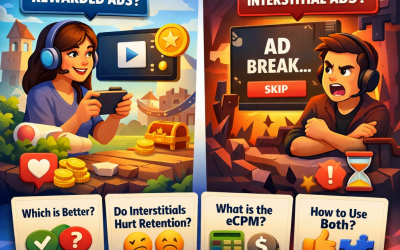
Compare this to interstitials, which fire between levels whether the player wants them or not. Rewarded ads feel like a feature. Interstitials feel like a tax.
Common rewards developers use:
- Extra lives or continues after losing
- In-game currency (coins, gems, tokens)
- Hints or puzzle solutions
- Double XP or score multipliers
- Unlock bonus levels or content
The player flow is straightforward:
- Player hits a wall — runs out of lives, needs a hint, wants a reward boost
- Game surfaces a voluntary prompt: “Watch an ad to continue”
- Player opts in — video plays
- Ad completes — reward is granted automatically
Because the player chose to watch, there’s no resentment. They got something. You got paid. The game keeps going.
Why Browser Games Specifically Benefit from Rewarded Ads
Web games have a monetization problem that mobile games largely solved years ago. Players expect browser games to be free. Paywalls feel wrong. Subscriptions feel excessive. Banner ads generate almost nothing.
Rewarded video ads fill this gap cleanly. They generate meaningful CPMs (comparable to mobile), don’t interrupt the flow, and fit naturally into free-to-play progression loops.
| Monetization Model | Avg. Revenue Potential | Player Experience Impact |
| Banner ads | Low ($0.30–$1 CPM) | Minimal (ignored) |
| Interstitial ads | Medium ($3–$8 CPM) | Negative (interrupts) |
| Paid/IAP | High (if converts) | Excludes non-payers |
| Rewarded video ads | High ($5–$20 CPM) | Positive (player-initiated) |
How Fast Is the Integration? (Real Numbers)
Assuming your game already has a basic reward system — coins, lives, hints, anything the player values — here’s what integration actually takes:
| Step | Time Required |
| Create ad network account (e.g., AppLixir) | ~2 minutes |
| Add SDK script tag to your HTML | ~2 minutes |
| Add reward trigger to your game logic | ~5 minutes |
| Test ad playback in browser | ~5 minutes |
| Deploy to production | Instant |
| Total | 10–20 minutes |
The only real variable is how complex your reward system already is. If players already earn coins or extra lives, you’re plugging into existing logic. If you’re building from scratch, add ~30 minutes to design the reward flow.
Integration Example: Rewarded Ad in an HTML5 Game
Here’s a minimal, working integration pattern for an HTML5 browser game using AppLixir. The full SDK is loaded with a single script tag.
Where to Place Rewarded Ads (Placement Strategy)
Placement is where most developers leave money on the table. The best placements feel like a natural part of the game — not a commercial break.
-
Continue After Losing
This is the highest-converting placement in most games. When a player dies or fails a level, show a prompt offering a free continue in exchange for an ad watch. The player is already invested — they’ve been playing for 3 minutes. They don’t want to restart.
Effective prompt: “Watch a short video to keep your progress.”
-
Double Reward on Level Completion
Player finishes a level and earns 50 coins. Offer to double it to 100 in exchange for an ad. This placement works because the player is in a positive emotional state — they just won. Watching an ad feels low-friction.
-
Hints and Unlocks
Puzzle and strategy games can offer hints, answers, or locked content in exchange for an ad. This placement is particularly effective because the player is stuck and actively looking for a way forward.
-
Daily Bonus Currency
Offer players a small currency drop (“Claim 50 coins”) once per session in exchange for an ad. This surfaces naturally on the home screen or level select and creates a habit loop — players check in daily to claim the bonus.
The common thread: every placement should answer the question “What does the player want right now?” If the reward is genuinely useful at that moment, opt-in rates stay high.
Revenue Benchmarks: What to Actually Expect
Revenue from rewarded ads depends on four variables: player count, geography, opt-in rate, and ads per session. Here are realistic benchmarks based on typical browser game performance:
| Region | Typical CPM Range | Notes |
| United States | $12–$20 | Highest fill rates |
| Western Europe | $8–$15 | Strong advertiser demand |
| Eastern Europe / LatAm | $4–$9 | Growing market |
| Global average | $5–$12 | Blended across all regions |
Back-of-Napkin Math
Assumptions: 10,000 daily players, 20% opt-in rate, 1.5 ads per viewer, $10 blended CPM.
10,000 players × 20% opt-in = 2,000 ad viewers/day
2,000 viewers × 1.5 ads each = 3,000 ad impressions/day
3,000 / 1,000 × $10 CPM = $30/day
≈ $900/month
Scale to 100,000 daily players and you’re looking at $9,000/month from rewarded ads alone — without a single paywall, subscription prompt, or IAP screen.
Rewarded ads scale directly with your audience. Every new player you retain is incremental revenue.
Common Mistakes That Kill Rewarded Ad Revenue
Most underperforming implementations have the same problems. Here’s what to avoid:
Weak Rewards
If players watch a 30-second ad and receive 5 coins in a game where a power-up costs 500, they’ll stop watching immediately. The reward needs to feel meaningful relative to the economy of your game. A good benchmark: the reward from watching an ad should feel roughly equivalent to 3–5 minutes of active gameplay.
Wrong Placement Timing
Showing the ad prompt at the wrong moment kills conversion. Interrupting mid-action (“Watch an ad!” while the player is clicking frantically) creates frustration. Rewarded prompts should always appear at natural pause points: after dying, on the level complete screen, on the pause menu, or at session start.
Not Handling the onError Case
Ad fill isn’t 100%. Sometimes there’s no ad available. If your button does nothing when this happens — no feedback, nothing — players assume the game is broken. Always handle the error state: hide the button, show a fallback message, or offer an alternative path.
Capping Too Low
Some developers set aggressive ad caps (1 per session) to avoid “ruining the experience.” For most free-to-play web games, 3–5 rewarded ads per session is well within acceptable range, especially when each one is player-initiated. Test higher caps before assuming they’ll hurt retention.
Ignoring A/B Testing
Reward value, button copy, and placement timing all affect opt-in rates significantly. “Watch an ad to continue” and “Keep your streak — free continue” can produce meaningfully different conversion rates on the same prompt. Run variants.
Frequently Asked Questions
Do rewarded ads work on desktop browsers?
Yes. HTML5 rewarded ad SDKs work across desktop Chrome, Firefox, Safari, and Edge. Mobile browser support is also solid, though the experience is typically optimized for desktop since most web game traffic skews there.
Do I need a large audience to make it worthwhile?
No. Even at 500 daily players with a 20% opt-in rate, you’re generating 100+ impressions/day. At a $10 CPM, that’s ~$1/day or ~$30/month. Small, but it’s passive. As you grow traffic, revenue scales automatically with no additional engineering work.
Can rewarded ads coexist with IAPs?
Yes, and they should. Rewarded ads are the monetization layer for players who never pay. IAPs serve players who want to go further or faster. The two models complement each other — ads convert the 97% who never purchase, IAPs convert the 3% who will.
Does showing ads hurt SEO or page quality scores?
Standard ad scripts don’t directly hurt SEO, but slow page loads from heavy ad SDKs can affect Core Web Vitals. Load your ad SDK asynchronously and defer it until after the game engine initializes. This keeps initial load times clean.
What’s the difference between a rewarded ad network and Google AdSense?
AdSense is a general-purpose display ad network optimized for content sites. It’s not designed for in-game rewarded flows. Dedicated game ad networks like AppLixir are purpose-built for rewarded video in HTML5 and WebGL contexts — better fill rates, proper game event hooks, and reward callback support out of the box.
AppLixir Rewarded Video
If your browser game has any kind of reward system — coins, lives, hints, anything — you can be running live rewarded video ads within the next 20 minutes. The integration is minimal. The player experience impact is positive. The revenue scales with your audience automatically.
The only thing slower than the integration is the decision to start.
AppLixir is a rewarded video ad platform built specifically for HTML5 and WebGL browser games. It handles ad delivery, reward callbacks, and fill optimization so you can stay focused on building the game. SDK integration takes under 20 minutes.
Tags: rewarded video ads, browser game monetization, HTML5 game ads, WebGL monetization, rewarded ads integration, AppLixir, web game revenue, eCPM browser games