
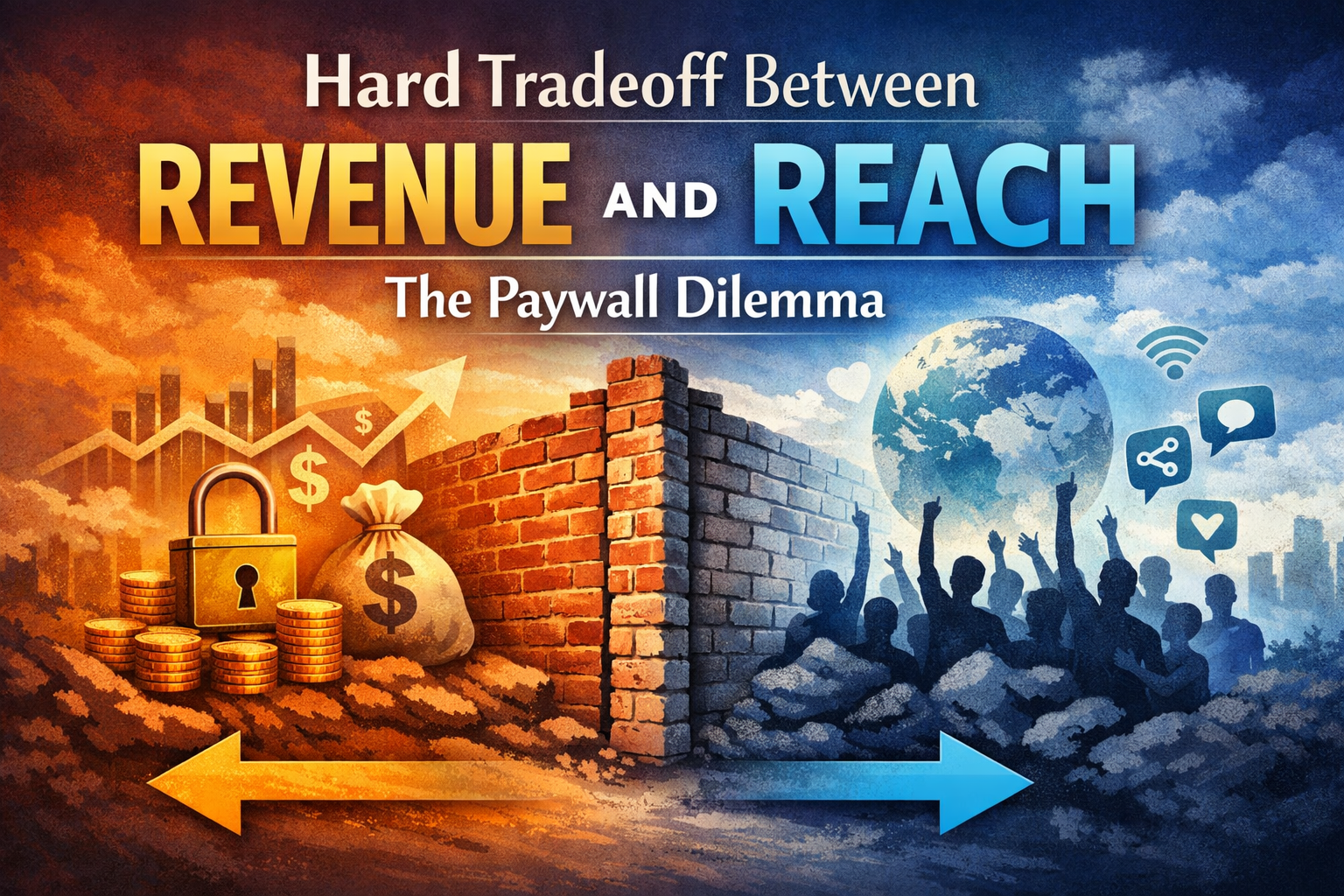
Hard Tradeoff Between Revenue and Reach: The Paywall Dilemma
At some point, every digital product faces an uncomfortable moment of truth.
You’ve built something people use. Traffic is growing. Engagement looks healthy. But revenue is lagging. Costs are rising. Investors, stakeholders, or even your own team start asking the same question:
Why don’t we just put it behind a paywall?
On the surface, it feels like the obvious next step. Subscriptions promise predictable income, cleaner business models, and freedom from the chaos of advertising. Many successful companies rely on them. So why not follow the same path?
Because paywalls come with a tradeoff that is often underestimated: you gain revenue per user, but you lose users. And once you lose reach, it is very hard to get it back. This is the paywall dilemma—the tension between making money today and staying relevant tomorrow.
This post explores why paywalls have become the default monetization choice, what they cost in terms of reach and growth, and why most teams dangerously overestimate conversion rates. We’ll examine the hidden tradeoffs of gating access, break down hybrid models that escape the binary choice, and outline strategic questions every platform should answer before locking content behind payment. The goal isn’t to avoid paywalls—it’s to understand when, how, and for whom they actually make sense.
Contents
- 1 Why Paywalls Keep Winning the Monetization Debate
- 2 The Immediate Upside: What Paywalls Do Well
- 3 The Hidden Cost: What You Lose When You Gate Access
- 4 The Conversion Reality Most Teams Underestimate
- 5 Escaping the Binary: Hybrid Monetization Models
- 6 Advertising: One Lever Among Many
- 7 Strategic Questions Every Platform Must Answer
- 8 AppLixir: Rethinking the Paywall Dilemma
Why Paywalls Keep Winning the Monetization Debate
Paywalls did not rise by accident. Several structural forces pushed platforms toward subscriptions as the “responsible” monetization choice. First, operating costs have increased. Content creation, engineering talent, cloud infrastructure, and compliance requirements are more expensive than ever. Free products must still be built, hosted, secured, and supported.
Second, advertising has become less reliable. Privacy regulation, signal loss, and platform dependency have introduced volatility into ad revenue. CPMs fluctuate, fill rates drop, and optimization requires increasingly complex ad-tech stacks. For many teams, subscriptions feel simpler and safer.
Third, investors reward predictability. Recurring revenue is easier to forecast, easier to model, and easier to defend in boardrooms. A stable base of paying users signals product maturity, even if growth slows. From this perspective, paywalls look like discipline. Free access looks risky.
The Immediate Upside: What Paywalls Do Well
When implemented correctly, paywalls deliver clear short-term benefits.
They raise average revenue per user by design. A smaller base of paying customers can generate more revenue than a massive free audience with weak monetization. This is particularly attractive when operational costs scale with usage. Paywalls also clarify value. Users who pay often perceive the product as more premium and intentional. Payment creates psychological commitment, which can increase retention within the paying cohort.
Operationally, subscriptions simplify monetization. Teams can focus on product improvements instead of ad yield optimization, demand sourcing, or mediation logic. The revenue stack becomes easier to manage. These benefits are real. But they tell only half the story.
The Hidden Cost: What You Lose When You Gate Access
The real impact of a paywall is not measured in revenue per user. It is measured in users who never arrive, never engage, and never return.
The most immediate loss is reach. Any form of gating—hard or soft—reduces top-of-funnel traffic. Casual users bounce. Exploratory users hesitate. Social sharing declines because content is no longer freely accessible. Engagement also suffers. When access is limited, users spend less time experimenting, discovering features, or building habits. Frequency drops. Session depth narrows. Products become transactional rather than habitual.
Perhaps most importantly, paywalls weaken network effects. Platforms that rely on scale—whether for community value, data learning, or social proof—depend on participation. Gating participation too early undermines the compounding benefits of growth. Over time, the product risks becoming exclusive instead of essential. It may serve a loyal niche while losing cultural relevance, mindshare, and organic discovery.
The Conversion Reality Most Teams Underestimate
One of the most dangerous assumptions in paywall strategies is overestimating conversion rates. Across industries, typical paywall conversion rates remain stubbornly low—often in the low single digits. This means that 90–95% of users will never pay, regardless of how much they enjoy the product.
This reality creates a structural imbalance. Product decisions increasingly cater to a minority of users while the majority are either blocked or ignored. Growth slows, experimentation declines, and the platform becomes optimized for extraction rather than expansion. Price sensitivity further complicates matters. Willingness to pay varies dramatically by geography, income, use case, and frequency of engagement. A single global price point inevitably excludes large segments of potential users.
When teams design primarily for payers, they risk shrinking the product’s future optionality.
Escaping the Binary: Hybrid Monetization Models
The most resilient platforms reject the false choice between revenue and reach. Instead, they design hybrid models that monetize depth rather than access.
- Freemium models preserve core functionality while charging for advanced features, customization, or productivity gains. Users experience value before committing.
- Soft paywalls use metered access, delayed gating, or limited free usage to preserve discovery while nudging high-intent users toward payment.
- Value-based gating focuses on enhancements rather than entry. Users pay to accelerate progress, unlock convenience, or personalize their experience—not to access the product at all.
- Engagement-based unlocks introduce non-monetary currency. Time, participation, or contribution can unlock premium value, aligning monetization with user motivation rather than exclusion.
The common principle is simple: monetize intensity, not presence.
Advertising: One Lever Among Many
Advertising is often positioned as the opposite of subscriptions. In reality, it is simply one monetization lever among many. When implemented thoughtfully, advertising allows platforms to monetize engagement without restricting access. Users pay with attention rather than money, preserving reach while generating revenue.
However, advertising has its own risks. Poorly integrated ads degrade user experience. Excessive ad load erodes trust. Revenue volatility can create financial instability. The mistake is not using ads—it is using them without regard for user context, consent, and experience. Monetization that feels extractive undermines long-term growth, regardless of the model.
Who Should Pay—and Who Should Not
Not all users should be monetized equally. Power users, professionals, and teams often derive disproportionate value and have higher willingness to pay. Monetizing these segments makes economic sense. New users, casual users, and exploratory users should face minimal friction. Their role is to learn, share, and grow the platform’s reach.
By segmenting users based on behavior rather than forcing a single monetization path, platforms preserve growth while capturing value where it naturally concentrates. This approach requires better analytics and more nuanced product design—but it avoids the blunt-force damage of universal gating.
Strategic Questions Every Platform Must Answer
Before implementing or expanding a paywall, teams should pause and ask difficult questions:
- Is revenue the immediate constraint, or is growth the bottleneck?
- Have users experienced enough value to justify payment?
- What value increases with scale, and what value does not?
- Are we monetizing users, or moments of engagement?
- What future opportunities are we sacrificing for short-term certainty?
Paywalls are not inherently wrong. They are simply powerful tools that demand strategic restraint.
 AppLixir: Rethinking the Paywall Dilemma
The tradeoff between revenue and reach is real—but it is not binary. Paywalls increase short-term revenue while constraining long-term growth. Free access fuels reach while complicating monetization. The most successful platforms recognize that timing, design, and segmentation matter more than ideology.
The goal is not to avoid paywalls entirely. It is to deploy them with intention—after value is clear, habits are formed, and alternatives have been explored. The most durable monetization strategies feel like upgrades, not toll booths. They invite users to go deeper rather than demanding payment at the door. In a world where attention is abundant but trust is scarce, the platforms that thrive will be those that earn revenue without sacrificing reach.