
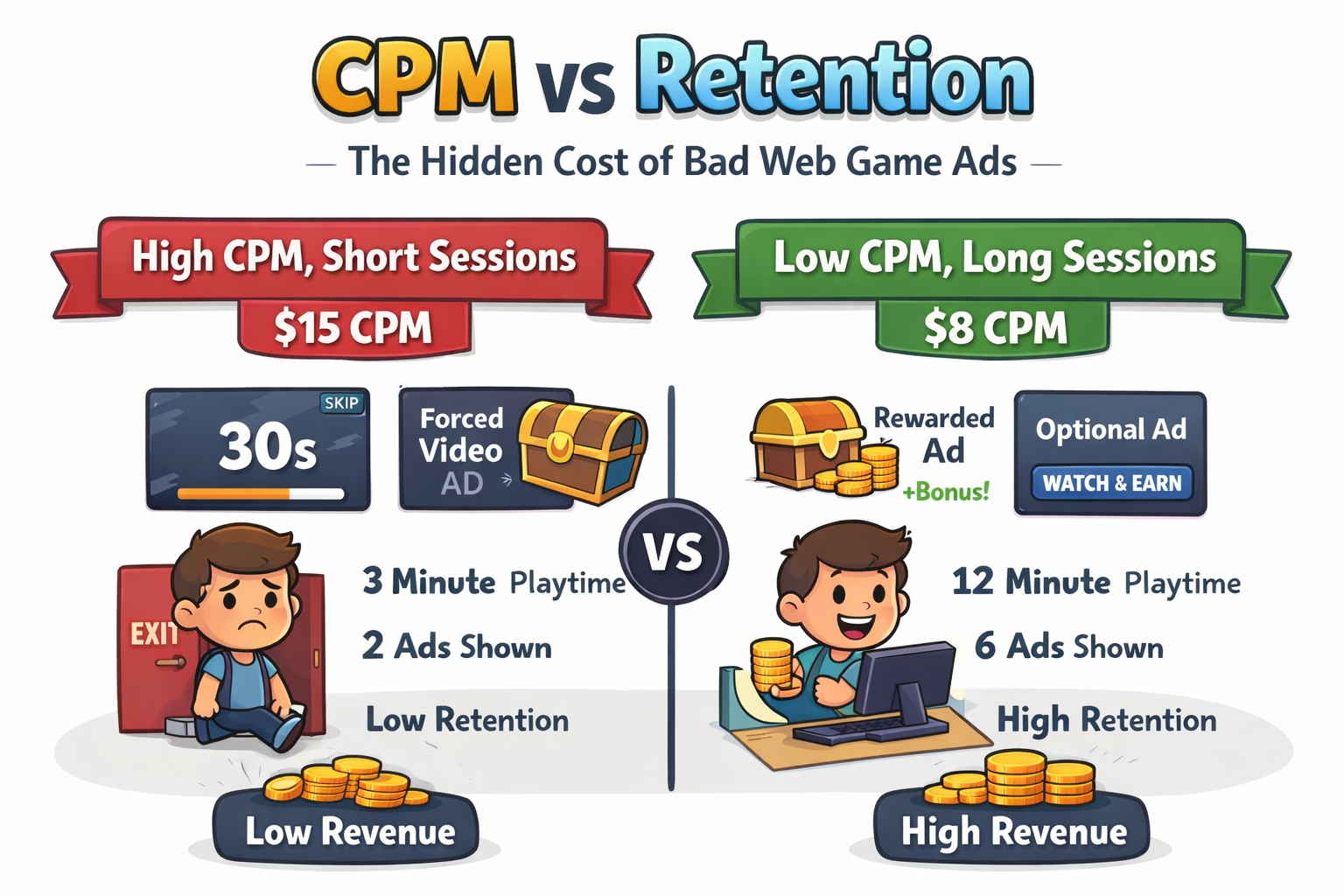
CPM vs Retention: The Hidden Cost of Bad Web Game Ads
Web game developers often focus on a single metric when evaluating advertising partners: CPM. Higher CPMs appear attractive because they promise immediate revenue per thousand impressions. If one network pays $15 CPM and another pays $8 CPM, the decision may seem obvious. However, focusing only on CPM can lead developers into a monetization trap that quietly reduces total revenue over time.
The real economic engine of a web game is not CPM — it is player retention. Games that keep players engaged longer generate more sessions, more ad impressions, and ultimately higher lifetime value per player. Aggressive ad strategies that increase CPM at the expense of user experience often cause players to leave early, reducing session length and return rates.
This creates a hidden cost: the highest CPM ads are not always the most profitable ads. In many cases, a lower CPM combined with strong retention generates significantly more revenue. Understanding the relationship between CPM, retention, and player lifetime value is essential for building a sustainable monetization strategy for browser-based games.
Contents
- 1 What Is CPM in Web Game Advertising?
- 2 What Is Retention in Web Games?
- 3 Why CPM Alone Is a Misleading Monetization Metric
- 4 The Hidden Cost of Bad Web Game Ads
- 5 CPM vs Retention: A Real Monetization Comparison
- 6 Why Rewarded Ads Solve the CPM vs Retention Problem
- 7 Building a Sustainable Ad Strategy for Web Games
- 8 A Balanced Monetization Framework
- 9 Key Takeaways, AppLixir
- 10 Frequently Asked Questions
What Is CPM in Web Game Advertising?
CPM (Cost per Mille) refers to the amount advertisers pay for 1,000 ad impressions. It is one of the most common metrics used in digital advertising because it provides a simple way to compare revenue across networks, ad formats, and inventory sources.
The basic formula is straightforward: Revenue = (Impressions ÷ 1000) × CPM. For example, if a web game serves 100,000 ad impressions at an $8 CPM, the revenue generated would be $800.
Because CPM directly affects revenue per impression, ad networks often promote their ability to deliver higher CPMs. This messaging is appealing to developers who want to maximize monetization quickly. However, CPM only measures the value of a single impression — not the value of a player. A high CPM does not guarantee strong monetization if players are leaving the game before generating meaningful engagement.
In the web gaming ecosystem, several ad formats influence CPM levels — display banners, interstitial ads, pre-roll video ads, and rewarded video ads. Video formats, especially rewarded video, typically generate the highest CPMs. But the effectiveness of any format depends heavily on how it affects the player experience.
What Is Retention in Web Games?
Retention measures how often players return to a game after their first session. It is one of the most important indicators of a game’s long-term health and monetization potential. Common retention metrics include Day 1 retention (D1), Day 7 retention (D7), session length, and sessions per player.
Retention directly influences how many ads a player will eventually see. A player who leaves after two minutes might generate one or two impressions. A player who returns daily and spends fifteen minutes per session could generate dozens. Because of this, many successful monetization models focus on maximizing lifetime value (LTV) rather than maximizing CPM.
A simplified version of the LTV relationship looks like this: Lifetime Value = Ads per Session × Sessions per Player × Revenue per Ad. When retention improves, the number of sessions per player increases — creating more opportunities for monetization even if CPM remains constant.
Why CPM Alone Is a Misleading Monetization Metric
Many developers compare ad networks using only CPM data. While this metric is useful, it ignores several factors that determine overall revenue.
Session Duration. If intrusive ads cause players to abandon the game early, session length decreases. Shorter sessions lead to fewer impressions, which reduces total earnings even when CPM is high.
Player Retention. Players who churn after their first session rarely produce meaningful monetization. Retention determines whether a player becomes a long-term contributor to ad revenue or a one-time visitor.
Total Ad Opportunities. Games that maintain strong engagement naturally create more moments where ads can appear without disrupting gameplay. These additional opportunities compound over time.
In other words, CPM measures the value of a single impression, while retention determines how many impressions are possible. Ignoring retention can produce misleading revenue projections.
The Hidden Cost of Bad Web Game Ads
Poor advertising experiences are one of the fastest ways to damage retention in web games. Players expect gameplay to feel smooth, responsive, and uninterrupted. When ads interfere with this experience, frustration builds quickly.
Intrusive Interstitial Ads. Interstitial ads often appear between gameplay events or during transitions. When used excessively or triggered unexpectedly, they break immersion and cause players to abandon the game.
Forced Video Ads. Non-skippable video ads can be particularly damaging in short-session environments. Many web games are designed for quick play sessions, and forcing players to watch long ads creates a poor experience.
Ad Frequency Overload. Showing too many ads within a short period makes the game feel like an advertising platform rather than an entertainment experience. Even high-quality ads can become frustrating when frequency is too high.
Low-Quality Ad Creatives. Misleading or poorly designed ads can reduce player trust. Ads with fake UI elements or deceptive download prompts create negative associations with the game itself.
These factors collectively reduce session length, player satisfaction, and return rates. When players leave early or decide not to return, the monetization potential of that player drops dramatically.
CPM vs Retention: A Real Monetization Comparison
To understand the impact of retention, consider two hypothetical monetization strategies.
| Metric | Strategy A: High-CPM Aggressive Ads | Strategy B: Player-Friendly Ads |
| CPM | $15 | $8 |
| Session Length | 3 minutes | 12 minutes |
| Ads per Session | 2 | 6 |
| Revenue per 1,000 Players | $30 | $48 |
Despite the lower CPM, Strategy B generates 60% more revenue because players stay longer and view more ads overall. This example highlights a critical insight: retention multiplies monetization opportunities.
Why Rewarded Ads Solve the CPM vs Retention Problem
Rewarded video ads have become one of the most effective monetization formats for games because they align incentives between players and developers. Instead of forcing ads onto players, rewarded ads allow players to choose whether they want to watch an ad in exchange for an in-game benefit — such as extra lives, in-game currency, unlockable content, or level progression boosts.
Because the ad is voluntary, it does not interrupt gameplay in the same way as interstitial ads. Best Rewarded ads also tend to perform well across several key metrics: completion rates often above 85%, CPMs typically between $15 and $30, and significantly higher player satisfaction compared to forced formats.
Players perceive rewarded ads as part of the gameplay loop rather than a disruption. As a result, they maintain engagement while still generating strong ad revenue. For many web games, rewarded video becomes the primary monetization driver, while other formats play a supporting role.
Building a Sustainable Ad Strategy for Web Games
Successful monetization requires balancing revenue goals with player experience. Developers who focus solely on short-term CPM often sacrifice long-term growth. A sustainable strategy typically follows three principles.
Protect the Core Gameplay Experience. Ads should never interrupt critical gameplay moments. When players feel that ads interfere with their enjoyment, they are less likely to return.
Use Voluntary Ads as the Primary Format. Rewarded video ads give players control over the experience. This format maintains retention while still generating strong revenue.
Optimize for Lifetime Value. Instead of focusing only on CPM, developers should evaluate session length, player retention, impressions per user, and lifetime value. When these metrics improve, total revenue often increases even if CPM remains stable.
A Balanced Monetization Framework
Most successful web games combine multiple ad formats to create a balanced monetization stack. Rewarded video ads serve as the primary revenue source because they provide high CPMs without damaging retention. Light interstitials appear occasionally between levels or during natural pauses in gameplay. Banner ads provide supplemental revenue without interrupting the player experience.
This layered approach ensures that monetization opportunities exist without overwhelming the player. The goal is to integrate ads naturally into the gameplay flow rather than forcing them into moments where they feel disruptive.
Key Takeaways, AppLixir
The biggest mistake many web game developers make is optimizing for CPM instead of player value. High CPM ads may look profitable in the short term, but if they reduce retention, they ultimately limit revenue. Players who leave early generate fewer impressions and lower lifetime value.
Games that prioritize player experience often produce stronger monetization results because they create longer sessions, higher engagement, and more opportunities for advertising. In practice, the most successful monetization strategies focus on maintaining strong retention, integrating ads into the gameplay loop, and prioritizing voluntary formats like rewarded video.
Because in the economics of web games, retention amplifies every monetization opportunity. A player who stays longer does not just see more ads — they create the foundation for sustainable revenue growth.
Frequently Asked Questions
Does higher CPM always lead to higher revenue?
No. Higher CPM increases revenue per impression, but total revenue depends on how many impressions players generate. If aggressive ads reduce session length or retention, overall revenue may decrease.
What is the best ad format for web games?
Rewarded video ads are widely considered the most effective format because they allow players to choose when to watch an ad in exchange for a reward. This approach preserves engagement while generating strong CPMs.
Why do intrusive ads reduce retention?
Intrusive ads interrupt gameplay and create frustration. When players feel that ads interfere with the experience, they are more likely to leave the game early or avoid returning.
Should developers optimize for CPM or retention?
Retention should generally be the priority. Strong retention increases the number of sessions and impressions per player, which often leads
